



Data Enrichment for Retail: A Practical Guide
Most retail organisations are sitting on more data than they can confidently use. Loyalty platforms, POS systems, e-commerce engines, and ERP systems collectively generate millions of records daily, but volume alone does not produce intelligence. The problem, almost universally, is quality: product records often lack category hierarchies, CRM databases are inflated by duplicate customer identities, and transactional records frequently carry unmapped promotion codes that render ROI analysis meaningless.
Data enrichment for retail is the structured discipline of closing that gap. It is the set of operational processes that transform raw, fragmented, inconsistent data into attributed, reconciled, and decision-ready records-the kind that AI recommendation engines, demand forecasting models, and segmentation tools can actually use without producing flawed outputs.
This guide covers the three data domains that need enrichment most urgently, the core techniques that power it, how pipeline timing affects system-wide quality, and the build-vs-outsource decision that most retail teams get wrong.
Getting enrichment right is not about buying the right tool. It is about knowing what to enrich, how to time it in the pipeline, and what to build versus outsource.
Key takeaways
- Raw retail data (POS, CRM, transactional) is rarely decision-ready without structured enrichment. Most analytics and AI failures in retail trace back to data quality, not model selection.
- Three data domains demand systematic attention: product data, customer data, and transactional data, each with distinct enrichment logic and downstream consequences.
- Core enrichment techniques-deduplication, taxonomy standardization, attribute appending, and field normalization-serve different purposes and should not be conflated in pipeline design.
- When enrichment happens in the pipeline matters as much as what enrichment is applied. Enriching too late means every upstream system has already propagated the unenriched version.
- The build-vs-outsource decision should be segmented: own customer identity matching and product taxonomy logic; consider specialist data enrichment companies or services for commodity enrichment (address validation, demographic append).
Further Reading:
- Data-Driven Insights & Intelligent Augmentation
- Comparison: Data Governance vs Master Data Management
- Generative AI for Retail: 7 Real Use Cases
What is data enrichment in retail, and why does it matter?
Data enrichment in retail is not just about buying third-party data. It is the structured discipline of transforming raw, fragmented data (from POS, CRM, and ERPs) into decision-ready records. This involves:
- Identity Resolution: Merging duplicate profiles into one Golden Customer Record.
- Taxonomy Standardization: Categorizing unstructured SKU data into a logical hierarchy.
- External Appending: Merging first-party data with external sources (demographics, weather, GS1 data) for deeper context.
This structural discipline translates directly to measurable ROI. Here is why foundational data quality is non-negotiable for modern retail:
- Trust in Analytics (Overcoming the AI Failure Rate): Generative AI and demand forecasting models cannot function effectively when missing attributes are present. According to Gartner’s 2026 Research on AI Project Returns, only 28% of AI initiatives fully meet ROI expectations, with 38% of leaders citing poor data quality and limited data availability as the direct cause of project failures.
- Hyper-Personalization & Business Growth: Algorithms need behavioural context to personalize offers. According to the Twilio Segment State of Personalization Report, 89% of business leaders believe personalization is critical to their business’s success in the next three years. To win over consumer spending, brands must ditch the one-size-fits-all approach and use unified data to deliver relevance.
- Machine-Readable Product Discovery: As procurement evolves, unenriched product data will render your catalogue completely invisible to automated systems. According to Gartner’s 2026 Strategic Prediction, by 2028, 90% of B2B buying will be intermediated by AI agents, pushing over $15 trillion in spend. Gartner explicitly warns that “products will need to be machine-readable” to participate in this ecosystem, a state that can only be achieved through rigorous taxonomy mapping and attribute enrichment.
- Mitigating AI Decision Risks: Allowing AI models to run on fragmented, unenriched retail data poses a significant liability. In the same 2026 report, Gartner warns that opaque AI models misfiring will lead to severe organizational and legal consequences, stressing that “clean data will become non-negotiable” to establish sufficient risk guardrails. Enrichment provides the structured context these AI engines need to avoid costly predictive errors.
What is data enrichment in retail, and why does it matter?
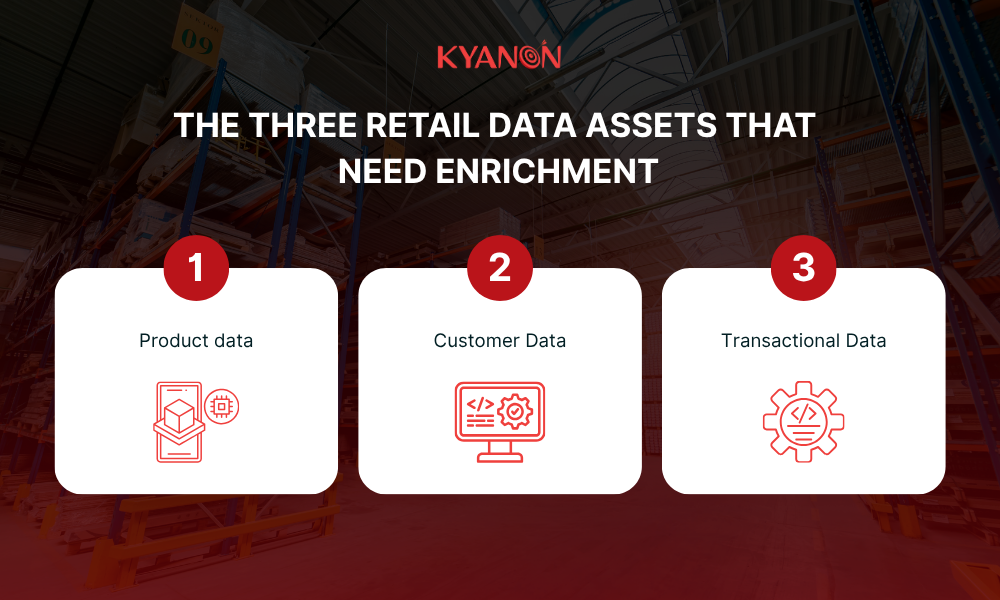
The three retail data assets that need enrichment
Not all data in a retail organization has equal enrichment priority. The three assets below consistently produce the most downstream damage when left unenriched, and the highest analytical value when properly structured.
-
Product data
The raw state problem: Product data ingestion suffers from severe structural fragmentation. Information flows from diverse supplier ecosystems (EDI feeds, APIs, legacy flat files) with unique schemas. Consequently, a raw record entering the data lake contains only an SKU, a barcode, and a price. Critical merchandising attributes are routinely missing or trapped in unstructured text.
What enrichment adds: Structured enrichment transforms this by adding:
- A standardized category hierarchy (e.g., Department > Category > Sub-Category > Type).
- Category-specific attributes (material, size range, brand).
- SEO metadata and canonical image URLs.
- Cost price linkage and margin fields (for private-label products).
Why it matters operationally: Without proper attributes, demand forecasting and GenAI recommendation engines fail (e.g., they cannot distinguish a red dress from a blue dress).
A practical example: By mapping conflicting supplier labels for “Outerwear” into a single internal taxonomy, one retailer enabled their AI markdown tool to operate at a sub-category level. According to Bain & Company’s 2025 Retailer Resolutions, having a structured product data foundation to build balanced assortments that cater precisely to customer preferences can boost sales by 2% to 5%.
-
Customer data
The raw state problem: CRM systems suffer from two persistent issues: duplicate records and channel fragmentation. A customer buying in-store, online, and via an app often creates three separate records
What enrichment adds: It builds a complete profile through:
- Identity resolution: Reconciling duplicates into a single Golden Customer Record.
- Demographic enrichment: Appending age bands, household composition, and geography.
- Behavioural enrichment: Deriving RFM scores (Recency, Frequency, Monetary Value) for segmentation.
- Why it matters operationally: A customer with three duplicate records artificially inflates your Customer Acquisition Cost (CAC) and undercounts Lifetime Value (LTV), causing them to be mis-tiered in loyalty programs. Resolving this drives immediate financial returns because it powers accurate personalization. As highlighted in a recent McKinsey analysis, relying on clean, deduplicated profiles for AI-driven personalization can increase revenue by 5 to 8 percent and reduce the cost to serve by up to 30 percent.
-
Transactional data
The raw state problem: Transactional data looks clean on the surface, but hides damaging quality issues. Status codes are rarely standardized (“shipped” vs. “fulfilled”). Promotion IDs lack links to their mechanic types. Return records default to unanalyzable free-text fields.
What enrichment adds: It provides essential context by:
- Mapping promotion IDs to a structured mechanic taxonomy (e.g., buy-X-get-Y).
- Classifying return reason codes into a controlled vocabulary.
- Appending cost price data to enable line-item margin reporting.
- Standardizing status codes across all systems
Why it matters operationally: Without this, measuring promotional ROI and product margins is impossible. Furthermore, structured return codes are essential for identifying systematic supply chain issues like fit or quality defects. According to a McKinsey report, by using AI and structured data to redesign the returns process, retailers can convert $200 billion in annual costs into business value.
The three retail data assets that need enrichment
Core retail data enrichment techniques
Understanding what enrichment adds is necessary, but knowing which operational technique to apply separates sustainable pipelines from ad hoc data patching. The four techniques below cover the majority of enrichment work in retail data environments.
Deduplication and identity resolution
- The goal: Identify records representing the same real-world entity (the same customer, product, or store) and merge them into a single canonical record.
- How it works: Enterprise implementations typically use a robust hybrid approach. First, a deterministic match handles exact matches on high-confidence identifiers (email, phone). Second, a probabilistic match uses fuzzy logic on names and addresses to catch remaining fragmented profiles.
- The output: A Master Customer Record (Golden Record) that aggregates all omnichannel transactional history.
- Why it matters: Unresolved duplicates inflate acquisition costs and break personalization models. As highlighted in Bain & Company’s 2025 report on Data Strategy in Retail, establishing a unified data strategy with consistent governance is the exact prerequisite for successfully scaling AI. Retailers that master this foundational data layer are the ones reporting that their Generative AI initiatives exceed ROI expectations at every stage of deployment.
Taxonomy standardisation
The goal: Map diverse product categories, exception codes, and status fields into a single internally controlled vocabulary.
The reality: In multi-supplier retail, ingesting unstructured product variants (e.g., conflicting supplier labels for what you internally classify as “Outerwear”) creates severe and costly data silos.
Why it matters: Normalizing these feeds to your internal hierarchy ensures accurate inventory planning at the sub-category level. According to McKinsey’s April 2026 insights on AI in shopping, maintaining clean catalogue feeds, accurate local availability data, and live pricing updates is now mandatory. This structural standardization directly boosts a store’s credibility when shoppers, or their AI agents, compare alternatives.
Attribute enrichment
The goal: Append entirely new data fields to internal records by drawing on external, third-party reference datasets.
Common applications:
- Demographics: Appending household income bands or population density to customer postcodes.
- GS1 Attributes: Appending standardized nutritional and allergen data for FMCG retailers.
- Contextual Drivers: Injecting historical and forecast weather data into sales records.
Why it matters: It allows demand models to account for external drivers, not just historical purchase behaviour. Bain’s 2025 NRF APAC Retail analysis notes that leading quick-commerce retailers actively draw on contextual data (like weather) to accurately predict location-specific demand, enabling them to instantly surface highly relevant products (like raincoats or umbrellas) the moment weather shifts.
Data standardisation and normalisation
- The goal: Converting raw data fields into universally consistent formats, such as date formats, currency codes, units of measure, and phone number formatting.
- The reality: This step is often overlooked in the rush to apply advanced AI models, but it is an absolute prerequisite before executing any JOIN operation across tables or merging disparate systems.
- Why it matters: Without normalized fields, reliable data warehouse queries are impossible. Standardisation is critical for accurate BI reporting, ensuring that analytical models and dashboards do not fail or produce skewed aggregations when combining data from multiple regional POS or e-commerce platforms.
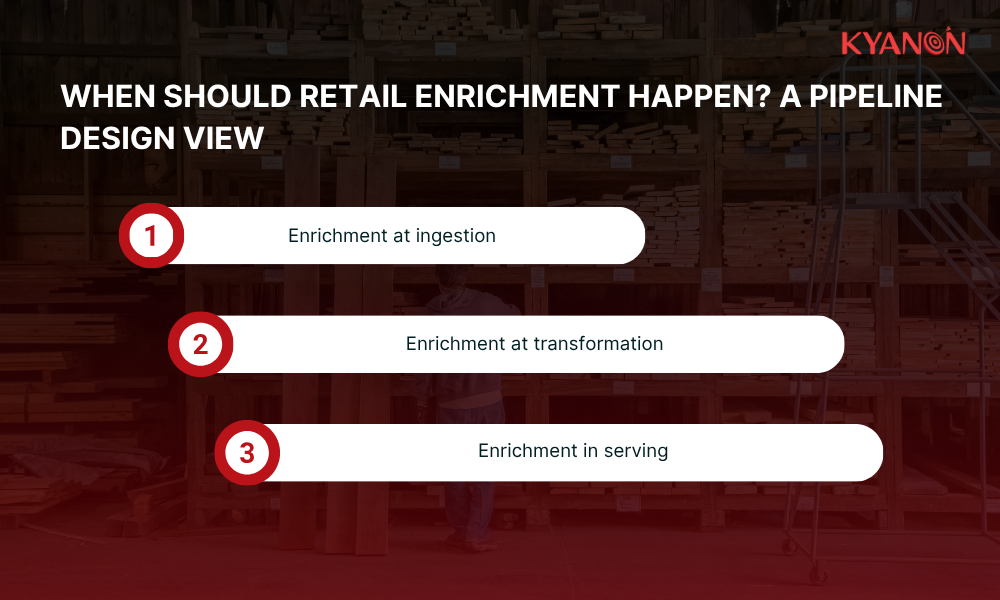
When should retail enrichment happen? A pipeline design view
A common mistake in retail data architecture is running all enrichment logic in one place (usually the data warehouse). This breaks downstream analytics. Here is the correct, decoupled framework:
Enrichment at ingestion
- Applies to: High-velocity streams (POS transactions, web events).
- What it does: Immediate taxonomy mapping and fast deterministic lookups before writing to the database.
- Why it belongs here: If unenriched data enters the warehouse, every downstream system inherits the broken version. Fixing it later requires expensive reprocessing.
Enrichment at transformation
- Applies to: Lower-velocity data (CRM exports, supplier feeds, ERP batches).
- What it does: Computationally heavy lifting (deduplication, probabilistic matching, external attribute appending).
- Why it belongs here: Outputs don’t need to be instantaneous. Run nightly batches to update Golden Records and RFM scores for personalization tools the next morning.
Enrichment in serving
- Applies to: Dynamic attributes (live product pricing, real-time inventory).
- What it does: Enriches data directly from source-of-truth systems at the exact moment the query is executed.
- Why it belongs here: Storing live prices at ingestion creates stale data within hours. Dynamic attributes must be pulled at query time.
When should retail enrichment happen? A pipeline design view
Build vs. outsource: Retail data enrichment decision framework
Treating data enrichment as a binary “build vs. buy” choice is a costly mistake.
According to Bain & Company, as tech models commoditize, your competitive edge flows entirely from proprietary data. To scale efficiently, you must fiercely protect core logic in-house and use data enrichment companies for commodity operations.
Here is the segmented framework:
What should always be built in-house?
- Customer identity resolution and deduplication logic: No external service has simultaneous visibility into your CRM, loyalty program, and POS schemas. The matching rules must be yours.
- Product taxonomy mapping: Your category hierarchy is a valuable intellectual asset. Converting varied supplier feeds into your specific 4-level structure requires intimate knowledge of your merchandise strategy.
- Promotion ID mapping and mechanic classification: The way your campaign IDs map to promotional mechanics exists only in your internal systems. This logic must be maintained internally.
What can be outsourced to specialist data enrichment companies?
These are commodity operations. Building them internally drains resources without adding proprietary advantage. Leverage a data enrichment service or outsourced engineering services for:
- Address standardization and validation: Commercial verification services deliver consistent, high-accuracy formatting at a fraction of the cost of building an internal parser.
- Postcode-level demographic append: External datasets provide household income bands and population density for postcodes. The data already exists; simply plug into their APIs.
- GS1 product attribute enrichment for FMCG categories: Relying on GS1 registries for standardized nutritional and allergen data is far more efficient than manual internal maintenance.
- Firmographic data for B2B or trade accounts: Commercial b2b data enrichment solutions offer company size, industry classification, and credit risk at a freshness level internal teams cannot cost-effectively match.
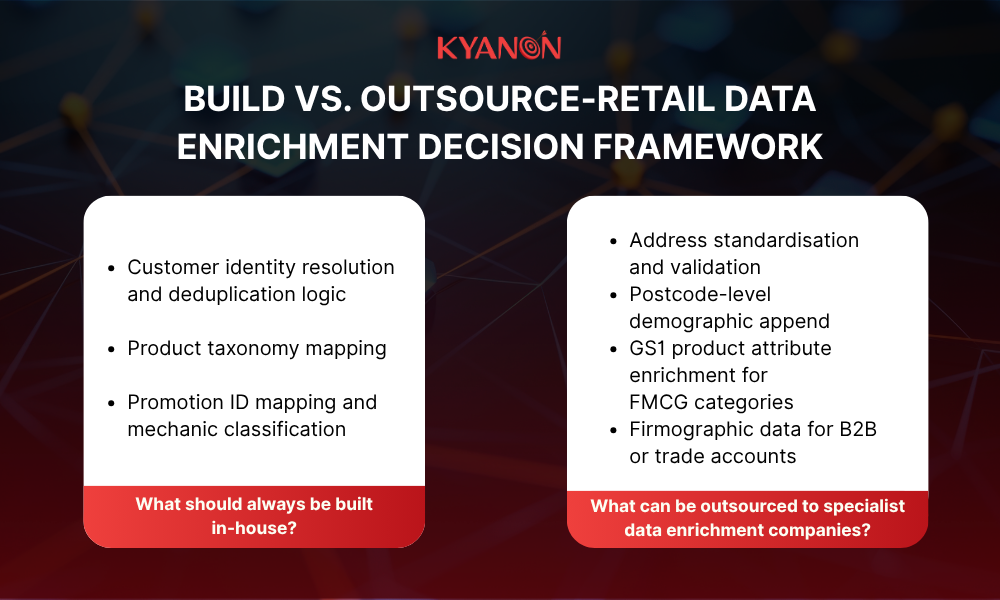
Build vs. outsource-retail data enrichment decision framework
Data enrichment best practices for retail teams
Data enrichment failures are preventable. According to Kearney (2026), 74% of business leaders cite fragmented data infrastructure as their primary barrier to scaling AI. The difference between a pipeline that sustains analytical quality and one that degrades silently lies in foundational architecture. Based on patterns observed in retail data platform deployments across APAC, here are six non-negotiable practices:
Define master data entities before designing enrichment logic
- The problem: Enrichment logic built on undefined entities is a house of cards. When the core definition of a “customer” or “product” shifts across departments, retroactive rules break.
- Action: Formally define the four master entities (Product, Customer, Store, Promotion). Document what constitutes a canonical record, mandatory fields, and the authoritative source system before writing a single rule.
Enrich close to the source
- The problem: Every step an unenriched record travels downstream is a chance for it to be ingested by another BI tool or AI model. Relying on retroactive batch cleanup is expensive and rarely achieves full historical coverage.
- Action: Apply enrichment immediately at the ingestion stage for high-velocity data (e.g., POS transactions, web sessions) to minimize the spread of unenriched records.
Version your enrichment rules
- The problem: Retail taxonomies and matching thresholds evolve constantly. If you update a category mapping rule without versioning, you lose the ability to perform accurate historical trend analysis across category boundaries.
- Action: Append a timestamp and rule version ID to every enriched record. This ensures you can audit exactly which logic produced its current state.
Measure enrichment quality proactively
- The problem: Enrichment quality degrades silently-a supplier changes an EDI feed format, and match rates plummet. Without monitoring, these events are only discovered months later when a marketing decision fails.
- Action: Continuously track four KPIs: Field completeness (target fields populated), Match rate (successful deduplication), Enrichment coverage (population with all attributes), and Enrichment freshness (time since last run).
Separate enrichment from transformation
- The problem: Conflating these operations creates debugging nightmares. Enrichment adds attributes; transformation changes shape (aggregates, joins, pivots). When an output is wrong, a tangled pipeline hides the root cause.
- Action: Keep them as strictly separate pipeline layers. This isolation makes it immediately clear whether an error stems from wrong attributes or wrong structural math.
Document your data dictionary
- The problem: Data dictionaries are often deprioritized because they aren’t visible on BI dashboards. However, undocumented data lineage becomes a massive operational bottleneck during team turnovers, vendor swaps, or audits.
- Action: Document the Definition, Source, Owner, and Update frequency for every enriched field. The cost of maintenance is a fraction of the cost of reverse-engineering data lineage later.
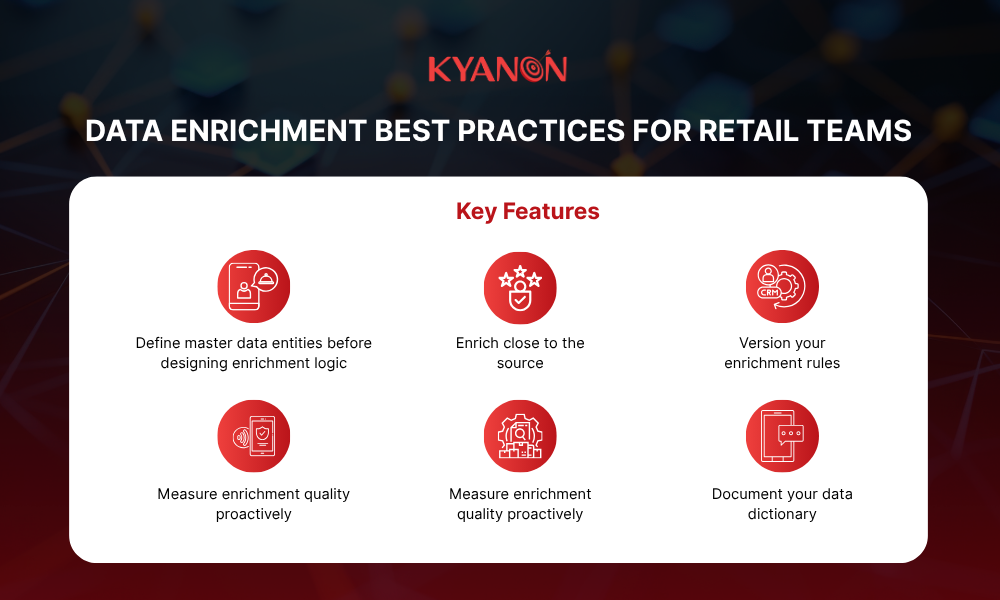
Data enrichment best practices for retail teams
How Kyanon Digital approaches retail data enrichment
Kyanon Digital designs data enrichment pipelines as the foundational component for end-to-end AI and Advanced Technologies engagements across APAC. Our approach is built on a simple premise: AI initiatives fail because of unenriched input data, not unsophisticated models.
Here is our four-step methodology to build production-grade enrichment pipelines:
Structured data audit
We assess the current state of your three core data assets (product, customer, transactional) to identify duplication rates, taxonomy gaps, and field completeness baselines.
- The output: A prioritized enrichment backlog that maps every data gap directly to its commercial consequence and technical remediation.
Architecture design
We design the structural blueprint, defining exactly which enrichment operations belong at ingestion, transformation, and serving.
- The output: Custom matching logic for identity resolution, tailored taxonomy mapping rules, and the selection of appropriate third-party providers for commodity data.
Pipeline implementation
We build and integrate the pipeline directly into your existing data warehouse or lakehouse architecture.
- The output: A fully operational enrichment pipeline, complete with automated quality monitoring dashboards (tracking the four core KPIs) and a version-controlled data dictionary.
Post-Implementation Governance
Data enrichment is a sustained operational discipline, not a one-time cleanup.
- The output: Ongoing quality monitoring and taxonomy support to ensure your enrichment logic evolves as your categories, suppliers, and systems change, preventing silent data degradation.
Case Study: AI-Driven BI & Data Warehouse for a Leading Retail Corporation

Case study: AI-Driven BI & Data Warehouse for a Leading Retail Corporation
Challenges:
- Severe data fragmentation across 190+ stores: Operational and transactional data were trapped in disconnected, manual workflows, leading to inconsistent and error-prone records.
- Delayed and unreliable business intelligence: Without unified pipelines or taxonomy standardization, report processing was slow. Decision-makers lacked real-time visibility into inventory, promotions, and sales.
- Inability to scale analytics: The manual infrastructure and lack of structured Master Data Management (MDM) meant any attempt at AI implementation would fail due to poor data quality.
Solutions:
- Centralized data warehouse (SSOT): Kyanon Digital engineered a robust data warehouse to aggregate fragmented data from all 190+ locations, replacing disconnected spreadsheets with an automated pipeline.
- Automated ETL & enrichment: Implemented ETL processes where raw operational data was systematically cleansed, deduplicated, and enriched at the transformation layer before ever reaching the reporting layer.
- AI-driven BI integration: Deployed Power BI for live, interactive dashboards, layering automated approval workflows and real-time notifications on top of the standardized data foundation.
Results and Impact:
- 90% faster reporting and approval cycles: By automating the enrichment pipeline, the retailer eliminated manual data manipulation, accelerating operational insights from weeks to real-time.
- Enterprise-wide data accuracy: The unified data model established strict governance, restoring trust and transparency in analytics across both management and store levels.
- A scalable, AI-ready foundation: The retailer successfully transitioned from looking at fragmented historical data to a fully scalable platform, enabling data-driven growth and predictive analytics.
Explore the full case study here: AI-Driven BI & Data Warehouse for a Leading Retail Corporation
Building a retail data platform that AI can actually use
Data enrichment for retail is not a preparatory step that happens before the “real” analytics work begins. It is the analytics work, or more precisely, it is the infrastructure that determines whether analytics work produces reliable outputs or misleading ones. The retail organizations that achieve consistent, compounding returns from AI and advanced analytics are those that have invested in enrichment as a sustained operational discipline, not as a one-time cleanup project.
The three data assets that require systematic enrichment are product, customer, and transactional data; each has distinct failure modes when left unenriched, and each requires specific techniques: deduplication and identity resolution for customer data, taxonomy standardization for product data, promotion mapping and margin enrichment for transactional data. The timing of enrichment in the pipeline matters as much as the enrichment logic itself. And the build-vs-outsource decision should be segmented: proprietary matching and taxonomy logic stays in-house; commodity enrichment can and should be sourced from specialist data enrichment companies.
For retail data leaders who are currently encountering inaccurate segmentation outputs, unreliable demand forecasts, or AI recommendation engines producing irrelevant results, the diagnosis is almost always the same: the input data quality has not been held to the standard the downstream model requires. The fix is not a more sophisticated model. It is a better-enriched data pipeline.
Ready to assess the enrichment state of your retail data? Kyanon Digital works with APAC retail enterprises to design and build enrichment pipelines that power reliable analytics and production-grade AI. Contact our team to start with a structured data audit.

















 Create project brief with AI