


B2B data enrichment is becoming a core eCommerce capability as enterprises move from simple online ordering to complex digital procurement, automated pricing, AI search, and account-based operations.
For many B2B eCommerce operations, the main issue is not the commerce platform itself. The deeper issue is fragmented data that makes search, pricing, and AI fail:
- Product catalogs arrive from multiple suppliers in different formats.
- Supplier records are duplicated, incomplete, or outdated.
- Business customer accounts often lack company size, industry, revenue band, or credit-risk context.
- Pricing engines depend on IDs and rules that do not always match catalog records.
- AI search and recommendation tools fail when product and account data are not structured.
This article, Kyanon Digital explains how enterprises should evaluate B2B data enrichment, where enrichment creates the most value, what breaks without it, and how to choose between internal development, data enrichment vendors, and data enrichment outsourcing services.
Key Takeaways
- B2B data enrichment is the structured process of appending, standardizing, and validating three critical e-commerce data assets: product catalogs, supplier records, and account firmographics.
- B2B eCommerce operations face a structurally different and harder data problem than B2C, because data comes from multiple suppliers, pricing tiers, and account types with no universal standard.
- The three most common failures without enrichment: product search returns no results, pricing engines misfire on contract accounts, and AI personalization produces irrelevant output.
- A five-step enrichment approach covers audit, standards definition, pipeline implementation, vendor selection, and governance, in that order.
- The build vs. outsource decision follows a clear rule: outsource commodity enrichment (firmographics, address validation, GS1 attributes); build in-house for proprietary taxonomy, identity matching, and behavioral data.
- The right B2B data enrichment solutions combine a PIM platform, external data vendor APIs, and internal CRM/CDP enrichment logic, not a single tool.
Further reading:
- Building an Enterprise Data Warehouse for Commerce
- Data Integration Outsourcing: Enterprise Trends
- Unlock Retail Growth with CI360: Real-Time Personalization at Scale
Why B2C Data Models Often Fail in B2B eCommerce
B2B eCommerce and B2C retail are fundamentally different data environments, and analytics approaches that work in one consistently fail in the other.
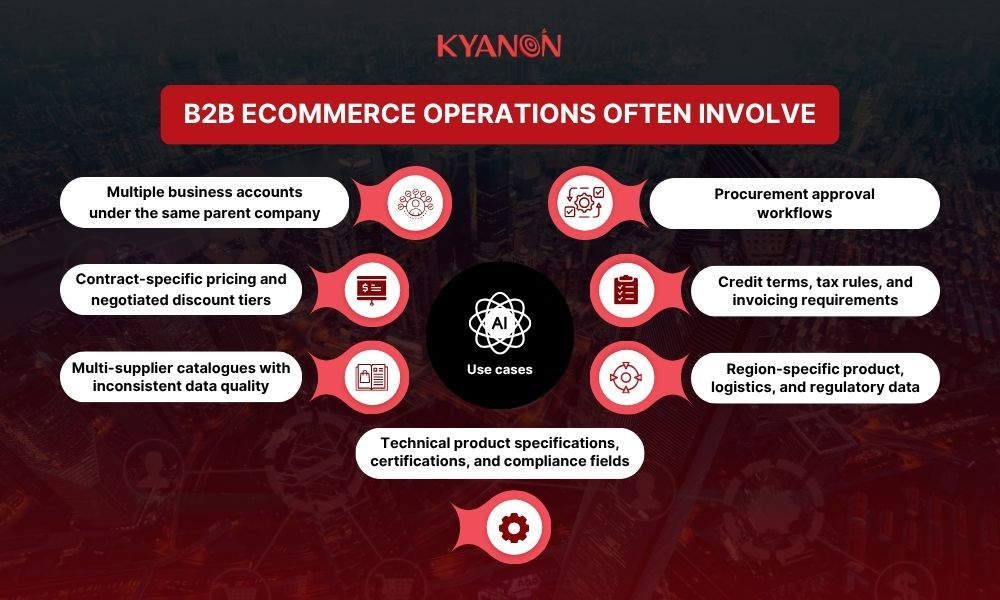
B2C retail data is relatively standardized:
- One product taxonomy owned by the retailer
- One customer type (individual consumers)
- Consistent transaction formats (cart, checkout, payment)
- Unified pricing logic
B2B data enrichment turns fragmented operational records into structured, trusted, and reusable data that can support commerce, analytics, automation, and AI at scale.
Area | B2C eCommerce | B2B eCommerce | Why Enrichment Matters |
Product data | Standard categories and consumer-friendly attributes | Supplier-specific catalogues, technical specs, units, certifications | Enrichment creates a unified product schema |
Customer data | Individual profiles | Company accounts, branches, subsidiaries, roles | Enrichment adds firmographics and account hierarchy |
Pricing | Public price, promotion, discount | Contract price, volume tier, region, credit terms | Enrichment aligns pricing rules with product and account data |
Search | Keyword and category search | Technical search, SKU search, compatibility search | Enrichment improves discoverability and filtering |
Analytics | Customer behaviour and basket analysis | Account-level revenue, supplier performance, procurement patterns | Enrichment makes reporting reliable |
Real implementation from Kyanon Digital
Kyanon Digital’s experience in B2B eCommerce implementations shows that many enterprises struggle not because of weak commerce platforms, but because their operational data is fragmented across ERP, CRM, supplier, inventory, fulfillment, and pricing systems. Unlike B2C retail, B2B commerce depends on multi-supplier product catalogs, contract pricing models, account hierarchies, and complex operational workflows.
Without proper B2B data enrichment, businesses often face inaccurate product search, pricing inconsistencies, unreliable analytics, fulfillment delays, and poor AI personalization. This makes data enrichment a critical foundation for scalable B2B eCommerce operations, omnichannel visibility, and AI-ready digital commerce.
Common B2B e-commerce data challenges
- Product data exists in multiple supplier formats with inconsistent specifications and naming conventions.
- Customer accounts are duplicated across ERP, CRM, POS, and logistics systems.
- Contract pricing rules fail because SKUs and account hierarchies are not standardized.
- Inventory, order, and fulfillment data are disconnected between operational systems.
- AI-powered search and recommendation engines perform poorly with incomplete or inconsistent data.
What B2B data enrichment improves
- More accurate product search and product discovery
- Better synchronization between ERP, CRM, eCommerce, and fulfillment systems.
- Improved pricing consistency across channels and account tiers.
- Stronger analytics and customer visibility for commercial teams.
- Higher fulfillment accuracy and operational efficiency.
- Cleaner, AI-ready data for automation and personalization initiatives.
The biggest operational bottleneck in B2B eCommerce is often manual reconciliation between disconnected systems. Teams spend significant time correcting product records, synchronizing orders, validating inventory, and resolving customer data conflicts instead of focusing on growth and customer experience. This is why B2B data enrichment should be treated as an operational architecture strategy, not just a data-cleaning exercise.
What changed in 2026
Several market shifts make enrichment more urgent:
- Digital procurement is growing. Grand View Research notes that the digital transformation of enterprise procurement and sales processes drives B2B eCommerce growth.
- Real-time data is now expected. McKinsey’s 2026 B2B survey shows that digital channel quality, reliability, and seamless engagement are becoming decisive factors in B2B channel choice, while Gartner warns that AI and analytics initiatives fail when data is not continuously governed, observable, and ready for operational use.
- AI depends on structured data. AI search, recommendations, dynamic pricing, and automated service workflows need clean product, supplier, and account data.
- Regulatory data obligations are expanding. The EU Data Act entered into application on 12 September 2025, giving businesses and consumers stronger rights around access to data generated by connected products and devices.

The 3 B2B eCommerce Data Assets That Need Enrichment
Product catalogue data
The core problem: In B2B, product catalogs typically originate from multiple suppliers. Each supplier uses its own category scheme, attribute naming conventions, and content quality standards. There is no single source of truth, unless the enterprise builds and enforces one.
Example:
Supplier feed | Product description | Attribute problem |
Supplier A | Industrial safety glove, size L | Missing material, certification, pack size |
Supplier B | Safety gloves, large nitrile | Different naming convention |
Supplier C | Nitrile glove blue L 100pcs | Different unit and pack format |
Supplier D | PPE hand protection item | Category too broad |
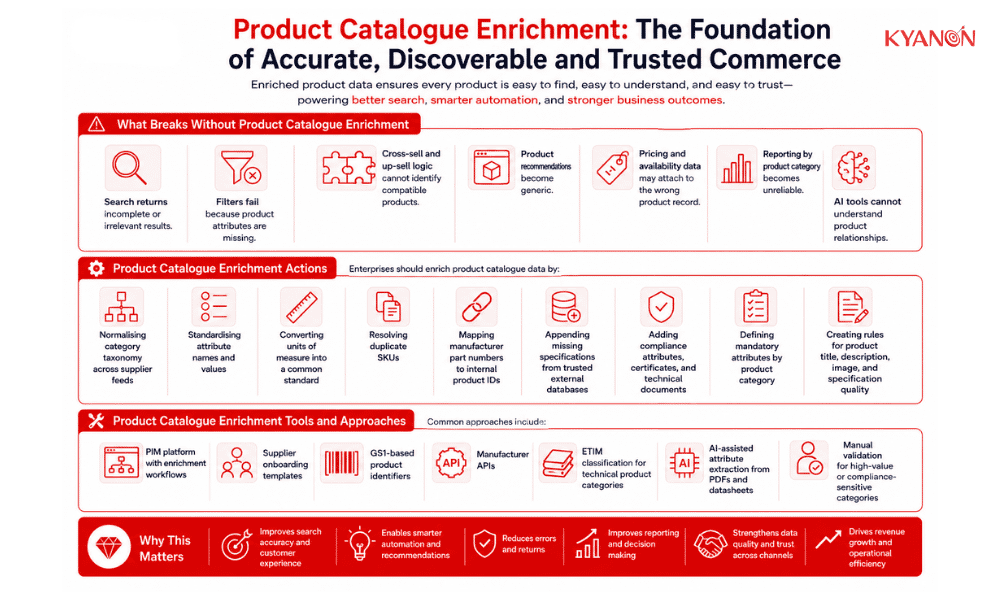
What breaks without product catalogue enrichment
- Search and discovery fails: the same product type exists under 8–15 different descriptions across supplier feeds. A search for “M8 hex bolt stainless 30mm” returns zero results because the product is catalogued as “SS Bolt HEX 30 M8” in one supplier feed and “Bolt Hex M8x30 A2-70” in another.
- Cross-sell and upsell logic cannot run: recommendation engines require a unified attribute schema. Without it, “customers who bought X also bought Y” produces meaningless output.
- Pricing misalignment: availability and contract pricing data become misaligned with product records when SKUs are not resolved across supplier feeds.
GS1 states that high-quality product data helps products be accurately identified and understood by trading partners and downstream systems, which is directly relevant to multi-supplier B2B catalogs.
Product catalogue enrichment actions
Enterprises should enrich product catalogue data by:
- Normalize category taxonomy across all supplier feeds into a single internal classification hierarchy.
- Standardize attributes: unit of measure, dimensions, technical specifications, and packaging type.
- Resolve duplicate SKUs across supplier feeds (the same physical product with 3 different supplier codes).
- Append missing attributes from external product databases (GS1, manufacturer spec sheets, ETIM for European technical products).
Tools and infrastructure
- Product Information Management (PIM) platform with configurable enrichment rules and supplier onboarding workflows.
- Integration with GS1 Global Registry or ETIM (European Technical Information Model) standards databases for commodity attribute enrichment.
- Supplier data onboarding standards are enforced at ingestion, not corrected post-hoc.
A PIM system can manage product data structure, but it does not solve enrichment alone. The enterprise still needs standards for taxonomy, attribute completeness, duplicate resolution, and supplier data submission.
Supplier data
The core problem: Supplier records in B2B eCommerce are almost universally maintained manually, and manual maintenance at scale produces inconsistent legal entity names, outdated contact records, and missing compliance attributes that procurement and finance systems depend on.
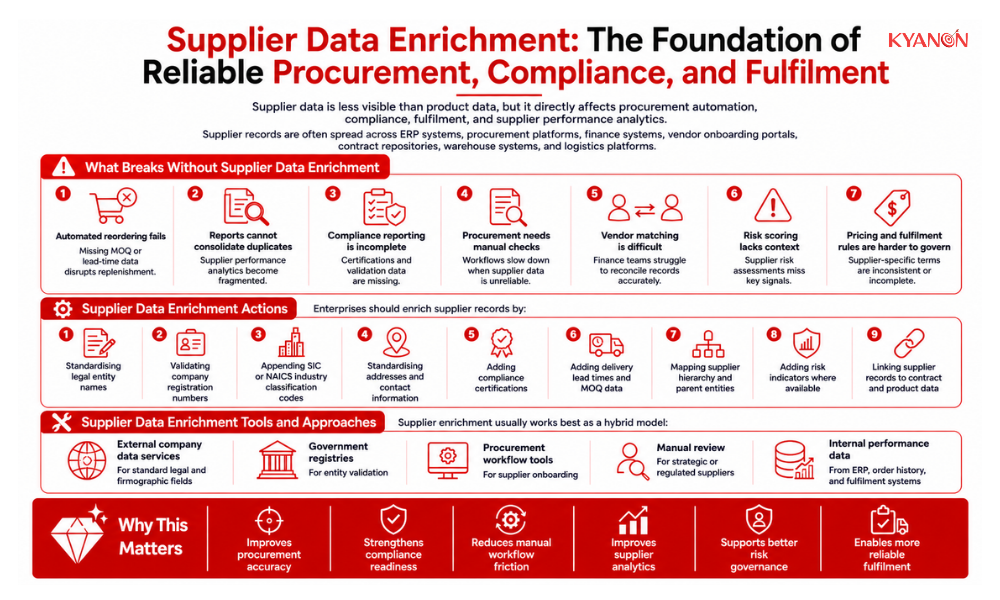
What breaks without supplier data enrichment
- Procurement automation fails: automated purchase order generation requires clean MOQ (minimum order quantity), lead time, and supplier contact data. Missing fields cause exceptions that require manual intervention at every cycle.
- Supplier performance analytics cannot aggregate: if the same supplier exists under three different account IDs (e.g., “Acme Corp”, “Acme Corporation”, “ACME Pty Ltd”), performance data cannot be consolidated.
- Compliance reporting is inaccurate: when certification data (ISO, food safety, and export compliance) is missing from supplier records, compliance audits require costly manual verification.
Supplier data enrichment actions
- Standardize supplier legal entity names against company registration databases (Companies House for the UK, ASIC for Australia/New Zealand, Orbis for global coverage).
- Append industry classification codes: SIC (Standard Industrial Classification) and NAICS (North American Industry Classification System).
- Add and validate compliance and certification attributes: ISO certifications, export licenses, and product safety approvals.
- Validate and standardize address and contact data.
Tools and infrastructure
- External company data services for standard legal and firmographic fields
- Government registries for entity validation
- Procurement workflow tools for supplier onboarding
- Manual review for strategic or regulated suppliers
- Internal performance data from ERP, order history, and fulfilment systems
Supplier enrichment is not only a procurement task; it is the data layer that supports supplier analytics, compliance control, automated replenishment, and reliable fulfillment.
Buyer firmographic data
The core problem: B2B accounts are typically created with the minimum data required to transact: company name, billing email, and address. No firmographic context is captured at account creation, and it is rarely enriched afterward. This leaves commercial and analytics teams operating blind.
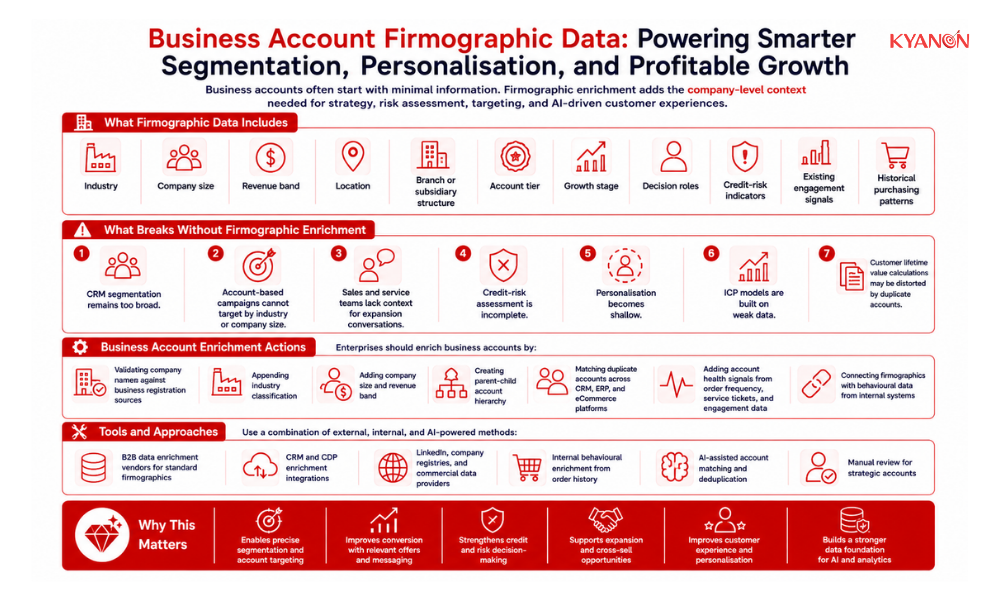
What breaks without enrichment
- Account-based segmentation is impossible: without industry classification and company size data, marketing cannot segment accounts by vertical, revenue band, or growth stage. Account-based marketing (ABM) requires this data as its input.
- Commercial teams lack context: without knowing whether an account is a $5M wholesaler or a $500M distributor, commercial conversations have no baseline.
- Credit risk assessment is incomplete: credit terms and exposure management require verified revenue and ownership structure data.
- ICP modeling produces unreliable output: Revenue Operations cannot build Ideal Customer Profile (ICP) models without consistent firmographic fields across all accounts.
Business account enrichment actions
- Append company size: employee count band, estimated annual revenue band
- Add industry classification: SIC and/or NAICS codes, mapped to internal vertical taxonomy
- Append decision-maker profile data where available: title, department, seniority level
- Validate and standardise company names against business registration databases
- Add account health scores derived from internal CRM engagement data and order history
Tools and infrastructure
Common options include:
- B2B data enrichment vendors for standard firmographics
- CRM and CDP enrichment integrations
- LinkedIn, company registries, and commercial data providers
- Internal behavioural enrichment from order history
- AI-assisted account matching and deduplication
- Manual review for strategic accounts
The data enrichment solutions market was valued at USD 2.2 billion in 2024 and is projected to reach USD 3.4 billion by 2030 (Research & Markets, 2026), showing rising enterprise demand for enriched, decision-ready data.
Note on vendor selection: No single data enrichment vendor covers all three asset types. Product catalog enrichment requires a PIM platform; supplier enrichment requires company registration data services; account enrichment requires B2B data vendors. Evaluate each category independently.
What Actually Breaks in B2B eCommerce Without Data Enrichment
Data enrichment is often treated as a “nice to have” until operational problems appear. In B2B eCommerce, those problems usually show up in five areas.
Search and discovery failure
When product catalog data is unenriched, search becomes one of the highest-friction points in the eCommerce experience, particularly for technical products with complex attribute requirements.
- The same product exists under multiple descriptions with no normalized attribute set.
- Search algorithms cannot surface relevant results against unstructured product data.
- Filtering by attribute (e.g., “show all 316 stainless products, M8, 30mm”) fails when attribute fields are empty or inconsistently named.
Example: If the same industrial component is described in 12 different ways across supplier feeds, the search engine cannot reliably understand equivalence, substitution, or compatibility.
What enrichment fixes:
- Unified product taxonomy
- Standard product titles
- Attribute completeness
- Synonym mapping
- Technical specification fields
- Related-product mapping
- Compatibility rules
Search quality in B2B eCommerce depends less on interface design and more on whether the underlying product data is structured, complete, and governed.
Pricing engine errors
B2B pricing is structurally complex: volume tiers, account-specific contract pricing, promotional windows, and currency/tax treatment all run simultaneously. Enrichment failures at the product data layer surface as pricing errors downstream.
Pricing failure pattern | Why it happens | What data enrichment fixes |
Contract price is not applied correctly | Product IDs in the pricing table do not match product IDs in the catalogue | SKU-to-price rule mapping |
Volume discount logic misfires | The same product exists under different SKUs across supplier feeds | Duplicate SKU resolution and product record matching |
ERP-to-eCommerce price sync breaks | Product master records are duplicated or inconsistently keyed across systems | Product master data standardisation |
Promotions apply to the wrong products | Product categories or attributes are incomplete or inconsistent | Product category standardisation |
Account-specific pricing becomes unreliable | Account hierarchy, buyer group, or contract data is incomplete | Account hierarchy enrichment |
Supplier cost changes are not reflected accurately | Supplier cost, availability, or lead-time data is not connected to product records | Supplier cost and availability matching |
Pricing rules require frequent manual overrides | Pricing logic is not validated against clean product, account, and contract data | Pricing-rule validation |
B2B data enrichment reduces pricing engine errors by aligning product IDs, account hierarchies, supplier data, and contract rules across ERP, eCommerce, and pricing systems.
Analytics and reporting gaps
Unenriched data produces analytics that look complete but are structurally unreliable.
Common symptoms:
- Revenue by product category cannot be trusted when 25–30% of products sit in an “uncategorized” or catch-all bucket.
- Customer Lifetime Value (LTV) calculations are wrong when the same account exists as three separate records with different company name formats.
- Cohort analysis by industry or account size is not possible without enriched firmographic fields.
- Year-on-year category performance comparisons break when taxonomy changes occur without backfilling historical records.
Example: If 30% of products are assigned to the “uncategorized” category, category-level revenue reports become unreliable. If the same business customer exists as five separate accounts, LTV and retention analyses become inaccurate.
What enrichment fixes:
- Category completeness
- Supplier ID consistency
- Account deduplication
- Product-to-supplier mapping
- Order-to-account hierarchy
- Clean reporting dimensions
Gartner’s 2025 AI-ready data research reinforces that data readiness is an ongoing practice, not a one-time cleanup, requiring metadata, observability, and governance maturity.
AI and personalization failure
AI systems are directly dependent on data quality. Recommendation engines, next-best-offer models, and dynamic pricing tools trained on unenriched data produce output that is either irrelevant or actively counterproductive.
- Recommendation engines trained on unenriched product data surface products from categories the account has never purchased from.
- Personalization logic that cannot distinguish between a 50-person manufacturer and a 5,000-person distributor sends the same content to both.
- AI-generated reorder suggestions fail when the account transaction history contains duplicate records for the same purchasing entity.
The cost: By 2026, over 60% of B2B enterprises that deploy AI without resolving underlying data quality issues will see neutral or negative commercial outcomes from those investments (Gartner, 2025).
For AI in B2B eCommerce, enrichment is not a data-cleaning side task; it is the control layer that determines whether AI outputs are useful, explainable, and trusted.
Procurement and supplier management inefficiency
Procurement and supplier operations become inefficient when supplier records are incomplete, duplicated, or not connected to product, contract, and fulfillment data.
| Supplier data issue | Why does it create problems | What data enrichment fixes |
Missing MOQ data | Reordering rules cannot calculate the right purchase quantity | Automated replenishment rules |
Missing lead-time fields | Fulfilment planning becomes inaccurate | More accurate fulfilment planning |
No supplier performance score | Businesses cannot compare supplier reliability, cost, or delivery quality | Supplier comparison and supplier scorecards |
No compliance certification status | Procurement teams cannot verify whether suppliers meet required standards | Compliance reporting |
No approved supplier mapping | Teams may purchase from unapproved or duplicate suppliers | Risk-based procurement workflows |
No standard supplier ID | The same supplier may appear as multiple records across ERP, procurement, and eCommerce systems | Supplier data matching and deduplication |
Incomplete payment and delivery terms | Contract terms may not align with orders, invoices, or fulfilment workflows | Contract-to-order alignment |
The EU Data Act also raises the importance of data access and interoperability for connected products, industrial equipment, and performance data, especially for sectors such as manufacturing, agriculture, and construction.
A Step-by-Step B2B Data Enrichment Approach
Step 1 – Audit your three core data assets
Before selecting tools or vendors, establish the current state of your data.
Asset | Key metrics to assess |
Product catalogue | % of products with complete mandatory attributes; % with missing category assignment; duplicate SKU rate across supplier feeds |
Supplier records | % with verified legal entity name; % with missing MOQ/lead time; % with current certification data |
Account records | % with industry classification; % with company size data; duplicate account rate |
What to prioritize:
- Identify which missing or incorrect attributes are causing the most downstream system failures.
- Map each gap to a specific operational impact: search failure, pricing error, analytics gap, or AI failure.
- Build an enrichment backlog prioritized by business impact, not data volume.
Step 2 – Define your master data standards
Enrichment without standards is just adding more inconsistent data. Standards definition must precede pipeline implementation.
Product catalog standards:
- Taxonomy depth: how many category levels (L1, L2, L3)?
- Mandatory attributes per category: which fields must be complete before a product is published?
- Naming conventions: how are product names, descriptions, and variants formatted?
Supplier record standards:
Required fields: Legal entity name, registration number, certification status, lead time, MOQ, primary contact
Verification sources: Which database is authoritative for each field?
Account record standards:
Required firmographic fields: company size band, industry classification (SIC/NAICS), account tier
Internal segmentation fields: ICP fit score, vertical, geographic territory
Step 3 – Choose enrichment approach per asset
Each of the three data assets requires a different enrichment mechanism. There is no single platform that covers all three adequately.
Asset | Recommended approach |
Product catalogue | PIM platform with supplier onboarding standards + external attribute databases (GS1, ETIM, manufacturer APIs) |
Supplier data | Automated enrichment via company data APIs + manual validation workflow for strategic suppliers |
Account firmographics | B2B data enrichment vendor API integrated into CRM or CDP at account creation and on a scheduled refresh cycle |
Step 4 – Implement enrichment pipelines
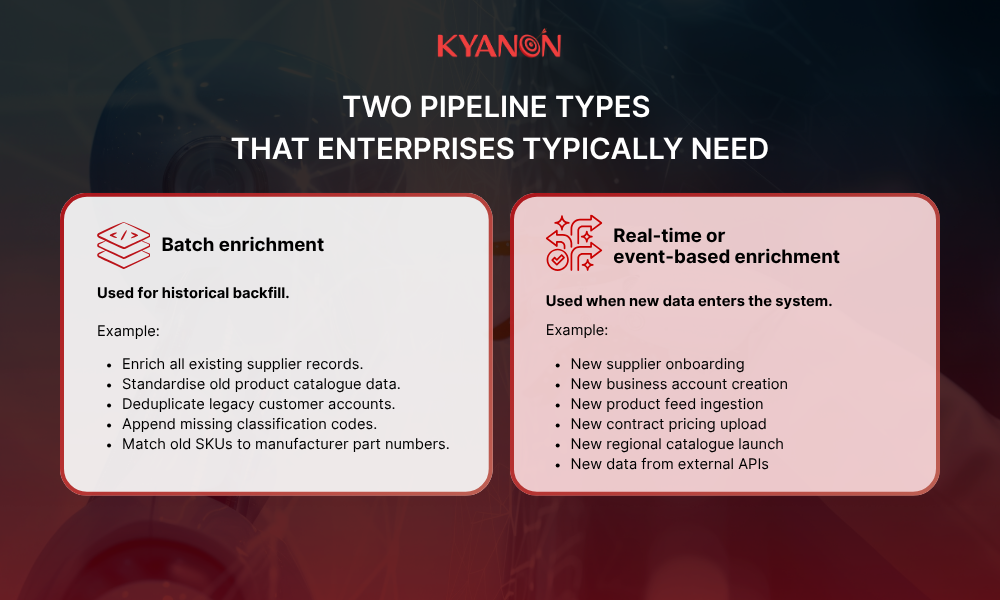
Data enrichment should be designed as a pipeline, not a one-time cleanup. Enterprises typically need two pipeline types:
Real-time or event-based enrichment
Used when new data enters the system.
Layer | Function |
Ingestion | Pull data from ERP, CRM, PIM, supplier feeds, APIs |
Standardization | Clean formats, names, units, categories |
Matching | Resolve duplicates and identity conflicts |
Enrichment | Append missing attributes from trusted sources |
Validation | Check rules, confidence scores, and exceptions |
Governance | Assign ownership, approval, and audit trail |
Activation | Push enriched data to commerce, analytics, CRM, and AI systems |
Batch enrichment (historical backfill)
- Runs enrichment rules against existing records that predate the enrichment pipeline
- Prioritize by data asset impact: product catalog first (search impact), account records second (analytics impact), and supplier records third (operational impact).
Monitoring requirements
- Track enrichment coverage rate: % of records that have passed through enrichment logic.
- Track field completeness rate: % of mandatory fields populated per record type.
- Alert on enrichment failure rate: failed API calls, records rejected by validation rules.
Step 5 – Validate and govern
Enrichment without governance degrades over time. Suppliers change their data. Companies are acquired. Taxonomies evolve.
Governance structure:
- Data stewardship: assign ownership of each data domain. Product catalog: product/category management team. Supplier data: procurement operations. Account data: Revenue Operations or Sales Operations.
- Quality SLAs: define minimum field completeness rates that must be met before a record can be used in analytics pipelines or AI training data. Example: no product goes live with fewer than 8 of 12 mandatory attributes complete.
- Review cycles: enrichment rules must be reviewed quarterly as taxonomy requirements change and as new supplier or account data sources become available.
- Quality SLAs: define minimum field completeness rates that must be met before a record can be used in analytics pipelines or AI training data. Example: no product goes live with fewer than 8 of 12 mandatory attributes complete.
- Review cycles: enrichment rules must be reviewed quarterly as taxonomy requirements change and as new supplier or account data sources become available.
Build vs. outsource: B2B data enrichment decision guide
The most common mistake is treating this as a binary decision. The right answer is almost always a hybrid, with a clear principle governing which part to outsource and which to build.
The governing principle: Outsource commodity enrichment. Build in-house for proprietary data that differentiates your analytics.
Enrichment area | Build internally | Use vendors | Outsource services | Recommended model |
Product taxonomy | High | Medium | Medium | Build core taxonomy and support with external standards |
Product attributes | Medium | High | Medium | Hybrid |
Supplier legal data | Low | High | Medium | Vendor-supported |
Supplier compliance data | High | Medium | Medium | Internal validation required |
Address validation | Low | High | High | Vendor or outsourcing |
Firmographic enrichment | Low to medium | High | High | Vendor-supported |
Account hierarchy | High | Medium | Medium | Hybrid |
Customer behaviour data | High | Low | Low | Internal |
Pricing logic | High | Low | Low | Internal |
| AI-readiness governance | High | Medium | Medium | Internal governance with implementation support |
When to lean toward outsourcing (data enrichment outsourcing services):
- The enrichment task requires access to an external database that would cost more to replicate than to license.
- The data type is standardized (e.g., company registration data, GS1 product attributes).
- The volume of records exceeds what an internal team can manually maintain.
- Speed to coverage is the priority (vendor APIs can enrich 100K accounts in hours; manual enrichment cannot).
When to build in-house:
- The enrichment logic requires proprietary business rules that reflect your specific market position.
- The data involved is a competitive differentiator (e.g., your internal taxonomy structure and your customer segmentation logic).
- The external vendor data does not exist for your specific product category or geography.
- Compliance requirements restrict data sharing with third-party vendors.
How Kyanon Digital Supports B2B eCommerce Data Enrichment
For enterprises evaluating B2B data enrichment in eCommerce operations, the implementation challenge is usually not a single tool. It is the architecture that connects product data, supplier data, account data, pricing logic, commerce platforms, analytics, and AI workflows.
Kyanon Digital’s relevant service areas include omnichannel eCommerce, data-driven insights, AI-powered automation, enterprise data strategy, master data management, data stewardship, and governance frameworks. Its omnichannel e-commerce service covers data-driven insights, predictive modeling, AI-powered product recommendations, dynamic pricing, smart search, and third-party system connectivity.
Kyanon Digital’s Analyze & Augment offering also includes enterprise data strategy, real-time and batch data architecture, master data management, data stewardship, data governance frameworks, and AI/ML integration.
Explore more: Data-Driven Insights & Intelligent Augmentation
Where does this fit in a B2B eCommerce data enrichment program?
Kyanon Digital can support enterprises across the following:
- Data audit for product, supplier, and account records
- Master data model design
- Product catalogue enrichment architecture
- PIM, ERP, CRM, CDP, and eCommerce integration
- Data warehouse and analytics readiness
- AI-ready data preparation
- Data governance workflows
- Supplier onboarding and data validation process design
- Enrichment pipeline implementation
- Dashboard and monitoring setup
A relevant implementation example is Kyanon Digital’s integrated omnichannel fulfillment and transportation management solution, where the project addressed fragmented delivery operations, limited visibility across channels, ERP/POS/eCommerce/logistics integration gaps, and real-time analytics needs.
How Kyanon Digital transformed fragmented e-commerce operations into a unified data-driven commerce ecosystem for Coway Vietnam

A fast-growing consumer retail enterprise unified eCommerce operations, product information, customer interactions, and backend workflows into a single integrated commerce platform to support omnichannel growth and operational visibility.
Challenges
- Fragmented customer, product, and operational data across channels.
- Manual order and inventory synchronization are causing inefficiencies.
- Inconsistent customer experience between online and offline touchpoints.
- Limited visibility into customer behavior, order status, and operational performance.
- Difficulty scaling promotions, product updates, and campaign execution across systems.
Solutions
- Built a centralized eCommerce ecosystem integrated with internal operational systems.
- Unified product catalogs, customer profiles, orders, and inventory data.
- Connected eCommerce workflows with ERP, CRM, and fulfillment operations.
- Enabled real-time order tracking, inventory synchronization, and customer engagement management.
- Improved backend operational visibility with centralized reporting and analytics readiness.
Results and impacts
- Faster operational coordination across commerce and fulfillment teams.
- Reduced manual processing and improved order accuracy.
- Better customer experience through synchronized omnichannel interactions.
- Improved visibility into inventory, orders, and customer activity.
- Stronger data foundation for personalization, analytics, and scalable digital commerce growth.
Read more: E-Commerce System For Coway.
Conclusion
B2B data enrichment is not just a data-cleaning exercise. It is the foundation that helps enterprises make product search more accurate, pricing engines more reliable, supplier workflows more efficient, and AI outputs more useful.
As B2B eCommerce becomes more complex in 2026, the strongest approach is not to rely on one tool or vendor. Enterprises need to audit their core data assets, define clear master data standards, automate enrichment pipelines, and govern data quality continuously across product catalog, supplier, and account data.
The real value of B2B data enrichment comes when clean, structured, and validated data flows across ERP, PIM, CRM, CDP, eCommerce, analytics, and AI systems. That is what turns fragmented commerce operations into a scalable, insight-ready, and AI-ready digital foundation.
Ready to fix the data problems behind poor search, pricing errors, unreliable reports, and failed AI personalization? Contact Kyanon Digital to assess your B2B eCommerce data foundation and design a scalable data enrichment roadmap for 2026.






 Create project brief with AI