

This guide maps the 6 AI automation use cases delivering measurable ROI for APAC logistics operators in 2026, covering the data requirements, implementation sequencing, and operational risks behind successful deployment. It also provides a practical framework for prioritizing high-impact AI initiatives and scaling toward more predictive and autonomous logistics operations.
In 2026, labor shortages, geopolitical volatility, rising transportation costs, and tighter delivery expectations are pushing traditional logistics systems to their limits. As supply chain disruptions become more frequent, manual coordination leads to slower response times, operational bottlenecks, and increasing margin pressure.
To respond, logistics organizations are shifting from reactive workflows toward AI-driven operational orchestration. AI automation is becoming the only scalable approach for improving decision speed, operational resilience, and cost efficiency across increasingly volatile logistics networks.
Key takeaways
- Logistics automation with AI has transitioned from experimental pilot projects to foundational enterprise infrastructure, with agentic AI systems autonomously resolving operational disruptions in real time.
- The financial divide between enterprises utilizing dynamic AI routing and those relying on static rule-based systems is widening rapidly due to margin compression and escalating last-mile delivery costs.
- Implementing AI logistics software without first architecting a unified, real-time data foundation invariably leads to systemic integration failures and negative return on investment.
- Functional leaders must sequence their AI deployments based on current data readiness, prioritizing low-complexity, high-impact use cases such as predictive ETA generation before attempting end-to-end network optimization.
- Enterprises must transition from evaluating isolated software tools to partnering with comprehensive digital transformation providers that address data governance, operating models, and legacy system integration.
Further Reading
- Logistics Data at Source: Why Input Quality Matters
- Data Hub & BI Analytics for Vietnam’s Largest Port & Logistics Operator
- Digital Platform Transformation in the Maritime & Logistics Sector
The state of AI automation in 2026 APAC logistics
As APAC logistics networks grow increasingly complex and volatile, enterprises are turning to AI-driven automation to strengthen resilience, control costs, and stabilize service performance. Yet despite rapid adoption, operational outcomes remain highly uneven. The key differentiator is no longer AI capability itself, but the underlying readiness of data architecture, system integration, and the degree to which AI is embedded into core operations rather than layered onto fragmented infrastructure.
The uneven distribution of ROI across the sector
While AI adoption grows in APAC logistics, ROI depends on execution maturity. Supply chains produce data volumes that surpass human processing capacity, making AI vital for competitiveness. However, the success of transforming this data into operational intelligence varies significantly across the region.
This gap is visible across the region. Singapore is applying AI to streamline port clearance processes, reducing turnaround time from days to minutes through automated verification systems. In contrast, The Platinum Capital reports that AI-enabled scheduling and crane coordination has increased throughput by 28%, demonstrating more targeted but still emerging optimization use cases. Malaysia is scaling national logistics modernization through smart infrastructure programs, including automated cold chain facilities, while Australia and New Zealand are focusing their AI investments on mitigating labor shortages and addressing geographic distribution challenges.
Despite these advances, outcomes remain inconsistent because deployment depth and data readiness differ substantially between organizations.
Characteristics of AI-mature enterprises
Despite regional progress, firms achieving real ROI share two traits: they prioritize data architecture over model deployment and sequence use cases by data readiness instead of novelty. While AI amplifies operational strength, financial success depends entirely on this execution strategy.
Mature enterprises view AI as a systemic capability, employing a self-funding digital transformation model. By first targeting high-cost supply chain levers with AI, these leaders generate rapid savings. This capital is then reinvested into further autonomous capabilities, creating a continuous cycle of end-to-end optimization.
The cost of ignoring data stacks
Enterprises failing to see results often overlook their data stacks. Deploying AI on fragmented or unstructured data leads to unreliable outputs and pilot failures. For example, inaccurate historical data causes flawed routing and operational chaos.
Without a unified data fabric, AI integration triggers bottlenecks and manual reverts, destroying ROI and causing organizational resistance. The following sections explore successful 2026 APAC use cases, data needs, and deployment strategies.
What is AI automation in logistics?
AI is shifting logistics from reactive operations to predictive, self-optimizing systems. However, many enterprises still struggle to understand its core components, its distinction from traditional automation, and its primary areas of operational impact.
Defining Agentic AI and Machine Learning
Logistics automation uses machine learning, agentic AI, and generative AI to replace manual workflows with machine-speed decision-making. By establishing clear operational boundaries, these systems scale efficiency beyond human capacity.
Agentic AI advances beyond simple analytics by autonomously executing corrective strategies. These systems monitor environments and trigger ERP workflows to resolve deviations independently, serving as a primary performance driver for modern supply chains.
Differentiating AI from rule-based logic
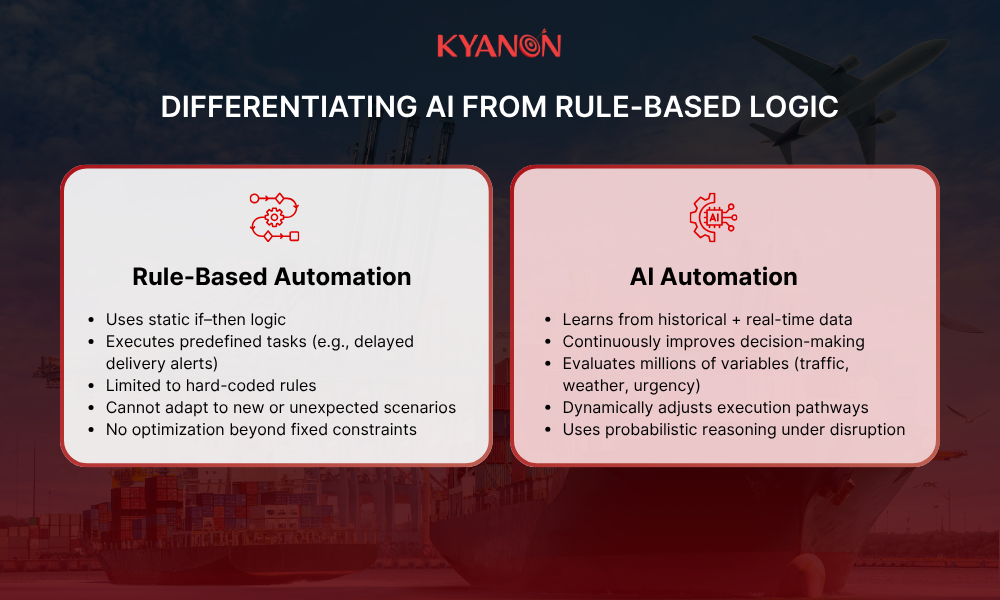
AI automation adds enterprise value by moving beyond traditional rule-based logic. Unlike static “if-then” systems limited by hard-coded constraints, AI adapts to changing conditions through continuous learning from historical and real-time data. By analyzing variables like weather, traffic, and priority, AI dynamically optimizes execution. This probabilistic reasoning provides flexible responses to disruptions that rule-based systems cannot match.
By evaluating millions of variables such as order urgency and traffic, AI adjusts execution pathways dynamically. This level of adaptability allows AI to find optimal responses during unprecedented disruptions where traditional hard-coded systems lack the necessary flexibility.
Core domains of high-impact automation
AI automation delivers maximum impact in route planning, exception management, inventory positioning, and customer communication. These domains involve complex data and time constraints that exceed human processing capacity.
Integrating AI transforms reactive operations into predictive networks. According to Accenture, autonomous supply chains can cut costs by up to 20%, creating a foundation for full logistics automation.
The 6 AI automation use cases delivering ROI in APAC logistics in 2026
In 2026, rising costs and customer demands drive logistics automation. Successful firms avoid fragmented data, instead targeting high-impact workflows where AI reduces costs and scales efficiency. These use cases demonstrate measurable results across APAC networks.
Use case 1: Dynamic route optimisation
The application of artificial intelligence to last-mile and middle-mile routing represents one of the most mature and financially rewarding investments in the modern logistics sector.
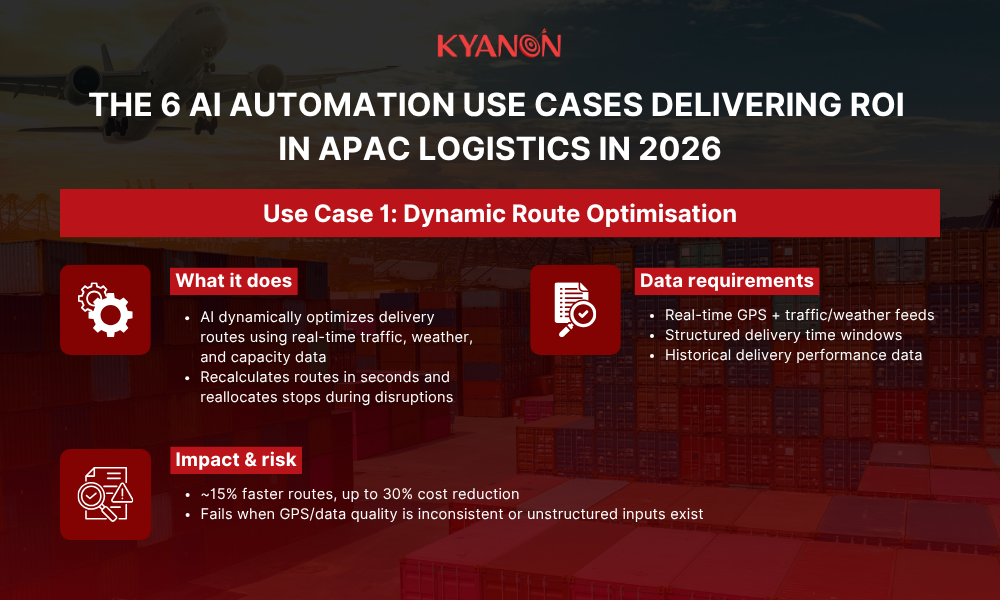
What it does:
AI continuously optimizes routing using live traffic, weather, delivery status, and fleet telemetry data. Instead of relying on static route planning, the system autonomously reallocates stops and adjusts sequencing during disruptions to maintain delivery efficiency in real time.
Data requirements:
Success requires high-fidelity streams:
- Low-latency GPS telemetry from all vehicles.
- Manifests with precise mathematical time windows.
- Historical delivery data segmented by route and driver.
- Integrated real-time traffic and weather API feeds.
ROI delivered:
Dynamic routing produces measurable operational gains because transportation costs are heavily influenced by idle mileage, failed sequencing, and inefficient stop allocation.
According to McKinsey, AI-enabled route optimization can reduce travel time by up to 15%, while broader logistics automation initiatives can reduce transportation-related operating costs by as much as 30%.
Why this matters financially:
- Lower fuel consumption.
- Reduced empty mileage.
- Higher driver utilization.
- More deliveries completed per route cycle.
- Lower overtime and subcontracting costs.
Common failure point:
Many deployments fail because routing algorithms depend heavily on structured operational data. Irregular GPS telemetry, inconsistent stop metadata, or unstructured delivery instructions such as “morning delivery” reduce optimization accuracy and break autonomous sequencing logic.
Use case 2: Predictive ETA and customer communication
Customer expectations regarding delivery visibility have escalated permanently, making precise arrival predictions a critical component of brand reputation and service quality.
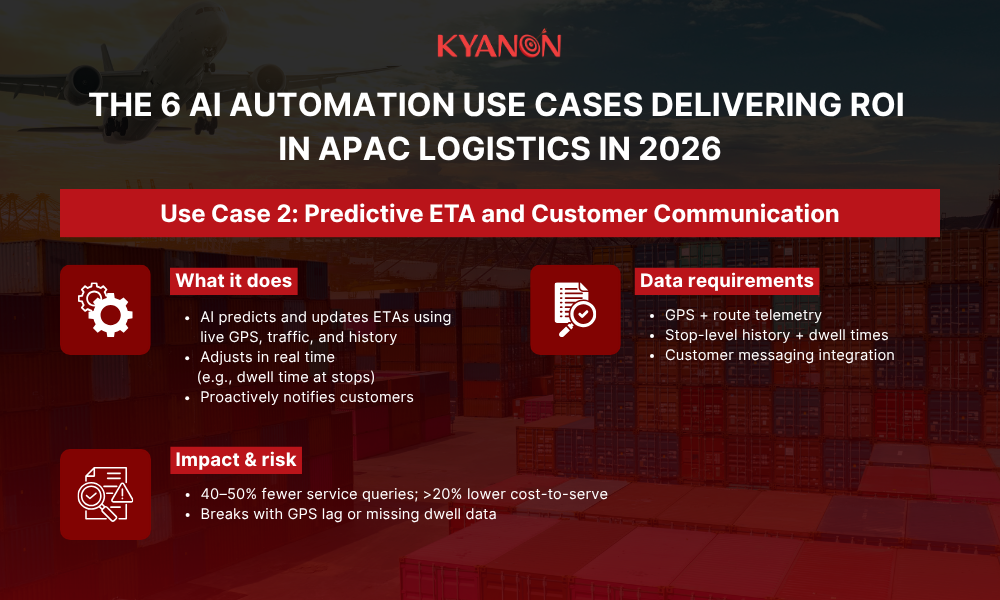
What it does:
Machine learning models continuously predict delivery arrival times using real-time route conditions, historical stop performance, traffic variability, and location-specific dwell patterns.
The system autonomously updates ETAs, triggers customer notifications, and reduces manual status inquiries without requiring dispatcher intervention.
Data requirements:
- Seamless GPS telemetry from vehicles.
- Stop-level historical performance and dwell time data.
- Integrated omnichannel customer contact systems.
ROI delivered:
Predictive ETA systems improve customer experience while simultaneously reducing operational support costs. McKinsey reports that proactive AI-driven customer communication can reduce service interactions by 40-50% and lower cost-to-serve by more than 20%.
Why these savings occur:
- Fewer inbound “Where is my order?” inquiries.
- Reduced call center workload.
- Lower manual coordination effort.
- Improved customer satisfaction and SLA confidence.
- Faster exception visibility during disruptions.
Common failure point:
ETA prediction accuracy collapses when telemetry latency increases or operators fail to track stop-specific dwell behavior at complex delivery environments such as malls, industrial parks, or high-rise buildings.
Use case 3: Automated exception handling and escalation
Disruptions are inevitable in complex physical supply chains, but the resolution process no longer requires extensive manual coordination and triage.
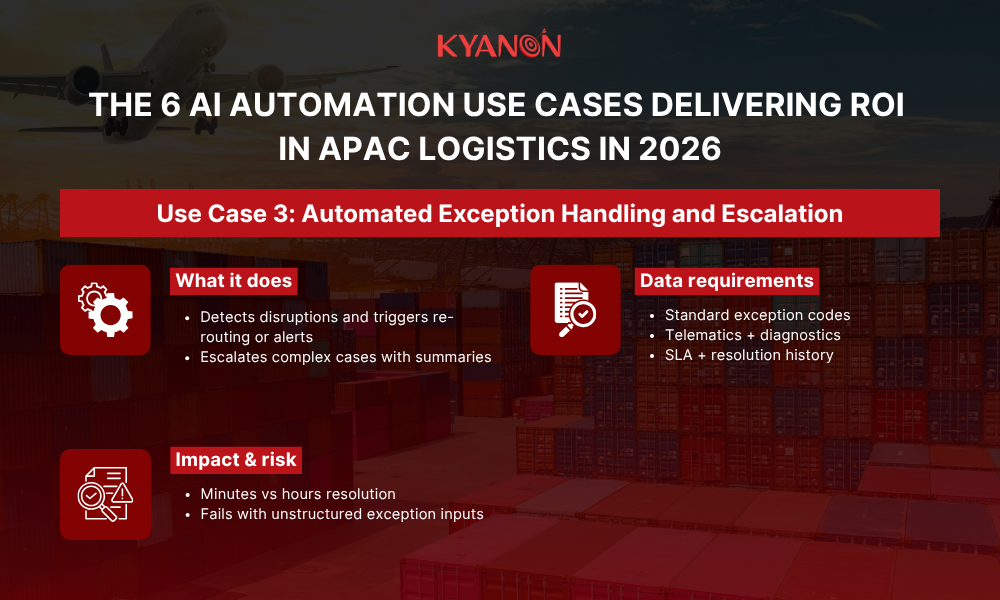
What it does:
Agentic AI continuously monitors logistics networks for anomalies such as failed deliveries, refrigeration breakdowns, route deviations, or warehouse bottlenecks.
The system can autonomously trigger predefined actions including:
- Rescheduling deliveries.
- Re-routing vehicles.
- Escalating SLA risks.
- Drafting customer notifications.
- Generating structured operational briefings for human teams.
Data requirements:
This capability requires highly standardized operational taxonomies:
- Structured exception codes across applications and sensors.
- Historical resolution data and operational outcomes.
- Customer SLA data for priority handling.
- Real-time vehicle telematics.
ROI delivered:
Automated exception management significantly reduces manual operational coordination during disruptions. According to IBM, AI-enabled workflow automation can reduce operational process time by up to 80% in complex enterprise workflows.
Why this produces measurable logistics ROI:
- Faster resolution cycles.
- Lower dispatcher workload.
- Reduced labor dependency during disruptions.
- Higher SLA compliance rates.
- Less revenue leakage from delayed escalation.
Common failure point:
Many organizations still rely on free-text operational notes rather than standardized exception codes. Without structured historical resolution data, AI systems cannot reliably classify incidents or determine the optimal remediation path.
Use case 4: Demand-driven inventory positioning
AI automation extends deeply upstream into the warehousing network to optimize inventory distribution prior to actual customer demand materializing.
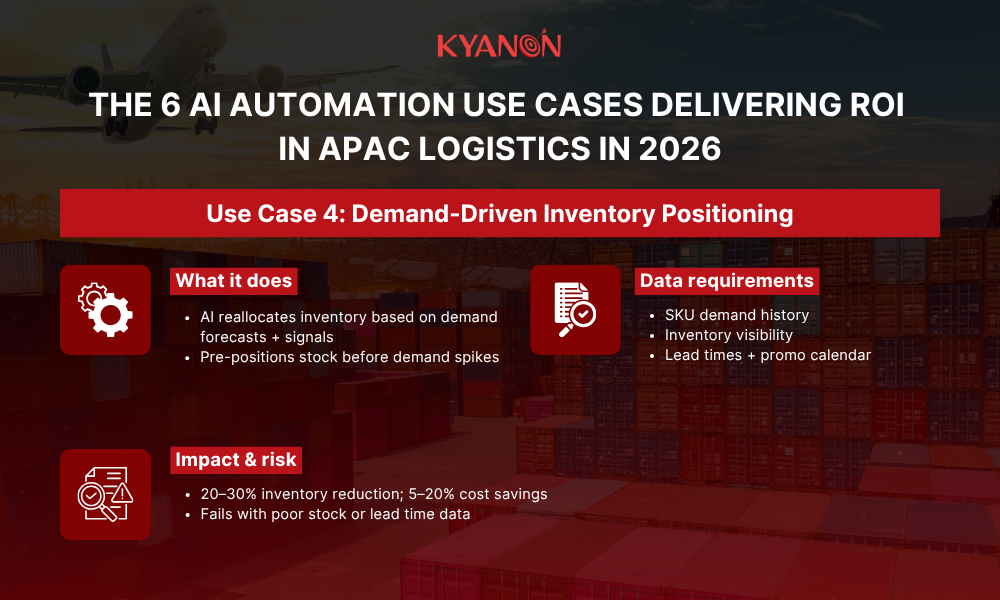
What it does:
AI models optimize inventory distribution across warehouse networks before customer demand materializes.
By combining historical order patterns with external demand signals such as promotions, weather, and seasonality, the system autonomously repositions inventory closer to expected consumption zones.
Data requirements:
This use case requires:
- Clean historical fulfillment records.
- Structured promotional and seasonal calendars.
- Accurate supplier lead-time data.
- Real-time synchronized inventory visibility.
ROI delivered:
AI-driven inventory positioning improves both working capital efficiency and fulfillment performance. McKinsey reports that AI-enabled supply chain optimization can reduce inventory levels by 20-30% while lowering logistics costs by 5-20%.
Why these gains occur:
- Lower inter-warehouse transfer costs.
- Reduced emergency shipping expenses.
- Improved fill rates for fast-moving SKUs.
- Lower inventory obsolescence and write-offs.
- Reduced safety stock requirements.
Common failure point:
Forecasting models frequently fail because historical stockouts are incorrectly interpreted as low demand rather than supply constraints. Poor lead-time governance also prevents AI systems from accurately modeling replenishment feasibility.
Use case 5: Freight procurement and carrier selection automation
The procurement of third-party transportation capacity has transitioned entirely from manual rate negotiations to dynamic algorithmic optimization.
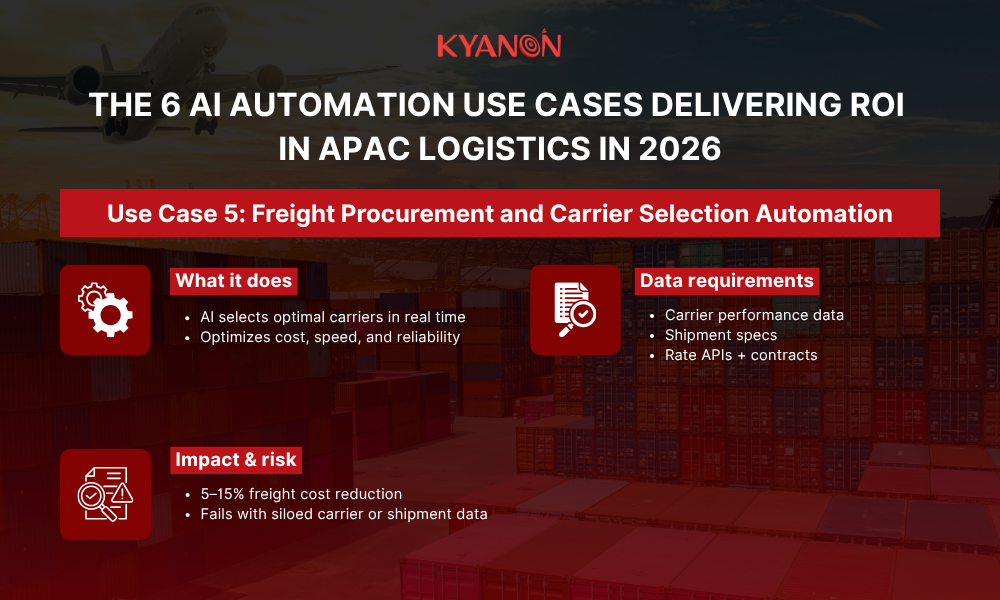
What it does:
AI automates carrier procurement by evaluating transportation providers in real time based on pricing, capacity, delivery reliability, lane performance, and SLA risk. Instead of selecting the cheapest option, agentic systems optimize for total operational outcome including transit reliability, damage reduction, and customer impact.
Data requirements:
Successful deployment requires:
- Structured carrier performance history.
- Accurate shipment attributes.
- Low-latency carrier API integrations.
- Digitized contractual pricing tables.
- Standardized lane-level performance metrics.
ROI delivered:
AI-driven freight procurement improves transportation economics by continuously optimizing carrier decisions at scale. McKinsey reports that automated carrier selection can reduce freight costs by 5-15%. Accenture additionally reports that augmented and autonomous sourcing models can generate 40-60% productivity improvements.
Why the ROI is significant:
- Reduced spot-market dependency.
- Better lane-level pricing decisions.
- Lower administrative procurement workload.
- Improved carrier accountability.
- Reduced damage and SLA penalty exposure.
Common failure point:
Procurement automation often breaks when carrier data is fragmented across multiple systems. Inconsistent shipment dimensions, missing lane history, or inaccurate API integrations lead to poor rate comparisons and margin leakage.
Use case 6: Generative AI for shipment exception narratives and reporting
Generative AI successfully translates complex, high-volume logistical data streams into actionable, human-readable intelligence for corporate stakeholders.
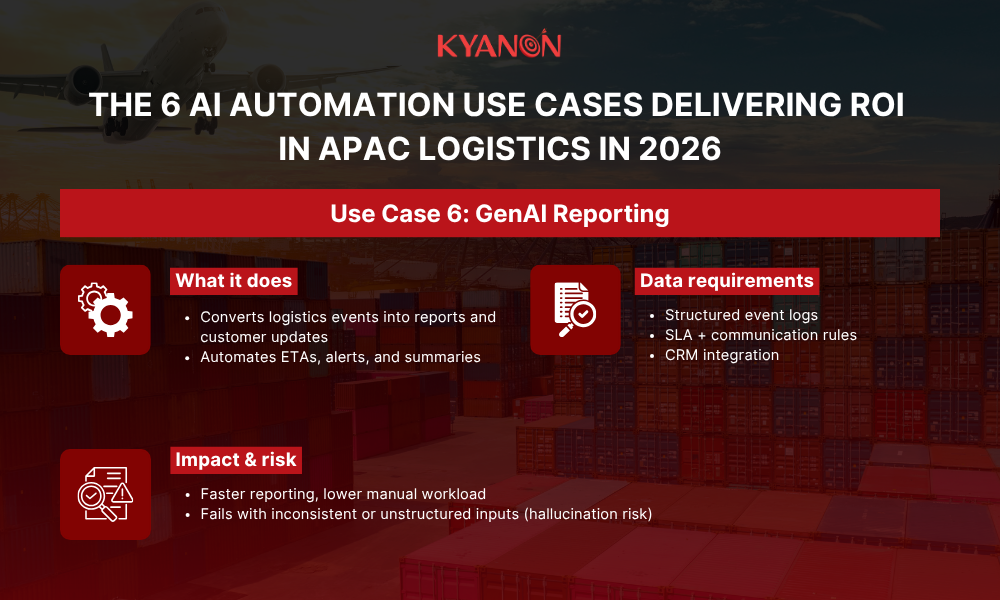
What it does:
Generative AI converts large volumes of operational logistics data into structured, human-readable reporting.
The system automatically drafts:
- Daily operational summaries.
- Delayed explanations.
- Customer disruption alerts.
- Shift handovers.
- Executive logistics briefings.
Data requirements:
LLMs require highly structured operational context, including:
- Standardized event timestamps and status codes.
- Customer SLA parameters.
- Internal SOPs and communication guidelines.
- CRM and enterprise communication integrations.
ROI delivered:
Generative AI streamlines logistics by automating repetitive reporting and communication. This technology boosts productivity by handling high-volume knowledge work and operational messaging at scale.
Why this matters operationally:
- Faster disruption of communication.
- Reduced manual reporting labor.
- More consistent customer messaging.
- Improved operational visibility.
- Lower coordination bottlenecks during incidents.
Common failure point:
Generative AI systems become unreliable when trained on inconsistent operational telemetry or unstructured event histories. Poor data governance increases hallucination risk and can generate inaccurate customer or executive communications.
The data stack required for logistics AI automation
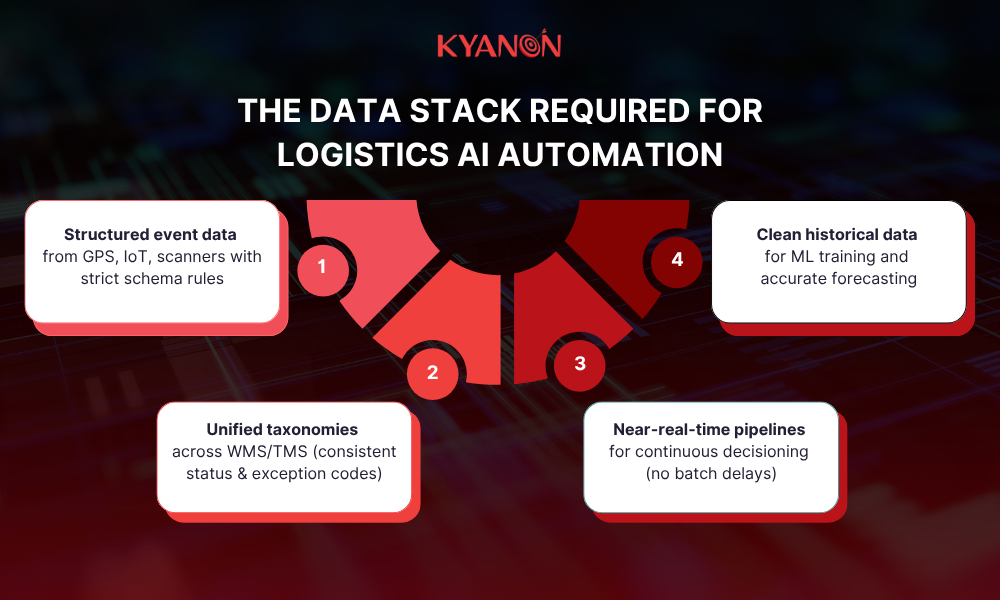
Many logistics enterprises invest in AI platforms only to find their operational data is too fragmented, delayed, or inconsistent to support reliable automation. In reality, logistics AI success is determined long before model deployment, at the level of data architecture. Without a unified foundation, even advanced models produce unstable forecasts, inaccurate routing, and unreliable execution.
Schema-consistent event data architectures
AI systems require structured, standardized event data from sources like GPS devices, scanners, and IoT sensors. Without strict schema enforcement at ingestion, data noise quickly degrades model accuracy.
Unified exception and status taxonomies
Operational states (e.g., delays, failures, handovers) must be defined consistently across all systems. A shared enterprise data dictionary ensures AI models learn from coherent signals rather than conflicting definitions.
Near-real-time data pipelines
Logistics optimization depends on timely data. Batch processing is too slow for dynamic routing or ETA prediction, making streaming or near-real-time pipelines essential.
Clean historical datasets
High-quality historical data enables demand forecasting, dwell-time analysis, and pattern recognition. Incomplete or inconsistent records significantly reduce model reliability.
Implementation sequencing for logistics AI automation
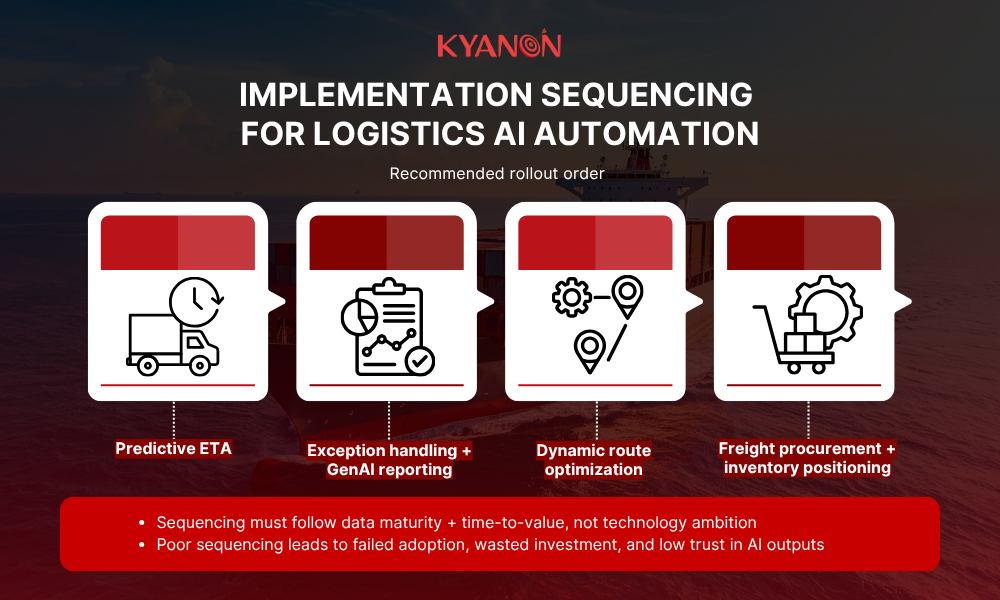
Many logistics AI projects fail by attempting large-scale autonomy before establishing solid data and operational foundations, leading to unreliable outputs and poor ROI. In 2026, leading enterprises succeed by using a phased approach: prioritizing small, high-impact use cases to generate quick savings that fund more advanced automation.
The self-funding deployment methodology
Successful logistics AI transformation follows a self-funding logic: organizations prioritize low-complexity, high-value use cases that deliver early operational gains. These savings are then reinvested into progressively more complex capabilities, enabling scaled automation without excessive upfront capital risk.
This sequencing discipline is critical. Deploying advanced autonomous systems too early overwhelms existing operating models and exposes gaps in data maturity, integration, and governance.
Strategic sequencing matrix
This matrix defines the strategic deployment sequence for six core logistics AI use cases, mapping data maturity requirements, ROI timelines, implementation order, and operational trade-offs. It serves as a framework to ensure functional leaders establish necessary digital infrastructure and governance before investing in high-complexity autonomous systems.
Logistics AI Automation Sequencing Matrix (2026)
|
AI Use Case |
Complexity | Time to Value | ROI Benchmark | Sequencing Risk |
| Predictive ETA | Low | 1-3 months | Forecasts improved 20-50%, costs cut 15%, and service levels rose 65%.
|
Low risk. Poor GPS latency, inconsistent scan events, and incomplete telemetry create inaccurate ETA baselines that quickly erode planner confidence. |
|
Exception Handling Automation |
Low | 1-3 months | McKinsey reports logistics firms saving $30-35M from AI supply chain automation after investing roughly $2M in large fleets. | Non-standard exception codes and fragmented workflows damage AI training and diminish operator trust before scaling. |
| Dynamic Route Optimisation | Medium | 3-6 months | Monthly transit costs fell 6%, fuel dropped 15%, and truck utilization rose from 85% to 97%. |
Poor telematics, slow data pipelines, and erratic driver inputs destabilize routing and hinder frontline adoption. |
|
Carrier Rate Benchmarking |
Medium | 3-6 months | Intelligent procurement transformations report 3-7% savings, 60% productivity gains, and up to 5x ROI potential. | Automating flawed procurement processes merely scales inefficiency. Inconsistent supplier master data remains a critical failure point. |
| Demand-Driven Inventory Positioning | High | 6-12 months | AI-powered inventory optimization cuts inventory by 20-35% and logistics costs by 5-20%. |
83% of organizations face data-readiness gaps in AI deployment, primarily due to poor SKU demand history and fragmented planning data. |
|
Autonomous Freight Procurement |
High | 9-18 months | Scaled AI operations report 10-25% EBITDA gains; Accenture estimates GenAI could impact 43% of supply chain hours. |
McKinsey notes that few firms achieve full AI value as governance, execution, and integration often trail technology spending. |
Source: McKinsey, Accenture, Bain & Company
Prioritize high-impact, low-complexity cases like Predictive ETA and Exception Handling to generate immediate savings. Following a self-funding model, these gains fund advanced efforts like Dynamic Route Optimization.
Strategic sequencing is vital; deploying Demand-Driven Inventory Positioning without high-quality data risks failure and damages operator trust. In 2026’s low-margin environment, firms must secure rapid, measurable ROI before scaling.
Organizations should audit data maturity, specifically GPS latency and signal reliability, while standardizing exception codes to provide structured AI inputs. Establishing a data quality scorecard will identify gaps and confirm readiness for advanced optimization.
How Kyanon Digital enables AI automation for APAC logistics
Kyanon Digital helps logistics and supply chain enterprises across APAC move from manual, fragmented operations to AI-enabled, automated decision systems. The focus is not only on digitizing workflows but on embedding intelligence directly into operational processes such as route planning, warehouse execution, inventory coordination, and exception management.
By connecting data systems across transportation networks, warehouse management platforms, ERP environments, and partner ecosystems, Kyanon Digital enables logistics organizations to shift from reactive reporting to real-time, AI-driven execution. This foundation supports use cases such as predictive ETA, automated dispatching, dynamic routing, and intelligent exception handling across multi-country operations.
With a distributed team of 500+ engineers across Vietnam, Singapore, Thailand, Australia, and Malaysia, Kyanon Digital delivers enterprise-grade AI engineering, data platform modernization, and automation solutions tailored for complex logistics environments operating at scale.
Kyanon Digital’s Relevant Tech Stack Capabilities for Logistics AI Automation
|
Area |
Tech Stack | Business Value |
| Data Ingestion | Kafka / FastAPI |
Real-time logistics event streaming and system integration |
|
Data Processing |
Python / Spark | Scalable transformation of high-volume operational data |
| AI / ML Layer | TensorFlow / Scikit-learn / PyTorch |
Demand forecasting, ETA prediction, anomaly detection |
|
Optimization Engine |
OR-Tools | Route optimization and resource allocation automation |
| Data Platform | PostgreSQL / Data Lake (AWS S3) |
Centralized, scalable logistics data foundation |
|
Workflow Automation |
Apache Airflow | Automated ETL pipelines and operational orchestration |
| Cloud Infrastructure | AWS / Azure |
Secure, elastic infrastructure for global logistics operations |
|
Integration Layer |
REST APIs / Middleware | Seamless connectivity across ERP, WMS, TMS systems |
| Frontline Applications | React / React Native |
Driver, warehouse, and operator-facing digital tools |
|
Observability |
Prometheus / Grafana |
System monitoring and operational performance tracking |
Kyanon Digital supports logistics enterprises through:
- End-to-end real-time logistics visibility across transportation, warehouse, and inventory systems.
- Predictive ETA and demand forecasting models that proactively adjust operational plans.
- AI-driven route optimization that continuously recalculates based on traffic, capacity, and constraints.
- Automated exception handling systems that detect delays, reroute shipments, and trigger workflows without manual intervention.
- Unified data governance frameworks ensure consistent and trusted operational data across regions.
- Event-driven automation architecture enabling logistics decisions to execute in near real time.
These capabilities reflect a key 2026 shift: logistics automation is no longer rule-based but continuously adaptive, powered by AI systems embedded directly into execution layers.
Case study: How Kyanon Digital enabled AI-ready logistics transformation for Vietnam’s largest port & logistics operator
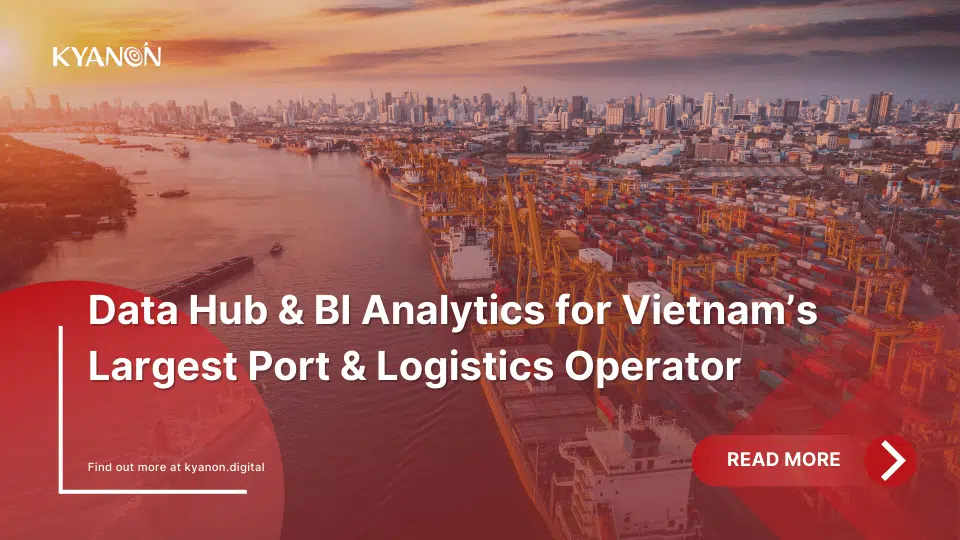
A representative example of logistics automation foundations in action is Kyanon Digital’s transformation of Vietnam’s largest port and logistics operator through a centralized data and analytics platform.
The challenge: Fragmented systems blocking automation
The organization operated multiple disconnected legacy systems, resulting in fragmented data, slow reporting cycles, and limited ability to automate operational decisions across ports and logistics hubs.
The solution: Unified data foundation for AI-ready operations
Kyanon Digital implemented a centralized data hub that integrated operational systems into a single governed architecture. This enabled real-time data flow, standardized logistics metrics, and BI dashboards supporting faster decision-making.
The impact: Foundation for scalable logistics automation
The platform significantly improved real-time operational visibility, reduced manual reporting overhead, and created the foundational data layer required for future AI-driven automation such as predictive operations and autonomous logistics workflows.
Read more: Data Hub & BI Analytics for Vietnam’s Largest Port & Logistics Operator
In conclusion: Choosing the right partner for logistics AI automation in 2026
Logistics automation with AI in 2026 is not a model challenge, it is an execution and data architecture challenge. Leaders seeing real impact are not only deploying AI use cases like predictive ETA or route optimization; they are first building reliable, real-time data foundations that make automation operationally stable at scale.
Ready to move from fragmented operations to AI-driven logistics automation that works in production?
Kyanon Digital helps enterprises build AI-ready data and automation foundations, from integration and governance to scalable execution systems across complex logistics networks. Contact Kyanon Digital.



















 Create project brief with AI