

Managed IT services have become essential for SMEs operating across Singapore and Hong Kong because cybersecurity threats, hybrid work, and AI adoption have made ad-hoc IT support increasingly insufficient. Modern MSPs do more than resolve technical issues; they help businesses secure their infrastructure, maintain compliance, and scale technology across multiple markets without significantly expanding internal IT teams.
The urgency is increasing as business technology grows more complex. The link between company headcount and technology value has fundamentally broken down, with automation and AI now driving operational complexity. According to McKinsey, while most organizations expect to adopt generative AI or AI agents within the next one to three years, only 5–10% have fully scaled these capabilities, leaving many businesses in the early stages of transformation.
Rather than selecting a provider based on price alone, businesses should evaluate pricing flexibility, regional compliance expertise, and the ability to support both Singapore and Hong Kong under a single service agreement.
This guide compares compliance requirements, government funding programs, and the leading MSPs serving SMEs across both markets.
Key takeaways
- Managed IT services are shifting from reactive support to proactive AIOps, helping organizations prevent incidents rather than simply responding to them.
- Choose an MSP based on long-term business value, evaluating AI capabilities, compliance expertise, commercial flexibility, and regional support.
- Business and IT leaders should evaluate providers together to balance predictable costs with operational resilience.
- Cross-border compliance requires localized expertise across both Singapore and Hong Kong regulatory environments.
- Managed IT services and business process automation play complementary roles, combining infrastructure reliability with workflow modernization and AI adoption.
- Long-term resilience depends on modern architecture, where managed services, cloud modernization, automation, and AI work together to support sustainable growth.
Further reading
- Managed IT Support Services
- Enterprise Digital Transformation Companies in Singapore 2026
- Business Process Automation in Singapore: Top Solutions 2026
- How to Choose a Custom Software Development Company in Singapore
How we evaluated these managed IT service providers
To provide Singapore- and Hong Kong-based enterprises with a reliable and actionable benchmark, Kyanon Digital’s evaluation framework assesses managed IT service providers against five core operational criteria. Drawn from our experience delivering enterprise technology modernization across APAC, this framework balances commercial priorities with long-term operational resilience because, in cross-border environments, compliance readiness, regional delivery capability, and AI maturity matter as much as pricing.
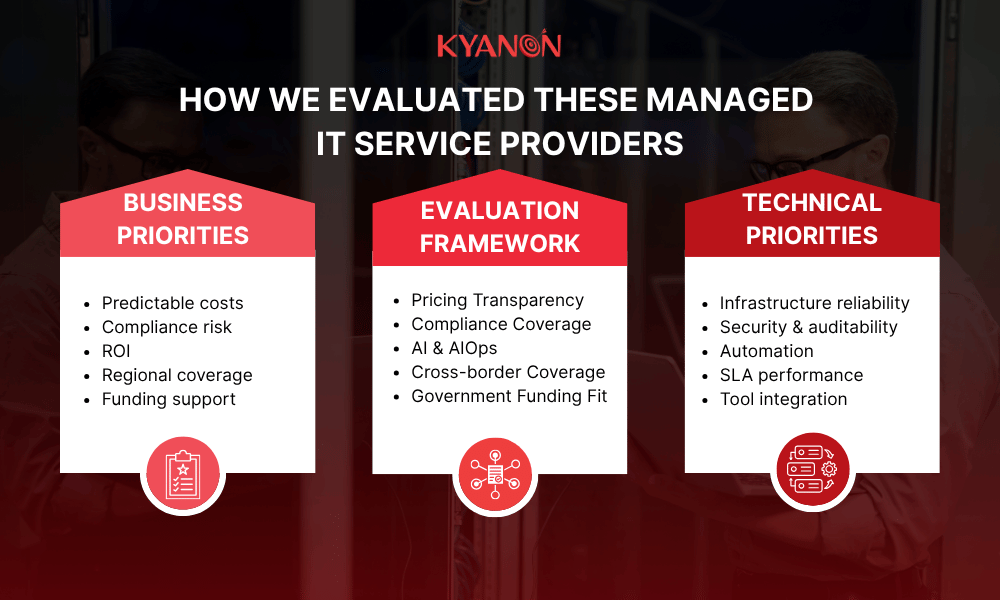
Selecting a managed IT partner is rarely a unilateral decision. While business leaders focus on cost-to-value ratios, financial predictability, liability mitigation, and commercial growth, technical managers prioritize system integrity, audit-trail completeness, response-time service level agreements, and tool integration.
The framework below combines business and technical evaluation perspectives into a single procurement scorecard, helping decision-makers compare providers using consistent criteria rather than marketing claims.
Evaluation criteria | Business POV (Founder / Operations Director) | Technical POV (IT Manager / Systems Engineer) |
Pricing transparency | Predictable monthly operating expenses; zero hidden onboarding, migration, or emergency call-out fees. | Fit of per-user, per-device, or flat-rate pricing models with the organization’s physical and cloud infrastructure mix. |
| Compliance coverage | Avoidance of regulatory penalties; protection against brand reputational damage; assurance of legal data residency. | Audit trail integrity; documented SLAs; technical enforcement of MAS TRM and PDPO controls; automated logging. |
AI & AIOps maturity | Maximization of employee productivity; reduction of operational downtime; lower total cost of ownership over time. | Implementation of native AI threat detection, automated patch management, and predictive event monitoring over manual dashboards. |
| Cross-border coverage | Consolidation of vendor relationships: a single regional contract covering multiple legal entities and offices. | Unified ticketing systems; coordinated regional IT helpdesk Hong Kong escalation pathways; cross-border timezone support. |
Government funding fit | Maximum utilization of local subsidies (PSG/SMEs Go Digital) to reduce net technology capital expenditure. | Technology alignment with approved vendor lists; compliance of pre-vetted tools with agency-mandated technical specifications. |
Failing to align business and technical evaluation criteria during the procurement process introduces immediate operational friction. If business directors select a low-cost, remote-only helpdesk strictly to optimize monthly operating expenses, technical teams are left to manage physical device deployments, complex local network failures, and compliance audits manually. This mismatch results in delayed incident resolution, system vulnerability, and eventual regulatory non-compliance.
Conversely, if technical managers procure a highly complex, customized IT support package without commercial guardrails, the business absorbs unsustainable variable costs for standard project integrations. The rise of hybrid working environments and decentralized cloud assets requires a balanced framework. Decision-makers must evaluate service providers on their ability to deliver both financial predictability and deep, localized engineering expertise in both Singapore and Hong Kong concurrently.

How to choose the right managed IT partner for your SG/HK footprint
Decision framework: Three guiding questions
SMEs selecting a regional technology partner must base their decisions on structural requirements rather than marketing promises. Three core questions dictate the ideal profile of an outsourced IT provider.
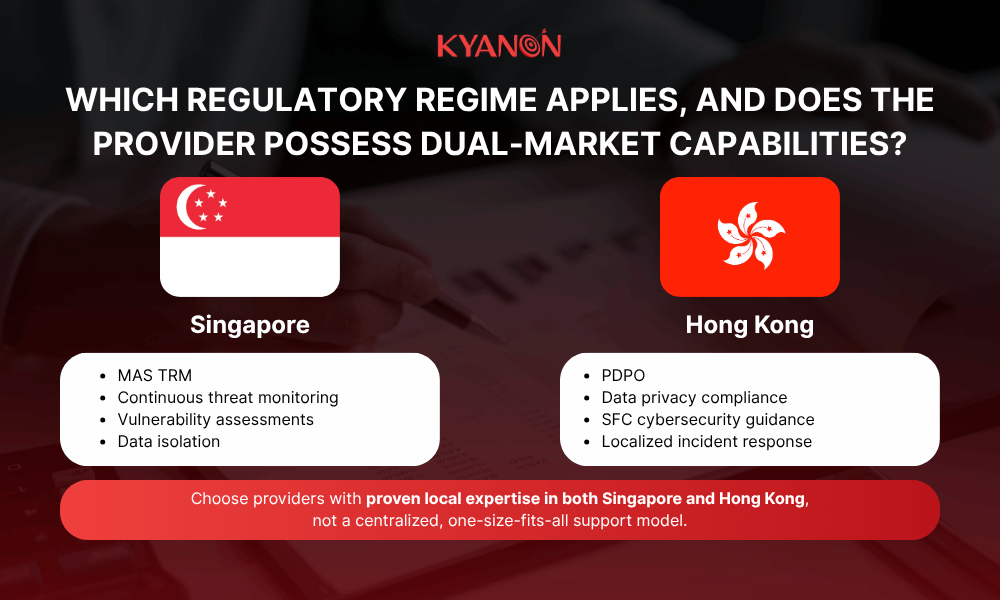
Question 1: Which regulatory regime applies, and does the provider possess dual-market capabilities?
SMEs operating across Singapore and Hong Kong often assume a centralized regional support model is sufficient for both jurisdictions. In practice, regulatory expectations continue to diverge, requiring localized compliance processes and technical controls.
- Conflicting requirements across jurisdictions lead to fragmented documentation, undermining an organization’s ability to maintain accurate compliance records. A service provider operating from a single, centralized regional help desk may implement a standard security policy that satisfies general data privacy yet fails the specific, technical audit requirements of local regulators.
- When a regional provider relies on a centralized dashboard instead of native, market-specific engineers, localized controls decay into manual, delayed checks. According to AML Network, financial institutions received US$3.8 billion in global AML, KYC, and sanctions penalties in 2025, as enforcement increasingly shifted toward EMEA and APAC. This trend strengthens the case for continuous monitoring and market-specific compliance controls across Singapore and Hong Kong.
For financial services, fintech-adjacent platforms, asset managers, and payment processors supporting MAS-regulated financial institutions in Singapore, familiarity with the Monetary Authority of Singapore (MAS) Technology Risk Management (TRM) Guidelines is essential. The MAS TRM Guidelines outline technology risk management principles and best practices, including continuous threat monitoring, documented vulnerability assessments, and robust data isolation protocols. Conversely, businesses handling Hong Kong customer data or operating under the oversight of the Securities and Futures Commission should comply with the Personal Data (Privacy) Ordinance (PDPO) and applicable SFC cybersecurity circulars.
A compliant partner must prove localized technical literacy in both markets. Rather than offering a generalized security posture, the selected provider must document exactly how they handle data residency, access control logging, and localized incident response to prevent regulatory risks.
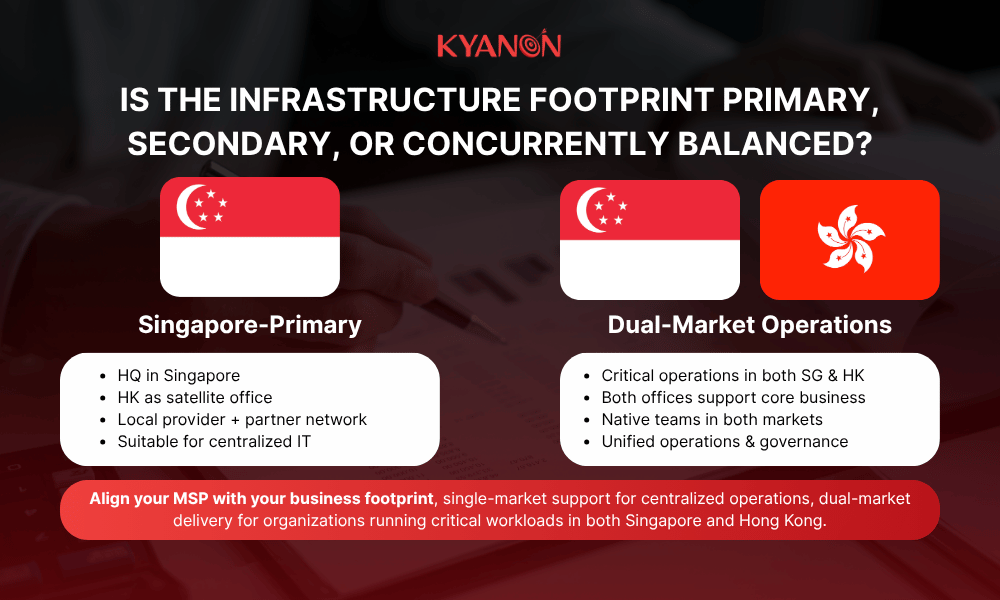
Question 2: Is the infrastructure footprint primary, secondary, or concurrently balanced?
The physical and cloud architecture of an SME dictates whether it requires a localized provider with external partner coverage or a native, dual-market managed service provider.
Organizations with a Singapore-primary footprint, where core infrastructure, active directories, and executive leadership reside in Singapore, may be adequately served by a Singapore-based provider that utilizes a trusted partner network to deliver on-site IT support for Hong Kong enterprise requirements. This model allows the business to leverage Singapore’s local co-funding initiatives while maintaining standard support for satellite staff.
However, organizations operating with concurrent hubs, where both the Singapore and Hong Kong offices run critical, localized operations, trade desks, or customer-facing applications, require a managed IT partner built for dual-market delivery from day one. An exemplary provider for this profile is Dual Layer IT Solutions, which maintains fully staffed, physical offices in Quarry Bay, Hong Kong, and MidView City, Singapore. A concurrent footprint demands a partner that can execute standardized onboarding, uniform security policies, and coordinated disaster recovery planning across both offices under a single master service agreement, eliminating the operational friction of managing separate, disjointed regional vendors.
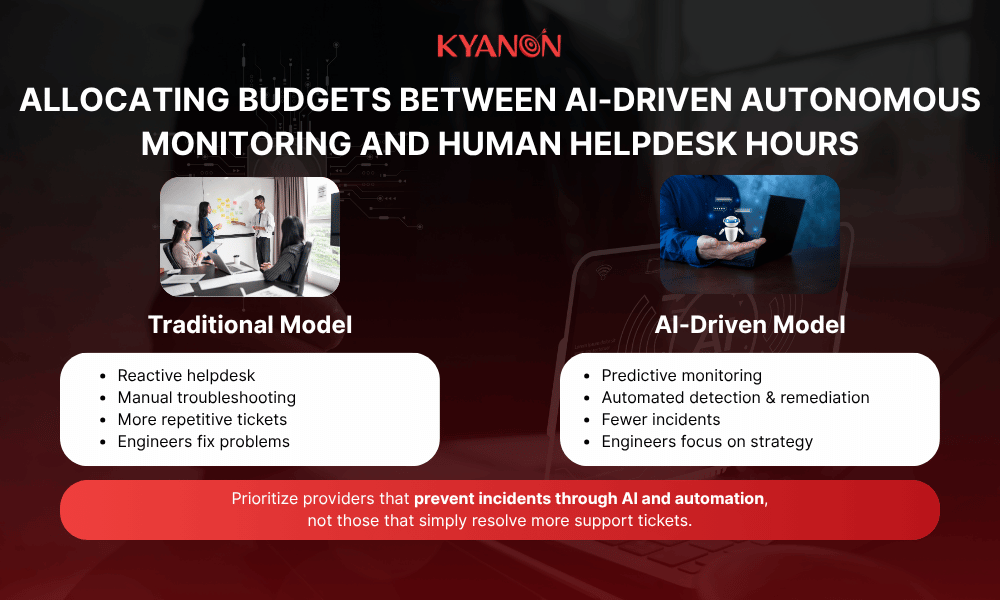
Question 3: Allocating budgets between AI-driven autonomous monitoring and human helpdesk hours
Enterprise IT budgets are undergoing a major structural rebalancing. Infrastructure and Operations (I&O) leaders are aggressively reducing variable human support pools in favor of automated event intelligence. A global Gartner survey of 782 I&O leaders found that only 28% of AI initiatives in infrastructure and operations achieve their expected return on investment, reinforcing the need to prioritize automation projects with clear operational value. Rather than treating AI as an auxiliary feature, enterprises are actively moving funds out of reactive staff augmentation to implement systematic automation.
The business impact of this transition is quantified by the IBM Cost of a Data Breach Report, which found that extensive use of security AI and automation saves organizations an average of USD 1.9 million per incident. This also represents a massive 34% reduction in total expenses compared to teams relying on manual workflows. Furthermore, organizations utilizing extensive automation identified and contained breaches 80 days faster than those without such capabilities, directly minimizing the operational disruption that threatens SME survival.
SMEs must evaluate whether their IT spend is directed toward paying human engineers to manually resolve repetitive desktop issues or toward purchasing automated event monitoring that prevents system failures entirely. A forward-looking IT budget should prioritize providers utilizing AI-driven network monitoring and security automation. This approach drives down ticket volumes, mitigates security risks, and ensures that when human intervention is required, it is focused on strategic architecture rather than endless fire drills.
Legacy modernization vs. baseline IT support
Managed IT services keep infrastructure secure, available, and compliant. As organizations mature, however, many also need to modernize legacy applications, migrate to cloud-native architectures, integrate enterprise platforms, and prepare data foundations for AI.
Kyanon Digital supports enterprises across Singapore and the wider APAC region with digital transformation, enterprise integration, cloud modernization, workflow automation, and AI implementation. Rather than replacing an MSP, Kyanon Digital complements managed IT providers by helping organizations redesign technology architecture and modernize business systems that extend beyond day-to-day infrastructure operations.
Learn how Kyanon Digital supports technology transformation across Singapore and Hong Kong.
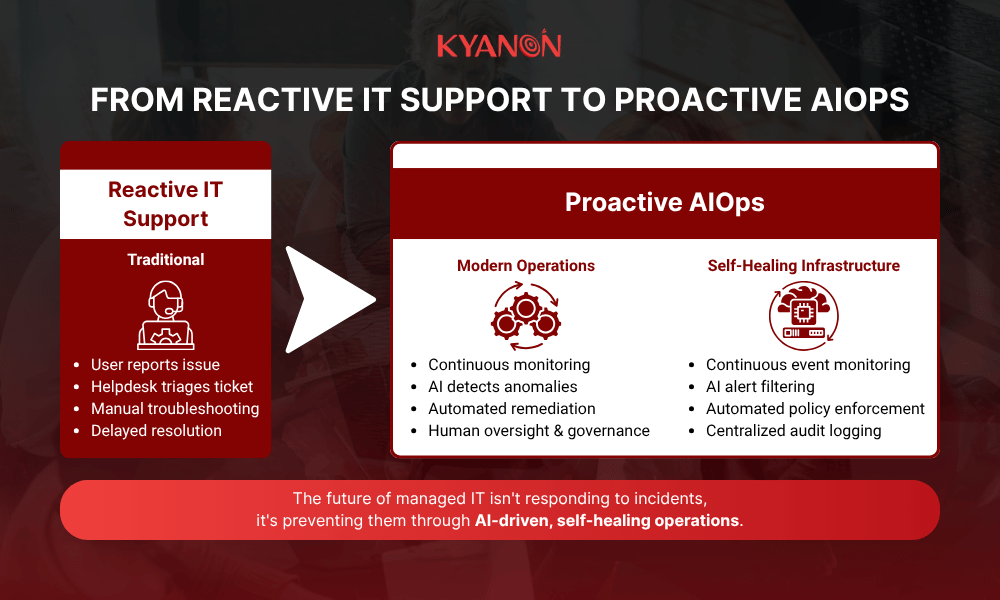
From reactive IT support to proactive AIOps
Modern managed IT services are evolving beyond reactive troubleshooting toward intelligent, autonomous operations. Rather than waiting for users to report problems, leading managed service providers now leverage Artificial Intelligence for IT Operations (AIOps) to continuously monitor infrastructure, predict failures, and execute approved remediation automatically. This shift reduces operational downtime, strengthens cybersecurity, and allows IT teams to focus on higher-value strategic initiatives instead of repetitive support tasks.
The limitations of traditional helpdesk models
The traditional IT support model relies heavily on recurring manual intervention. Every incident requires users to submit tickets, wait for engineers to investigate the problem, and depend on human intervention before services can be restored. As infrastructure becomes more distributed and cyber threats become more sophisticated, this reactive operating model creates unnecessary delays and operational risk.
In 2026, legacy ticketing workflows are incapable of supporting the fast-latency demands of hybrid corporate environments. When an endpoint is compromised by a modern ransomware attack, waiting 30 minutes for a human analyst to review a helpdesk ticket results in widespread operational disruption. Proactive operations demand the immediate detection, isolation, and remediation of infrastructure events before they impact end-users or compromise data security.
Architectural shift: From human intervention to agentic supervision
The transition to modern technology operations requires moving away from basic, assistive copilot tools toward autonomous agentic workflows. In this emerging model, human roles shift from executing procedural tasks with software to supervising intelligent, policy-bound agents that execute tasks autonomously on their behalf.
This structural shift redefines the relationship between business logic and IT execution. Execution authority is no longer treated as a simple software feature; it is an architectural control plane that manages identity, system-of-record permissions, security policies, and auditability. McKinsey’s analysis of agentic AI deployments highlights that organizations prioritizing end-to-end workflow transformation can achieve compound annual productivity gains of 3% to 5%, alongside execution speeds that are ten to 15 times faster than manual processes.
Humans transition to the role of “Agent Stewards,” overseeing autonomous systems that monitor networks, distribute software patches, isolate compromised devices, and optimize server capacities in real time.
Implementing self-healing infrastructure in mid-market enterprises
For medium-sized enterprises, implementing self-healing infrastructure is no longer a privilege reserved for global corporations. Modern managed service providers utilize artificial intelligence for IT operations (AIOps) platforms to automate event resolution across the standard technology stack.
Implementing this proactive architecture involves:
- Continuous event ingestion: Consolidate real-time telemetry from endpoints, cloud infrastructure, firewalls, and identity platforms into a centralized monitoring layer.
- Machine learning de-noising: Filter millions of low-value alerts so engineers and automation engines can focus on genuine operational incidents.
- Automated policy enforcement: Execute pre-approved remediation actions, such as isolating compromised endpoints or restarting failed services, within defined governance policies.
- Immutable audit logging: Record every automated action to support MAS TRM, PDPO, and internal compliance requirements.
By shifting the operational paradigm from human-centric troubleshooting to agent-centric supervision, SMEs eliminate the latency that defines traditional IT support, ensuring continuous uptime and immediate defense-in-depth security.
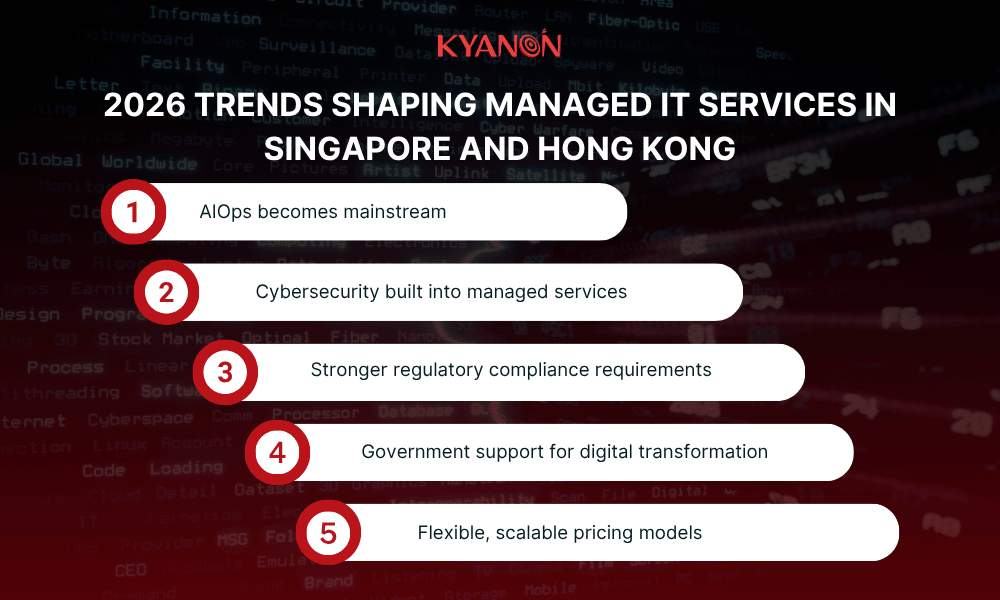
2026 trends shaping managed IT services in Singapore and Hong Kong
The managed IT services market in Singapore and Hong Kong is entering a new phase where automation, cybersecurity, and regulatory compliance are becoming core service expectations rather than premium add-ons. For SMEs, selecting a managed service provider is no longer just about reducing IT costs but ensuring resilience, compliance, and long-term scalability
Key trends in managed IT services for 2026
2026 trend | Business impact |
| AIOps becomes standard | AI-powered monitoring and automated remediation reduce downtime and improve operational efficiency. |
Cybersecurity by default | Endpoint protection, threat detection, and incident response are now expected components of MSP contracts. |
| Dual-market compliance | Providers increasingly support MAS TRM, PDPO, and localized governance across Singapore and Hong Kong. |
Flexible commercial models | SMEs mix recurring managed services with project-based engagements to improve cost efficiency. |
| Cloud and AI modernization | MSPs increasingly complement infrastructure management with cloud optimization and AI readiness. |
Together, these trends indicate that managed IT services are evolving from operational support into a strategic foundation for long-term digital transformation.
For growing businesses, the priority is clear: Choose a managed IT partner that combines AI-powered operations, built-in security, regulatory expertise, and flexible commercial models to support both current operations and future digital transformation.
Conclusion
Managed IT services are no longer just about outsourcing technical support. For SMEs operating across Singapore and Hong Kong, the right provider should combine proactive AIOps, built-in cybersecurity, regulatory expertise, and scalable commercial models under a unified regional strategy. Rather than choosing an MSP solely based on monthly pricing, businesses should evaluate whether the provider can support long-term resilience, compliance, and digital transformation as their operations grow.
From Kyanon Digital’s experience delivering enterprise technology modernization across Southeast Asia, sustainable IT operations depend on more than responsive helpdesk services. Organizations achieve the greatest business value when managed IT support is complemented by modern cloud architecture, automation, AI-ready infrastructure, and well-governed technology foundations that enable continuous innovation beyond day-to-day operations.
Ready to modernize your technology architecture beyond traditional IT support?
Contact Kyanon Digital to assess your existing IT environment and develop a practical roadmap for infrastructure modernization, AI adoption, and long-term digital transformation across Singapore and Hong Kong.




 Create project brief with AI