
What is a loss function?
In machine learning (ML), a loss function is used to measure model performance by calculating the deviation of a model’s predictions from the correct, “ground truth” predictions. Optimizing a model entails adjusting model parameters to minimize the output of some loss function. (IBM)
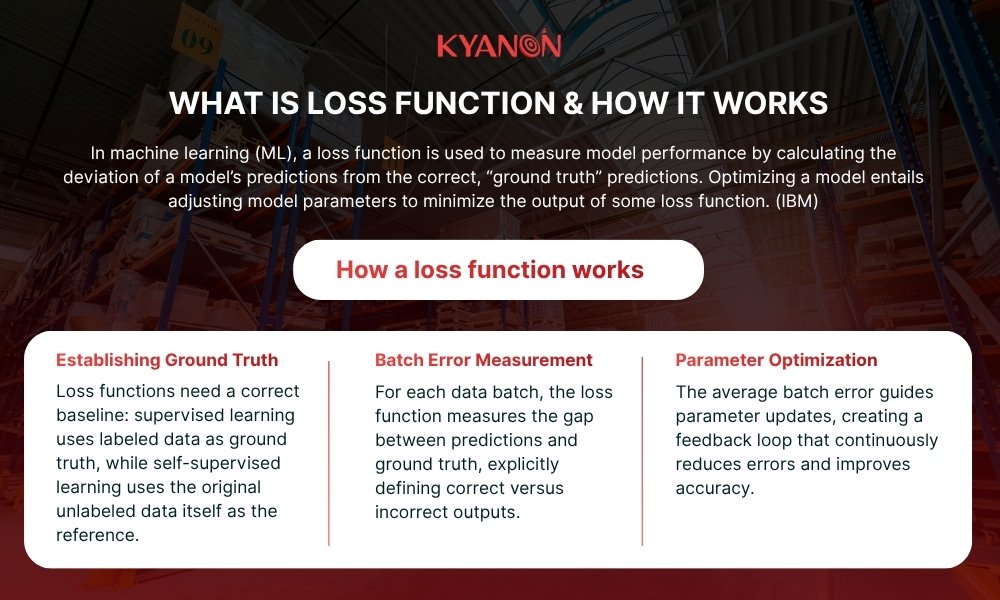
How a loss function works
In a typical training setup, an AI model makes predictions on a batch of sample data points, and the loss function mathematically measures the average error to optimize the system’s parameters. Because this process requires a definitive “right answer” or ground truth to measure against, loss functions are specifically utilized in supervised and self-supervised learning architectures, rather than conventional unsupervised models.
Establishing Ground Truth
The loss function must have a correct baseline to measure against. In supervised learning, this ground truth comes from manually annotated datasets (such as specific pixel labels in image segmentation), while self-supervised learning masks parts of unlabeled data and uses the original, untransformed sample itself as the ground truth.
Batch Error Measurement
As the model processes a batch of data, the loss function calculates the exact deviation between the raw predictions and the ground truth. Unlike conventional unsupervised learning algorithms (such as clustering or association) which merely seek intrinsic patterns in unlabeled data, this step explicitly quantifies “right” versus “wrong” answers.
Parameter Optimization
The average error calculated across the batch provides the exact quantitative feedback needed by the system. This information is then used to optimize the model’s internal parameters, creating a continuous feedback loop that reduces the error margin and improves predictive accuracy over time.
Loss Function vs Evaluation Metric
Both concepts assess a machine learning model’s behavior, but they dictate entirely different phases of the AI development lifecycle.
|
Dimension |
Loss Function | Evaluation Metric |
| Primary purpose | Guiding parameter updates via an optimizer |
Human interpretation of model performance |
|
Mathematical requirement |
Must be smooth and differentiable | Does not need to be differentiable |
|
Application phase |
Training |
Validation and post-deployment monitoring |
| Primary consumer | Optimization algorithms (e.g., Gradient Descent) |
Data scientists and business stakeholders |
|
Common examples |
Mean Squared Error (MSE), Cross-Entropy |
Accuracy, F1-Score, BLEU |
When to consider customizing a loss function
Consider customizing a loss function if:
- Standard accuracy metrics fail to reflect the true financial cost of a false positive versus a false negative in your specific domain.
- Your dataset contains extreme class imbalances (e.g., fraud detection), causing standard functions to ignore the minority class entirely to achieve a deceptively low overall error rate.
- You are training a specialized model where errors in certain boundary conditions carry critical regulatory or safety implications.
It may not be the right priority if:
- Your organization is deploying off-the-shelf, pre-trained AI models via APIs for general-purpose tasks like standard text summarization or basic sentiment analysis.
Why a loss function matters for enterprise AI
For enterprise AI, a loss function is not just a mathematical formula; it is the translation mechanism that converts business goals into machine code. If your loss function is misaligned, your AI will perfectly optimize for the wrong target, leading to financial loss, operational risk, or damaged user trust.
According to a global executive AI assessment published by the MIT Sloan Management Review and Boston Consulting Group (BCG), a massive disconnect persists between corporate AI deployment and tangible enterprise value. While investments are scaling rapidly, a mere fraction of organizations achieve significant financial returns due to a fundamental failure to align automated system workflows with strategic corporate goals.
Common misconceptions
A lower loss value always means a better, more accurate model
Reality: A dropping loss value can sometimes hide critical flaws like overfitting or class imbalance. The training loss can approach zero while the model completely fails on unseen validation data.
All loss functions treat prediction errors equally
Reality: Different loss functions heavily dictate how a model perceives mistakes. Mean Squared Error (MSE) squares the errors, making it exceptionally sensitive to outliers, while Mean Absolute Error (MAE) treats errors linearly, ignoring how extreme an outlier is.
Cross-Entropy only evaluates the correct target class
Reality: While the final scalar value in the formula $L = -\mathbf{y} \cdot \log(\mathbf{\hat{y}})$ only depends on the target class prediction, learning happens via the gradient of the loss. When calculating the gradient through the Softmax layer, the model actively updates the weights of all classes, pushing the incorrect class probabilities down while pulling the correct one up.
How Kyanon Digital applies loss functions
Kyanon Digital implements customized loss functions using PyTorch and TensorFlow for enterprise clients across Southeast Asia and the US. Our engineering teams select and construct domain-specific objective functions for ML models where standard accuracy metrics fail to capture the true business cost of errors, ensuring our AI architectures optimize directly for measurable business outcomes rather than isolated technical benchmarks.
Explore our ML and AI services:











 Create project brief with AI