

IT staff augmentation in the Philippines is increasingly compared with that in Vietnam, as both markets expand from different foundations. The Philippines’ IT-BPM industry employs approximately 1.8 million people and generates revenue equal to around 8% of GDP (OECD, 2026). At the same time, Vietnam reported an estimated US$198 billion in digital technology industry revenue and more than 80,000 active technology companies in 2025 (Viet Nam Government News, 2026).
The two countries do not solve the same talent problem.
The Philippines has a mature service-outsourcing industry, strong English proficiency, and deep experience supporting Western organizations. Vietnam has a fast-growing engineering ecosystem and a larger strategic focus on software, digital products, data, AI, and technology exports.
IT staff augmentation also differs from traditional project outsourcing:
- Staff augmentation: External specialists join an existing team, while the business retains control of priorities and daily work.
- Project outsourcing: The provider owns delivery of a defined scope or outcome.
- Dedicated team: A stable external team works on a longer roadmap, often with shared delivery governance.
- Build-operate-transfer: A provider establishes and operates a team before transferring it to the business.
The Philippines-versus-Vietnam decision should therefore be based on role type, technical depth, communication requirements, continuity, employment structure, and total operating cost, not hourly rates alone.
This comparison examines those factors and explains where each country is more likely to fit.
Key takeaways
- The Philippines has the stronger structural advantage for English-intensive work. It is well suited to technical support, implementation, customer-facing delivery, and roles requiring frequent verbal communication.
- Vietnam generally fits engineering-intensive work. Its expanding technology ecosystem supports backend development, cloud, mobile, data, AI, QA automation, and systems integration.
- Hourly rates overlap. Vietnam is not automatically cheaper for every role, especially when comparing senior engineers or scarce AI and cloud skills.
- Attrition should be evaluated by provider, not country alone. No reliable public 2026 dataset gives directly comparable software developer attrition rates for both markets.
- Labor structures differ. The Philippines requires 13th-month pay for covered employees, while Vietnam treats bonuses according to employer policy, contracts, and performance.
- Time-zone differences are small. The Philippines is UTC+8, and Vietnam is UTC+7; team schedules and management overlap matter more than the one-hour difference.
- A blended model can outperform a single-country model. Businesses may combine Philippine customer-facing specialists with Vietnamese engineering teams
Further reading:
- IT Staff Augmentation Services
- Top 10 Best Countries to Outsource Software Development 2026
- Comparison: Outsourcing Software Development Vietnam vs. India
- Top Countries for Software Development Outsourcing 2026
Quick comparison: Philippines vs Vietnam for IT staff augmentation
| Criteria | Philippines |
Vietnam |
|
Structural strength |
Mature IT-BPM and service-outsourcing ecosystem | Fast-growing software and digital technology ecosystem |
| Best-fit roles | Technical support, implementation, customer success, business analysis, English-heavy operations |
Backend, full-stack, mobile, cloud, data, AI, QA automation, systems integration |
|
English capability |
Strong verbal English and Western business alignment | Functional-to-strong technical English; verbal fluency varies more by provider |
| Engineering orientation | Growing software capability within a BPO-heavy industry |
Stronger market orientation toward engineering and technology production |
|
Directional vendor rates |
Approximately US$20–45/hour for common offshore roles | Common roles often start around US$18–30/hour; senior specialists can reach US$40–55+ |
| Retention risk | Provider-specific BPO environments can experience higher turnover |
Provider-specific engineering teams are often structured for longer engagements |
|
Time zone |
UTC+8 | UTC+7 |
| US live coverage | Usually requires evening or night shifts |
Usually requires evening or night shifts |
|
Mandatory 13th-month pay |
Yes, for covered rank-and-file private-sector employees | No fixed statutory 13th-month salary; bonuses depend on policy and performance |
| Employment compliance | Mature outsourcing and EOR ecosystem |
Mature outsourcing, EOR, and technology-service ecosystem |
|
Main risk |
Assuming BPO scale automatically means deep engineering capability | Assuming low cost automatically means strong communication or senior architecture |
| Most suitable model | Customer-facing or communication-heavy augmentation |
Long-term engineering and product-development augmentation |
The Philippine market should not be reduced to call centers. OECD’s 2026 review notes that the industry has expanded into software, data analytics, global capability centers, and other higher-value services. It also identifies high-skill shortages in areas such as data science and machine learning.
Vietnam’s government reported 80,052 active digital technology companies in 2025 and targets a technology workforce exceeding three million people by 2030. This supports a broad engineering pipeline, although provider quality still varies significantly.
How we compared the Philippines and Vietnam for IT staff augmentation
The comparison separates commercial considerations from technical delivery requirements.
|
Business criteria |
Technical criteria |
|
Fully loaded hourly or monthly rate |
Backend and systems architecture depth |
| Recruitment and replacement time |
Framework and technology specialization |
|
Employee retention and team continuity |
Automated testing and QA maturity |
| Statutory employment costs |
DevOps, cloud, data, and AI capability |
|
Contract and termination exposure |
Technical documentation quality |
| Time-zone and working-hour overlap |
Security and engineering governance |
|
English and stakeholder communication |
Ability to integrate with an existing codebase |
| Scaling and replacement flexibility |
Senior engineering and technical leadership |
Philippines vs Vietnam: Detailed comparison
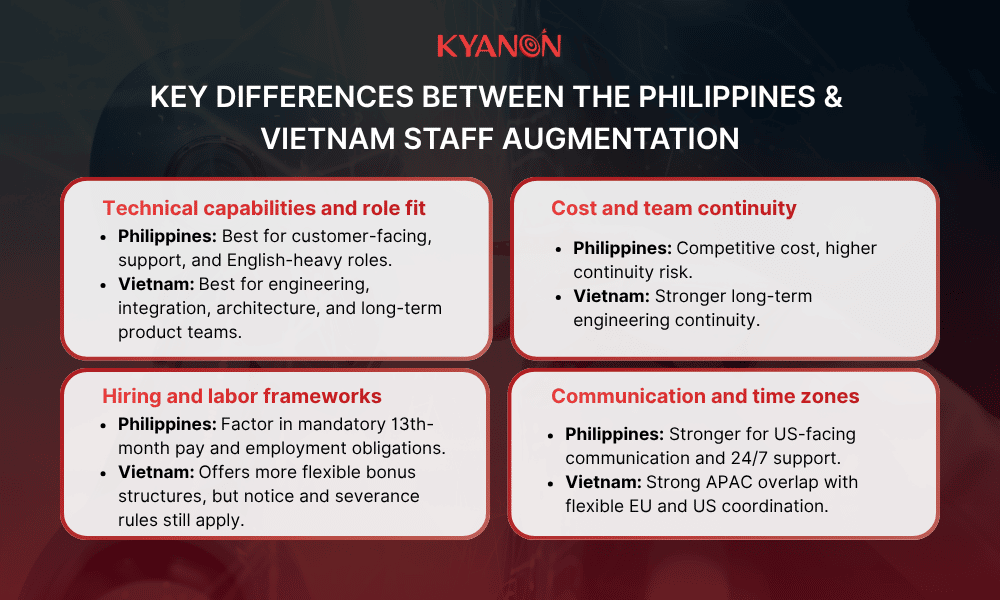
Technical capabilities and role fit
Philippines: Strong for communication-intensive and service-linked roles
The Philippines’ main structural advantage is not simply lower labor costs. It is the combination of English proficiency, Western cultural alignment, and decades of experience delivering services to overseas organizations.
The OECD ranks the Philippines second in Asia for English proficiency and links this strength to the long-standing use of English in education and alignment with Western business norms.
Business advantages
- Stronger verbal communication for customer-facing work.
- Familiarity with US and Australian working styles.
- Mature recruiting, payroll, facilities, and shift-management processes.
- Large service-delivery ecosystem.
- Easier scaling for support-oriented functions.
Technical risks
- Software capability varies widely between providers.
- Large BPO headcount does not prove deep backend or architecture capability.
- High-demand AI, data, cloud, and security specialists may be difficult to source.
- Night-shift models can increase burnout and retention risk.
- Businesses may need stronger internal engineering oversight.
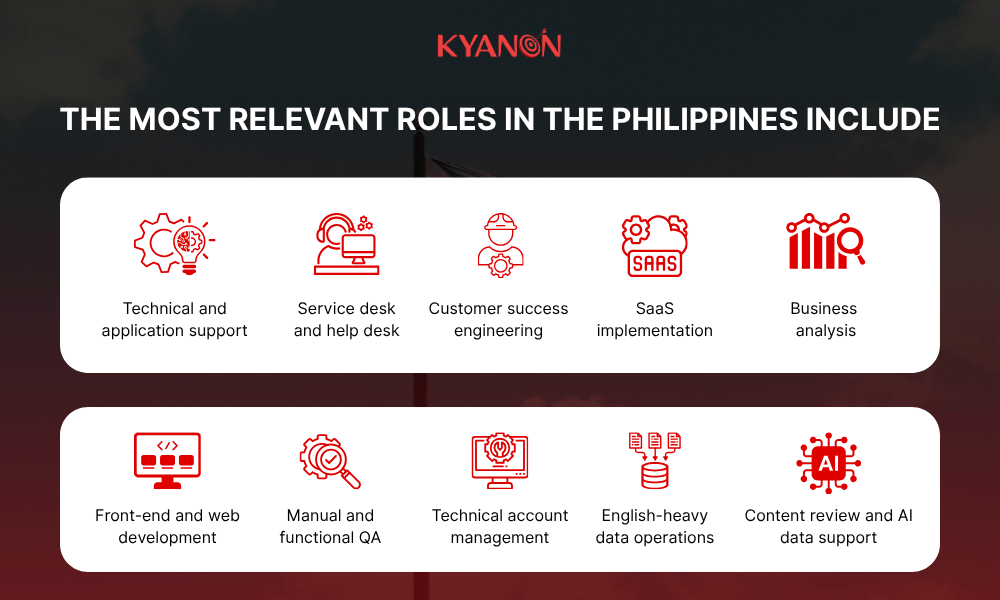
Choose the Philippines when communication, customer interaction, service delivery, or English-intensive coordination is central to the role.
Vietnam: Strong for engineering-intensive and product roles
Vietnam’s digital technology sector is oriented more heavily toward engineering, software exports, digital products, electronics, and technology services.
The Government of Vietnam reported that digital technology industry revenue reached an estimated US$198 billion in 2025, up 26% year over year. Its 2026–2030 program targets at least US$300 billion in industry revenue and more than three million technology workers by 2030.
Business advantages
- Strong engineering-to-cost ratio for long-term development.
- Large regional software outsourcing ecosystem.
- Broad capability across modern and enterprise technology stacks.
- Strong fit for dedicated product and platform teams.
- Natural overlap with Singapore, Japan, Korea, and other APAC markets.
Technical risks
- English fluency varies more between individual engineers and providers.
- Senior architects and experienced product leaders command higher rates.
- Low-cost quotations may rely on junior-heavy teams.
- Businesses may require explicit documentation and communication standards.
- Vendor maturity varies across the large supplier market.
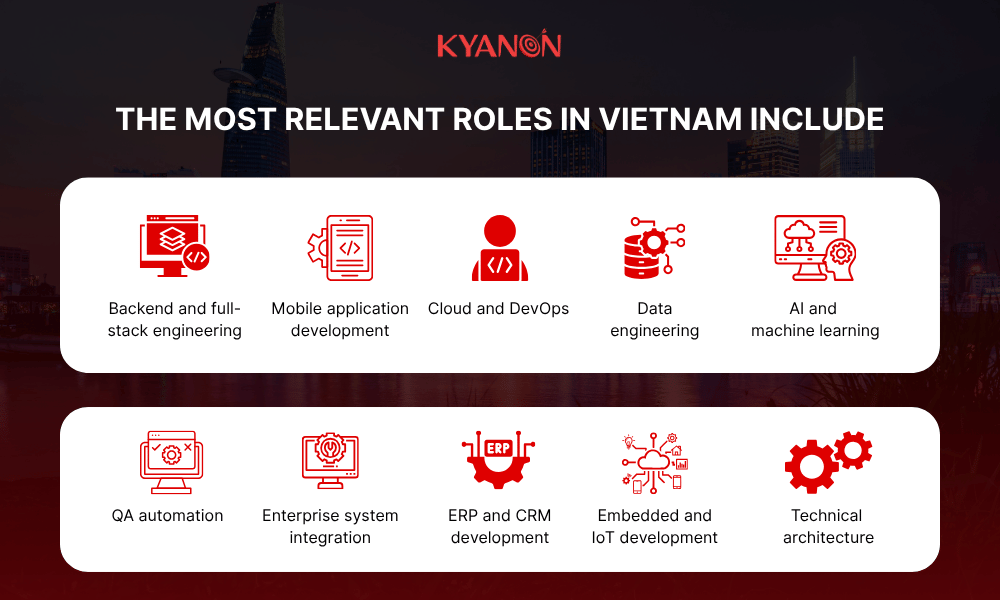
Choose Vietnam when the work is engineering-heavy, integration-intensive, architecture-critical, or part of a long-term product roadmap.
Philippines vs Vietnam by role
|
Role requirement |
More natural market fit |
Why |
|
Technical support and service desk |
Philippines | English fluency and mature service operations |
| Customer success engineering | Philippines |
Frequent live communication and Western business alignment |
|
SaaS implementation consultant |
Philippines | Strong combination of communication and process delivery |
| Backend product engineering | Vietnam |
Larger engineering-oriented delivery ecosystem |
|
Enterprise integration |
Vietnam | Strong fit for ERP, APIs, middleware, and complex systems |
| Data engineering and AI | Vietnam |
Expanding technology and STEM-focused talent market |
|
Manual QA |
Philippines or Vietnam | Depends on domain and communication requirements |
| QA automation | Vietnam |
Stronger engineering-oriented testing fit |
|
Front-end development |
Both | Assess portfolio, framework depth, and UX capability |
| DevOps and cloud | Vietnam |
Strong fit, but senior specialists are competitively priced |
|
Technical product owner |
Philippines | Communication advantage, subject to product experience |
| Solution architect | Provider-specific |
Senior capability matters more than country |
Note: These are market tendencies, not absolute rules. A strong specialist provider in either country may outperform a weak provider in the market considered the default fit.
Cost and team continuity
Hourly rates overlap more than many comparisons suggest
The Philippines and Vietnam both sit within the lower-cost Asia-Pacific outsourcing market.
Software engineer salaries overlap across both markets. NodeFlair’s reported median base salaries equal approximately US$1,051 per month in the Philippines and US$855 per month in Vietnam, with senior and specialized roles earning substantially more.
These figures represent employee base salaries, not client billing rates. Staff augmentation costs also include statutory benefits, recruitment, equipment, provider management, replacement coverage, shift premiums, and commercial margin. Businesses should therefore request fully loaded role-based quotations rather than relying on generalized country hourly rates.
Compare fully loaded cost
| Cost component |
Questions to ask |
|
Engineer compensation |
Is the rate based on role and seniority? |
| Statutory benefits |
Are social contributions and required benefits included? |
|
13th-month pay |
Is it included in the Philippine monthly rate? |
| Recruitment |
Is sourcing included or separately charged? |
|
Equipment |
Who provides laptops, security tools, and licenses? |
| Management |
Is account management or engineering leadership included? |
|
Replacement |
Is replacement free, and how long can it take? |
| Bench coverage |
Can the provider cover sudden absence or attrition? |
|
Shift premium |
Is US-hour coverage priced separately? |
| Currency |
Which party carries foreign-exchange risk? |
|
AI tooling |
Are coding agent and token costs included? |
| Exit |
Are transition and knowledge-transfer costs included? |
Lower hourly rates do not always reduce total delivery cost, as supervision, rework, technical debt, and engineer replacement can offset the initial savings.
- Replacing a professional in a technical role can cost approximately 80% of that employee’s salary, showing how turnover can outweigh apparent rate savings (Gallup, 2026).
- Technical debt is consistently associated with weaker software delivery performance, slower development, and reduced ability to innovate (Google Cloud DORA, 2025).
Attrition should be treated as a vendor metric
The Philippines’ outsourcing industry has historically faced turnover risk in high-volume BPO environments. However, this should not be applied automatically to technical teams or every provider. The Philippine market is also moving toward longer-lived software, analytics, and specialist roles.
Instead of relying on country-level claims, ask each provider for:
- Trailing 12-month voluntary attrition.
- Attrition by role and seniority.
- Average engineer tenure.
- Replacement time.
- Percentage of replacements during the first six months.
- Bench capacity.
- Knowledge-transfer process.
- Retention incentives.
- Employee engagement and learning programs.
Decision point: Vietnam may offer a stronger continuity model for long-term engineering teams, but retention should be proven through provider-level data rather than assumed from country averages.
Hiring and labor frameworks
Both countries support staff augmentation through local outsourcing companies, employers of record, and dedicated-team providers.
Once a candidate is selected, an EOR may complete employment setup quickly. However, total hiring time still depends on candidate availability, interviews, notice periods, background checks, equipment, security access, and onboarding.
A provider promising a five-day start may be referring only to employment processing, not the time needed to identify and validate the right engineer.
Philippines employment considerations
Philippine labor rules require covered rank-and-file private-sector employees who have worked for at least one month during the calendar year to receive 13th-month pay equal to at least one-twelfth of their basic salary earned during that year.
Businesses should verify:
- Whether team members are employees or contractors.
- Whether statutory benefits are included.
- How 13th-month pay is priced.
- Night-shift and overtime rules.
- Separation and notice obligations.
- Worker-classification responsibility.
- IP assignment and confidentiality.
- Data-processing responsibilities.
Vietnam employment considerations
Vietnam does not require a fixed statutory 13th-month salary, but bonuses may still apply through employment contracts, company policies, or established practices.
For businesses using staff augmentation, the main considerations are:
- Contract type and notice periods.
- Social insurance and statutory employment costs.
- Bonus, overtime, and shifted-hour policies.
- Severance and redundancy exposure.
- IP, confidentiality, and data-access controls.
- Which employment obligations are included in the provider’s rate.
The key business question is not whether Vietnam is automatically more flexible, but whether the provider has clearly priced, documented, and accepted responsibility for local employment obligations.
Communication and time zones
The Philippines operates at UTC+8, while Vietnam operates at UTC+7.
- For APAC teams, both provide strong working-hour alignment. Vietnam has natural overlap with Singapore, Japan, Korea, Australia, and parts of Europe. The Philippines offers similar APAC coverage.
- For North American teams, neither country naturally overlaps with a full US working day. Live US daytime support usually requires evening or night work.
The Philippines’ advantage for US-facing delivery comes primarily from:
- English fluency.
- Familiarity with American communication styles.
- Long experience operating night shifts.
- Mature customer-service processes.
Vietnam can still support US teams through:
- Two-to-four-hour overlap windows.
- Rotating schedules.
- Early or late daily standups.
- Asynchronous documentation.
- Follow-the-sun delivery.
A 2026 study of global software development found that reduced temporal distance was associated with better communication, quality, schedule performance, and lower project-management effort, particularly for communication-intensive and Agile work.
Time-zone decision matrix
|
Main headquarters |
Philippines |
Vietnam |
|
Singapore or Southeast Asia |
Excellent overlap | Excellent overlap |
| Japan or Korea | Strong overlap |
Strong overlap |
|
Australia |
Strong overlap | Strong overlap |
| Western Europe | Partial morning overlap |
Slightly more convenient overlap |
|
US East Coast |
Shifted schedule required | Shifted schedule required |
| US West Coast | Shifted schedule required |
Shifted schedule required |
|
24/7 support model |
Strong mature shift capability |
Possible with structured shift management |
Decision point: Choose the operating schedule before choosing the country. A provider’s shift design, meeting discipline, and documentation practices matter more than the one-hour difference between the Philippines and Vietnam.
How to choose between IT staff augmentation in the Philippines and Vietnam
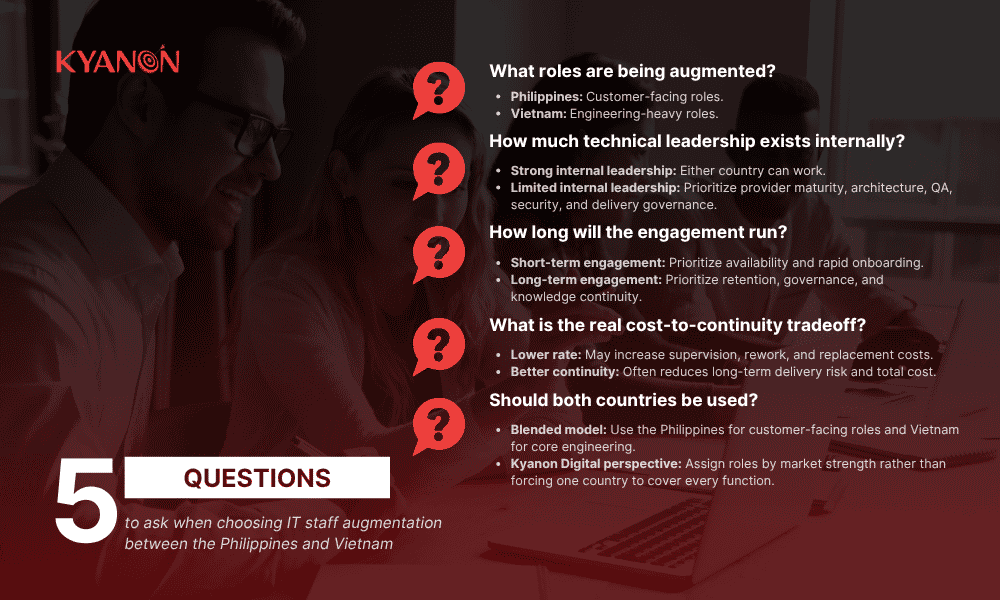
Question 1: What roles are being augmented?
Choose the Philippines when the work is primarily:
- Customer-facing.
- Support-heavy.
- Implementation-led.
- Process-driven.
- English-intensive.
- Dependent on frequent verbal communication.
Choose Vietnam when the work is primarily:
- Backend-heavy.
- Architecture-critical.
- Data- or AI-intensive.
- Integration-heavy.
- Cloud- or DevOps-focused.
- Part of a long-term engineering roadmap.
Question 2: How much technical leadership exists internally?
A business with strong internal architecture, product, and engineering management may successfully use either country.
Where internal technical leadership is limited, the provider must contribute:
- Solution architecture.
- Engineering standards.
- Quality assurance.
- Security governance.
- Technical documentation.
- Delivery management.
- Mentoring and capability development.
In that situation, provider maturity matters more than access to individual developers.
Question 3: How long will the engagement run?
|
Engagement type |
More relevant consideration |
|
Three-to-six-month capacity gap |
Availability and rapid onboarding |
| Product release or migration |
Relevant platform experience |
|
Multi-year product roadmap |
Retention, learning, and knowledge continuity |
| 24/7 service operation |
Shift maturity and workforce management |
|
AI or data program |
Scarce skill validation and engineering governance |
| Core platform ownership |
Architecture, security, documentation, and succession |
Short engagements can tolerate some team movement. Multi-year teams require stronger retention, career development, backup coverage, and knowledge management.
Question 4: What is the real cost-to-continuity tradeoff?
Compare:
- Fully loaded monthly rate.
- Expected productivity.
- Management overhead.
- Attrition.
- Replacement time.
- Knowledge loss.
- Rework.
- Quality controls.
- Security risk.
- AI-tooling costs.
- Exit and transition effort.
The lowest hourly rate should not determine the final decision.
Question 5: Should both countries be used?
A blended model may be appropriate when the operating model contains different role types.
For example:
| Philippines team |
Vietnam team |
|
Technical support |
Backend engineering |
| Customer success |
Platform development |
|
Business analysis |
Systems integration |
| Implementation |
Data engineering |
|
Technical account management |
AI and machine learning |
| English-heavy operations |
QA automation and DevOps |
From Kyanon Digital’s delivery perspective, the country decision should follow role decomposition. Separating customer-facing, product, engineering, and operational responsibilities often produces a stronger model than forcing every role into one location.
How to evaluate the partner
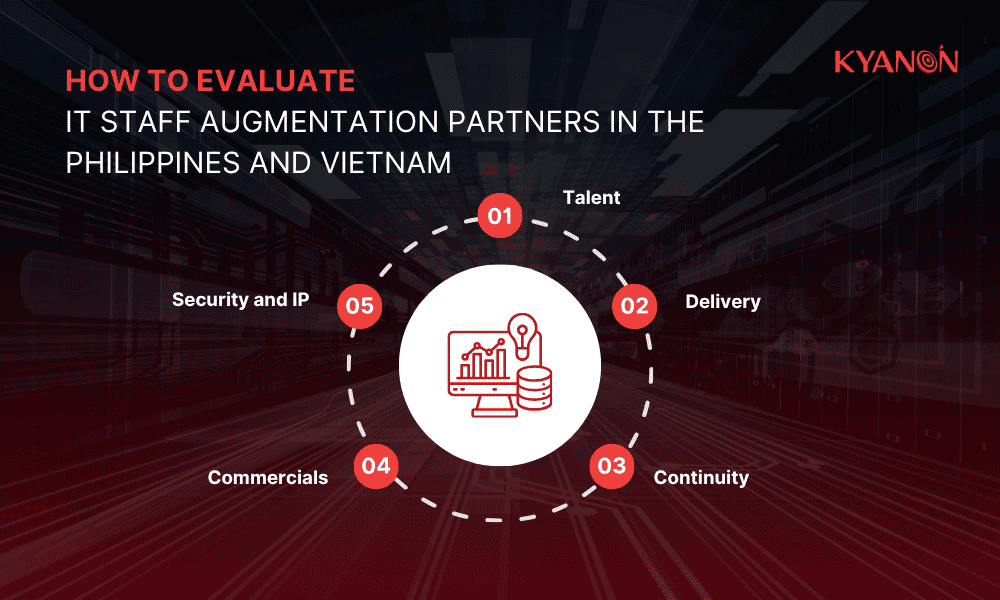
The performance gap between two providers in the same country may be larger than the difference between the Philippines and Vietnam.
Country fit matters, but provider quality determines delivery results.
Talent
- Real work technical tests.
- Seniority and communication checks.
- Relevant domain experience.
- AI coding governance.
Delivery
- Clear roles and escalation paths.
- Defined engineering and QA standards.
- Release, security, and incident processes.
Continuity
- Transparent attrition data.
- Replacement commitments.
- Knowledge transfer and backup coverage.
Commercials
- Fully loaded rates.
- Shift, recruitment, and management fees.
- Annual increases and exit costs.
Security and IP
- Clear IP ownership.
- Controlled system and repository access.
- Secure devices and development practices.
- Confidentiality and subcontractor controls.
Recommended vendor scorecard
Score each provider from one to five and apply the weighting.
|
Evaluation category |
Weight |
| Role and technology fit |
20% |
|
Technical screening and seniority accuracy |
15% |
| Delivery governance and engineering quality |
15% |
|
Retention and continuity |
15% |
| Communication and time-zone model |
10% |
|
Security and IP protection |
10% |
| Commercial transparency |
10% |
|
Scaling and exit flexibility |
5% |
| Total |
100% |
Note: This scorecard is based on Kyanon Digital’s staff augmentation delivery experience and is intended as a practical reference. Businesses should adjust the criteria and weightings to match their technical, operational, security, and commercial priorities.
A high score should not override a critical failure.
Do not proceed if the provider cannot demonstrate:
- Clear IP ownership.
- Secure system access.
- Reliable technical screening.
- Named delivery ownership.
- Attrition and replacement processes.
- Code and documentation handover.
- Transparent employment and rate structure.
Evaluate your IT staff augmentation model with Kyanon Digital.
Case study: How Kyanon Digital scaled enterprise engineering through IT staff augmentation
Kyanon Digital helped a global consulting enterprise expand engineering capacity with dedicated Vietnam-based software engineers aligned with its technical, security, and Agile delivery standards.
Challenges
- Limited access to specialized engineering talent.
- High internal recruitment and training costs.
- Different skill requirements across projects.
- Need for seamless integration with existing teams.
Solutions
- Selected engineers based on technical skills, domain knowledge, and cultural fit.
- Provided Agile, DevOps, and project-specific training.
- Used a Center of Excellence for continuous upskilling.
- Met enterprise technical, security, and compliance requirements.
Results & impact
- Faster access to scalable engineering capacity.
- Lower internal hiring overhead.
- Stronger technical capability and project flexibility.
- Smooth collaboration across distributed teams.
Read the full case study: Scaling Accenture’s Digital Capabilities with Kyanon Digital’s Dedicated Software Engineers
2026 trends shaping IT staff augmentation in Southeast Asia
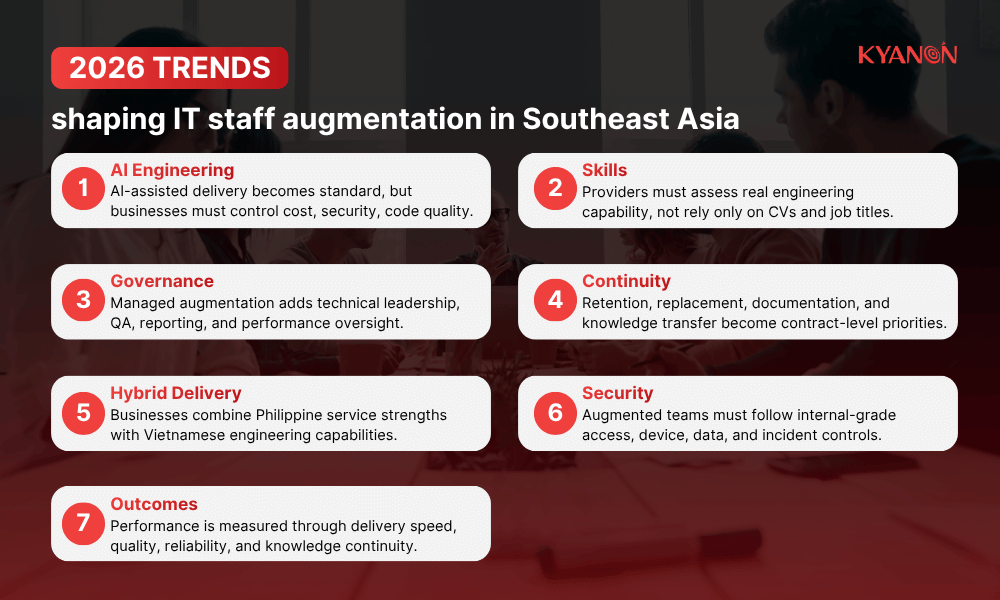
AI-augmented engineering becomes standard
Staff augmentation is moving from supplying developer capacity to supplying engineers who can work effectively with coding agents, automated testing, documentation tools, and AI-assisted delivery.
Gartner predicts that AI coding costs could exceed the average developer salary by 2028 as token consumption and usage-based pricing expand. This means AI productivity must be governed alongside cost, security, and code quality.
Businesses should ask:
- Which AI tools can engineers use?
- Who pays for token consumption?
- Can proprietary code be submitted to external models?
- How are generated changes reviewed?
- How are security and licensing risks controlled?
- Is productivity measured by code volume or delivered outcomes?
AI access alone is not a differentiator. Controlled and measurable AI-assisted engineering is.
Skills-based hiring replaces CV matching
Technology stacks change faster than job titles.
Providers increasingly need to assess:
- Problem-solving.
- Code review.
- Architecture decisions.
- AI-assisted development.
- Security practices.
- Documentation.
- Communication.
- Ability to work in an existing codebase.
Gartner reports that organizations investing in upskilling and reskilling are 2.5 times more likely to achieve positive business outcomes from AI. This increases the importance of providers with structured learning, technical mentoring, and skills intelligence.
Managed augmentation replaces unmanaged headcount
Businesses increasingly expect more than individual résumés.
A stronger augmentation model includes:
- Technical leadership.
- Quality assurance.
- Architecture support.
- Security controls.
- Employee development.
- Performance management.
- Replacement planning.
- Delivery reporting.
This reduces the risk of building a collection of contractors without shared engineering standards.
Continuity becomes a commercial metric
Retention affects architecture knowledge, delivery speed, quality, and rework.
Contracts are increasingly expected to define:
- Replacement time.
- Knowledge-transfer requirements.
- Minimum overlap.
- Role backup.
- Documentation standards.
- Transition assistance.
- Attrition reporting.
The business implication is simple: continuity should be priced and governed, not treated as an HR issue outside the delivery contract.
Hybrid country models become more practical
Organizations do not need to choose one country for every role.
A blended Southeast Asian model can combine:
- Philippine communication and service-delivery strengths.
- Vietnamese software engineering and platform capability.
- Local product or architecture leadership.
- Distributed QA, DevOps, and support coverage.
This approach can improve role fit but requires one operating model, shared engineering standards, and clear accountability.
Security expectations move closer to internal-team standards
Augmented engineers increasingly access:
- Production data.
- Customer information.
- Cloud environments.
- Source repositories.
- AI systems.
- Internal documentation.
- Payment and operational platforms.
External teams should therefore follow the same identity, device, access, review, and incident controls as internal employees.
Staff augmentation becomes outcome-aware
Businesses still control the backlog under staff augmentation, but stronger agreements increasingly connect capacity with measurable indicators such as:
- Deployment frequency.
- Lead time.
- Defect escape rate.
- Sprint predictability.
- Incident volume.
- Test automation.
- Documentation coverage.
- Knowledge concentration.
- Stakeholder satisfaction.
These indicators should support management decisions without turning staff augmentation into an inflexible fixed-scope contract.
Explore more: Top 7 IT Staff Augmentation Trends to Watch
Conclusion
The Philippines and Vietnam are both credible IT staff augmentation markets, but their strongest use cases differ.
The Philippines is generally better aligned with communication-heavy, customer-facing, implementation, and support roles. Vietnam is generally better aligned with engineering-intensive, integration-heavy, data, AI, cloud, and long-term product development work.
The decision should not be reduced to hourly rates.
Businesses should compare:
- Role and technology fit.
- Seniority accuracy.
- Communication requirements.
- Engineering governance.
- Team continuity.
- Employment obligations.
- Security and IP controls.
- Fully loaded cost.
- Post-onboarding support.
Country selection creates the talent pool. Partner selection determines execution quality.
Kyanon Digital provides Vietnam-based IT staff augmentation and dedicated engineering teams across software development, data, AI, DevOps, quality assurance, and technical delivery. Its published model includes role definition, candidate validation, client interviews, team integration, delivery governance, and flexible scaling.
Businesses evaluating the Philippines, Vietnam, or a blended delivery structure can contact Kyanon Digital to assess role allocation, technical requirements, team governance, and long-term delivery risk before committing to an augmentation model.













 Create project brief with AI