


Choosing a mobile app development company in Singapore in 2026 is no longer only about building iOS or Android screens. Gartner predicts that 40% of enterprise applications will include task-specific AI agents by the end of 2026, which means mobile apps are becoming workflow, data, identity, and automation layers inside the business.
For Singapore businesses, the real risk is choosing a vendor that can design a good interface but cannot handle backend integration, secure data flows, compliance, QA, release readiness, and post-launch support. A mobile app now often connects payments, loyalty, ERP, CRM, logistics, analytics, AI features, and customer service workflows.
The decision should therefore start with one question: Can the partner build a secure, scalable, and maintainable mobile product that fits the business model, not just the app store?
From Kyanon Digital’s delivery experience, mobile app selection should begin with integration risk, compliance exposure, QA coverage, and long-term ownership before comparing UI portfolios or hourly rates. This article compares leading mobile app developers in Singapore for 2026, explains how to evaluate them, and highlights the trends that should shape vendor selection.
Key takeaways
Quick comparison table of the Top Mobile App Development Companies in Singapore:
Company | Key strengths | Pricing tier |
| Kyanon Digital | Enterprise mobile development, backend/API integration, cross-platform development, modernization, QA, DevOps, and L1–L3 support | 25–49/hr |
NCS Group | Large-scale enterprise and government delivery, cybersecurity, legacy system integration, digital transformation | Not publicly disclosed |
| AppTech System | Custom business applications, operational workflow integration, backend connectivity, web admin portals | Not publicly disclosed |
Codigo Group | Premium consumer products, product strategy, UX/UI design, native iOS and Android development | Not publicly disclosed |
| Vinova | Mobile development for startups and mid-market businesses, Flutter, React Native, iOS, Android, agile product development | Not publicly disclosed |
Buuuk | Premium enterprise apps, polished UX/UI, high-performance business applications, established brands | Not publicly disclosed |
| SleekDigital | Logistics and field operations, workforce automation, workflow digitization, operational applications | Not publicly disclosed |
Swag Soft | Gamification, mobile experiences, AR/VR, interactive marketing, gaming and entertainment applications | Not publicly disclosed |
MS Web Developers | SME mobile applications, e-commerce tools, web admin systems, online transaction integration | Not publicly disclosed |
Top Mobile App Development Companies in Singapore 2026
Further reading:
- Mobile App Development Services
- Best iOS App Development Companies in Singapore
- Top Android App Development Companies in Singapore
- Mobile App Engineering Trusted by Singapore Brands
- Mobile App Development Strategy for Omnichannel Retail in Singapore
How to evaluate mobile app developers
This list is not based only on public rankings or marketing claims. The evaluation focuses on enterprise fit, technical risk, compliance exposure, and delivery maturity.
Criteria | What we checked | Why it matters |
Technical breadth | Native iOS, native Android, Flutter, React Native, backend and API capability | Cross-platform can reduce cost and time-to-market, but complex apps still need strong architecture |
Compliance readiness | PDPA, MAS TRM awareness, Singpass integration, security-by-design practices | Critical for finance, government-linked, logistics, healthcare, and data-heavy apps |
Portfolio depth | Case studies, client industries, third-party reviews, visible delivery evidence | Helps separate real delivery capability from broad service claims |
| Team scale and model | In-house team, dedicated team, project model, support model | Determines whether the company can handle enterprise-scale builds and long-term product evolution |
UX and design maturity | Research process, prototyping, usability testing, design systems | Drives adoption, retention, and operational efficiency after launch |
| Post-launch support | SLA, maintenance, monitoring, release cadence, App Store and Play Store support | Apps need continuous updates, not only a one-time launch |
Decision note: Business-side reviewers should give more weight to compliance, timeline, cost control, and operating model. Technical-side reviewers should give more weight to architecture, stack flexibility, API maturity, observability, and security controls.
In enterprise mobile projects, vendor maturity becomes visible when the team can explain how the app will connect with existing systems, how data will move across platforms, and who owns release stability after launch.
In Kyanon Digital’s view, the strongest mobile app development partner is not always the one with the broadest portfolio but the one that can reduce uncertainty across architecture, compliance, integration, QA, and long-term maintenance.

Top mobile app development companies in Singapore (2026)
Enterprise Digital Transformation & Heavy System Integration
Kyanon Digital
Founded in 2012, Kyanon Digital is a digital transformation and software engineering company with 14 years in Agile engineering, 500+ consultants and engineers, and 5 global offices. The company builds human-centric, high-performance mobile applications across iOS, Android, and cross-platform ecosystems for enterprises across Singapore and APAC.
Kyanon Digital’s mobile app development capability covers the full product lifecycle, from product design, UI/UX, development, API integration, QA, DevOps, and modernization to L1–L3 post-launch support. Its ISO 9001-certified quality management and ISO 27001-certified security management make it especially relevant for businesses that need reliable mobile delivery with clear governance.
- Website: https://kyanon.digital/
- Founded: 2012
- Team size: 500+ (across Vietnam, Singapore, Thailand, Australia, Malaysia)
- Pricing tier: $25 – $49/hr (Vietnam-based engineering)
- Key clients: Enterprises, Fortune 500 companies, and regional organizations with complex digital transformation and software delivery needs.
Best for: Enterprise mobile app development with backend integration, API connectivity, and long-term delivery support.
Case study: How Kyanon Digital accelerates Singapore digital insurance app launch readiness
As a mobile app development company in Singapore, Kyanon Digital helped a Singapore-based digital insurance provider stabilize its mobile app, improve launch readiness, and reduce delivery risk before pilot release.
How Kyanon Digital Accelerates Singapore Digital Insurance App Launch Readiness
Challenges
- Inconsistent mobile UX across claims, policy details, document upload, and notification screens.
- Limited visibility into completed, blocked, and launch-critical features.
- Internal tech lead overloaded with coordination, technical decisions, and stakeholder updates.
- Security hygiene gaps around repository access, credentials, branch permissions, and offboarding.
- Testing gaps across key insurance journeys such as claims submission, login, policy viewing, and document upload.
Solutions
- Introduced Agile delivery governance with sprint planning, acceptance criteria, risk tracking, demos, and monthly reporting.
- Stabilized launch-critical mobile journeys, including claims submission, policy viewing, document upload, authentication, notifications, and agent-assisted workflows.
- Applied quality and security controls, including code review, static checks, smoke testing, MFA, credential review, branch permission control, and access cleanup.
- Used AI-assisted development for repetitive coding, refactoring, test generation, and frontend implementation, while keeping human review for final validation.
Results & impacts
- Pilot readiness improved from 62% to 91% across priority insurance journeys.
- Open launch blockers reduced by 72%, from 18 active blockers to 5 lower-risk items.
- Sprint completion predictability improved to 86%.
- Internal tech lead coordination time reduced by around 35%.
- High-priority frontend defects reduced by 46%.
- Smoke testing reached 100% coverage for priority launch journeys.
- Repository access was fully reviewed before launch, with unused access removed and MFA enforced.
Explore full case study here: Accelerating Singapore Digital Insurance App Launch Readiness with an AI-Driven Agile Team
NCS Group

Founded in 1981, NCS Group is a technology services company delivering large-scale digital transformation and IT solutions across Asia Pacific. The company works extensively with government agencies, public sector organizations, and large enterprises that require secure, scalable technology delivery and integration with complex enterprise environments.
NCS Group’s mobile and digital delivery capabilities are suited to organizations that need mobile experiences connected to enterprise systems, legacy infrastructure, and large-scale digital platforms. Its strength in cybersecurity, systems integration, and enterprise technology makes it relevant for mobile initiatives where governance, reliability, and integration complexity are key requirements.
- Website: https://www.ncs.co/
- Founded: 1981
- Team size: 13,000+ employees
- Key clients: Government agencies, public sector organizations, and large enterprises across Asia Pacific.
Best for: Government, public sector, and large-scale enterprise mobile projects requiring complex system integration and strong security governance.
AppTech System

AppTech System is a Singapore-based software development company focused on custom business applications and digital solutions. Its services support organizations that need mobile applications connected closely with operational systems, internal workflows, and business administration platforms.
The company’s mobile development approach emphasizes connecting mobile interfaces with custom business processes, secure data infrastructure, and administrative web portals. This makes it relevant for organizations looking to extend existing operational software into mobile experiences rather than building standalone consumer applications.
- Website: https://www.apptech.com.sg/
- Specialization: Custom software development, mobile applications, and business systems integration
- Core focus: Business applications, operational workflows, data connectivity, and web-based administration.
Best for: Businesses that need mobile applications integrated with custom operational software, backend systems, and administrative workflows.
Consumer Products & Elite UI/UX Design
If your mobile application depends heavily on brand loyalty, frictionless checkout flows, and award-winning interface layouts, these boutique product houses are the market favorites.
Codigo Group

Codigo Group is a Singapore-based digital product development company focused on building digital experiences for consumer brands and service businesses. The company combines product strategy, UX/UI design, and mobile engineering to support products from initial concept through development and deployment.
Its capabilities span native mobile development for iOS and Android alongside product design and digital strategy. This makes Codigo particularly relevant for consumer-facing applications where brand experience, usability, and high-quality interface design are central to product adoption.
- Website: https://www.codigo.co/
- Specialization: Digital product development, UX/UI design, and mobile applications
- Core focus: Consumer products, digital experiences, native iOS and Android development.
Best for: Premium consumer brands and high-traffic consumer applications where product strategy, UX/UI, and native mobile development are critical.
Vinova

Vinova is a Singapore-founded software development company with more than 15 years of experience delivering digital products and applications for startups, enterprises, and technology companies. The company provides mobile development across native and cross-platform technologies, supporting businesses at different stages of product development and scaling.
Its engineering capabilities cover iOS, Android, Flutter, React Native, and other modern development technologies. This combination of technical breadth and product development experience makes Vinova relevant for businesses seeking to scale mobile products while maintaining flexibility across technology stacks.
- Website: https://vinova.sg/
- Founded: 2010
- Specialization: Mobile app development, software development, and digital product engineering
- Core focus: iOS, Android, Flutter, React Native, and scalable digital products.
Best for: Startups and mid-market businesses looking for flexible mobile development across native and cross-platform technologies.
Buuuk

Buuuk is a Singapore-based digital product studio specializing in mobile applications and digital experiences for enterprises and established brands. The company has delivered mobile solutions for organizations across sectors, with a strong emphasis on product usability, interface quality, and business functionality.
Its approach combines product design and mobile engineering to create applications that support both customer-facing experiences and enterprise operations. The company is particularly relevant for organizations that prioritize polished interfaces alongside reliable business functionality.
- Website: https://www.buuuk.com/
- Specialization: Mobile applications, digital products, and enterprise solutions
- Core focus: Product design, mobile engineering, enterprise applications, and digital experiences.
- Notable clients: Singtel, CapitaLand, and other established brands.
Best for: Enterprise and premium-brand mobile applications where polished UX, product quality, and business usability are priorities.
Operational, SME, & Specialization Agencies
These engineering teams build tailored utilities engineered specifically for field staff operations, interactive campaigns, or mid-market e-commerce ecosystems.
SleekDigital

SleekDigital is a Singapore-based digital solutions company providing software development and digital transformation services for businesses. Its application development capabilities can support operational workflows, workforce management, and business processes that require mobile access.
The company is particularly relevant to organizations that need practical mobile tools for field teams and operational staff. Mobile interfaces can be connected to backend systems and workflows to improve data collection, task management, and operational visibility across distributed teams.
- Website: https://sleekdigital.sg/
- Specialization: Software development, mobile applications, and digital solutions
- Core focus: Business applications, workflow digitization, operational tools, and workforce solutions.
Best for: Logistics, field operations, and internal workforce applications that require streamlined mobile workflows and operational data management.
Swag Soft
Swag Soft is a Singapore-based mobile and game development company specializing in interactive digital experiences. Its capabilities extend beyond conventional mobile application development into gamification, augmented reality, virtual reality, and other immersive technologies.
The company combines mobile engineering with interactive technologies to create applications designed around engagement and user interaction. This makes it particularly relevant for brands and organizations seeking mobile experiences that incorporate gamified or immersive elements.
- Website: https://www.swagsoft.com/
- Specialization: Mobile app development, game development, AR, and VR
- Core focus: Interactive applications, gamification, immersive experiences, and entertainment platforms.
Best for: Brands seeking mobile applications with gamification, AR/VR, interactive campaigns, or entertainment-focused experiences.
MS Web Developers

MS Web Developers is a Singapore-based web and software development company serving businesses with digital solutions including mobile applications and e-commerce systems. Its services are positioned toward organizations that need practical application development combined with web-based business administration.
The company can support standard iOS and Android application development alongside web portals, e-commerce functionality, and transaction systems. This makes it relevant for SMEs seeking to extend existing web or commerce operations into mobile channels.
- Website: https://www.mswebdevelopers.com/
- Specialization: Web development, mobile applications, and e-commerce solutions
- Core focus: iOS and Android applications, web administration, e-commerce, and online transaction functionality.
Best for: SMEs looking for practical mobile applications connected to e-commerce platforms, web admin systems, and online transaction workflows.
How to choose the right mobile app development company for your business
Selecting the right partner is less about finding the most famous name and more about matching the app’s risk profile with the vendor’s real strengths.
From our project experience, the highest hidden cost in mobile app development often appears after the first release, when analytics, backend workflows, third-party APIs, security controls, and support ownership were not planned clearly from the beginning.
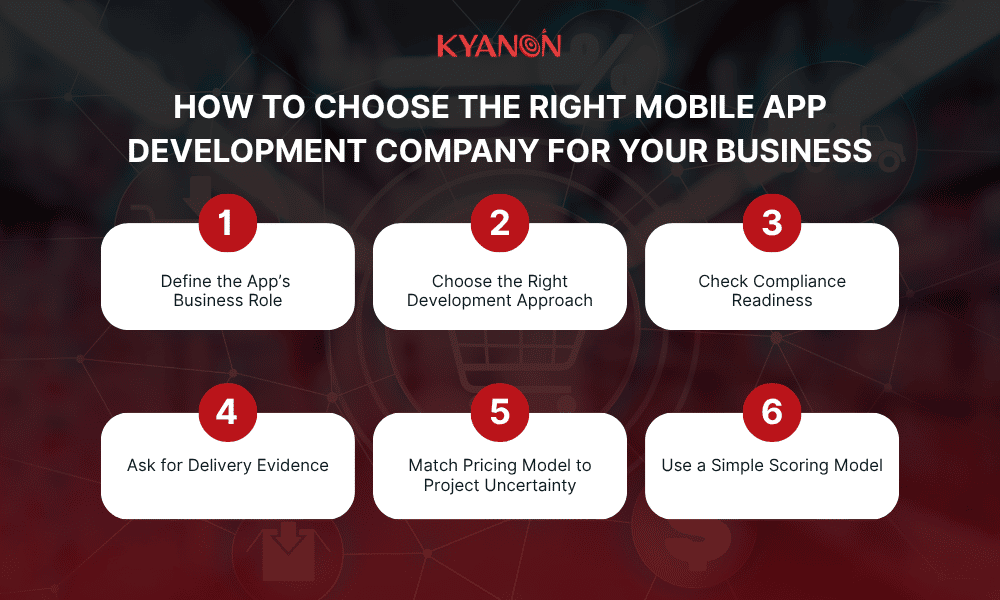
Start with the business role of the app
Before comparing vendors, define what the app must do for the business.
App type | Main risk | Best-fit vendor profile |
Customer app | Adoption, UX, retention, performance | Strong UX, analytics, mobile QA |
| Employee app | Workflow fit, system integration, offline use | Strong backend and enterprise integration |
Commerce app | Payments, inventory, loyalty, promotions | eCommerce, payment, API, security experience |
| Logistics app | Real-time tracking, device support, reliability | Android, geolocation, offline sync, SLA support |
Finance app | Security, compliance, auditability | MAS TRM awareness, secure SDLC, penetration testing |
| AI-powered app | Data quality, model reliability, cost control | AI governance, observability, human validation |
Kyanon Digital perspective: Businesses that define the app as a workflow layer, not only a screen layer, usually make better vendor decisions because they can identify integration, data, compliance, QA, and support requirements earlier.
Decide between native and cross-platform early
A business should not choose native or cross-platform based only on trends. It should choose based on performance, cost, timeline, maintenance, and device-level requirements.
| Option | Best for | Watch out for |
Native iOS | Premium Apple experience, high performance, device-specific features | Higher cost if Android is also required |
| Native Android | Broad device reach, logistics, field teams, operational apps | More device fragmentation and testing complexity |
React Native | Faster iOS and Android delivery with one shared codebase | Needs experienced architecture to avoid performance issues |
| Flutter | Strong UI consistency and cross-platform experience | Talent availability and long-term maintainability should be checked |
PWA | Lightweight access without app-store friction | Limited native device capability and weaker app-store presence |
For most businesses, a React Native app development company in Singapore or a Flutter-capable partner can reduce time-to-market. For performance-heavy apps, device-specific apps, and regulated use cases, native development may still be safer.
Treat compliance as architecture, not paperwork
Singapore app projects increasingly need compliance-by-design.
- The PDPA governs the collection, use, and disclosure of personal data by organizations in Singapore.
- MAS Technology Risk Management Guidelines set risk management principles and best practices for financial institutions.
- Singpass APIs must be fully compliant with FAPI 2.0 by 31 December 2026.
- From 1 April 2026, designated app stores in Singapore are required to implement age assurance measures to prevent users under 18 from accessing age-inappropriate apps.
For businesses, this means vendor evaluation should include:
- Consent and data collection flows.
- Data retention and deletion logic.
- Encryption and secure storage.
- Authentication and session management.
- API security.
- Role-based access control.
- Logging and audit trails.
- Penetration testing.
- Incident response process.
- App store policy readiness.
Ask for delivery evidence, not only portfolio visuals
A polished UI does not prove delivery maturity.
Ask each vendor for:
- A similar project reference.
- Architecture diagram sample.
- API integration example.
- QA test plan.
- Release checklist.
- Security checklist.
- App Store and Play Store deployment process.
- SLA and post-launch maintenance terms.
- Code ownership and documentation terms.
- Team structure by role and seniority.
Kyanon Digital perspective: Compliance-heavy mobile apps should be reviewed at the architecture stage, not after development, because consent flows, user identity, secure storage, audit logs, and access control affect how the app must be designed from the start.
Match pricing model to uncertainty
Pricing model | Best for | Risk |
Fixed price | Clear scope, simple apps, limited changes | Change requests can become expensive |
| Time and material | Evolving scope, product discovery, technical uncertainty | Needs strong governance to control cost |
Dedicated team | Long-term roadmap, multiple releases, enterprise integration | Needs internal ownership and cadence |
| Hybrid model | Discovery first, then build phase | Requires clear phase gates |
For complex apps, the cheapest quote is often not the lowest total cost. Hidden cost usually appears in rework, integration delays, weak QA, unclear requirements, and post-launch fixes.
Use a weighted scoring model
Evaluation area | Suggested weight |
| Relevant portfolio and references | 20% |
Technical architecture and integration maturity | 20% |
| Compliance and security readiness | 20% |
UX and product discovery process | 15% |
| Team model and delivery governance | 15% |
Post-launch support and SLA | 10% |
For simple apps, UX and cost may carry more weight. For enterprise apps, architecture, compliance, integration, and support should carry more weight.
2026 trends shaping mobile app development in Singapore
Mobile app development in Singapore is becoming more enterprise-focused in 2026, with stronger demand for AI features, secure identity flows, cross-platform delivery, and backend integration. Businesses should use these trends as evaluation signals when choosing a mobile app development company in Singapore.
Trend | What it means for businesses | What to check in a vendor |
AI-enabled mobile apps | More apps now include AI chat, smart search, workflow copilots, recommendations, or automated support. | Ask how AI features are reviewed, tested, secured, and monitored after launch. |
| Cross-platform delivery | React Native and Flutter help reduce duplicated iOS and Android development effort. | Check whether the vendor can explain when cross-platform is suitable and when native development is safer. |
Compliance-ready architecture | Apps handling personal data, payments, insurance, finance, or identity need stronger security and documentation. | Review PDPA awareness, authentication design, access control, audit logs, and security testing process. |
| Enterprise system integration | Mobile apps increasingly connect with ERP, CRM, POS, loyalty, warehouse, eCommerce, analytics, and AI systems. | Ask for API integration experience, backend capability, data flow design, and post-launch support model. |
Post-launch optimization | App success depends on continuous updates, OS compatibility, bug fixing, performance tuning, and user feedback. | Confirm SLA, maintenance scope, support levels, release cadence, and ownership of app improvements. |
Kyanon Digital perspective: AI-assisted mobile development only creates business value when it is paired with human review, clear QA gates, secure coding practices, and accountable release ownership.
Conclusion
The best mobile app development company in Singapore depends on the business problem behind the app.
For a simple MVP, a smaller fixed-scope vendor may be enough. For a customer app, UX and analytics maturity matter more. For an employee or operations app, backend integration and workflow design become critical. For finance, healthcare, logistics, or government-linked services, compliance and security must be built into the architecture from the start.
The right selection process should answer five questions:
- What business workflow will the app control?
- Which platforms are truly required: iOS, Android, or cross-platform?
- What systems must the app integrate with?
- What compliance and security risks apply?
- Who owns support, iteration, and performance after launch?
Kyanon Digital can be evaluated by businesses that need mobile development together with backend integration, enterprise system connectivity, dedicated delivery teams, and long-term product evolution.
To discuss a Singapore mobile app project with integration, AI, or enterprise delivery requirements, contact Kyanon Digital for a technical consultation.








 Create project brief with AI