
What is in-store digitization?
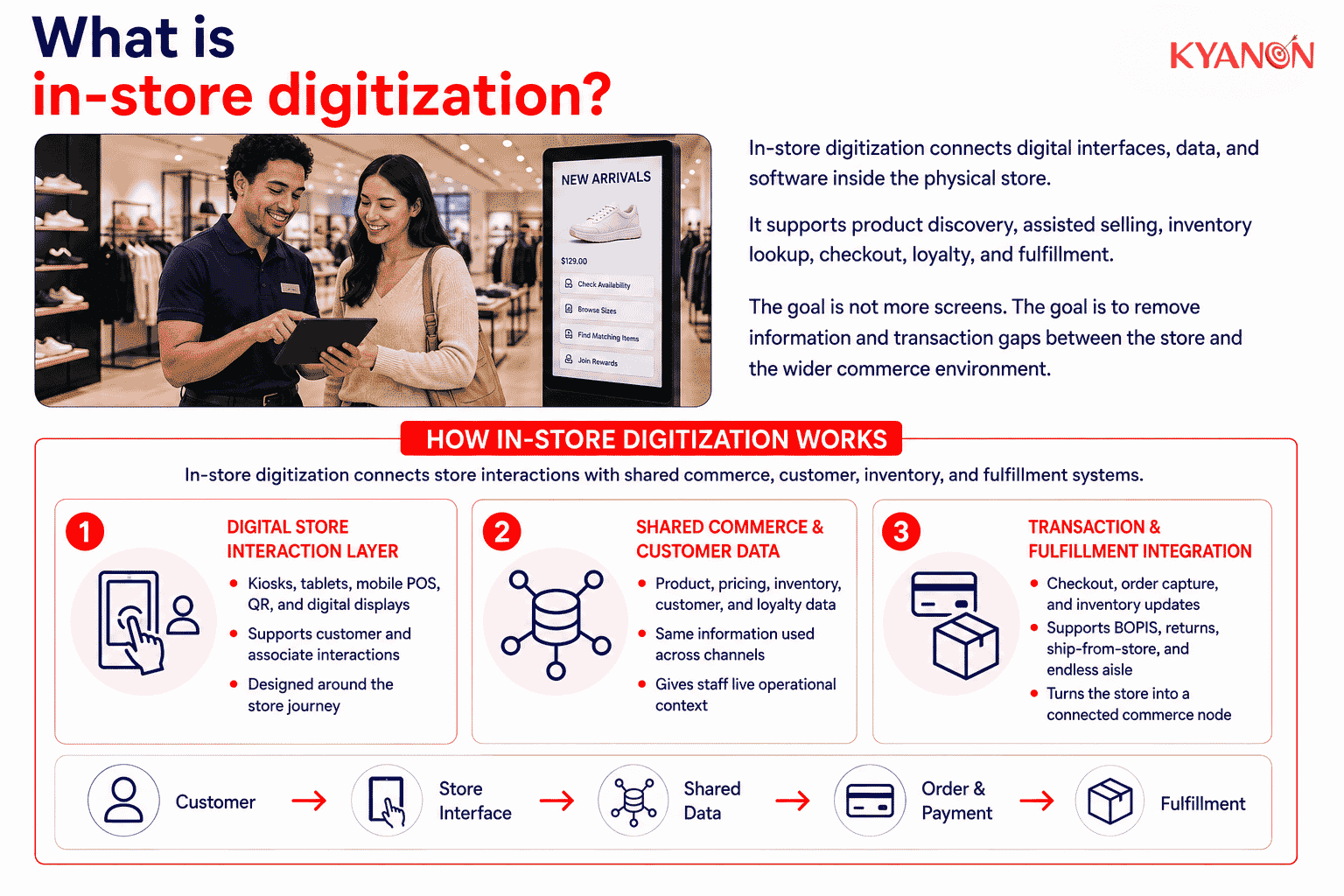
In-store digitization is the integration of digital interfaces, connected data, and software into physical retail stores to support customer journeys and store operations such as product discovery, associate-assisted selling, inventory lookup, checkout, loyalty, and fulfillment. It turns the store from an isolated transaction point into a connected commerce touchpoint linked with wider customer, product, inventory, and order systems.
In practice, in-store digitization can include associate tablets, mobile point of sale, self-service kiosks, QR-enabled product information, digital signage, self-checkout, clienteling tools, loyalty identification, and access to inventory beyond the current store.
How in-store digitization works
In-store digitization works by connecting customer- and associate-facing store interfaces to shared commerce systems so that product, inventory, customer, loyalty, transaction, and order data can be used at the point of service. Modern retail POS models similarly depend on a shared view of customer, inventory, and order information rather than treating the store as a separate system.
The objective is not to place more screens in stores. The objective is to remove the information and transaction gaps between the physical store and the retailer’s wider commerce environment.
Digital store interaction layer
The digital interaction layer gives customers and store employees access to commerce capabilities inside the physical store.
It can include kiosks, associate applications, mobile checkout, electronic shelf labels, smart fitting-room interfaces, digital displays, or customer mobile applications. The specific technology matters less than the store journey it supports and the enterprise data it can access.
Shared commerce and customer data
A digitized store becomes materially more useful when its interfaces can access the same product, pricing, inventory, customer, and loyalty information used by other commerce channels.
Retail platforms increasingly connect physical-location data, online behavior, and loyalty information to create a shared customer view, while modern POS systems expose customer, inventory, and order information to store teams.
For example, an associate tablet can retrieve current stock availability, product specifications, previous purchases, loyalty status, applicable promotions, or online order information instead of relying on store-only records.
Transaction and fulfillment integration
In-store digitization also connects the store to transaction and fulfillment workflows rather than limiting the location to traditional checkout.
A connected store can support activities such as buy online, pick up in store, online returns in store, ship-from-store, cross-location inventory lookup, endless aisle ordering, and mobile checkout. Oracle’s retail architecture similarly links shared inventory with store pickup and other omnichannel fulfillment models.
This makes the physical store both a selling location and an operational node within the wider commerce network.
What technologies are used in in-store digitization?
In-store digitization typically combines customer-facing interfaces with operational technologies that connect store interactions to product, inventory, customer, pricing, payment, and fulfillment systems. The technology mix should be selected around specific store journeys and business KPIs rather than deployed as an independent collection of devices.
Customer-facing technologies
|
Technology |
What it does |
Business use case |
|
Interactive kiosks |
Let shoppers search products, check availability, access loyalty information, and place orders without staff assistance. | Product discovery, endless aisle, queue reduction |
| Electronic shelf labels (ESLs) | Replace printed price labels with centrally managed digital displays that can synchronize pricing and promotional information across stores. |
Pricing consistency, faster promotion updates, lower manual workload |
|
Mobile POS and associate tools |
Give store employees mobile access to product, inventory, customer, loyalty, and payment capabilities. | Assisted selling, clienteling, queue busting, mobile checkout |
| Mobile self-checkout | Allows customers to scan products and complete payment through a mobile application or supported in-store interface. |
Checkout capacity, reduced queues, convenience |
|
Smart fitting rooms |
Connect fitting-room interfaces with product information, size requests, recommendations, or associate assistance. | Fashion conversion, cross-sell, service efficiency |
| Augmented reality and digital displays | Add digital product visualization, virtual try-on, contextual content, or promotions to the physical shopping journey. |
Product evaluation, engagement, assisted decision-making |
Customer-facing store technology creates the most value when it can retrieve live product, inventory, pricing, customer, and order data rather than operating as a standalone interface.
Backend and operational technologies
|
Technology |
What it does |
Business use case |
|
RFID |
Uses tagged products and readers to improve item-level inventory identification and stock visibility. | Inventory accuracy, replenishment, item location |
| IoT sensors | Collect environmental or equipment data such as temperature, equipment status, or other store conditions. |
Cold-chain monitoring, maintenance, operational control |
|
Computer vision |
Analyzes visual information from store environments for approved operational use cases. | Shelf monitoring, availability detection, operational analytics |
| AI-enabled associate tools | Apply search, recommendations, workflow assistance, or decision support within staff-facing applications. |
Faster product lookup, guided selling, task prioritization |
|
Foot-traffic analytics |
Measures movement patterns and store-zone activity using sensors or analytics systems, subject to privacy and governance requirements. | Layout optimization, staffing, merchandising analysis |
| Integration and API layer | Connects store applications with POS, commerce, inventory, OMS, CRM/CDP, loyalty, ERP, and payment systems. |
Shared data, omnichannel transactions, reduced system fragmentation |
The integration layer is the architectural foundation of in-store digitization because it determines whether store technologies can participate in shared commerce, customer, inventory, and fulfillment workflows.
For enterprise retailers, the technology decision should therefore follow this sequence:
- Identify the store friction: lost sales, checkout queues, unavailable stock, weak associate visibility, or inconsistent pricing.
- Define the required data: product, inventory, customer, loyalty, pricing, promotion, or order data.
- Select the interaction technology: kiosk, mobile POS, ESL, mobile app, RFID, sensor, or another interface.
- Connect it to enterprise systems: POS, OMS, CRM/CDP, ERP, loyalty, commerce, and inventory platforms.
- Measure the outcome: conversion, service time, inventory accuracy, associate productivity, fulfillment performance, or operating cost.
The objective is not to digitize every store touchpoint. It is to digitize the interactions where better data access, automation, or cross-channel connectivity can produce a measurable operating or commercial outcome.
In-store digitization vs. omnichannel commerce
In-store digitization modernizes the physical store itself, whereas omnichannel commerce coordinates customer journeys, data, inventory, and fulfillment across physical stores and other sales channels. Omnichannel therefore has a broader operating scope; in-store digitization can be one component of an omnichannel strategy.
| Dimension | In-Store Digitization |
Omnichannel Commerce |
|
Primary scope |
Physical retail locations | Physical stores, websites, apps, marketplaces, social and other channels |
| Primary objective | Improve store journeys and store operations with digital capabilities |
Coordinate commerce journeys and operations across channels |
|
Typical touchpoints |
Kiosks, associate tablets, mPOS, QR codes, self-checkout, digital signage | Store, eCommerce, mobile app, marketplace, customer service and fulfillment channels |
| Core data requirement | Product, inventory, customer, loyalty and transaction data needed in-store |
Shared customer, inventory, order, pricing and promotion data across channels |
|
Fulfillment role |
Supports store pickup, returns, ship-from-store and endless aisle | Orchestrates fulfillment across stores, warehouses and digital channels |
| Implementation pattern | Can be phased by store journey, format, region or capability |
Usually requires coordination across several business functions and systems |
|
Typical KPIs |
Checkout time, assisted conversion, inventory lookup success, associate productivity |
Cross-channel conversion, fulfillment cost, inventory utilization, retention and customer lifetime value |
A retailer can digitize selected store processes without achieving full omnichannel commerce. Conversely, an omnichannel architecture normally requires the store to exchange data and transactions with other channels rather than operate independently.
When to consider in-store digitization
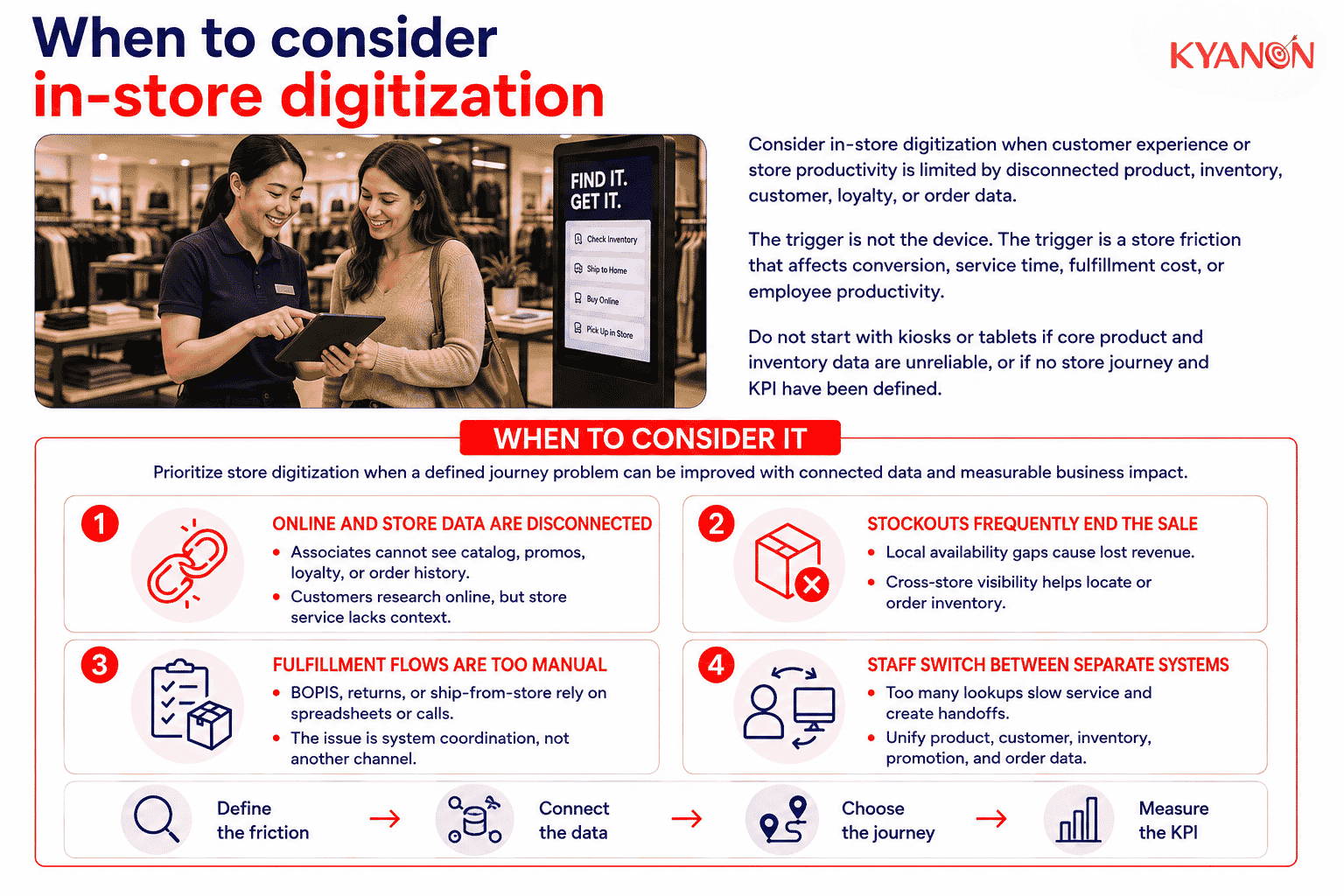
In-store digitization should be considered when customer experience or store productivity is constrained by disconnected product, inventory, customer, loyalty, or order information.
Consider in-store digitization if:
- Customers research online but store associates cannot see the same information. Associates may lack access to digital catalogs, online order history, loyalty status, current promotions, or customer profiles when serving shoppers in person.
- A local stockout frequently ends the sale. Cross-store and distribution-center inventory visibility can allow associates to locate or order products that are unavailable at the current location rather than losing the transaction. Salesforce describes this type of inventory access as a core use case for connected associate tools.
- BOPIS, returns, or ship-from-store depend on manual processes. When online orders require spreadsheets, separate terminals, calls between locations, or manual reconciliation, the issue is usually system coordination rather than another customer-facing channel.
- Store employees switch between disconnected systems to serve one customer. Consolidating customer, product, order, promotion, and inventory information can reduce unnecessary lookup and handoff steps.
It may not be the right priority if:
- Core product and inventory data cannot yet be trusted. Adding store interfaces on top of inconsistent stock, pricing, or catalog data can expose existing data problems more quickly rather than resolve them.
- There is no defined store journey or KPI to improve. Buying kiosks, tablets, or digital signage without a measurable use case can create another technology layer without changing conversion, service time, fulfillment cost, or employee productivity.
The program should therefore start with the store friction to remove and the business metric to change, not with the device to deploy.
Why in-store digitization matters for retail
In-store digitization matters because physical stores increasingly operate as transaction, service, experience, and fulfillment locations within a customer journey that also includes digital channels. Retail technology therefore needs to connect store interactions with the data and workflows used before and after the customer enters the location.
This changes the economics of store technology. Its value is not limited to replacing a manual task with a screen; it can also affect assisted selling, inventory utilization, fulfillment, loyalty recognition, checkout capacity, and the cost of operating separate online and offline workflows.
Salesforce reported in 2025 that physical stores were projected to account for 41% of shopper purchase volume in 2026, compared with 45% in 2024. The figure indicates that stores remain a major part of commerce even as purchasing activity spreads across more digital channels.
How Kyanon Digital connected physical retail with digital commerce

Challenges
- Legacy commerce systems struggled to scale with growing transaction volumes.
- Product, inventory, pricing, promotions, and orders were fragmented across channels.
- Store and online operations lacked consistent real-time data.
- Fulfillment across stores, warehouses, and marketplaces required better coordination.
Solutions
- Implemented a microservices-based commerce architecture for inventory, pricing, promotions, orders, and customer data.
- Built a centralized operational engine to coordinate commerce processes.
- Connected web, mobile, and third-party marketplaces through real-time APIs.
- Integrated inventory and fulfillment workflows across physical stores and digital channels.
- Delivered a mobile ordering experience connected to live inventory, pricing, and promotions.
Results & Impact
- 26,000+ SKUs managed across six digital sales channels.
- Real-time inventory management across nine physical stores.
- 8,000+ orders per day processed without system interruption.
- 99% of offline promotions transitioned into online campaigns.
- Orders could be fulfilled across stores, warehouses, owned channels, and third-party marketplaces.
The case illustrates how in-store digitization can extend beyond customer-facing devices: shared inventory, pricing, promotion, order, and fulfillment services allow physical stores to operate as connected nodes within a broader omnichannel commerce ecosystem.
Read more: Integrated Commerce Platform For Thailand’s Largest Retail Group
Common misconceptions
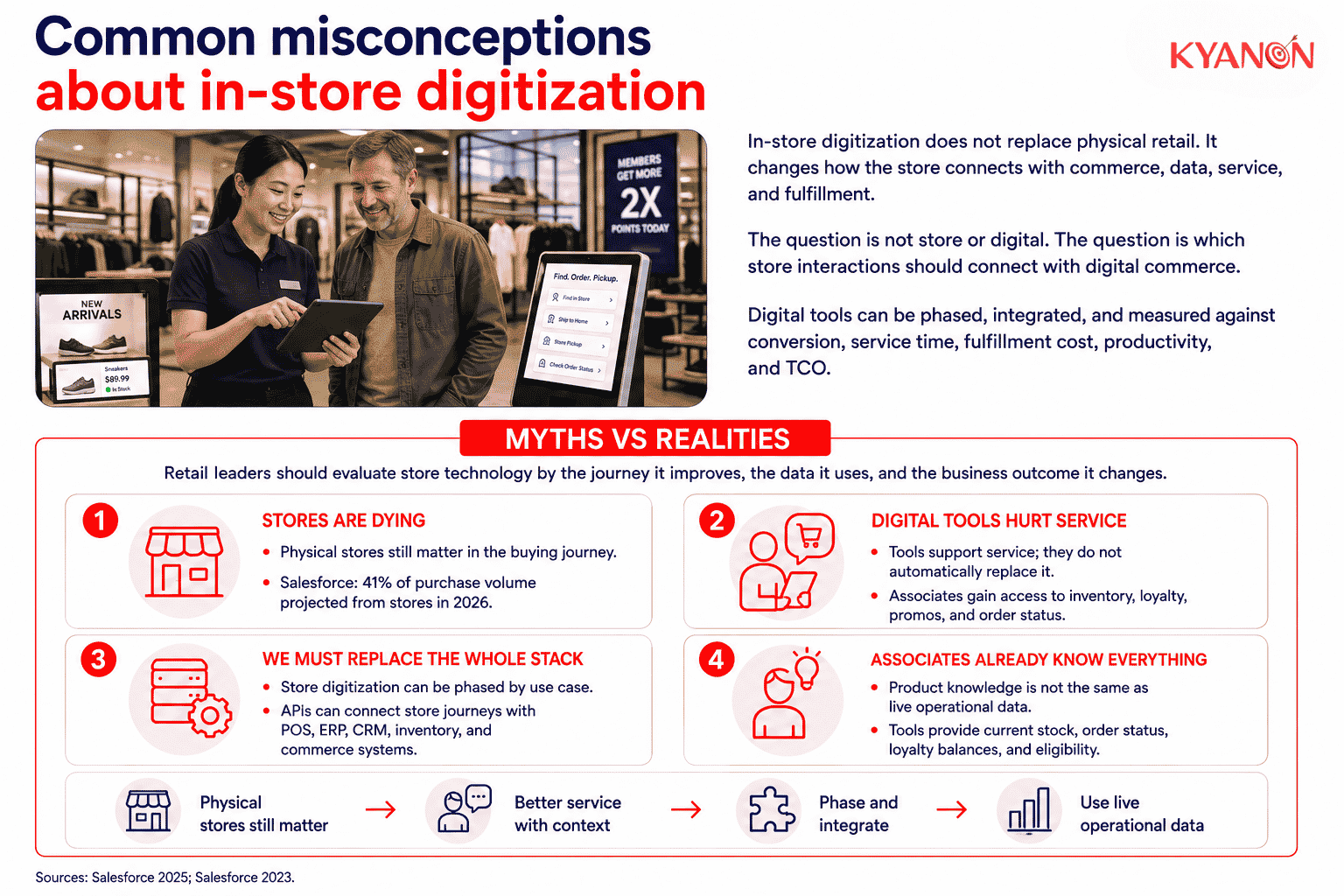
In-store digitization does not replace physical retail; it changes how the store participates in a connected customer and commerce journey.
“Physical stores are dying, so our investment should go entirely to e-commerce.”
Reality: Digital commerce has changed the role of stores, but it has not removed them from the buying journey. Salesforce’s 2025 retail research projected physical locations to account for 41% of purchase volume in 2026, while stores increasingly support pickup, returns, service, product evaluation, and fulfillment.
The strategic question for a retail leader is therefore not “store or digital?” but “which store interactions need to connect with digital commerce?”
“Tablets, kiosks, and automation will weaken personal customer service.”
Reality: Digital store tools do not inherently replace human service; associate-facing technology can give employees access to information that is difficult to maintain manually, including customer history, rewards balances, promotions, order status, and inventory availability. Salesforce specifically identifies these data points as use cases for mobile associate tools.
The design decision is whether a task should be self-service, associate-assisted, or human-led with better digital context.
“Store digitization means replacing our entire retail stack, so the program will be too expensive and slow.”
Reality: In-store digitization does not require every enterprise system to be replaced at once. Capabilities can be phased around defined journeys such as inventory lookup, associate selling, loyalty identification, pickup, returns, or mobile checkout, while APIs and middleware connect store experiences with existing POS, ERP, CRM, inventory, and commerce systems.
Kyanon Digital’s omnichannel implementation model, for example, uses integration between commerce platforms and POS, ERP, CRM, and inventory systems rather than assuming a complete core-system replacement.
For decision-makers, the relevant test is whether each phase has a measurable business case in conversion, service time, fulfillment cost, productivity, or TCO.
“Our store associates already know the products, so they do not need digital product tools.”
Reality: Product expertise and access to current operational data are different capabilities. An experienced associate cannot reliably memorize changing stock across locations, online order status, promotion eligibility, customer purchase history, or loyalty balances.
Connected associate tools provide access to this time-sensitive information while the employee provides the human judgment and service context.
How Kyanon Digital applies in-store digitization
Kyanon Digital approaches in-store digitization as an implementation and systems integration problem: physical store experiences are connected with commerce, POS, inventory, customer, loyalty, order, and enterprise systems rather than deployed as isolated digital features. Kyanon Digital’s omnichannel offering specifically includes in-store digital experiences and integration between eCommerce platforms and POS, ERP, CRM, and inventory systems.
For enterprise retail programs, this can include connecting the online catalog to associate or self-service interfaces, exposing cross-location inventory for Endless Aisle, synchronizing customer identity and loyalty across online and offline transactions, and integrating store fulfillment with OMS and commerce platforms.
The implementation can be phased around measurable store journeys while preserving existing systems where replacement does not provide sufficient business value. Kyanon Digital’s retail commerce work demonstrates this implementation-led model through centralized product, stock, pricing, promotion, and order services that connect multiple customer and fulfillment channels.
→ Explore Kyanon Digital’s omnichannel eCommerce development services.











 Create project brief with AI