



The BFSI domain encompasses a broad financial-services ecosystem, including banking, payments, lending, investment, wealth management, and insurance. In technology and consulting, it covers the business processes, systems, data, regulations, and operational requirements that underpin these services. While each area has distinct business models and use cases, they share common challenges around sensitive financial data, complex transactions, risk management, compliance, and secure digital experiences.
BFSI is widely used in IT services, consulting, BPO, and technology outsourcing, where providers support financial institutions with software development, process automation, data management, compliance, and digital transformation. Understanding the domain therefore requires more than knowing the technology; teams must also understand the financial processes and regulatory requirements behind it.
This guide explains the three core BFSI sectors, their scope and economic role, the regulatory environment surrounding them, and the technologies reshaping the domain in 2026. It also explains the difference between the BFSI sector, industry, and domain, and why domain knowledge matters when building or modernizing financial systems.
Key takeaways
- BFSI brings together Banking, Financial Services, and Insurance within a connected ecosystem of financial products, processes, systems, data, and regulations.
- Banking, Financial Services, and Insurance each serve distinct purposes, yet their operations increasingly converge through shared customers, digital platforms, payments, data, and regulatory frameworks.
- Regulatory compliance remains fundamental to BFSI, shaping how institutions manage financial crime, customer protection, data security, cybersecurity, risk, payments, and cross-border operations.
- The distinction between sector, industry, and domain depends on context, with sector referring to the broader economic landscape, industry to commercial businesses, and domain to the operational and technological foundation behind BFSI services.
- Economic activity depends heavily on BFSI, as the ecosystem facilitates savings, credit, investment, payments, risk protection, financial inclusion, and cross-border trade.
- Technology is reshaping BFSI in 2026, with AI, cloud modernization, open banking, digital payments, RegTech, and distributed ledger technology enabling more connected and automated operations.
- Domain expertise can determine the success of BFSI technology projects, since effective solutions must account for financial workflows, business rules, compliance requirements, security, and operational risks.
Further reading
- Digital Transformation in BFSI: A Framework for APAC Banks in 2026
- Top 10 Digital Transformation Challenges in the BFSI Industry
- Top 10 Tech Trends 2026 by Gartner
What does BFSI stand for? (Full form & meaning)
BFSI stands for Banking, Financial Services, and Insurance.
BFSI is an umbrella term for the industry cluster that provides financial products and monetary intermediation. It covers businesses involved in mobilizing savings, facilitating credit, enabling payments, managing financial assets, and providing risk protection through insurance.
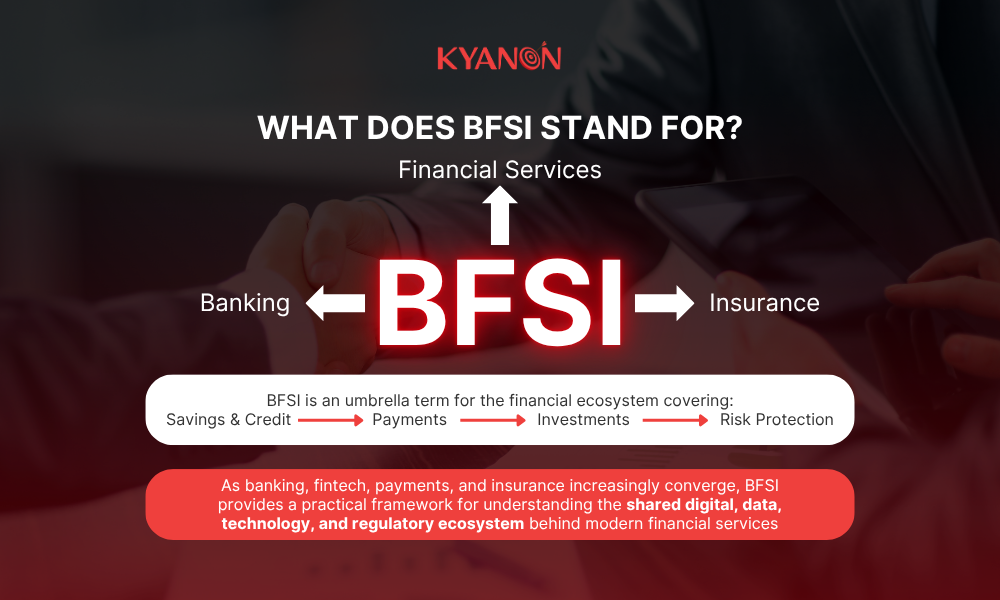
Why these sectors are grouped under BFSI: Although banking, financial services, and insurance are distinct sectors, they share core business and technology requirements:
- Sensitive data: They process large volumes of personal, financial, and transactional data, requiring strong security, privacy, and governance controls.
- Complex transactions: Lending, payments, investments, and insurance claims rely on interconnected systems and complex workflows.
- Overlapping regulation: Requirements such as KYC (Know Your Customer) and AML (Anti-Money Laundering) apply across multiple financial activities.
These shared needs cause IT providers, BPO firms, and consulting companies to treat BFSI as a unified vertical for enterprise software, testing, compliance automation, cybersecurity, and operations.
The convergence of financial services reinforces this view. Banks offer insurance, fintechs provide lending, and frameworks like KYC and AML span traditional boundaries. As digital, data, and regulatory ecosystems interconnect, BFSI serves as a practical framework for technology and operations.
The 3 core sectors of the BFSI domain
BFSI comprises three interconnected sectors, Banking, Financial Services, and Insurance. While each serves a distinct financial function, they increasingly overlap through shared customers, digital platforms, data infrastructure, and regulatory requirements.
BFSI market scale in 2026: The global BFSI ecosystem operates at enormous scale. Banking generated approximately $6.4 trillion in revenue and held around US$406 trillion in deposits, loans, and assets under management in 2025, as reported in McKinsey & Company’s Global Banking Annual Review 2026. The broader financial-services industry generated roughly $15 trillion in revenue, with McKinsey & Company’s 2026 industry analysis estimating the sector at this level. Global insurance premiums are forecast to grow by 1.3% in 2026, according to projections from the Swiss Re Institute, while funds intermediated by the global financial system reached approximately US$468 trillion in 2025, as highlighted by McKinsey Global Institute’s 2026 Global Balance Sheet research.
3 core sectors of the BFSI domain
|
Sector |
Core role | What it includes |
Common enterprise systems |
|
Banking |
Deposits, lending, payments, and financial account services | Commercial, retail, cooperative, payments & small-finance banks, NBFCs, investment banks | Core banking, loan origination & servicing, payment processing, digital banking, CRM, fraud detection, and risk management |
| Financial services | Investment, capital allocation, wealth management, and financial intermediation | Capital markets, asset & wealth management, mutual funds, stockbroking, fintech, payments |
Trading & brokerage, portfolio management, wealth management, investment management, lending platforms, payment platforms, CRM, and risk & compliance |
|
Insurance |
Risk transfer, financial protection, and claims management | Life, health, general (P&C), reinsurance, insurtech |
Policy administration, underwriting, claims management, billing & collections, reinsurance, CRM, and risk/actuarial analytics |
Banking manages deposits, credit, and payments through banks and NBFCs, while Financial Services enables investment, trading, capital allocation, and wealth management through markets, asset managers, fintech, and payment platforms. Insurance complements these services by pooling risk and providing financial protection across life, health, property, and other areas through insurers, reinsurance, and insurtech.
Together, these three sectors form the BFSI ecosystem, with increasing convergence across payments, lending, investment, insurance, and digital financial services. For enterprises, this convergence creates a greater need for connected data, interoperable platforms, and technology infrastructure that can support multiple financial functions while meeting sector-specific regulatory requirements.
Banking: The foundation of financial infrastructure
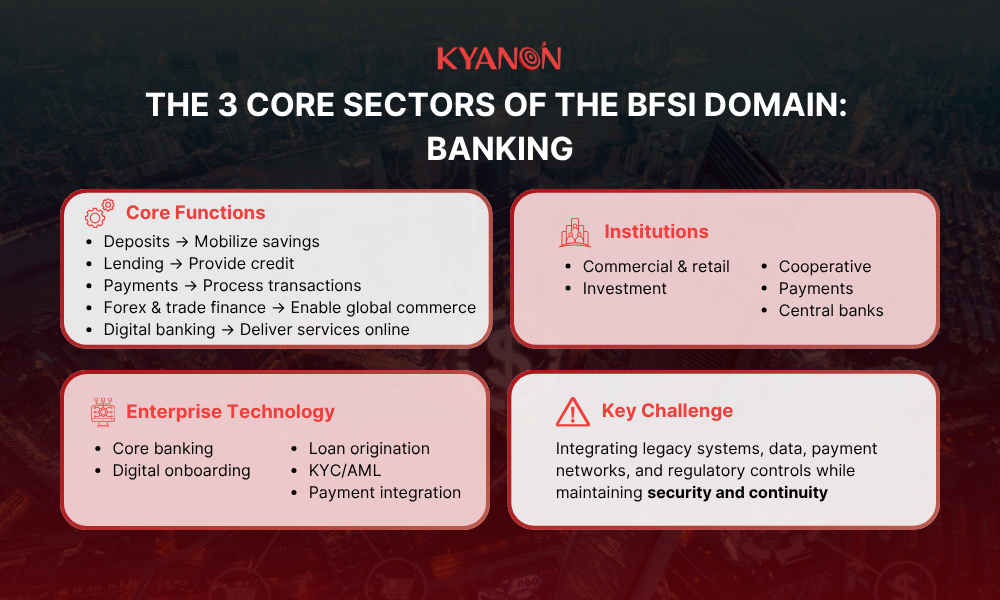
Banking is the BFSI core, intermediating between depositors and borrowers. Banks mobilize savings into loans and productive investments while providing the essential payment infrastructure for global economic activity.
- Commercial, retail, & investment banks: Manage deposits, everyday consumer services, and corporate financing/advisory.
- Specialized banking: Includes cooperative, payment, and small-finance banks focused on community needs and financial inclusion.
- Central banks: Regulate the system to ensure monetary and financial stability.
Core banking functions include:
- Deposits & lending: Safeguarding funds and providing credit for economic expansion.
- Payments & settlement: Processing domestic and cross-border transactions through card networks, bank transfers, instant-payment systems, and clearing infrastructure. Examples include UPI in India, PayNow in Singapore, FPS in Hong Kong, SEPA in Europe, and FedNow in the United States.
- Forex & trade finance: Supporting international trade through exchange services and letters of credit.
- Digital Banking: Mobile and web delivery of all core account and loan services.
Enterprise projects often focus on CBS migrations, digital onboarding, LOS implementation, and KYC/AML automation. These require seamless integration between legacy systems, payment networks, and evolving regulatory controls to ensure security and continuity.
Financial services: Wealth, capital, and securities markets
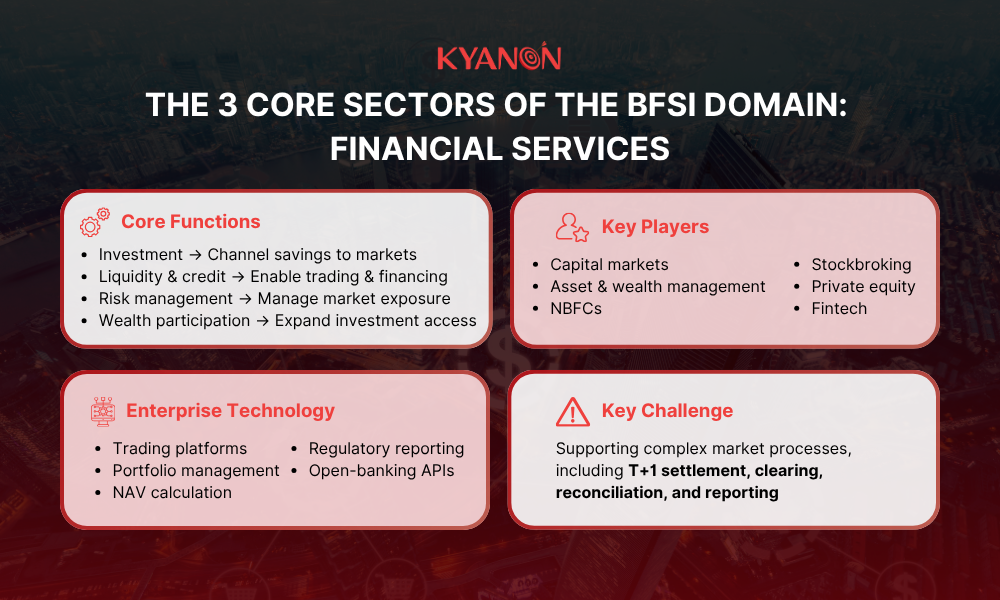
Financial services connect capital and investment markets, encompassing institutions that help individuals and businesses allocate funds, manage wealth, and access credit beyond traditional banking.
Key sector participants include:
- Capital markets: Platforms for trading securities and financial instruments.
- Asset & wealth management: Professional portfolio management for investors.
- Mutual funds & Asset management companies (AMCs): Entities that pool and allocate capital across diversified assets.
- Non-banking financial companies (NBFCs): Providers of specialized credit outside traditional banks.
- Stockbroking & advisory: Market access and investment guidance services.
- Venture capital (VC) & private equity: Funding for startups and business transformations.
- Credit-rating agencies: Firms that assess financial instrument creditworthiness.
- Fintech: Digital solutions for payments, lending, and wealth management.
Core functions include:
- Mobilizing savings: Channeling capital into productive investment opportunities.
- Providing liquidity: Enabling asset trading and specialized financing.
- Risk management: Utilizing derivatives and hedging to mitigate market exposure.
- Retail participation: Increasing investor access via digital platforms and advisory.
Enterprise projects in this sector typically focus on trading platforms, portfolio management, and API integration. Teams must also support market infrastructure requirements such as the T+1 settlement cycle, where trades are settled one business day after execution, to improve processing efficiency and meet regulatory requirements.
Insurance: Risk transfer, actuarial science, and protection
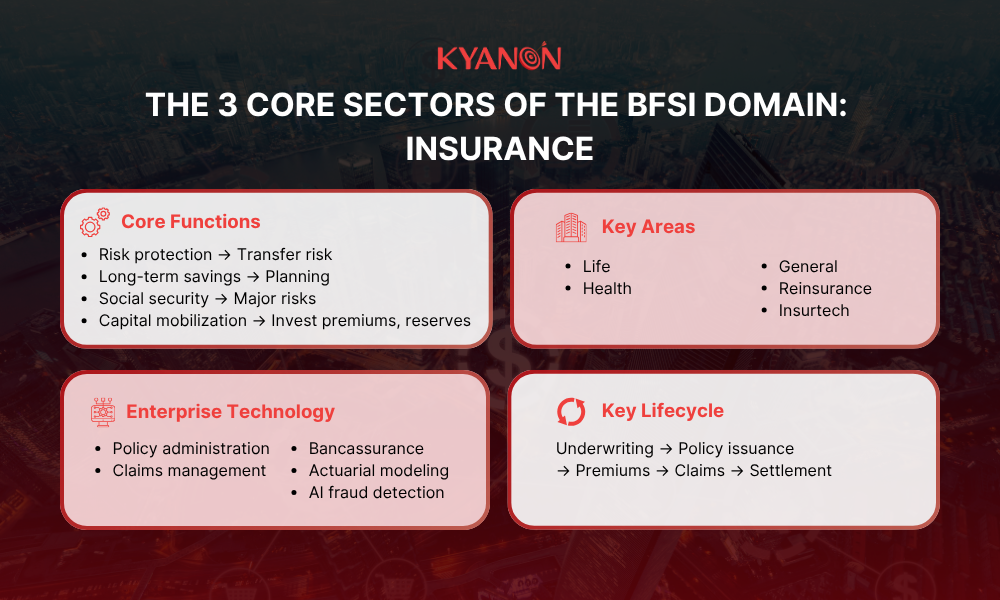
Insurance provides financial protection by pooling premiums from many policyholders to cover the losses of the few who experience insured events. This risk-pooling model allows individuals and businesses to transfer financial exposure to insurers while giving insurers a data- and actuarial-intensive framework for pricing and managing risk.
The insurance sector includes several major categories:
- Life insurance: Offers financial safety, savings, and retirement options.
- Health insurance: Handles medical costs and related risks.
- General insurance: Covers auto, property, marine, travel, and liability risks.
- Reinsurance: Transfers risk to other providers to mitigate major losses.
- Insurtech: Integrates AI, data, and automation into insurance operations.
Core functions include:
- Risk protection: Transfers financial exposure to insurers in exchange for premiums.
- Long-term savings: Supports financial planning via life insurance and savings products.
- Social security: Provides financial support against health, disability, and mortality risks.
- Capital mobilization: Channels accumulated premiums and reserves into financial markets and infrastructure.
Common enterprise insurance projects include Policy Administration Systems (PAS), Claims Management Systems (CMS), bancassurance platforms, actuarial modeling, and AI-powered fraud detection. The core insurance lifecycle typically follows underwriting → policy issuance → premium collection → claims → settlement, with data and automation supporting decision-making across each stage.
Common pain points: Insurance enterprises often face fragmented policy and claims data, manual underwriting and claims processes, fraud detection challenges, legacy Policy Administration Systems (PAS) that are difficult to integrate, and slow claims processing. These issues can increase operational costs, delay decisions, and make it harder to deliver consistent customer experiences across the insurance lifecycle.
Regulatory landscape across the BFSI domain
BFSI operates under extensive regulatory oversight because financial institutions manage customer assets, credit, payments, investments, and sensitive financial data. Regulations aim to maintain financial stability, protect customers and investors, prevent financial crime, and strengthen data security.
Key regulatory areas include:
- Prudential regulation: Capital, liquidity, leverage, and risk-management requirements, including the Basel III framework for banking institutions.
- Financial crime compliance: Know Your Customer (KYC) and Anti-Money Laundering (AML) requirements for identity verification, transaction monitoring, and financial-crime prevention.
- Consumer and investor protection: Requirements covering fair treatment, disclosures, market conduct, and protection against financial abuse.
- Data protection & cybersecurity: Controls for protecting personal and financial data and maintaining secure digital operations. Requirements vary across jurisdictions, including frameworks such as the General Data Protection Regulation (GDPR) in Europe.
- Payments and market infrastructure: Oversight of payment systems, clearing, settlement, securities markets, and operational resilience.
- Insurance regulation: Requirements covering solvency, underwriting, claims, policyholder protection, reporting, and reinsurance.
- Cross-border compliance: Institutions operating across markets must manage different regulatory frameworks, reporting requirements, and supervisory authorities.
Regulation directly influences BFSI technology, shaping requirements for data architecture, identity verification, transaction monitoring, audit trails, access controls, reporting, cybersecurity, and system integration. As regulatory requirements evolve, institutions increasingly use automation, analytics, AI, and RegTech to manage compliance more efficiently.
BFSI sector vs. industry vs. domain: Key distinctions
The decision matrix below clarifies the functional, analytical, and operational differences between the terms sector, industry, and domain. This table helps organizational stakeholders align executive terminology, operational scope, and technology investments.
Terminology classification matrix
|
Terminology |
Definition | Primary stakeholders |
Business focus |
|
BFSI Sector |
The economic segment that covers banking, financial services, and insurance. | Policymakers, regulators, central banks | Economic activity, regulation, and systemic risk |
| BFSI Industry | The commercial businesses that provide financial products and services. | Executives, analysts, investors |
Market competition, growth, revenue, and M&A |
|
BFSI Domain |
The processes, systems, data, and technology that support BFSI operations. | Technology leaders, architects, analysts, BPO partners |
Digital transformation, system integration, and automation |
In practical terms:
- BFSI sector is used when discussing the broader economic and regulatory landscape, for example, the size, growth, employment, or regulation of financial services.
- BFSI industry is more business-oriented, referring to the organizations that operate across banking, financial services, and insurance.
- BFSI domain is primarily used in technology and consulting contexts, where teams need specialized knowledge of financial processes, business rules, data, systems, and compliance requirements.
For example, a regulator may discuss the BFSI sector, an employer may advertise a role in the BFSI industry, while an IT services company may describe BFSI as a domain for software development, system integration, or consulting projects.
The distinction is therefore mainly about context rather than scope. All three terms can refer to the same underlying ecosystem; what changes is the perspective from which BFSI is being discussed.
Scope of the BFSI ecosystem and its macroeconomic role
The BFSI sector is a modern economic backbone, uniting banks, financial institutions, and insurers to provide savings, lending, payments, investment, and risk protection. Beyond financial intermediation, it directly drives business growth, infrastructure, entrepreneurship, and economic activity by mobilizing savings, expanding credit, fostering financial inclusion, managing risk, and developing capital markets.
Across the economy, BFSI supports eight interconnected functions:
- Capital formation & savings mobilization: Channels household and corporate savings into productive investment, supporting industrialization, entrepreneurship, and infrastructure development.
- Credit availability & business growth: Provides loans, working capital, and other financing that enable businesses of different sizes to expand and invest.
- Financial inclusion: Extends access to formal financial services through Jan Dhan Yojana, microfinance, digital payments, and micro-insurance, particularly for underserved populations.
- Risk management: Helps individuals and businesses manage financial and commercial exposure through insurance and other risk-management mechanisms.
- Capital-market development: Supports investment, liquidity, and capital allocation through stock exchanges, bonds, derivatives, mutual funds, and other financial-market institutions.
- Globalization & cross-border trade: Facilitates international payments, foreign exchange, trade finance, and cross-border investment.
- Policy transmission: Provides channels through which monetary and fiscal policies influence credit, investment, liquidity, and wider economic activity.
- Technological advancement & the digital economy: Digital banking, fintech, UPI, AI, blockchain, open banking, and API-based services are reshaping how financial products are delivered and managed.
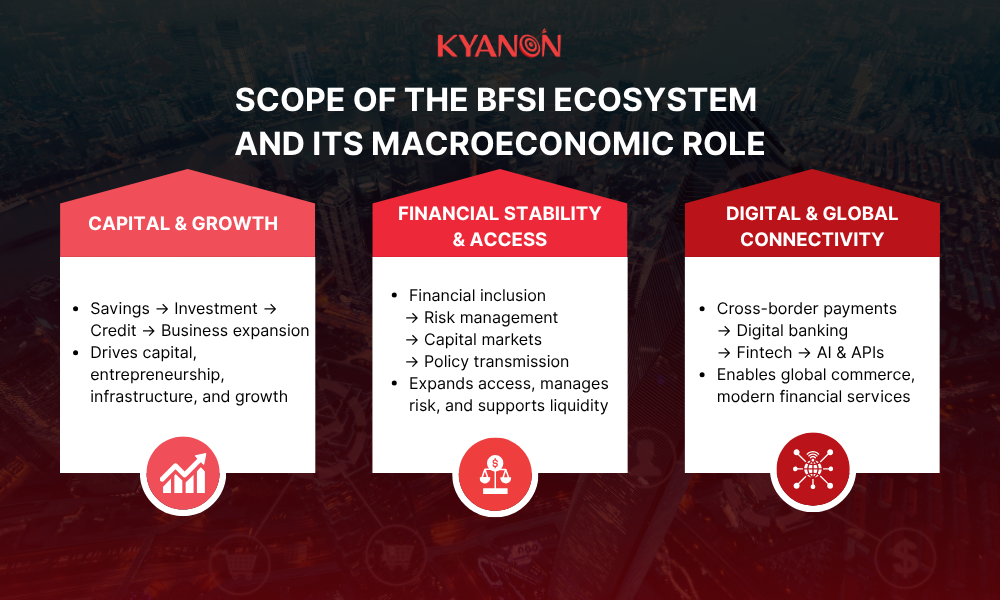
The BFSI ecosystem operates at a substantial economic scale, Investopedia estimates financial services drive 20%–25% of global economic activity, while Gartner projects banking and investment IT spending is projected to reach $857.5 billion in 2026, reflecting continued investment in AI, open banking, cybersecurity, fintech, and connected platforms.
This scale, combined with complex regulatory requirements, makes BFSI a critical technology domain. Kyanon Digital supports BFSI organizations with digital transformation, software development, system integration, and automation to modernize financial operations while meeting regulatory requirements.
For more on enterprise modernization, explore 2026 Tech Trends Shaping Enterprise Software Architecture.
Technologies transforming the BFSI domain in 2026
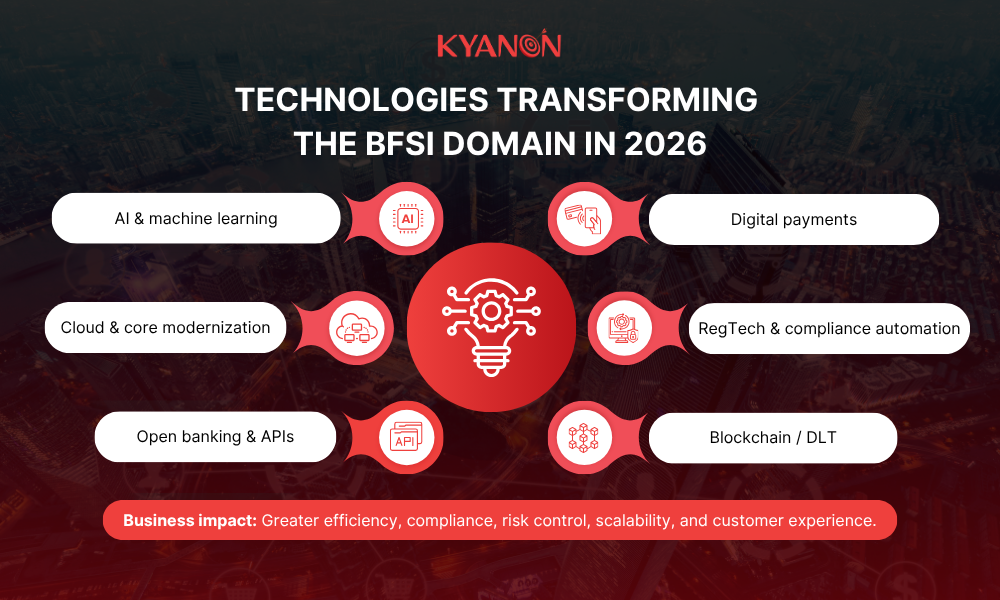
BFSI is rapidly adopting technology to improve efficiency, compliance, risk management, and customer experience across core financial operations.
- AI & machine learning: Analyzes large structured and unstructured datasets to improve fraud detection, credit scoring, underwriting, and operations. It powers 24/7 customer support chatbots and automates data extraction from regulatory documents, contracts, and claims.
- Cloud & core modernization: Employs cloud-native infrastructure, microservices, and APIs to update legacy architectures, scale services, and integrate fintech. Incremental modernization allows banks and insurers to deploy new capabilities while ensuring core stability.
- Open banking & APIs: Facilitates secure, consent-driven financial data sharing among banks, fintech companies, and third-party providers. This connected ecosystem supports account aggregation, personal finance management, digital lending, payments, and embedded services.
- Digital payments: Real-time payment systems, digital wallets, and BNPL options are transforming transactions. This shift drives the need for scalable processing, real-time transaction monitoring, fraud prevention, and merchant integration.
- RegTech & compliance automation: Integrates automation, AI, analytics, and RPA into KYC, AML, reporting, monitoring, and approvals. These solutions lower manual workloads, enhance operational consistency, and manage expanding transaction and regulatory volumes.
- Tokenization & distributed ledger technology (DLT): Offers transparent, tamper-resistant records for targeted financial use cases. Key applications include trade finance, cross-border payments, KYC, smart contracts, and settlement where reducing reconciliation adds clear value.
Together, these technologies are shifting BFSI modernization from isolated digital initiatives toward connected, automated, and data-driven financial operations, with measurable gains in efficiency, compliance, risk management, scalability, and customer experience.
Why the BFSI domain matters for business & technology teams
BFSI is not simply another enterprise vertical. Banks, financial institutions, and insurers manage loans, investments, payments, insurance, and large volumes of financial transactions, connecting their operations directly to individuals, businesses, and the wider economy. For teams building products, entering financial markets, or selling technology to financial institutions, understanding the domain is therefore essential.
Why domain knowledge matters:
- Strategic & commercial relevance: BFSI underpins commerce and capital formation. Understanding its operating models and financial processes is essential for teams building products, entering the market, or selling solutions to financial institutions.
- Technology & compliance requirements: BFSI involves large, complex, and highly regulated technology programs. Knowledge of KYC, AML, CBS, NAV, and underwriting helps teams translate business requirements into systems that meet regulatory and operational requirements.
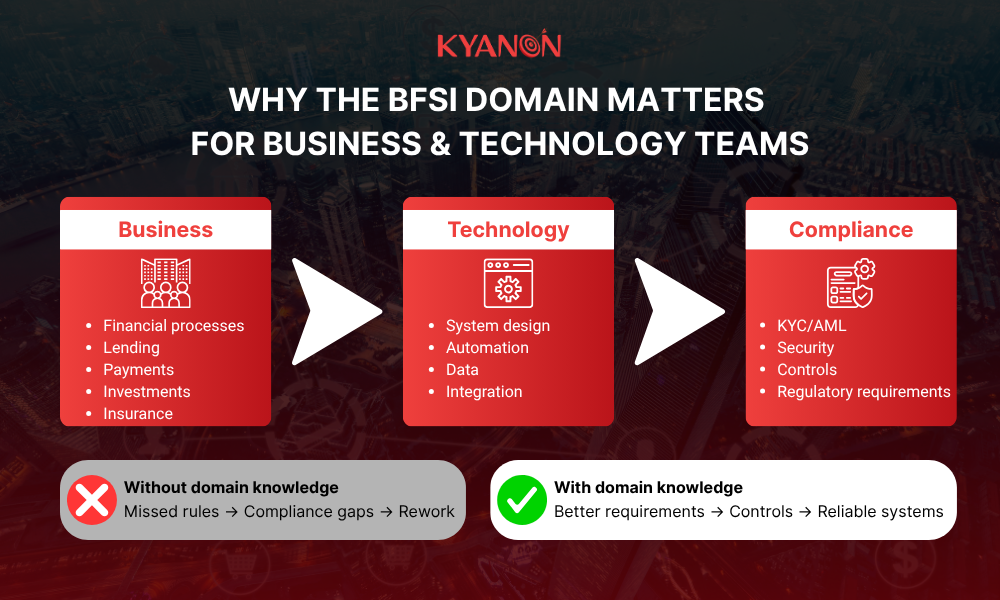
A loan-origination platform illustrates the difference. Loan processing involves document validation, credit analysis, and compliance checks, with automation used to gather information, update loan systems, and flag exceptions. A team without BFSI expertise may implement the basic workflow while overlooking important lending rules. In the outline’s example, this could mean missing the distinction between hard-pull and soft-pull credit checks or failing to account for applicable Debt-to-Income (DTI) limits.
A domain-fluent team can incorporate KYC/AML controls, credit assessment, and risk logic during requirements and solution design rather than treating compliance as a later-stage addition. This reduces rework and helps produce systems that are compliant, secure, and operationally reliable. The source similarly emphasizes the importance of regulatory compliance, security, and controls across BFSI operations.
Case study: How Kyanon Digital helped a mid-tier Vietnamese bank reduce core banking go-live risk
The project demonstrates how BFSI domain knowledge and technology expertise come together to manage the complexity of a high-stakes banking transformation.
Kyanon Digital partnered with a mid-tier joint-stock commercial bank in Vietnam to independently assess the readiness of three interconnected systems: its core banking platform, retail mobile banking application, and corporate digital banking solution.
The challenge:
The bank was preparing for a simultaneous go-live involving multiple mission-critical systems. Tight system interdependencies, operational readiness gaps, limited cross-functional visibility, and an aggressive timeline increased the risk of disruption during deployment.
The solution:
Kyanon Digital conducted a structured, end-to-end go-live readiness assessment covering:
- System readiness: Assessed the core banking and digital banking platforms and their interdependencies.
- Operational readiness: Evaluated business processes, user preparedness, and support models.
- Risk & governance assessment: Identified critical gaps, dependencies, and risks across technology, operations, and governance.
- Go/No-Go advisory: Delivered prioritized recommendations and an evidence-based readiness view to support leadership decision-making.
The impact:
- Reduced deployment risk: Critical risks and readiness gaps were identified before go-live, enabling proactive mitigation.
- Stronger decision-making: Leadership received a consolidated view of readiness and risk exposure.
- Improved cross-functional visibility: A structured assessment framework aligned technology, operations, and governance teams.
- More controlled transformation: The bank gained greater confidence in launching interconnected systems while maintaining operational stability.
Read more: Core Banking Go-Live Readiness Assessment for a Mid-tier Bank in Vietnam
In conclusion
BFSI is more than a classification of banking, financial services, and insurance. It is a critical economic domain where financial intermediation, risk management, regulatory requirements, and digital transformation increasingly converge. As AI, cloud modernization, open banking, digital payments, and RegTech reshape the sector, technology is becoming increasingly embedded in core BFSI operations.
For enterprises building or modernizing financial platforms, the key question is not simply “Can this technology be implemented?” The better question is “Does the technology partner understand the BFSI processes, regulatory requirements, and operational risks behind the solution?”
Building or modernizing a BFSI solution with the right domain and technology expertise? Contact Kyanon Digital!


















 Create project brief with AI