


As enterprise eCommerce ecosystems become more complex, many organizations struggle with fragmented customer data, inconsistent reporting, rising acquisition costs, and unreliable analytics across platforms. Even with major investments in ERP, CRM, OMS, CDP, marketplaces, and mobile apps, disconnected systems often create duplicate data, operational inefficiencies, and poor decision-making.
The core issue is not the technology itself, but the lack of a governed data foundation and a clear Single Source of Truth (SSOT). Without standardized definitions and ownership, enterprises cannot scale personalization, omnichannel commerce, AI initiatives, or analytics effectively.
This article explores the most common eCommerce data governance challenges enterprises face, why these issues are becoming more critical in the AI-driven era, and how businesses can build a scalable governance foundation for long-term growth.
Key takeaways
- The identity crisis: Fragmented customer identities distort marketing analytics, inflate Customer Acquisition Costs (CAC), and create privacy compliance risks.
- Revenue leakage: Inconsistent order status definitions and billing errors lead to an unintentional loss of 5% of annual earnings, which the OECD attributes to operational inefficiency.
- The AI prerequisite: Without a governed foundation, AI investments remain “innovation theater” rather than production-grade assets.
- Ownership shift: Governance fails when delegated to IT. Success requires business executives to own data domains (Product, Customer, Order) to align quality with tangible revenue KPIs.
- Actionable path: A focused governance audit followed by a 3-6 month iterative implementation can resolve critical gaps, delivering measured time-to-value through stabilized CAC and increased LTV.
Further Reading
- What Is Data Governance? 7 Exciting Data Governance Trends
- B2B Data Enrichment for eCommerce Operations
- Data Enrichment for Retail: A Practical Guide
Why enterprise ecommerce data governance is harder than it looks
With Gartner forecasting a $6.86 trillion global eCommerce market by 2025, scaling enterprise ecosystems face severe data fragmentation. Fragmented stacks of OMS, ERP, CRM, and other platforms often harbor disconnected versions of product and customer records. Consequently, eCommerce data governance has evolved from a technical cleanup into a critical business discipline focused on ownership and trusted standards across complex enterprise architectures.
From Kyanon Digital’s experience in enterprise eCommerce transformation projects, governance issues often emerge when businesses scale channels and technologies faster than they scale operational alignment and data standards. This becomes even more critical in the AI era. Gartner forecasts that by 2028, AI agents will intermediate 90% of B2B buying interactions, making machine-readable and governed data a business requirement rather than a technical preference.
Standardized foundations and a Single Source of Truth (SSOT) prevent analytics errors and resolve conflicting metrics across siloed teams, boosting executive confidence. Compliance with GDPR and CCPA further necessitates data visibility. Kyanon Digital emphasizes that successful, AI-ready ecosystems require integrating ownership, workflows, and architecture from the start to ensure long-term scalability and resilience.
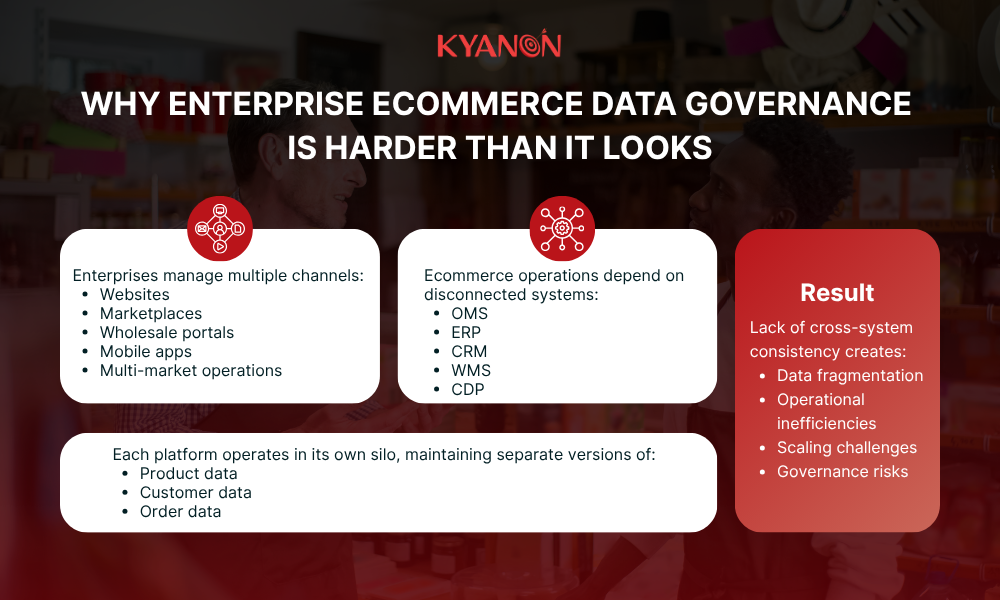
In the 2026 Agentic Era, governance shifts from reporting to securing AI-driven actions. As AI agents autonomously manage transactions, data precision becomes critical; errors immediately disrupt inventory, budgets, and customer experiences. This transition makes data quality a direct business risk, compounded by legacy infrastructure and multi-market scaling. Enterprises isolating governance within IT face scalability hurdles. To succeed, organizations must treat eCommerce data as a strategic asset requiring executive oversight and financial-grade discipline.

The 5 most common data governance failures in enterprise eCommerce
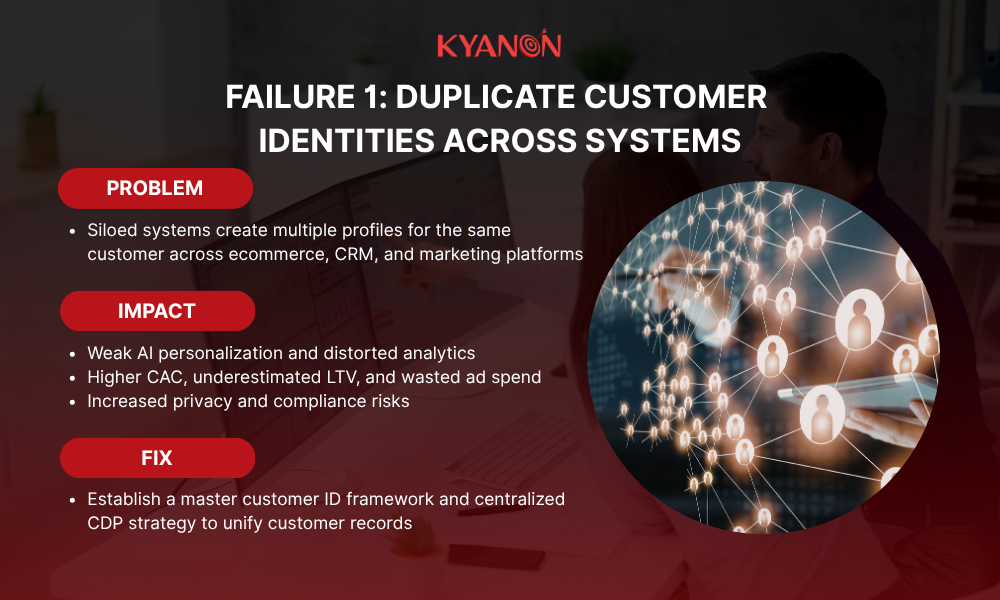
Failure 1: Duplicate customer identities across systems
The “Identity Crisis” is a major eCommerce failure where siloed, non-durable identifiers cause one person to appear as multiple entities across a tech stack. Research from McKinsey & Company shows that 25% of profiles in large organizations are mismatched, creating a fragmented database.
When customer identities are fragmented, the entire marketing and analytics funnel becomes distorted. In McKinsey & Company’s report “AI-Powered Marketing and Sales Reach New Heights with Generative AI”, AI-driven personalization engines, which are supposed to increase conversion rates by up to 23%, instead serve redundant or irrelevant recommendations because they cannot link the customer’s past behavior with their current intent.
The financial impact of identity fragmentation is significant. Duplicate profiles artificially deflate Customer Acquisition Cost (CAC) by miscounting existing customers as new, while Customer Lifetime Value (LTV) is understated due to split spending histories. This obscures high-value customers and undermines retention. These issues typically arise as eCommerce ecosystems expand across platforms and markets without evolving data governance standards. Kyanon Digital frequently observes this pattern in digital transformations where rapid growth precedes a unified data foundation.
Based on this experience, Kyanon Digital recommends implementing durable customer identifiers and cross-channel data synchronization early in the transformation process. A centralized customer data strategy allows personalization engines, analytics systems, and retention programs to operate from a consistent source of truth rather than fragmented customer records.
The Identity resolution maturity matrix
Identity resolution maturity | Duplication rate | Impact on Marketing ROI | Decision logic |
| Laggard | 25% – 30%+ | -40% due to overlap | CAC is likely 2x higher than reported. |
Median | 10% – 20% | -15% due to fragmentation | Consolidation will yield immediate 10% retention lift. |
Leader | < 1% | +20% lift in ROI | Data is ready for high-fidelity agentic personalization. |
Identity duplication severely impacts profitability. McKinsey & Company reports that a 20% duplication rate in 1 million records wastes millions in ad spend and retention. Non-compliance with privacy laws also risks fines over 4% of global turnover. C-suite leaders must prioritize identity resolution to stabilize CAC and support AI investments.
Enterprises should implement a master customer ID model with clear resolution rules and business ownership. A Customer Data Platform (CDP), such as Adobe Real-Time CDP, centralizes first-party data and maintains durable identifiers.
Failure 2: Unmapped product taxonomies
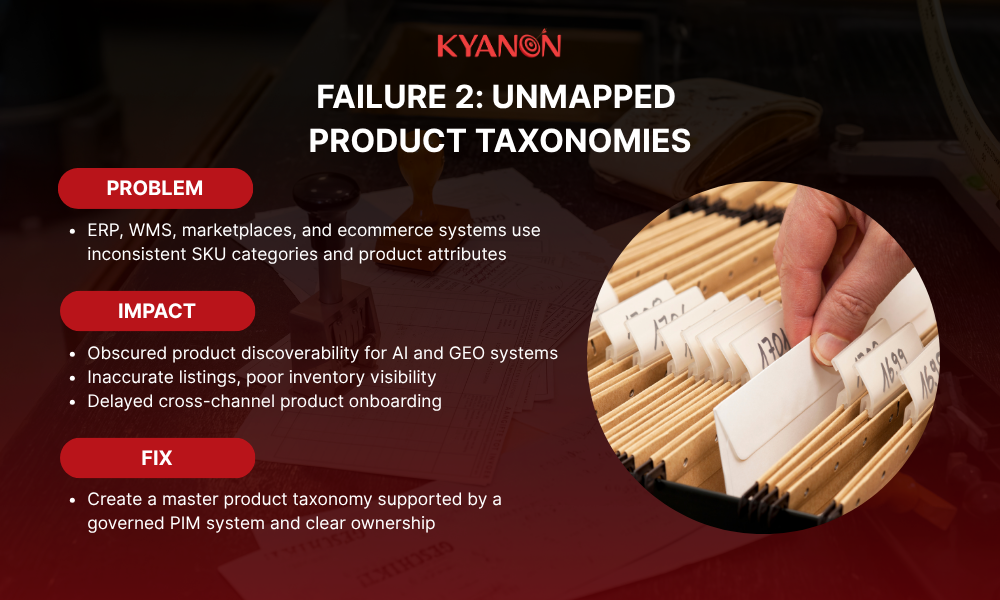
Fragmented product taxonomies create major operational and commercial inefficiencies. ERP, WMS, marketplace, and ecommerce systems frequently classify the same SKU differently, making cross-channel inventory management and reporting inconsistent. Without standardized taxonomy mapping, products become semantically disconnected across systems.
This issue is becoming more serious in the AI-driven commerce era. AI agents and generative search systems rely on machine-readable product structures to understand relationships between categories, attributes, and inventory. Gartner projects that AI-driven systems will influence 90% of B2B buying journeys by 2028. Products with inconsistent or unmapped taxonomies risk becoming effectively invisible to AI-powered discovery and recommendation systems.
Inconsistent product attributes, such as material or size, fail to map correctly from the ERP to the web, causing rising return rates as customers receive unexpected items. This creates a costly chain reaction of reverse logistics, restocking fees, and customer service overhead. For businesses with thousands of SKUs, even a 1% increase in returns due to data errors can translate into millions in lost profit.
The Taxonomy maturity framework: From silos to agentic commerce
Taxonomy maturity | Sales visibility | AI readiness | Risk of failure |
| Siloed | Fragmented; requires manual reconciliation. | Zero; AI cannot interpret category relationships. | High; products are “invisible” to search filters and GEO. |
Mapped | Integrated; cross-channel reporting is automated. | Partial; recommendation engines work within silos. | Medium; new product onboarding remains slow. |
| Governed (SSOT) | Real-time; single truth for all SKU attributes. | High; ready for autonomous agentic transactions. | Low; data-driven merchandising scales automatically. |
Without a governed taxonomy model, enterprises struggle to scale product onboarding, marketplace expansion, and AI-driven merchandising. The governance solution is to establish a centralized product taxonomy supported by a Product Information Management (PIM) system that standardizes data at the point of creation. Organizations should also assign a dedicated Product Data Owner responsible for maintaining taxonomy integrity across suppliers, marketplaces, and internal systems.
Failure 3: Inconsistent order status definitions
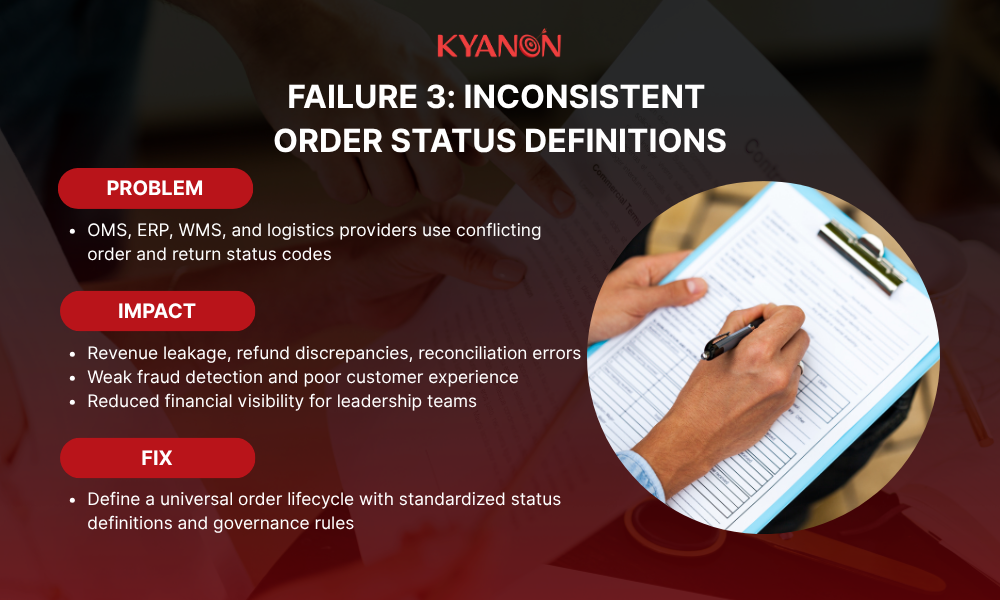
One of the most overlooked governance failures is inconsistent order status definitions across systems. While this may appear operationally minor, it is a significant source of revenue leakage and reporting inaccuracy. Forbes estimates that revenue leakage can account for up to 5% of annual earnings, often caused by discrepancies between shipped, invoiced, refunded, and collected orders.
When OMS, ERP, WMS, and logistics platforms define statuses differently, finance and customer service teams lose visibility into the actual lifecycle of an order. Terms such as shipped, refunded, cancelled, returned, or reversed are often interpreted differently between systems, creating reconciliation issues and poor customer experiences.
Inconsistent order data also weakens fraud detection and exception handling. When return statuses and fulfillment events are unreliable, analytics systems cannot accurately distinguish legitimate returns from suspicious activity. This creates operational blind spots that directly affect profitability and customer trust.
Order-to-cash data integrity audit
Order data error type | Root cause | Financial impact | Action required |
| Status Mismatch | Disconnected OMS and WMS codes. | Higher CS tickets; unrecorded refunds. | Define 7 universal status codes. |
Billing Discrepancy | Untracked carrier surcharges/overcharges. | 1% – 3% margin erosion per order (McKinsey). | Compare quoted vs. actual shipping costs. |
| Return Lag | Delayed status update from logistics. | Inventory “darkness”; tied-up capital. | Sync returns carrier data directly to ERP. |
According to IBM, order status inconsistency is a financial control problem, causing hidden daily losses and up to 5% revenue leakage due to systems that don’t share the same language. To fix this, governance requires establishing a canonical order lifecycle with agreed-upon status codes, enforcing them across all systems, and creating a data dictionary that maps every system-specific code to the master set.
Failure 4: No data ownership model
Many eCommerce data governance initiatives fail because ownership is unclear. Product, customer, and operational data are managed across multiple departments, but without defined accountability. Merchandising teams update content, IT manages infrastructure, finance oversees reporting, and eCommerce teams control pricing. When data issues appear, responsibility becomes fragmented and problems remain unresolved.
As enterprises scale AI adoption, this issue becomes even more critical. Organizations now need accountability not only for data quality, but also for how AI systems access, interpret, and act on enterprise data. Research from McKinsey & Company shows that companies with defined AI governance roles achieve stronger operational maturity and greater business impact from technology investments.
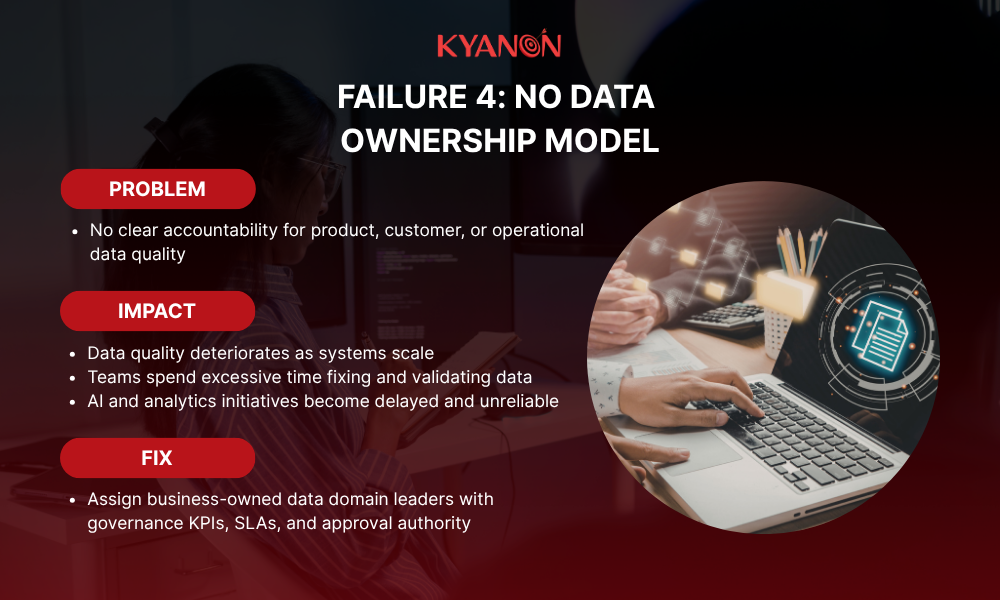
This is why data governance can no longer remain solely an IT responsibility. Enterprises need business-side ownership to define standards, approve changes, and enforce governance policies across teams. Assigning Data Domain Owners at the VP or C-suite level helps shift governance from reactive cleanup to proactive quality control.
In enterprise eCommerce transformation projects, Kyanon Digital often sees governance challenges rooted more in organizational misalignment than technology limitations. To address this, Kyanon Digital helps enterprises build governance workflows, ownership models, and cross-functional operating structures that improve data consistency, AI readiness, and long-term scalability.
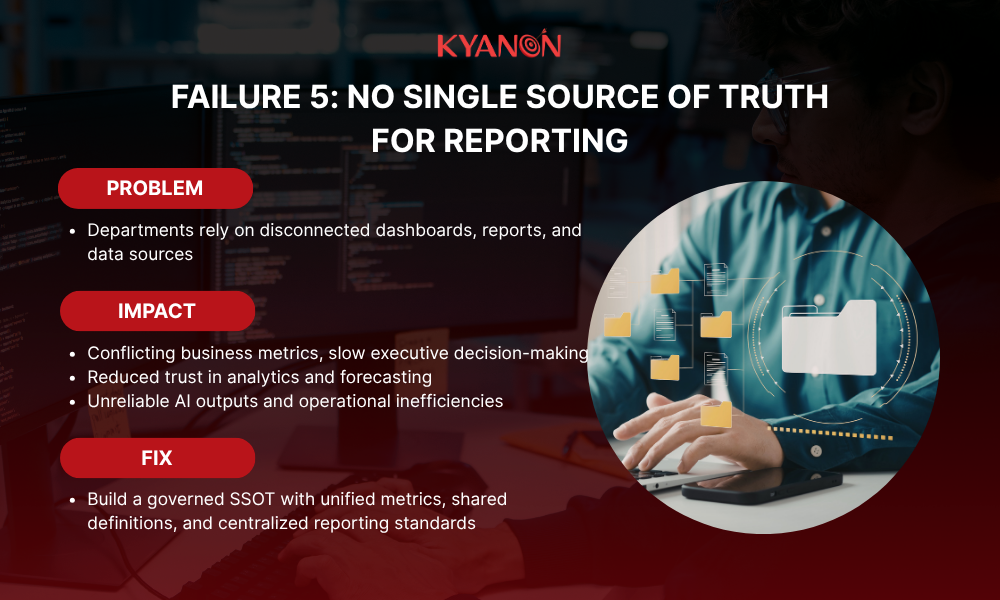
Failure 5: No single source of truth for reporting
Without a Single Source of Truth (SSOT), enterprise teams operate from conflicting datasets and inconsistent reporting logic. Marketing teams rely on analytics platforms, finance teams pull data from ERP systems, and ecommerce teams build isolated dashboards from commerce platforms. The result is a constant cycle of conflicting KPIs, duplicated reporting efforts, and low executive confidence in analytics.
These fragmented reporting environments often create what enterprises informally call dashboard wars, where teams spend more time debating numbers than making decisions. As trust in reporting declines, leaders revert to spreadsheets, manual reconciliation, or intuition-based decision-making.
Implementing a governed SSOT is not simply about rebuilding a data warehouse. It requires establishing a unified enterprise data model that every system follows. According to McKinsey & Company, while 62% of organizations are experimenting with AI agents, fewer than 10% have scaled them successfully due to fragmented systems and unreliable operational data. In the Agentic Era, a governed SSOT becomes the operational foundation that enables AI systems to act consistently and safely.
The analytics evolution matrix: From fragmentation to governance
| Reporting mode | Characteristics | Business result | ROI |
| Fragmented | Each team has a separate dashboard. | Strategic misalignment; “Dashboard Wars.” | Low; wasted analyst hours. |
| Consolidated | Data is in one place but ungoverned. | Higher volume of bad data; “Garbage In, Garbage Out.” | Negative; high risk of bad decisions. |
| Governed (SSOT) | Unified data model; agreed definitions. | High-speed, fact-based decisions; AI readiness. | 13x scaling advantage. |
A governed SSOT functions as the enterprise’s operational backbone, reducing manual reconciliation work while improving decision speed, forecasting accuracy, and AI readiness. Building this foundation requires agreement on metric definitions, ownership responsibilities, and enterprise-wide governance standards that scale consistently across channels and business units.
Why governance cannot be outsourced to a data vendor
Data-as-a-Service (DaaS) providers supply structured or enriched data via subscription, acting as external extensions for tasks where internal collection is inefficient. While DaaS assists with specialized data feeds, Kyanon Digital serves as a digital transformation partner rather than a DaaS provider. Kyanon Digital differs by managing the governance, ownership, and process layers that external data vendors cannot address.
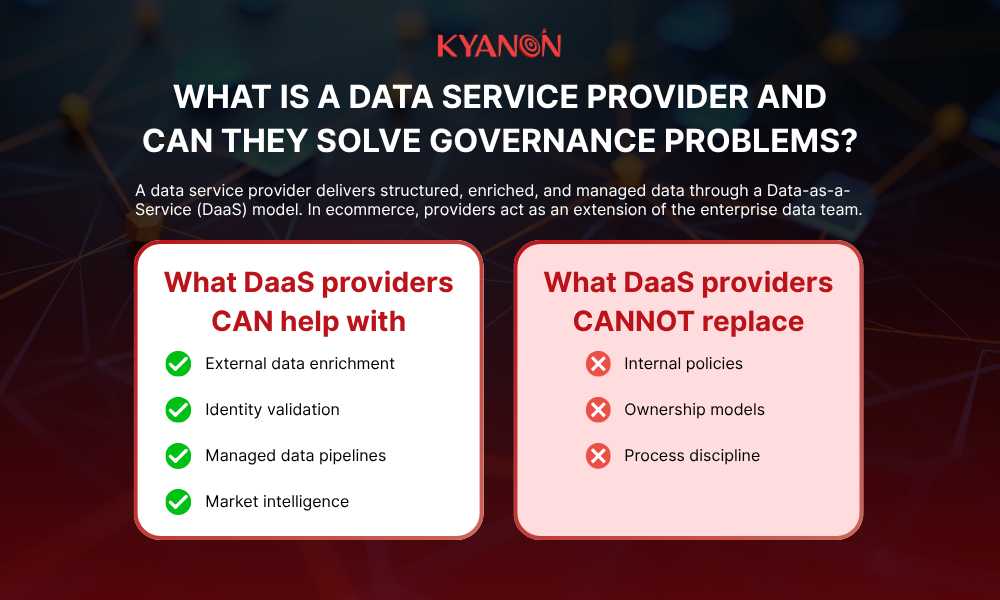
What DaaS providers can help with:
- External data enrichment: Providing missing product attributes, competitive pricing feeds, or firmographic data for B2B buyers.
- Identity validation: Verifying customer addresses in real-time to reduce shipping errors and validating tax IDs for international compliance.
- Managed data pipelines: Handling large-scale data movement between marketplaces, warehouses, and analytics systems while monitoring data quality.
- Market intelligence: Supplying macro-retail trends and “benchmarks” to help C-suite leaders understand their performance relative to the industry.
What DaaS providers cannot replace:
- Internal policies: Providers can supply clean data, but they cannot define how the enterprise classifies customers, products, or business metrics internally.
- Ownership models: Governance is about internal accountability. You cannot outsource the responsibility for how your own systems create and use data.
- Process discipline: Even high-quality external data deteriorates if internal workflows, integrations, and governance controls remain inconsistent.
A data service provider is a valuable input to a governed data architecture, not a substitute for one. C-suite leaders should view DaaS as a way to accelerate the impact of their governance framework by offloading the commodity work of data collection and enrichment, allowing the internal team to focus on strategic data ownership and business-aligned definitions.
How to build an eCommerce data governance foundation
Building a strong data governance foundation is not a one-time transformation project. It requires a long-term operational shift in how the enterprise manages, standardizes, and governs information across systems. Organizations that succeed typically move away from fragmented innovation initiatives and instead focus on unified, scalable governance capabilities that support both operational efficiency and AI readiness.
The four pillars of ecommerce data governance
| Pillar | Strategic focus | Expected business outcome |
| Data Ownership | Assigning C-suite/VP accountability for specific domains (Product, Customer, Order). | Eliminates “passing the bucket”; ensures long-term data health. |
Data Standards | Defining canonical definitions, formats, and valid ranges for all critical fields. | Cross-system consistency; 20% reduction in analytics errors. |
| Data Quality SLAs | Establishing thresholds for accuracy, completeness, and timeliness per domain. | Prevents $100M+ revenue losses from data ingestion errors. |
Change Management | Formalizing how changes to data models are approved and communicated. | Prevents “silent” system breaks during platform upgrades or market expansion. |
Starting with a Governance Audit
To transition from chaos to control, the Head of Commerce or CTO should initiate a Governance Audit focused on the five failure modes. This audit should assess each domain (Product, Customer, Order, Supplier, Inventory) across three dimensions:
- Ownership clarity: Is there a named business leader responsible for this data?
- Standardization: Does a written, system-agnostic definition exist for every critical field?
- Measurement: Is data quality monitored continuously, or only investigated after reporting issues appear?
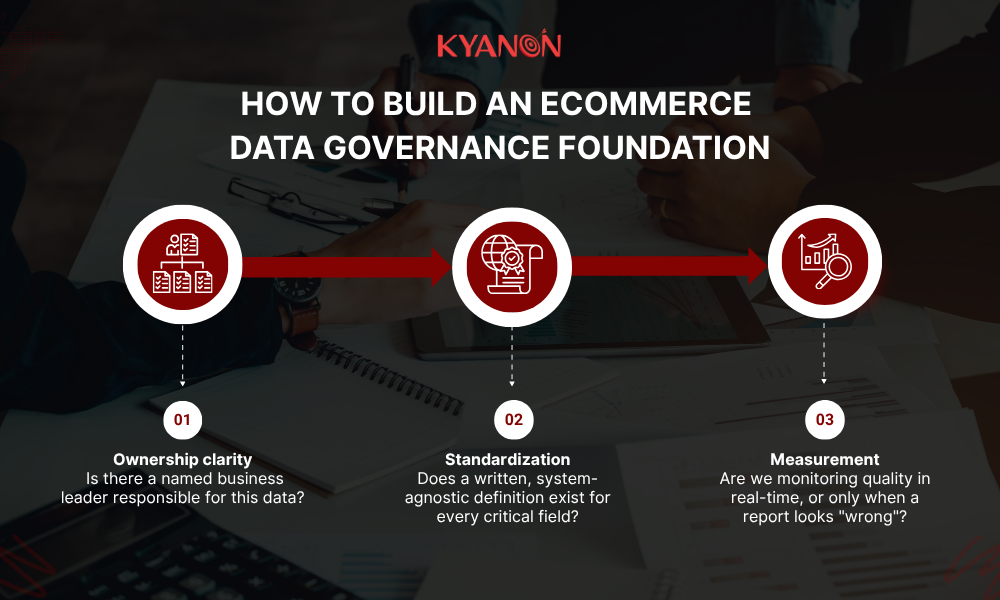
By scoring governance maturity across these dimensions, enterprises can identify the highest-impact gaps and prioritize improvements incrementally. In many organizations, customer identity resolution or order lifecycle standardization delivers the fastest measurable business impact. This phased approach helps organizations build internal trust, demonstrate operational value early, and scale governance initiatives more effectively across the enterprise.
How Kyanon Digital helps enterprise eCommerce teams build data governance
Kyanon Digital is a digital transformation partner implementing data governance for eCommerce enterprises in Singapore, ANZ, and the UK. The company focuses on production-ready solutions that treat governance as the foundation for successful AI and analytics investments.
Kyanon Digital’s service context includes:
- Governance strategy & roadmapping: Aligning technology goals with architectural strategies to guide the transformation journey.
- Data modeling & warehousing: Building governed data environments that serve as the Single Source of Truth for reporting and AI.
- Identity resolution & CDP implementation: Unifying customer identities across web, app, and offline touchpoints to address fragmented customer profiles.
- PIM & taxonomy governance: Implementing systems to manage complex product data and ensure machine-readability for GEO and AI agents.
Case study: How Kyanon Digital built a scalable eCommerce system for Coway

The Coway project illustrates how targeted digital transformation can fix operational data failures at their source. This specific implementation resolved two major governance gaps: it standardized order status definitions via automated sales and commission tracking and unified product taxonomies through centralized administrative controls.
Kyanon Digital partnered with Coway, a global leader in water and air purifiers, to build a future-ready eCommerce platform that unified online operations and improved omnichannel sales management.
The Challenge:
Coway struggled with managing an omnichannel presence. They lacked a robust infrastructure to track sales, manage agent commissions, and provide a seamless customer journey across diverse markets. Internal inefficiencies in data tracking were preventing the company from scaling its digital consumer demand effectively.
The Solution:
Kyanon Digital implemented a comprehensive digital hub using a .NET and ReactJS stack, hosted on AWS. The solution included:
- Integrated agent management: Unified commission and sales tracking within the commerce system, reducing inconsistencies in order status handling.
- Advanced admin portal: Providing administrators with full control over product listings and SEO, ensuring taxonomy consistency at the source.
- Composable architecture: A modular design that allows for future updates and expansion without breaking existing workflows.
The Impact:
- Enhanced customer experience: A seamless and smooth purchasing journey that boosted satisfaction and conversion rates.
- Operational efficiency: A 50-70% reduction in manual operational tasks through automated data flows.
- Scalability: The platform now supports rapid promotion launches and inventory updates, allowing Coway to adapt to market trends in real-time.
Read more: E-Commerce System For Coway
Conclusion: Building a governance foundation for the AI-driven commerce era
As enterprise eCommerce shifts toward AI-first and agent-driven operating models, data governance becomes a core enabler of scalable intelligence rather than a back-end IT concern. Autonomous systems, real-time personalization, and predictive analytics depend on consistent, governed, and machine-readable data foundations.
For commerce leaders, the strategic priorities are:
- Governance before AI scale: Reliable AI requires a Single Source of Truth (SSOT), standardized taxonomies, and resolved identities.
- Data as a business asset: Move beyond IT silos by assigning business ownership to customer, product, and order domains.
- Operational ROI over complexity: Prioritize fixing foundational issues like duplicate identities and fragmented reporting over advanced tech.
- Scalable architectures: Adopt modular, governed frameworks to support omnichannel growth and AI-driven models.
The shift away from fragmented dashboards, inconsistent metrics, and manual reconciliation is accelerating. In the Agentic Era, competitiveness will increasingly depend on how reliably enterprises can structure, govern, and operationalize their data.
Kyanon Digital supports enterprises in designing governance-first commerce architectures, including identity resolution systems, data platforms, and AI-ready digital foundations. For organizations exploring how to operationalize trusted data at scale, the first step is typically a governance readiness assessment to identify fragmentation points and define a phased modernization roadmap. Contact Kyanon Digital.








 Create project brief with AI