

Speaking at the 2023 Year-End Party, Tai Huynh, CEO of Kyanon Digital, highlighted the company’s direction for 2024 with the core theme of “Autonomy & Sustainability.”
Nearly halfway through 2024, various departments at Kyanon Digital have shown great adaptability and quick learning in embracing this mindset. This set the perfect stage for the return of Leader’s Talk #8, where Tai shared deep insights into autonomy and how to build a truly autonomous team.
Key highlights from Leader’s Talk #8: “Understanding & Building Team Autonomy”:
What autonomy actually means
- It’s about managing project outcomes, not micromanaging the people on the team.
- It doesn’t mean total freedom to just do whatever you want individually.
Autonomy vs. Alignment
- True autonomy is the freedom to contribute within your skill set, essentially, freedom within clear guardrails.

The different levels of autonomy
- Applying the “7 Levels of Delegation” when empowering teams
What is autonomy?
Following a case study video screening titled “Role of leadership in employee engagement” by Simon Sinek / Noah from Spotify, Mr. Tai shared the definition of Autonomy from Wikipedia: “Autonomy is the capacity to make an informed, uncoerced decision.” According to ChatGPT, autonomy is the freedom and ability to decide how you execute your work.
In project management, autonomy means focusing on project control (deadlines, deliverables, etc.) rather than controlling people. Therefore, to build an autonomous team, managers should focus on goals and output quality, while letting team members choose how to get the job done. Tai shared a relatable example based on the services Kyanon Digital (KD) provides to clients. When working with partners, the KD team focuses heavily on the final deliverables, proposing the right digital applications to meet client goals. However, deciding how to build it and which tools or tech stack to use is entirely up to Kyanon Digital.
To be clear, autonomy does not mean total freedom to do whatever you want. Autonomy within a team means members are free to operate within their capabilities to contribute to a shared goal. Members think, decide, and plan with the team, but always within boundaries and their own scope. In an ideal daily standup, each member proactively shares what they achieved last week or yesterday, what they are tackling today, and how their tasks drive the overall sprint goals.
For example, if the sprint goal for the next two weeks is to build user login and ordering features, autonomy shows when members actively report in daily meetings: “Yesterday I completed Feature A, today I am moving on to Feature B, and here is how they both support our sprint goal.” Conversely, a member who remains passive, waiting around to be assigned tasks instead of taking initiative, lacks an autonomous mindset.
“Within boundaries” means that once the team’s shared goal is clear, each member organizes and breaks down tasks based on their specific role (Front-end, Back-end, etc.). The same applies to working “within your capabilities.”
Autonomy and alignment
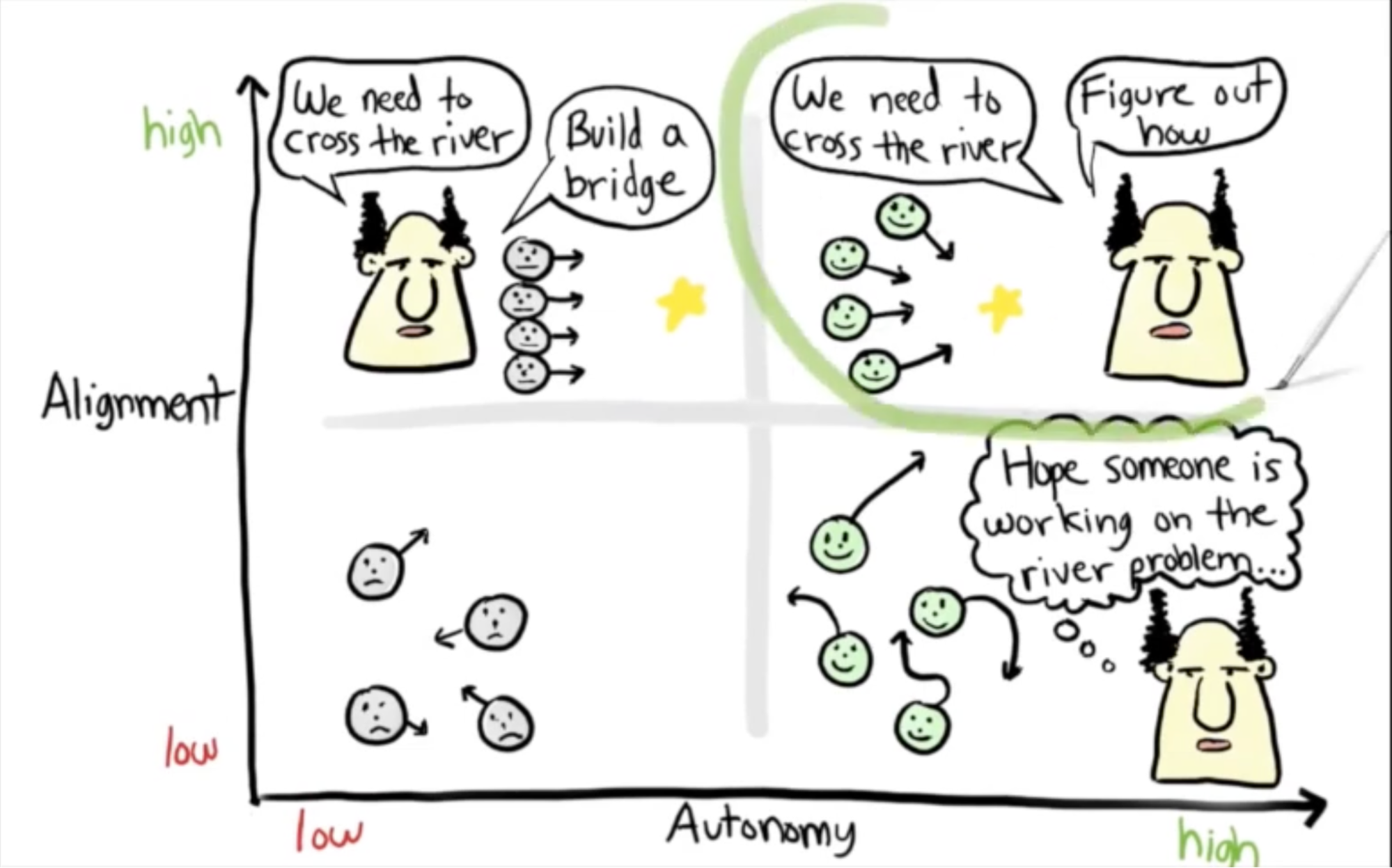
Referencing Henrik Kniberg’s video on “Autonomy – Alignment,” Kyanon Digital aims for a “High Autonomy – High Alignment” environment. This means everyone is fully aligned on the shared goal while remaining autonomous and free in how they execute their part.
For instance, in the video, a leader sets the goal (the WHAT): “We need to cross the river.” The team then figures out the HOW, whether to build a bridge, swim across, or find another way. In situations where team members lack the experience to cross that river, the leader steps in with guidance, shifting temporarily to a “High Alignment – Low Autonomy” model. However, this is just the first step toward eventually reaching High Alignment – High Autonomy.
To foster autonomy, leaders must align with their teams on the ultimate goal and clearly explain why it needs to be done. This empowers members to work more effectively or even discover smarter ways to hit the target.

- Autonomy and alignment
Boundaries and limitations
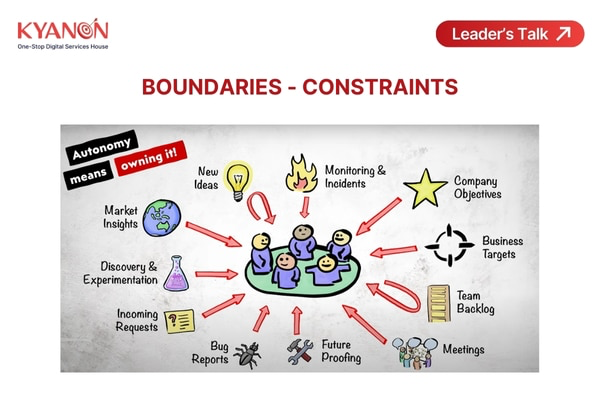
Following up on the idea of autonomy within boundaries, or “freedom within a framework,” the primary boundary in an organization involves aligning individual initiatives with the company’s bigger goals and guardrails (such as budgets, corporate plans, etc.).
Zooming into a team level, taking initiative must align with the team’s development roadmap or OKRs. Furthermore, autonomy must co-exist with security protocols, quality assurance standards, client communication guidelines, and documentation practices.
Using Dave Snowden’s example of organizing a children’s party through the video “ How to Organize a Children’s Party, there are three problem-solving approaches:
- Order system: Everything follows a strict process and is heavily controlled.
- Chaotic system: Chaos where everyone does whatever they want, creating massive risks.
- Complex system: A complex approach that allows flexibility while keeping things under control.
In an organization, we need to manage through a “complex system” because people have different values, life principles, and social dynamics, unlike pre-programmed machines or robots. Much like an ideal Scrum Master, leaders should step back and observe how the team operates as a whole, rather than micromanaging every single move a team member makes.
To be truly autonomous, each team member needs to own their work completely while ensuring they stay aligned with company goals, the team’s current backlog, incident management, and bringing new ideas based on market insights with an experimental mindset.
- Boundaries and limitations
Levels of autonomy
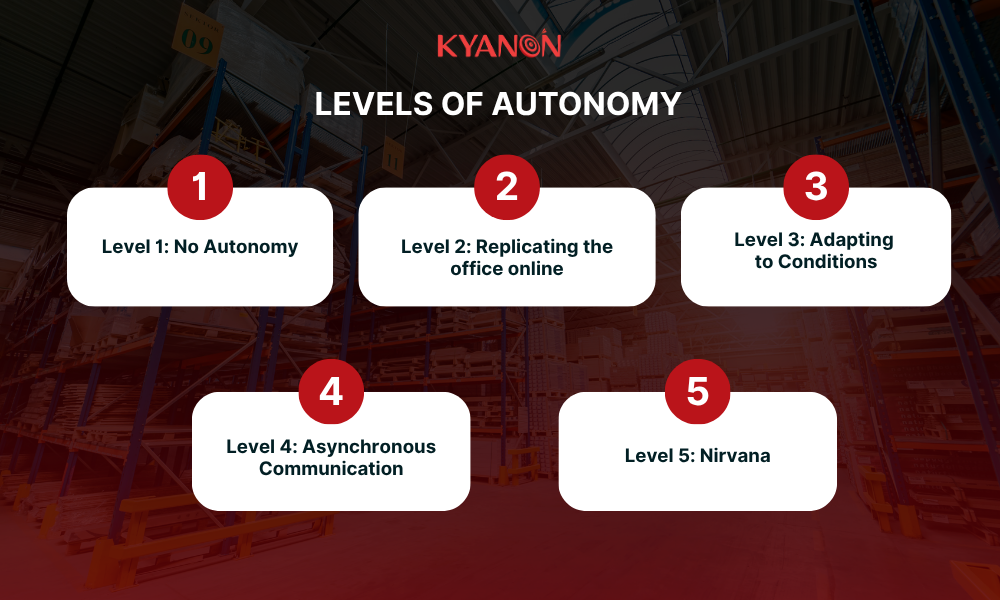
- Level 1: No autonomy: Employees must commute to the office and sit at their designated desks to work. The company lacks remote-work policies or support.
- Level 2: Replicating the office online: Remote work options are introduced, but with little to no adjustments for a true remote setup. High disruptions and heavy synchronous communication are still required to get things done.
- Level 3: Adapting to conditions: The company starts documenting processes and investing in equipment to make remote work smoother.
- Level 4: Asynchronous communication: The team reaches an “asynchronous communication” stage. Members no longer need to be in the same place at the same time to collaborate effectively. Instead, communication becomes purposeful and proactive. For example, instead of waiting for a live meeting to start a discussion, updates or approval requests can be shared via email or chat beforehand. This minimizes synchronous meetings, saves time, and boosts overall productivity.
- Level 5: Nirvana: The organization consistently operates at peak efficiency, matching or exceeding the productivity of the traditional in-office model (Level 1).
- Levels of autonomy
Delegation with boundaries and clarity
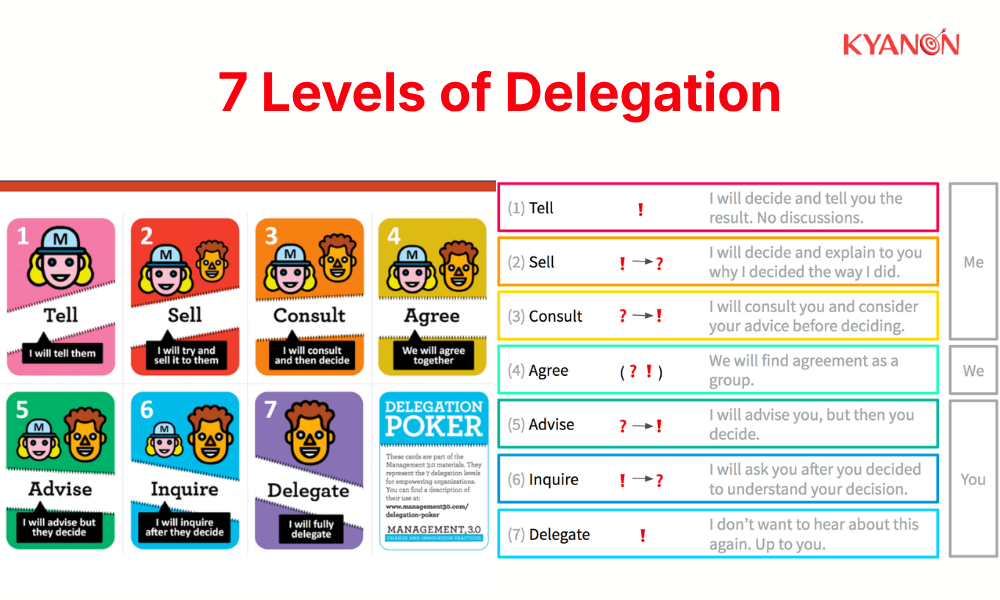
Leaders can start building autonomy by empowering employees using the “7 Levels of Delegation” framework. For each specific task, the leader and team member should agree on the level of delegation (from lowest to highest):
- Level 1: Tell – The leader makes the decision completely without prior discussion; team members simply execute it.
- Level 2: Sell – The leader makes the decision but explains the goals and reasoning to the team before they execute it.
- Level 3: Consult – The leader still makes the final call but gathers and considers input from team members first.
- Level 4: Agree – The leader and team members must reach a mutual consensus to make a decision.
- Level 5: Advise – The leader guides and offers advice, but leaves the final decision up to the team members.
- Level 6: Inquire – Team members have full decision-making power, and the leader checks in afterward to understand the choice.
- Level 7: Delegate – Team members take full ownership, and the leader plays no role in the task.
- Delegation with boundaries and clarity
Leader’s Talk #8 wrapped up with active participation and insights from over 30 managers and key members at Kyanon Digital alongside Tai Huynh.
We hope this article offers fresh ideas and references for your personal and departmental growth. Stay tuned for the topic of Leader’s Talk #9!




 Create project brief with AI