
What is a 3D convolutional neural network?
A 3D convolutional neural network (3D CNN) is a deep learning architecture that applies three-dimensional mathematical filters to extract spatial and temporal features from volumetric data, such as medical scans, video sequences, and 3D modeling representations. By computing across width, height, and depth simultaneously, the model preserves the contextual relationships between adjacent layers in a volume.
How a 3D convolutional neural network works
Unlike standard image models that process flat grids, a 3D convolutional neural network mathematically convolves filters across three dimensions to capture volumetric geometry or temporal motion. This structural approach ensures the algorithm identifies patterns that span across multiple frames or slices, which is a fundamental requirement for continuous sequence analysis.
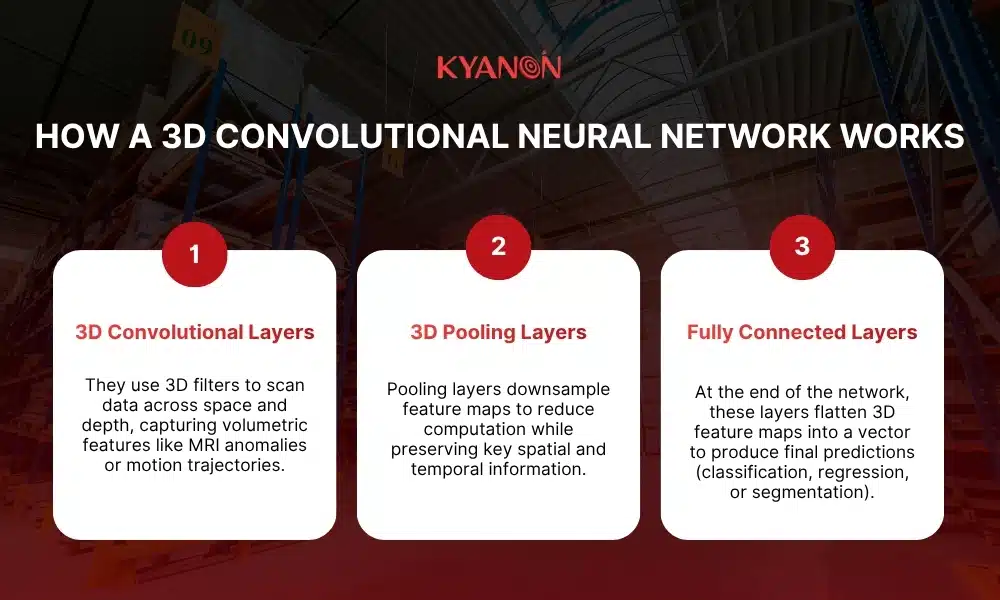
3D Convolutional Layers
These layers utilize three-dimensional filter kernels that slide across the spatial and depth dimensions of the input tensor. This mechanism captures localized volumetric features, such as the exact shape of an anomaly in an MRI or the trajectory of a moving object in a security feed.
3D Pooling Layers
Pooling layers reduce the spatial and temporal dimensions of the feature maps, systematically decreasing the computational load. They perform downsampling operations while retaining the highest-value structural or temporal information extracted by the prior convolutional operations.
Fully Connected Layers
Positioned at the end of the network architecture, these layers flatten the high-level 3D feature maps into a one-dimensional vector. They aggregate the extracted multi-dimensional patterns to compute the final classification, regression, or segmentation prediction.

3D convolutional neural network vs 2D Convolutional Neural Network
Both architectures automate visual data analysis, but they differ fundamentally in dimensional capacity and the resulting infrastructure requirements.
Dimension | 3D Convolutional Neural Network | 2D Convolutional Neural Network |
| Data input format | Volumetric grids (Voxels, videos) | Flat pixel grids (Images) |
Feature extraction | Spatial and depth/temporal | Spatial only (Width, Height) |
| Computational cost | Exponentially high (Cubic scaling) | Moderate (Quadratic scaling) |
Memory requirement | High bandwidth required | Standard bandwidth |
| Best for | Medical imaging, Action recognition | Image classification, Object detection |
When to Consider a 3D convolutional neural network
Consider a 3D convolutional neural network if:
- Your engineering team needs to automate defect detection on complex, multi-layered manufactured parts using multi-angle volumetric scanning.
- You are developing temporal sequence analysis models, such as tracking human motion or mechanical behavior over time in continuous video feeds.
- Your organization processes dense medical imaging (like CT or MRI scans) where contextual depth between spatial slices dictates diagnostic accuracy.
It may not be the right priority if:
- Your data pipeline consists primarily of sparse, unstructured 3D data like LiDAR point clouds, which require different inductive biases better suited for Graph Neural Networks.
Why a 3D convolutional neural network Matters for Healthcare and Manufacturing
Adopting a 3D convolutional neural network directly impacts the precision of automated analysis in environments where depth, volume, and time dictate operational outcomes.
According to a 2022 study by the Radiological Society of North America (RSNA), implementing 3D CNN architectures reduces false-positive rates in volumetric scan analysis by up to 30% compared to traditional 2D slice processing. A European medical technology firm used a 3d convolutional neural network to analyze continuous MRI sequences, resulting in a 40% faster anomaly detection pipeline for their radiology departments. This demonstrates how volumetric architecture translates from theoretical depth processing to measurable clinical efficiency.
Common misconceptions
Transitioning from 2D to 3D CNNs is a simple structural extension with minimal operational impact
Reality: Adding a third dimension scales memory and computational costs cubically, not linearly. Processing voxel grids requires specialized hardware accelerators and significantly more memory bandwidth to avoid rapid infrastructure bottlenecks.
3D CNNs natively handle any type of 3D data input
Reality: A 3d convolutional neural network is exclusively optimized for structured, dense volumetric grids like medical scans or video frames. The architecture does not naturally align with unordered spatial data like point clouds, which require extensive preprocessing to convert into voxel formats.
How Kyanon Digital Applies 3D convolutional neural network
Kyanon Digital implements 3D convolutional neural network architectures using enterprise-grade frameworks for clients in healthcare, manufacturing, and media across Southeast Asia and APAC. Our machine learning approach focuses on optimizing the cubic computational load through strict model pruning and efficient data pipeline engineering, ensuring that volumetric computer vision deployments yield high predictive accuracy while maintaining sustainable infrastructure costs.
→ Explore our Data & AI Consulting Services: https://kyanon.digital/development/artificial-intelligence/

 Create project brief with AI