
What is a Convolutional Neural Network?
A Convolutional Neural Network (CNN) is a specialized deep learning architecture designed to process grid-like data, such as digital images, by applying mathematical filters to automatically extract and identify visual features. It eliminates the need for manual feature engineering by learning spatial hierarchies directly from pixel input arrays.
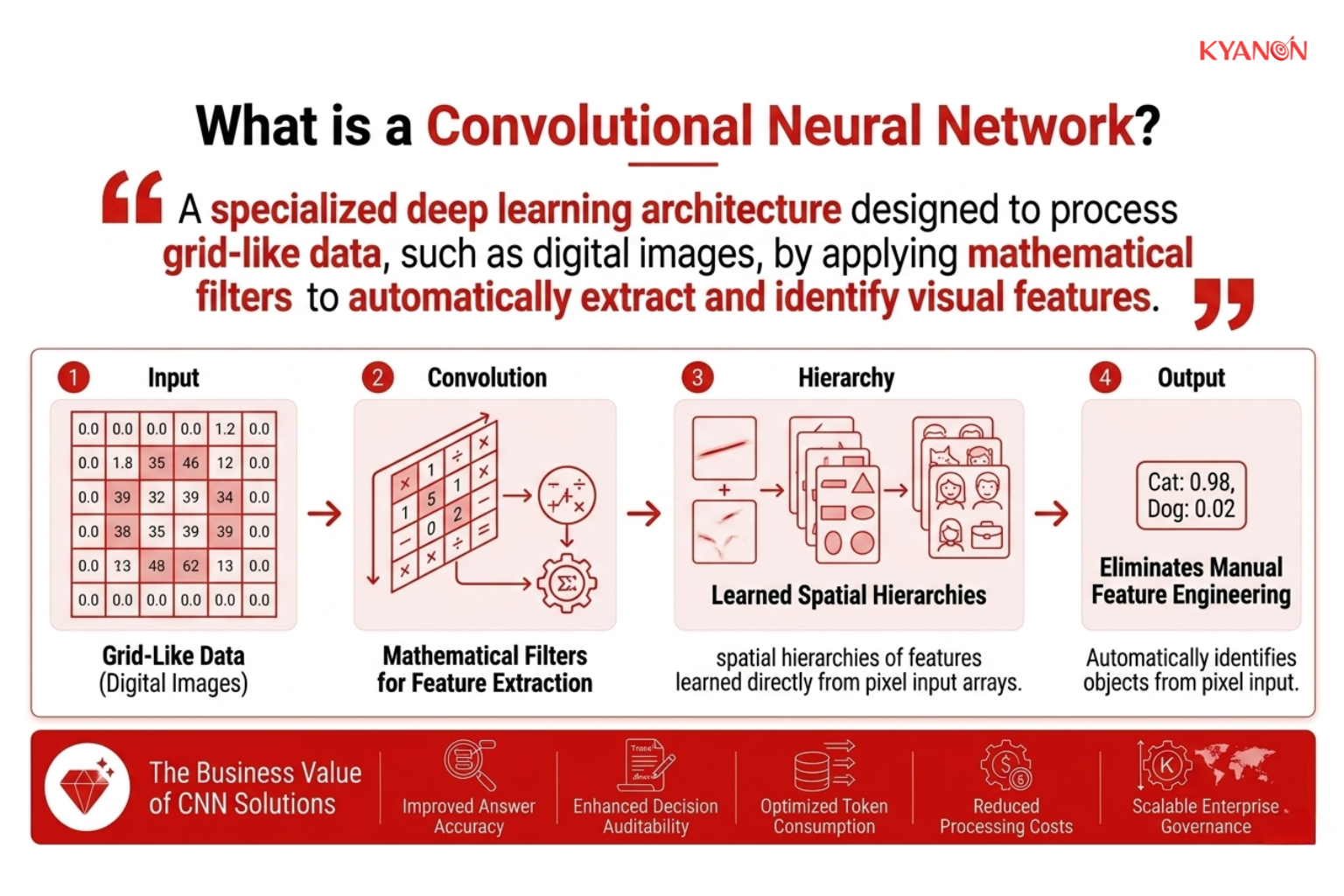
Unlike traditional computer vision systems that depend on manually programmed rules, CNN learns visual relationships directly from data. The network gradually moves from identifying simple visual signals to recognizing complex structures such as damaged products, facial features, packaging labels, or manufacturing defects. This ability to learn directly from images is what made CNN the dominant foundation of modern computer vision systems.
Today, CNN supports a wide range of enterprise use cases across manufacturing, logistics, healthcare, retail, and digital commerce. Organizations use them to automate visual inspection, classify products, detect anomalies, monitor operational environments, and improve real-time decision-making at scale.
As enterprise operations become increasingly digital and image-driven, CNN has evolved from research-focused AI models into production-grade infrastructure for operational automation.
How a Convolutional Neural Network Works
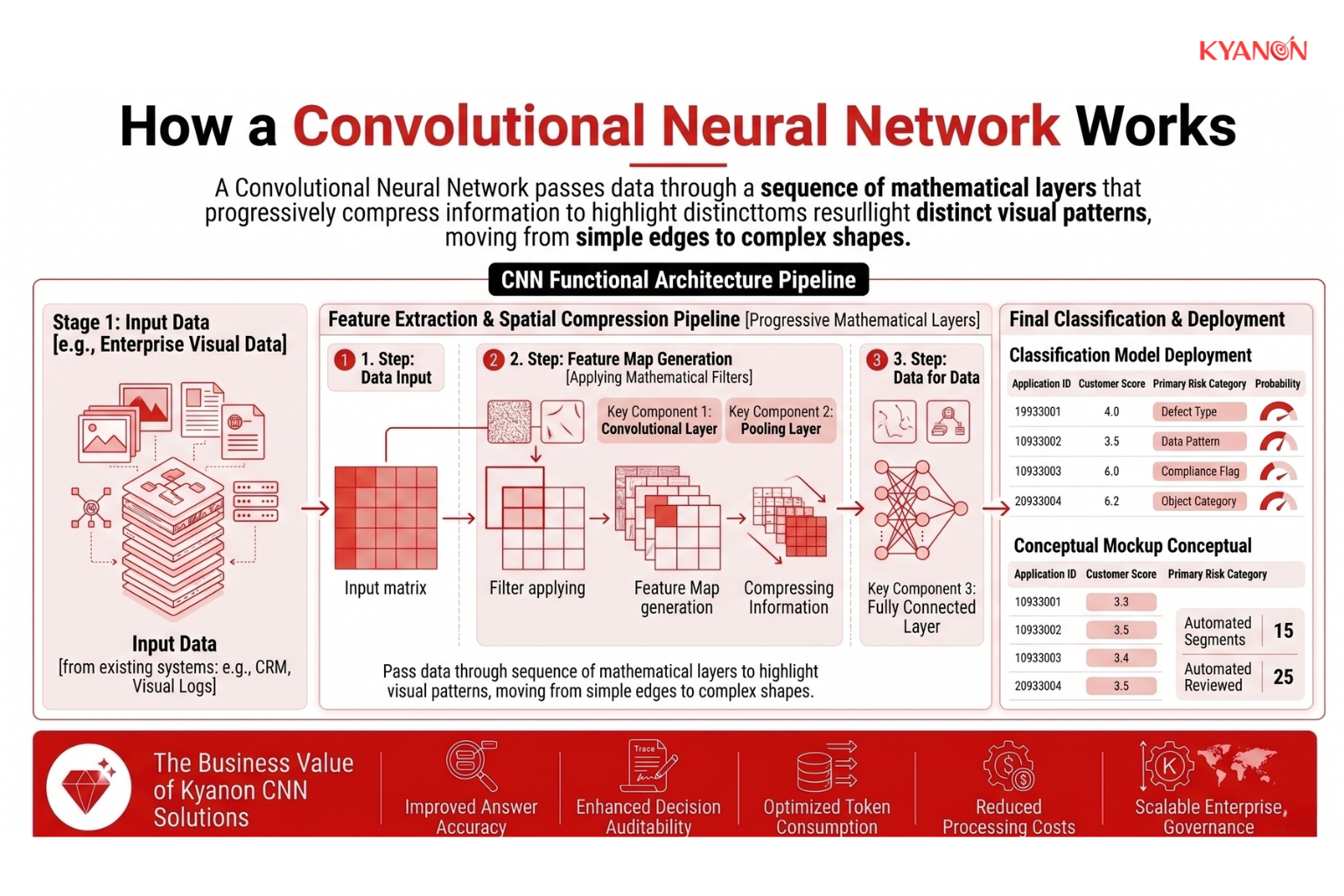
A Convolutional Neural Network processes images through multiple computational layers that progressively transform raw pixel information into structured business insights. Rather than analyzing an image as a single object, the network gradually extracts and condenses visual information step by step.
While the underlying mathematics can become highly complex, the conceptual workflow can be simplified into three major architectural layers.
Key Component 1: Convolutional Layer
The convolutional layer acts as the feature extraction engine of the network. It scans localized regions of an image using small mathematical filters that identify visual characteristics such as edges, textures, contours, color transitions, and object boundaries.
As data moves deeper into the network, CNN gradually learns increasingly sophisticated visual relationships. Early layers may detect simple shapes or contrast changes, while deeper layers identify more meaningful structures such as product defects, vehicle outlines, damaged packaging, or specific industrial components.
This layered learning structure is particularly valuable in enterprise environments where visual conditions constantly change. CNN can still recognize important patterns even when images vary slightly in lighting, angle, scale, or positioning.
From a business perspective, convolutional layers enable organizations to automate visual tasks that previously required highly repetitive manual inspection.
Key Component 2: Pooling Layer
After features are extracted, the pooling layer compresses the information into a smaller and more computationally efficient representation. This step helps the network focus on the most important visual signals while reducing unnecessary pixel-level detail.
Pooling improves both speed and scalability. By condensing the data, the model becomes more efficient to train and faster to deploy in real-world operational environments.
This process also improves the model’s ability to recognize objects consistently even when their position shifts slightly inside the image frame. For example, a scratch on a manufactured product may appear in different locations across thousands of images, but the CNN can still identify it reliably.
For enterprises deploying AI systems at scale, pooling layers are critical because they support:
- Lower computational requirements
- Faster inference speed
- Edge-device deployment
- Real-time operational processing
This efficiency advantage is one reason CNN remains highly practical for smart cameras, IoT devices, warehouse automation systems, and industrial inspection infrastructure.
Key Component 3: Fully Connected Layer
The fully connected layer serves as the decision-making stage of the CNN architecture. At this point, the network combines all extracted features and converts them into classification probabilities or predictive outputs.
In enterprise applications, this final stage determines what the image actually represents from a business perspective. The system may classify whether:
- A product passes quality inspection
- A package is damaged
- A barcode matches inventory records
- A manufacturing component contains defects
The output can then trigger automated workflows across operational systems. In production environments, CNN classifications often connect directly to ERP platforms, warehouse systems, manufacturing execution systems, or automated alerting infrastructure.
The real business value of CNN emerges here, not simply from image recognition itself, but from the ability to transform visual data into automated operational decisions.

Convolutional Neural Network vs Vision Transformer (ViT)
Both CNN and Vision Transformers process visual data for AI applications, but they differ significantly in operational design philosophy and infrastructure requirements.
CNN analyzes localized image regions progressively, making them highly efficient for real-time operational environments. Vision Transformers, by contrast, process broader contextual relationships across image segments using attention mechanisms that require substantially larger computing resources.
For many enterprise environments, CNN remains the preferred architecture because they are easier to optimize for production deployment and require less computational overhead.
Dimension | Convolutional Neural Network (CNN) | Vision Transformer (ViT) |
| Data processing mechanism | Local pixel convolutions | Global self-attention across image patches |
Training data requirement | High | Exceptionally high |
| Hardware efficiency (Edge) | Highly optimized | Resource-intensive |
Handling spatial hierarchy | Translation equivariant natively | Requires explicit positional embeddings |
| Best enterprise use case | Real-time defect detection, mobile AI | Large-scale image generation, complex context analysis |
While Vision Transformers continue gaining attention in advanced AI research, CNN remains dominant in practical industrial computer vision because of their operational maturity, inference speed, and infrastructure efficiency.
When to Consider a Convolutional Neural Network
Consider a Convolutional Neural Network if:
- Your manufacturing facilities require real-time, automated visual inspection systems to identify microscopic product defects on high-speed assembly lines.
- Your retail or e-commerce platform needs to automatically categorize thousands of inbound supplier images into a standardized product taxonomy without manual data entry.
- Your logistics operations rely on automated license plate recognition or container code extraction from field cameras operating under variable lighting conditions.
It may not be the right priority if:
- Your primary data infrastructure relies entirely on structured tabular data, such as ERP financials or CRM records, which require tree-based machine learning models rather than computer vision architectures.
Why Convolutional Neural Network Matters for Enterprise Operations
Many operational processes still rely heavily on human visual inspection. Manufacturing teams inspect product quality manually, warehouse workers verify packaging conditions, retailers organize large product catalogs by hand, and logistics operators monitor assets across distributed environments.
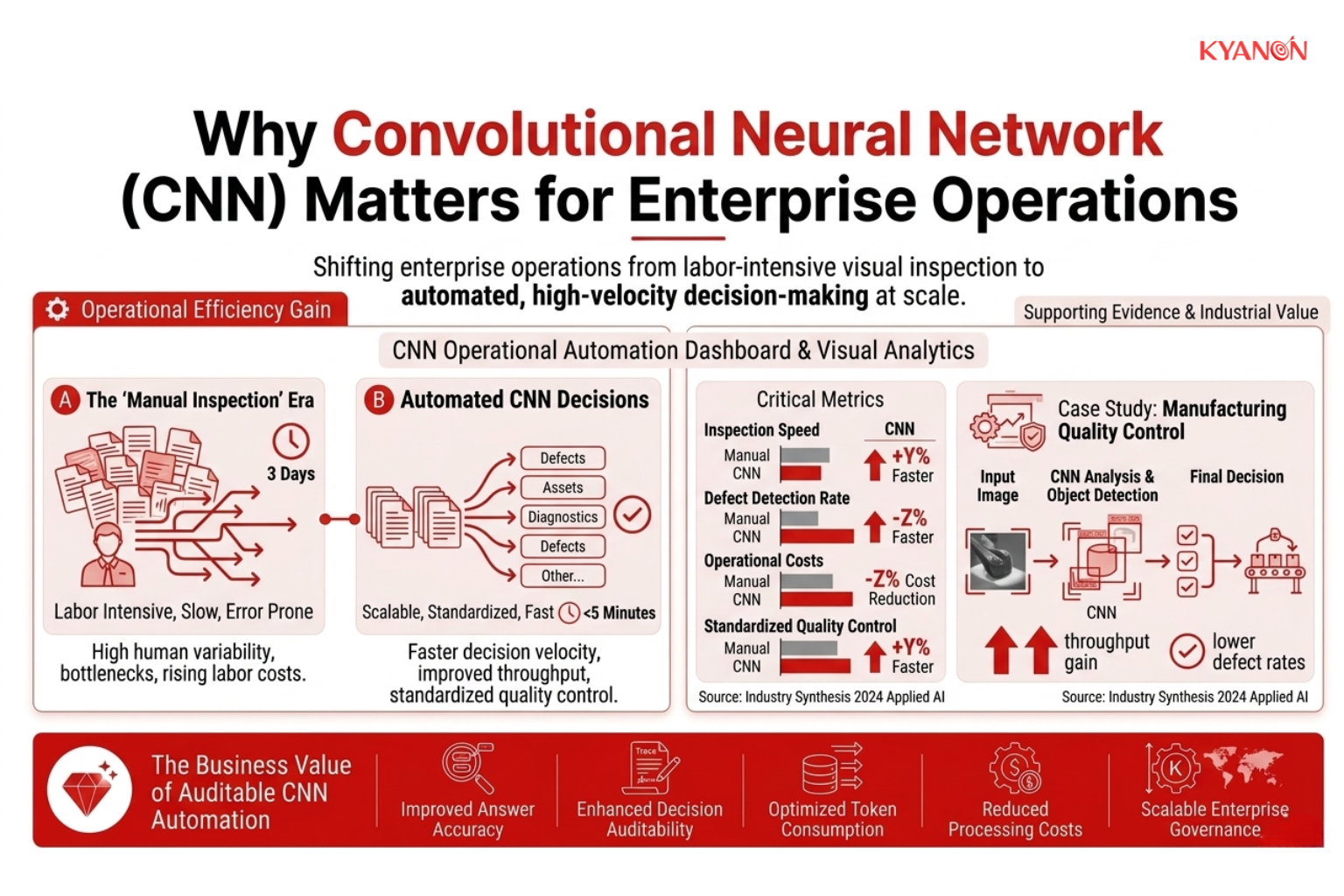
These processes become increasingly difficult to scale as organizations grow. Human inspection introduces variability, labor costs rise, and operational bottlenecks emerge when visual workflows cannot keep pace with production volume.
Traditional automation systems struggle in these environments because they rely on rigid rules that cannot adapt effectively to changing lighting conditions, surface textures, product variations, or unpredictable real-world scenarios.
CNN solved this differently. Instead of following predefined visual rules, they learn directly from image data and continuously improve their ability to recognize patterns through training. This enables organizations to automate tasks that previously depended almost entirely on human judgment.
For enterprise leaders, the strategic value of CNN deployment extends beyond technical innovation. CNN-driven automation can improve throughput, standardize quality control, reduce inspection costs, strengthen operational visibility, and support scalable AI-driven operations.
The table below illustrates how CNN typically create operational value across industries:
Enterprise Area | Operational Challenge | CNN Business Impact |
| Manufacturing | Manual defect inspection | Faster quality control and lower defect rates |
Retail & E-commerce | Large product catalog management | Automated product classification and tagging |
| Logistics | Package and asset verification | Real-time tracking and reduced manual handling |
Healthcare | High-volume medical imaging analysis | Faster diagnostic support workflows |
| Smart Surveillance | Large-scale visual monitoring | Automated anomaly and safety detection |
As labor shortages and operational complexity continue increasing globally, CNN is becoming a foundational layer for enterprise automation initiatives.
Common Misconceptions
Misconception 1: “The network understands the image structure exactly like a human inspector does.”
Reality: A Convolutional Neural Network primarily recognizes local texture and pixel correlations rather than global geometric logic; it identifies an object by detecting enough localized patterns (like surface textures) rather than comprehending its holistic, physical shape.
Misconception 2: “Deeper networks with more layers will automatically yield higher accuracy for our application.”
Reality: Beyond an optimal threshold, excessively deep networks suffer from optimization failures such as the vanishing gradient problem. Improving performance requires specific structural optimizations rather than simply stacking arbitrary computational layers.
How Kyanon Digital Applies Convolutional Neural Networks
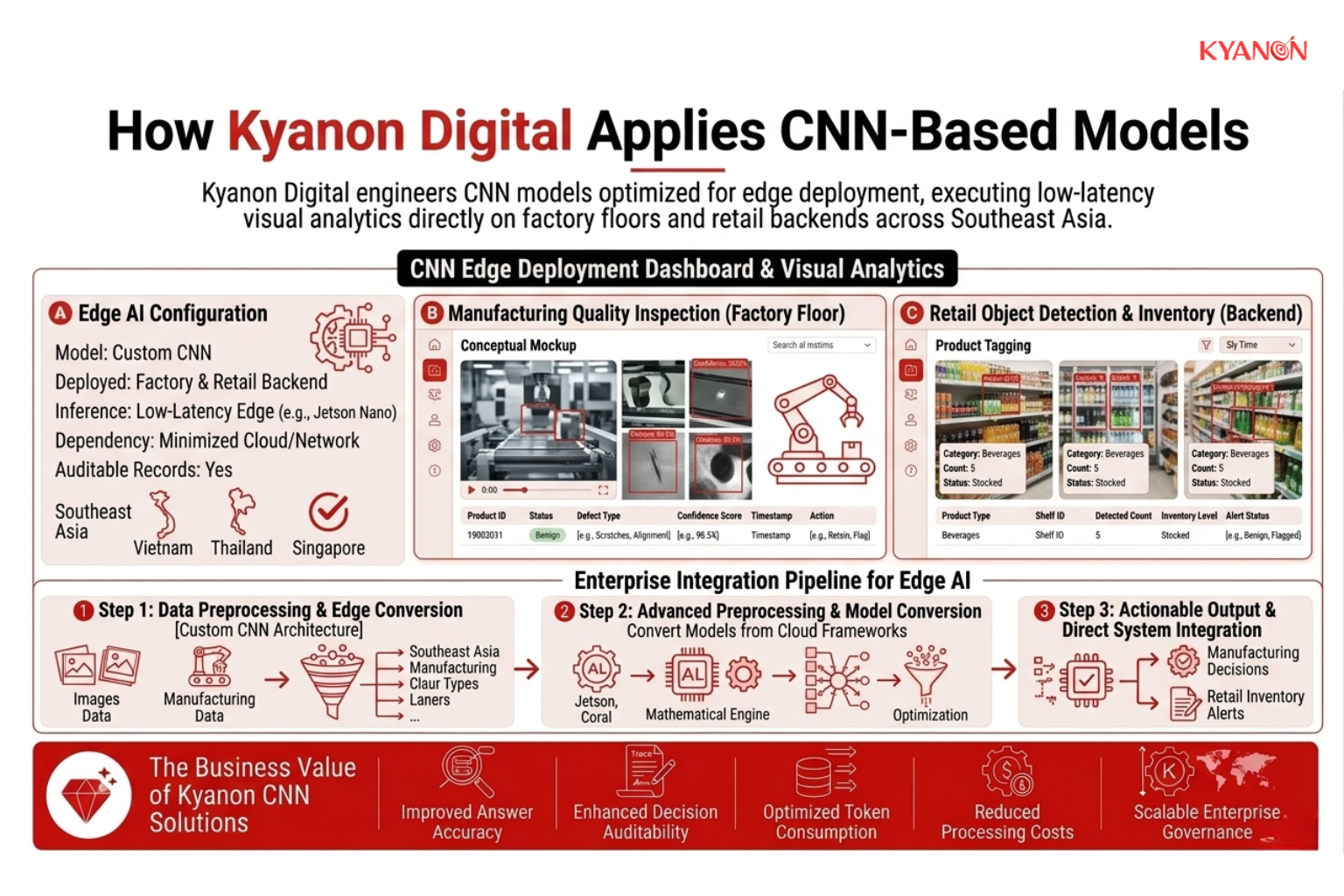
Kyanon Digital helps organizations transform computer vision from isolated experimentation into production-grade enterprise capability. Our teams support the full operationalization lifecycle, from AI architecture assessment and edge deployment strategy to ERP/WMS/MES integration and long-term infrastructure modernization.
→ Explore our Machine Learning Development services.

 Create project brief with AI