
What is bias?
Bias in machine learning is a systematic error that occurs when an algorithm produces prejudiced results due to flawed assumptions in the modeling process or unrepresentative training data. It fundamentally skews predictive outcomes, resulting in decisions that are statistically inaccurate or unintentionally discriminatory.
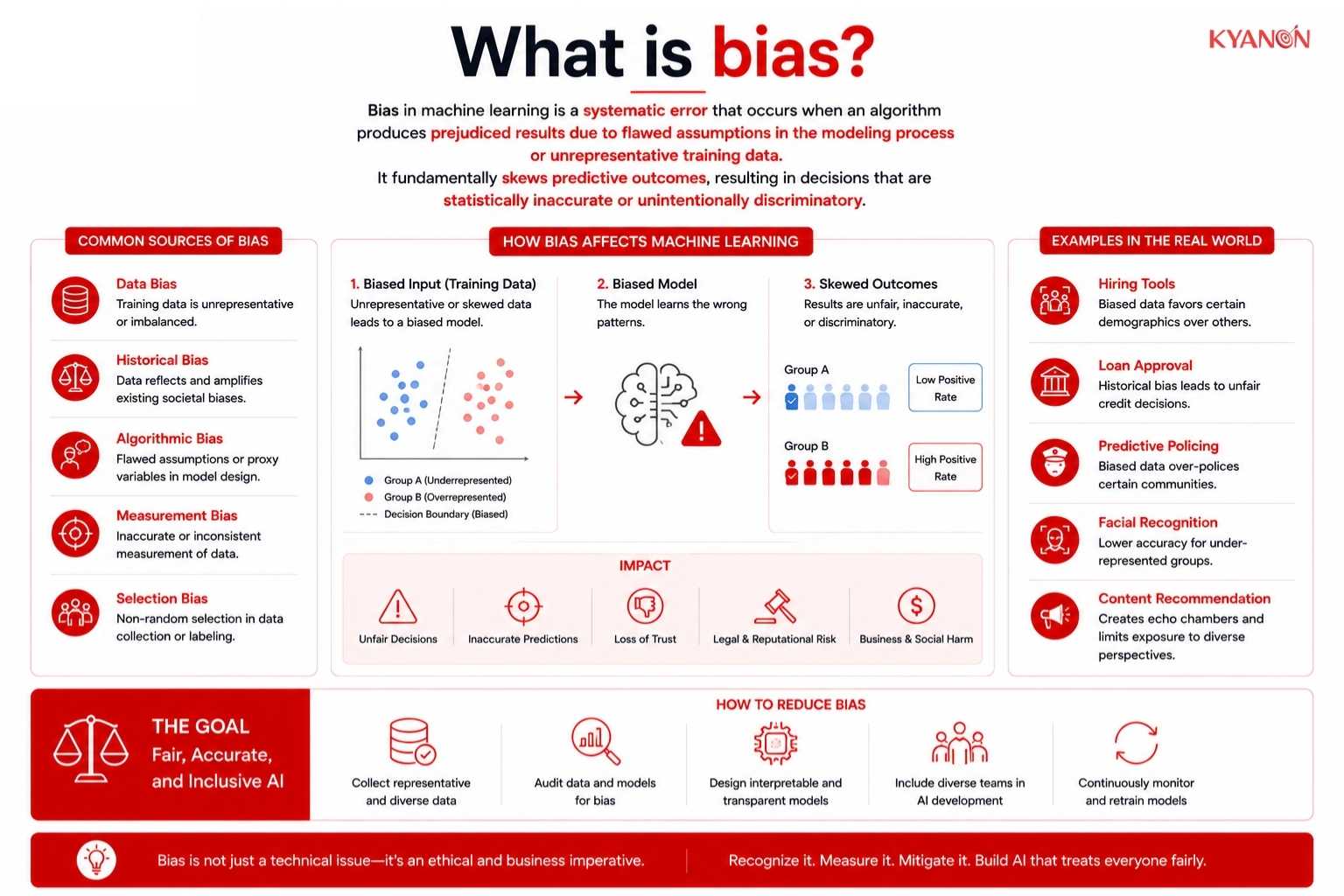
Types of ML Bias
- Sample/Selection Bias: Data is not collected randomly, skewing the model’s perspective.
- Prejudice Bias: Data contains stereotypes, often social or cultural.
- Measurement Bias: Data is measured inaccurately or improperly.
- Algorithmic Bias: The algorithm itself is designed or utilized improperly, prioritizing some results over others.

How ML Bias works
Machine learning bias emerges during data collection or model training when an algorithm learns to map inputs to outputs based on historical inequities or incomplete datasets. It functions by encoding past human decisions and sampling errors into mathematical weights, treating statistical correlations as absolute facts without establishing actual causality.
Historical data encoding
The model ingests past operational decisions, absorbing systemic inequalities present in that historical record. This creates an automated feedback loop where past prejudices strictly dictate future automated actions.
Proxy variable correlation
Algorithms identify patterns in non-sensitive data, such as postal codes or education history that correlate closely with protected demographic attributes. This mathematical mapping bypasses explicit exclusionary filters and allows the model to learn the bias indirectly.
Statistical assumption (Bias-variance)
In technical modeling, bias refers to the simplifying assumptions a model makes to ensure it can predict target variables. A model with high statistical bias oversimplifies the data, leading to systematic underfitting and poor predictive accuracy across all cohorts.
How to mitigate ML Bias
Mitigation requires a proactive approach across the entire ML development lifecycle, before, during, and after training.
Phase 1: Data Collection and Preprocessing
Fixing bias at the source is the most effective approach.
- Diversify training data: Ensure your dataset accurately represents all demographic groups, edges cases, and real-world scenarios.
- Resample datasets: Over-sample underrepresented groups or under-sample dominant groups to balance the dataset.
- Synthetic data: Use tools like SMOTE (Synthetic Minority Over-sampling Technique) to generate artificial, balanced data points.
- Data pre-cleansing: Remove explicit sensitive attributes (e.g., race, gender) and their correlated proxies (e.g., zip codes reflecting systemic redlining).
Phase 2: Model Training (In-Processing)
You can force the model to prioritize fairness during its optimization phase.
- Adversarial debiasing: Train a primary model to maximize accuracy while simultaneously training an “adversary” model that tries to guess protected attributes from the primary model’s outputs.
- Adjust loss functions: Penalize the model heavily when it makes errors on minority or protected groups.
- Constraint optimization: Set mathematical fairness constraints (like equal opportunity or demographic parity) that the algorithm must satisfy.
Phase 3: Post-Processing and Evaluation
Adjust the model’s outputs after training to ensure equitable decisions.
- Threshold Calibration: Adjust classification thresholds individually for different demographic groups to ensure equal error rates.
- Fairness Toolkits: Use open-source audit libraries to test your model before deployment:
- AI Fairness 360 (AIF360): IBM’s toolkit for dataset and model bias metrics.
- Fairlearn: A Microsoft-backed library for assessing and mitigating unfairness.
- What-If Tool: Google’s visual interface for analyzing model behavior and counterfactuals.
Phase 4: Governance and Monitoring
Bias is dynamic and often reappears after a model goes live.
- Establish diverse teams: Include engineers, ethicists, domain experts, and diverse stakeholders to identify blind spots.
- Continuous monitoring: Track live inputs and outputs to detect “data drift” or emerging bias over time.
- Model explainability: Use tools like SHAP (SHapley Additive exPlanations) or LIME to verify why a model made a specific prediction.
Bias vs Model Variance
Both concepts dictate a statistical model’s predictive accuracy, but differ entirely in their source of error and impact on generalization.
Dimension | Bias | Model Variance |
| Error source | Erroneous assumptions in the learning algorithm | High sensitivity to fluctuations in training data |
Generalization impact | Causes systematic underfitting | Causes systematic overfitting |
| Upfront complexity | High bias indicates an overly simplistic model | High variance indicates an overly complex model |
Mitigation tactic | Increasing model complexity or feature engineering | Dimensionality reduction, regularization, or gathering more data |
| Primary focus | Accuracy of the average prediction | Spread and fluctuation of the predictions |
When to consider Bias
Consider Bias mitigation if:
- Your engineering team is deploying automated decision systems in regulated domains such as banking, insurance underwriting, or human resources.
- Your model performance metrics show high overall accuracy but precision and recall drop significantly when evaluating specific demographic or geographic subsets.
- You are migrating legacy scoring methodologies to ML architectures and must audit historical datasets for encoded systemic prejudices.
It may not be the right priority if:
- Your application relies entirely on deterministic, rule-based automation engines that do not utilize predictive statistical modeling or historical training data.
Why Bias matters for enterprise IT & Finance
In sectors where algorithmic decisions determine credit risk or employment viability, unchecked bias translates directly to regulatory compliance failures and measurable financial penalties.
According to Gartner (2024), organizations adopting AI face increasing risks related to biased or insecure data, poor governance, and lack of explainability, which can lead to incorrect or culturally misaligned AI outputs that erode stakeholder trust. A leading multinational retail bank deployed a machine learning credit scoring system and utilized targeted bias auditing to identify demographic proxy variables. This intervention reduced unfair loan rejections by 22% while maintaining strict compliance with the bank’s predefined risk thresholds.
Common misconceptions
Removing sensitive attributes (like race or gender) eliminates bias
Reality: Algorithms are highly efficient at identifying proxy variables, such as zip codes or purchase histories, that correlate strongly with protected characteristics. The model learns the bias indirectly through these alternative data points.
More data equals less bias
Reality: Expanding a dataset amplifies existing biases if the underlying data collection methods remain flawed. If the expanded population data reflects historical social inequities, the model will simply scale those flawed assumptions.
Algorithms are completely objective and impartial
Reality: Algorithms are designed by human engineers and trained on human-generated data records. They locate statistical correlations efficiently but frequently mistake them for causality if the training data is imbalanced.
How Kyanon Digital applies bias
Kyanon Digital addresses ML bias directly as a foundational component of our responsible AI delivery frameworks. We execute rigorous bias auditing and structural dataset reviews for heavily regulated enterprise clients in the banking and HR technology sectors. Our approach focuses on identifying proxy variables and quantifying uncertainty, ensuring compliance and fairness across Southeast Asian markets without degrading predictive accuracy.
Explore our Machine Learning services

 Create project brief with AI