
What is CX transformation?
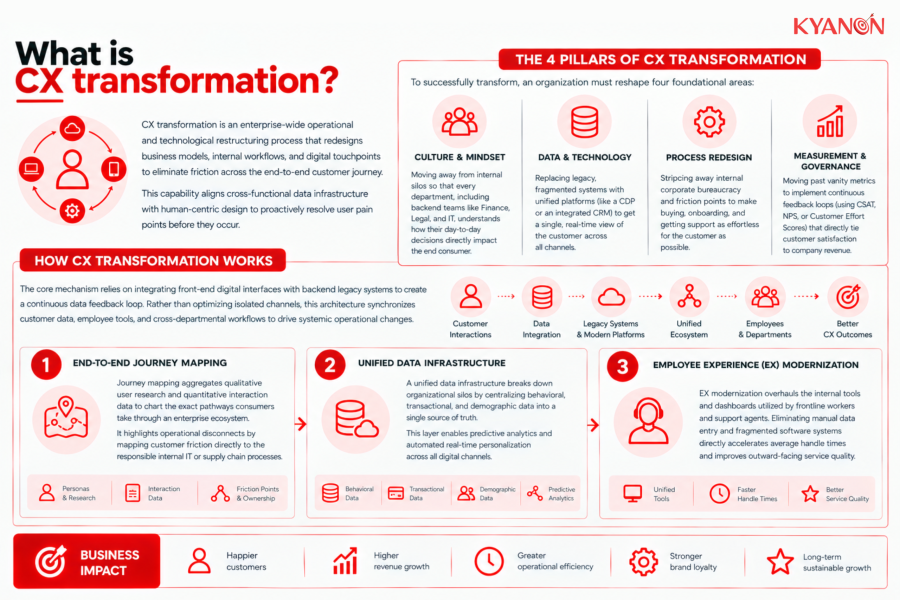
CX transformation is an enterprise-wide operational and technological restructuring process that redesigns business models, internal workflows, and digital touchpoints to eliminate friction across the end-to-end customer journey. This capability aligns cross-functional data infrastructure with human-centric design to proactively resolve user pain points before they occur.
The 4 pillars of CX Transformation
To successfully transform, an organization must reshape four foundational areas:
- Culture & Mindset: Moving away from internal silos so that every department, including backend teams like Finance, Legal, and IT, understands how their day-to-day decisions directly impact the end consumer.
- Data & Technology: Replacing legacy, fragmented systems with unified platforms (like a CDP or an integrated CRM) to get a single, real-time view of the customer across all channels.
- Process Redesign: Stripping away internal corporate bureaucracy and friction points to make buying, onboarding, and getting support as effortless for the customer as possible.
- Measurement & Governance: Moving past vanity metrics to implement continuous feedback loops (using CSAT, NPS, or Customer Effort Scores) that directly tie customer satisfaction to company revenue.

How CX transformation works
The core mechanism relies on integrating front-end digital interfaces with backend legacy systems to create a continuous data feedback loop. Rather than optimizing isolated channels, this architecture synchronizes customer data, employee tools, and cross-departmental workflows to drive systemic operational changes.
End-to-End Journey Mapping
Journey mapping aggregates qualitative user research and quantitative interaction data to chart the exact pathways consumers take through an enterprise ecosystem. It highlights operational disconnects by mapping customer friction directly to the responsible internal IT or supply chain processes.
Unified Data Infrastructure
A unified data infrastructure breaks down organizational silos by centralizing behavioral, transactional, and demographic data into a single source of truth. This layer enables predictive analytics and automated real-time personalization across all digital channels.
Employee Experience (EX) Modernization
EX modernization overhauls the internal tools and dashboards utilized by frontline workers and support agents. Eliminating manual data entry and fragmented software systems directly accelerates average handle times and improves outward-facing service quality.
CX transformation vs Customer Service Optimization
Both initiatives aim to improve user satisfaction, but they operate at entirely different scales of proactive structural change.
Dimension | CX transformation | Customer Service Optimization |
| Primary objective | Proactive friction elimination | Reactive issue resolution |
Operational scope | Enterprise-wide (IT, Product, HR) | Departmental (Support teams) |
| Technology focus | Data unification & core platforms | Ticketing systems & contact centers |
Measurement metric | Customer Lifetime Value (CLV) | Average Handle Time (AHT) & CSAT |
| Business impact | Redefined business models & revenue | Reduced support costs |
When to consider CX transformation
Consider CX transformation if:
- Your front-end digital touchpoints function perfectly, but disjointed backend handoffs between fulfillment and billing cause consistent customer churn.
- You are collecting massive volumes of consumer data across fragmented dashboards but lack the operational feedback loops to translate that data into product improvements.
- Your frontline employees suffer from high burnout rates because they are forced to navigate multiple legacy systems to resolve a single user inquiry.
It may not be the right priority if:
- Your enterprise operates a highly commoditized, single-touchpoint wholesale model where buyers make purchasing decisions exclusively via automated API price indexing without multi-step evaluation.
Why CX transformation matters for enterprise operations
Isolating digital experience initiatives within a single marketing department inflates technical debt and creates fractured user journeys. Restructuring the entire operational ecosystem aligns technology investments with actual consumer behavior, reducing the total cost of ownership (TCO) while securing long-term market differentiation.
Deloitte’s 2026 Future of Service found that 64% of surveyed service leaders reported higher agent productivity from AI, while 39% reported lower cost per contact. Deloitte also found that 43% of organizations believe AI could reduce contact-center costs by 30% or more within three years.
Common misconceptions
Buying the latest AI and CRM software will automatically transform our CX
Reality: Technology acts as an accelerator rather than a standalone solution. Automating a broken, confusing operational process with expensive AI tools simply delivers a bad customer experience at a faster, larger scale.
Our dedicated CX department completely owns the CX Transformation
Reality: Isolating this initiative to a single department guarantees systemic failure, as legal, finance, and engineering dictate the actual user experience just as heavily as marketing. Successful restructuring requires strict cross-functional alignment and shared executive accountability.
We just need to fix our website touchpoints and checkout flow to transform the journey
Reality: A company can feature a fast checkout and polite support agents, but if the internal data handoffs between those departments remain broken, the customer still experiences a disjointed journey. True optimization evaluates the end-to-end ecosystem rather than isolated interactions.
Employee experience (EX) has nothing to do with customer experience
Reality: Organizations cannot deliver high-tier customer interactions using frustrated, burnt-out employees operating broken internal tools. EX and CX remain inextricably linked, meaning frontline internal workflows must undergo optimization before external channels can improve.
How Kyanon Digital applies CX transformation
Kyanon Digital executes CX transformation initiatives for enterprise clients through comprehensive digital platform implementation, unified data infrastructure, and strategic change management. Serving organizations across Vietnam, Singapore, Thailand, ANZ, and Malaysia, our engineering teams bridge the gap between front-stage user touchpoints and back-stage legacy systems. We structure internal operational workflows to eliminate customer friction proactively, ensuring your digital investments yield measurable improvements in conversion rates and reductions in TCO.
Explore our IT Customer Experience Services.

 Create project brief with AI