
What is Your Brand Promise (CX Alignment)?
Your Brand Promise in CX alignment is the operational discipline of engineering end-to-end customer experience technology, backend integrations, and service workflows to systematically fulfill the core commitments a brand communicates to its market.
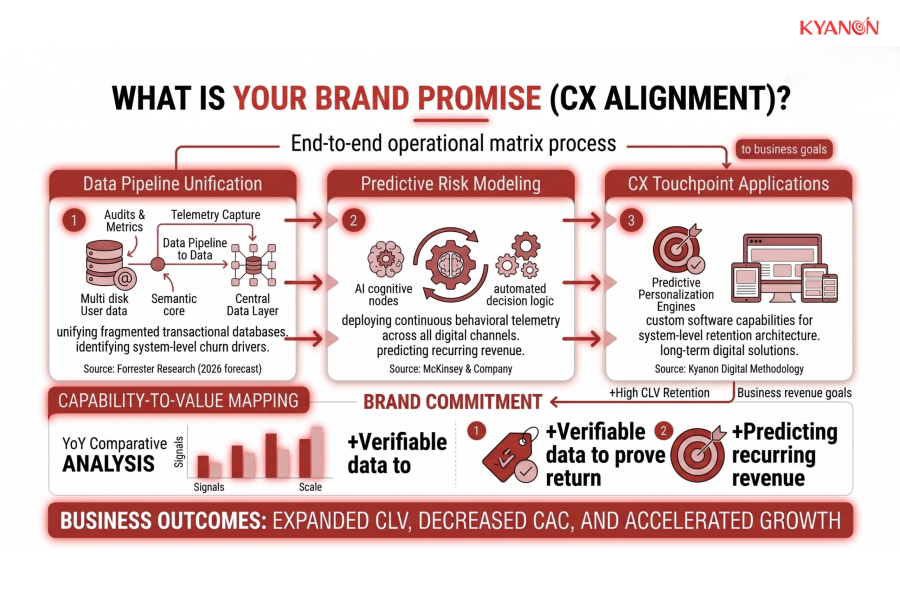
How Your Brand Promise (CX Alignment) Works
Achieving true CX alignment requires mapping strategic brand promises into software logic, orchestration layers, and cross-departmental operations. Rather than treating brand commitments as static slogans, engineering teams program these promises into core interaction logic to ensure system behavior aligns with customer expectations.
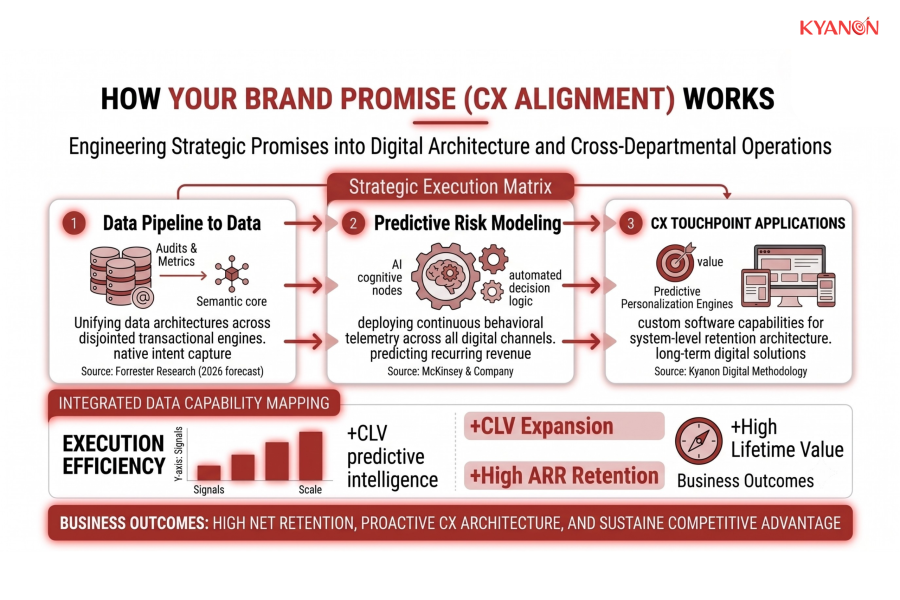
Orchestration & Rule Engine Integration
The customer experience architecture enforces brand values dynamically across all digital channels. Interaction rules evaluate real-time user context to deliver service outcomes that match explicit brand positioning.
Unified Data Governance
Systemic alignment relies on single-source-of-truth customer data layers. Decoupled backends aggregate interaction data, order histories, and real-time preferences to prevent fragmented or contradictory service delivery.
Human-in-the-Loop Escalation
Automated systems integrate fallback logic that hands off complex requests to human operators smoothly. This guarantees that automated efficiency does not compromise high-touch service promises during critical interactions.

Comparative Analysis: Brand Promise-Aligned CX vs. Traditional Channel-Siloed CX
Dimension | Brand Promise-Aligned CX | Traditional Channel-Siloed CX |
| Architectural Focus | Unified brand rule engine & decoupled data layer | Isolated department software & fragmented channels |
System Goal | Strategic consistency & trust preservation | Localized throughput & functional cost-cutting |
| Cross-Functional Sync | Synchronized data flows across all business units | Siloed operations with disjointed touchpoints |
Escalation Logic | Immediate, context-aware human-in-the-loop routing | Rigid automated loops with dead-end resolution flows |
| Business Impact | Lower churn and increased long-term lifetime value | High friction, brand erosion, and customer drop-off |
Why Your Brand Promise (CX Alignment) Matters
As enterprises accelerate their digital transformations, the gap between market positioning and technical execution represents a primary threat to customer retention. The massive infusion of capital into automated engines makes CX alignment an operational imperative. Enterprise spending on advanced customer-facing AI technology has surged by 38%, despite total operational support budgets remaining flat at just 2% growth according to Gartner. This capital shift underscores the need to ensure automated infrastructure actively upholds brand commitments rather than eroding them for short-term cost savings.
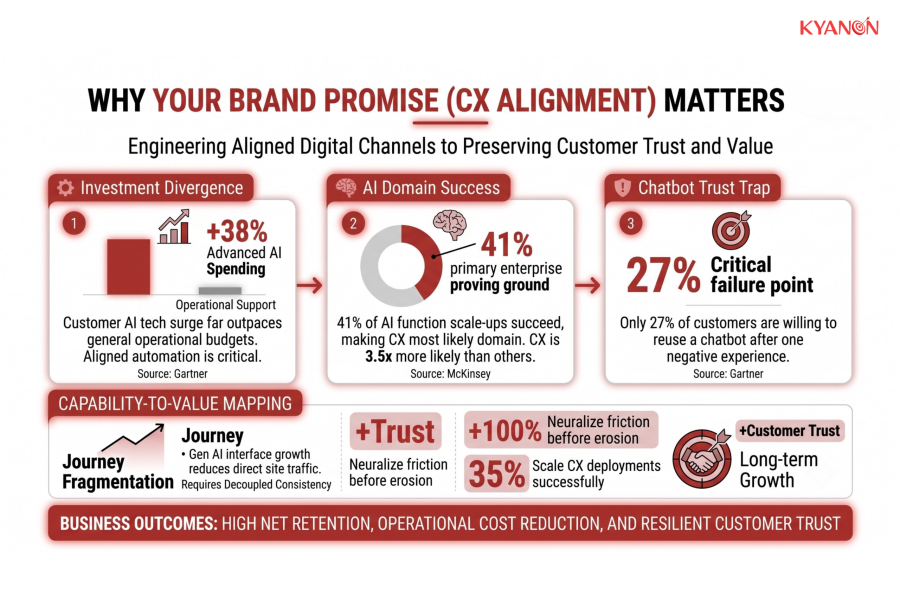
When technical channels fail to deliver on baseline brand expectations, recovery is difficult. Gartner indicates that customer tolerance for poorly engineered self-service is critically low, finding that only 27% of customers are willing to reuse a chatbot after a single negative experience. At the same time, digital discovery is shifting drastically. Research from McKinsey highlights that consumer journeys are increasingly fragmented as Generative AI interfaces capture high-intent traffic, reducing direct brand-site visits and making decoupled, multi-interface consistency essential.
To succeed in this evolving landscape, technical teams must build scalable systems grounded in operational discipline. According to McKinsey, 41% of AI deployments in customer-facing functions have successfully scaled, making customer experience the primary enterprise proving ground, 3.5 times more likely to scale than any other business domain. Engineering teams that embed brand commitments into their core software logic establish a resilient foundation for long-term growth and customer trust.
Common Misconceptions
A brand promise is a tagline owned exclusively by the marketing team
Marketing communicates the promise, but CX technology executes it. When systems deliver high hold times or fragmented data while advertising frictionless support, the promise becomes a brand liability.
Aligning CX with a brand promise is strictly about fixing customer-facing software
Frontline employees cannot deliver an experience they do not experience internally. Rigid, punitive internal systems force staff to pass friction directly to customers, breaking the brand promise regardless of frontend design.
The primary goal of a brand promise is to sound grand to drive initial sales
Setting expectations too high creates a gap between anticipation and reality that damages long-term trust. Authentic, achievable system commitments that consistently under-promise and over-deliver yield higher lifetime value.
CX alignment happens naturally if every department performs its individual role well
Customers evaluate an enterprise as a single entity rather than independent departments. Isolated operational wins across sales, legal, or fulfillment fail to deliver a cohesive experience if underlying system data remains siloed.
High satisfaction survey scores automatically prove brand alignment
General satisfaction metrics fail to measure whether a specific brand commitment was fulfilled. Broad satisfaction can mask a disconnect if the core value proposition communicated to the market differs from customer perception.
How Kyanon Digital Applies Your Brand Promise (CX Alignment)
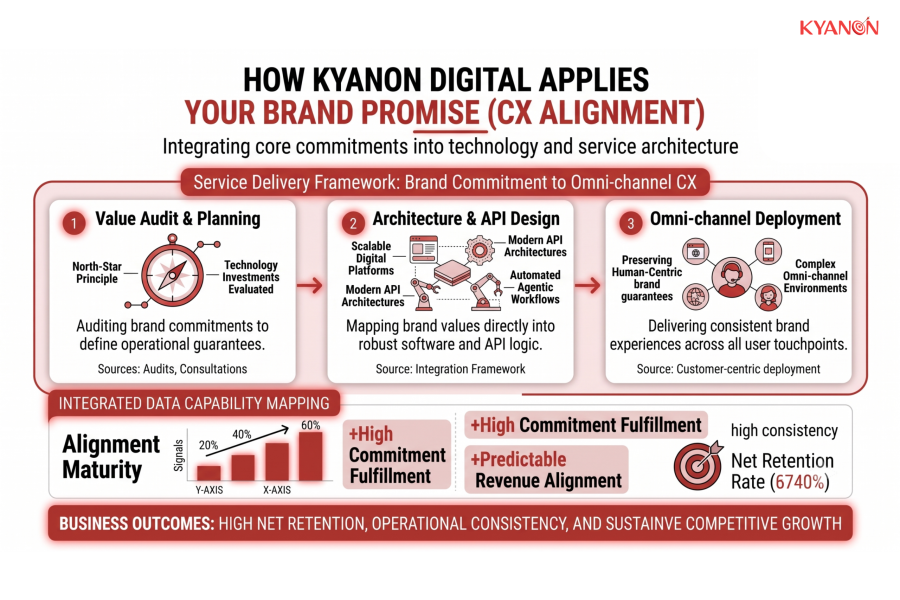
Kyanon Digital uses the brand promise as a north-star design principle in enterprise CX transformation, evaluating technology investments by their ability to deliver on core brand commitments. We build scalable digital platforms, modern API architectures, and automated agentic workflows that preserve human-centric brand guarantees across complex omni-channel environments.
Explore our services:

 Create project brief with AI