
What is Year-on-Year CX Improvement?
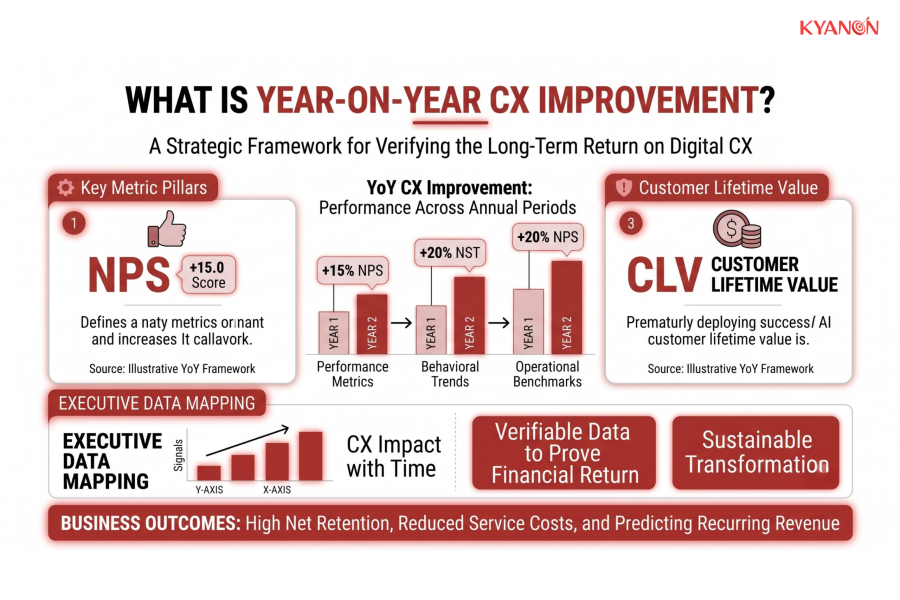
Year-on-Year (YoY) CX Improvement is a strategic evaluation framework that measures the long-term progress of customer experience initiatives by comparing performance metrics, behavioral trends, and operational benchmarks across consecutive annual periods. This framework provides executive teams with verifiable data to prove the financial return on customer-centric digital transformations.
How Year-on-Year CX Improvement Works
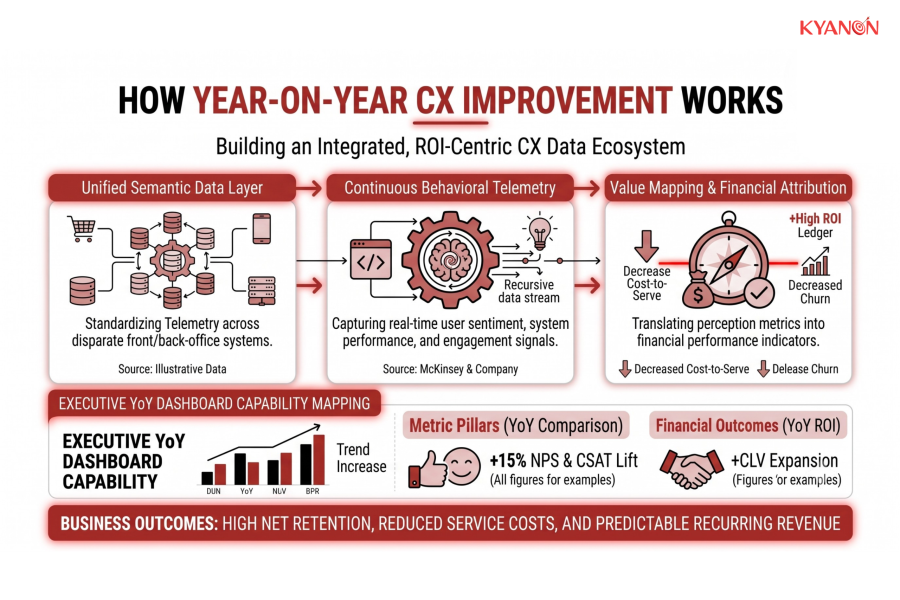
Year-on-Year CX Improvement functions by shifting enterprise measurement from isolated, point-in-time metrics to an integrated data ecosystem. Rather than relying on sporadic feedback, organizations construct continuous measurement architecture that correlates real-time operational events directly with financial performance indicators.
Unified Semantic Data Layer
To track longitudinal customer behavior accurately, enterprises integrate disparate front-office interaction channels and back-office transactional engines into a unified data architecture. This centralized layer standardizes telemetry across touchpoints, establishing a single source of truth for year-over-year comparative analysis.
Continuous Behavioral Telemetry
Continuous telemetry captures in-the-moment user sentiment, system performance, and engagement patterns across digital channels. Replacing annual static audits, these continuous signals offer uninterrupted baseline visibility, isolating temporary macro disruptions from authentic, long-term operational shifts.
Value Mapping & Financial Attribution
The financial attribution engine translates qualitative perception metrics into core business outcomes. By linking behavioral trends directly to financial performance indicators—such as reduced cost-to-serve, decreased churn, and expanded customer lifetime value (CLV)—enterprises establish a clear ROI ledger for CX investments.

Comparative Analysis: YoY CX Framework vs. Point-in-Time Metrics
Dimension | Point-in-Time CX Metrics | Year-on-Year CX Improvement Framework |
| Data Scope | Isolated, snapshot-in-time feedback | Continuous, integrated longitudinal telemetry |
Operational Focus | Reactive resolution of immediate complaints | Proactive, root-cause structural optimization |
| System Architecture | Siloed application and channel tracking | Unified semantic data layer across IT systems |
Business Impact | Difficult to correlate with financial performance | Direct attribution to CLV, retention, and TCO reduction |
| Executive Value | High risk of score manipulation and bias | Auditable, board-ready ROI tracking |
Why Year-on-Year CX Improvement Matters
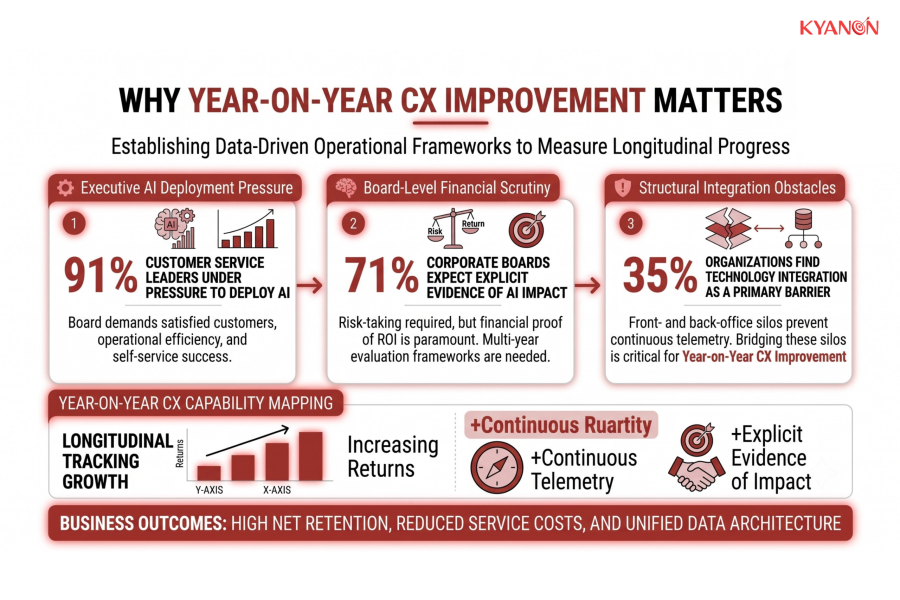
Achieving sustained customer experience progress requires moving beyond superficial perception scores to build verifiable, data-driven operational frameworks.
According to a report by Gartner, 91% of customer service and support leaders experience intense pressure from executive leadership to deploy AI capabilities within their tech architecture. This board-level priority reflects an urgent demand to improve customer satisfaction, operational efficiency, and self-service success. However, deploying new technologies without establishing longitudinal tracking leaves organizations unable to measure true transformation ROI.
At the same time, executive leadership demands rigorous financial proof before validating long-term technology investments. Research published in Gartner AI Value Metrics indicates that 71% of corporate boards expect enterprises to take calculated technology risks with AI while providing explicit, measurable evidence of impact. To meet these expectations, market leaders deploy sentiment-analyzing models that convert qualitative user feedback into structured data points, embedding them within multi-year evaluation frameworks.
Engineering this comparative baseline requires overcoming structural integration barriers across existing application stacks. IDC reports that 35% of enterprise organizations identify severe integration challenges across their CX technology stacks as a primary obstacle to scaling intelligent customer experiences. Bridging these front- and back-office system silos through a unified data architecture provides executive teams with the continuous telemetry required to validate Year-on-Year CX Improvement.
Common Misconceptions
Chasing NPS or CSAT Growth Guarantees Better CX
A year-over-year increase in Net Promoter Score (NPS) or Customer Satisfaction (CSAT) does not automatically mean the underlying customer experience has improved. Teams can artificially inflate scores through short-term incentives or strategically timed surveys, while process defects, service friction, and long-term customer churn remain unchanged.
Annual Customer Audits Provide a Reliable Baseline
Conducting a comprehensive survey once a year does not provide a sufficient foundation for long-term strategic planning. Annual data represents a lagging indicator that misses seasonal shifts, immediate product failures, and sudden market changes. Authentic longitudinal tracking requires continuous, real-time feedback embedded directly within customer workflows.
Declining Complaint Volumes Signal Strong CX Health
A drop in customer complaints often indicates growing friction rather than high satisfaction. When service channels become difficult to navigate, frustrated customers silently abandon the brand instead of seeking resolution, making reduced complaint volumes a common indicator of customer churn.
CX Improvements Can Be Achieved Solely Through Front-End Design
Optimizing journey maps and user interfaces without addressing core technical infrastructure leads to service degradation. When customer-facing teams lack visibility into legacy back-office systems and technical dependencies, front-end improvements fail under operational stress.
CX Metrics Do Not Require Financial Justification
Customer experience initiatives that operate independently of core business indicators remain vulnerable to budget reductions. Unless CX performance is mapped directly to customer lifetime value, lower cost-to-serve, and churn reduction, programs struggle to retain executive sponsorship.
How Kyanon Digital Applies Year-on-Year CX Improvement
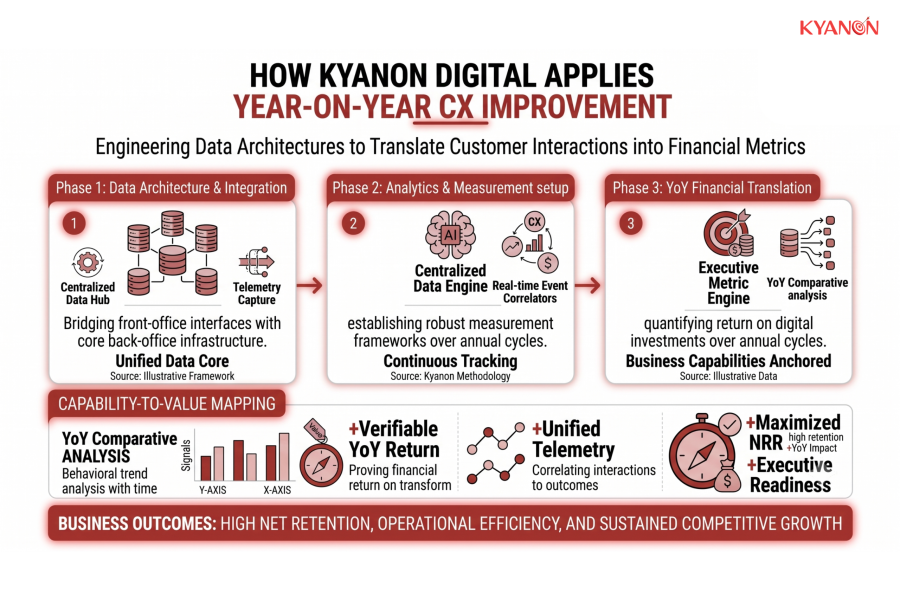
Kyanon Digital establishes robust measurement frameworks and integrated data architectures that allow enterprises to quantify the return on their digital investments over annual cycles. By bridging front-office interfaces with core back-office infrastructure, Kyanon Digital builds unified telemetry systems that translate customer interactions into executive-ready financial metrics.
Explore our services:

 Create project brief with AI