
What is deflection rate?
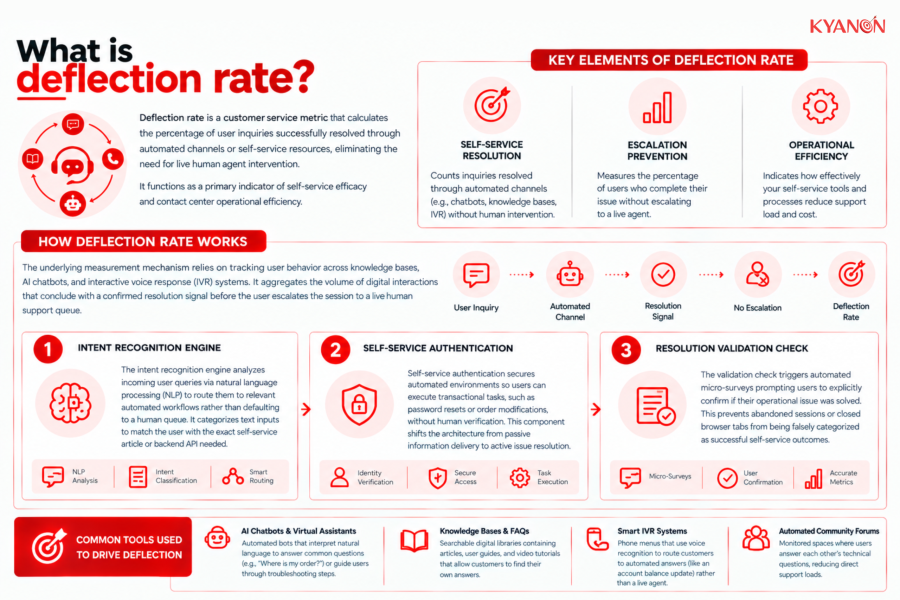
Deflection rate is a customer service metric that calculates the percentage of user inquiries successfully resolved through automated channels or self-service resources, eliminating the need for live human agent intervention. It functions as a primary indicator of self-service efficacy and contact center operational efficiency.
How deflection rate works
The underlying measurement mechanism relies on tracking user behavior across knowledge bases, AI chatbots, and interactive voice response (IVR) systems. It aggregates the volume of digital interactions that conclude with a confirmed resolution signal before the user escalates the session to a live human support queue.
Intent recognition engine
The intent recognition engine analyzes incoming user queries via natural language processing (NLP) to route them to relevant automated workflows rather than defaulting to a human queue. It categorizes text inputs to match the user with the exact self-service article or backend API needed.
Self-service authentication
Self-service authentication secures automated environments so users can execute transactional tasks, such as password resets or order modifications, without human verification. This component shifts the architecture from passive information delivery to active issue resolution.
Resolution validation check
The validation check triggers automated micro-surveys prompting users to explicitly confirm if their operational issue was solved. This prevents abandoned sessions or closed browser tabs from being falsely categorized as successful self-service outcomes.

Common tools used to drive deflection
- AI Chatbots & Virtual Assistants: Automated bots that interpret natural language to answer common questions (e.g., “Where is my order?”) or guide users through troubleshooting steps.
- Knowledge Bases & FAQs: Searchable digital libraries containing articles, user guides, and video tutorials that allow customers to find their own answers.
- Smart IVR Systems: Phone menus that use voice recognition to route customers to automated answers (like an account balance update) rather than a live agent.
- Automated Community Forums: Monitored spaces where users answer each other’s technical questions, reducing direct support loads.
The business value of deflection rate
When tracked accurately alongside customer satisfaction, a healthy deflection rate offers massive operational benefits:
- Drastically reduces support costs: Answering a support ticket via a live agent can cost a business anywhere from $5 to $20+ per interaction. Self-service automation costs pennies per resolution.
- 24/7 availability: Automated tools don’t sleep. Customers can resolve urgent, basic issues instantly at midnight or on holidays without waiting for business hours.
- Elevates the Agent Experience: By routing away boring, repetitive queries (like password resets), live agents can focus their energy on complex, high-value problem-solving.
Deflection rate vs Resolution Rate
Both metrics evaluate support efficiency, but they measure entirely different stages of the operational pipeline.
Dimension | Deflection rate | Resolution Rate |
| Measurement scope | Pre-agent automated interactions | Post-agent ticketing outcomes |
Primary channel | Knowledge base, AI chatbots, IVR | Live chat, email, phone support |
| Cost implication | Reduces incoming contact center costs | Measures cost-per-ticket efficiency |
Metric intent | Prevent human intervention | Measure human intervention success |
| Data validation | Requires user confirmation of success | Requires ticket closure status |
When to consider deflection rate
Consider tracking deflection rate if:
- Your contact center is consistently overwhelmed by high volumes of repetitive, low-complexity queries regarding order statuses or account setup.
- You are deploying an AI chatbot and require a baseline financial metric to calculate the exact reduction in contact center operational expenditure.
- Live agent Average Handle Time (AHT) is escalating because agents are spending billable hours answering questions already documented in your public knowledge base.
It may not be the right priority if:
- Your enterprise provides high-touch, premium advisory services where white-glove, human-to-human interaction is the primary value proposition of the business model.
Why deflection rate matters for enterprise contact centers
Unmanaged inbound query volume heavily inflates contact center operational expenditure (OpEx) and accelerates live agent burnout. Architecting structured self-service pathways reduces this baseline volume, directly lowering the total cost of ownership (TCO) for support operations while allowing human staff to dedicate resources to high-value technical escalations.
Salesforce’s 2025 State of Service, based on 6,500 service professionals, found that service teams estimated 30% of cases were already being handled by AI in 2025, with respondents expecting this to reach 50% by 2027. Salesforce also reports that service teams using AI agents expect service costs and case-resolution times to decrease by an average of 20%.
Common misconceptions
Any user who visits a help center page and doesn’t call us counts as a deflected ticket
Reality: Many tracking setups use weak logic, assuming that if a user opens an article and closes the tab, they are resolved. The user might have actually found the article completely unhelpful and closed it in annoyance; true measurement requires explicit validation, such as a “Did this answer your question?” confirmation click.
A deflected ticket equals a happy, resolved customer
Reality: Avoiding a live agent does not guarantee a problem was solved. Customers may have simply gotten frustrated with a rigid chatbot, given up entirely, and abandoned your business for a competitor. This metric must always be paired with Customer Satisfaction (CSAT) or Customer Effort Score (CES) to ensure you are actually resolving issues rather than just hiding from customers.
The ultimate goal of deflection is to completely eliminate our human support staff
Reality: The true operational goal is to filter out repetitive, low-value queries like basic password resets. This frees up expensive live human agents to handle complex, high-value, or high-emotion issues that require advanced technical problem-solving and empathy.
A high deflection rate means our product or service is incredibly easy to use
Reality: A high volume of self-service interactions often points to a fundamental design flaw in your core product interface. True CX excellence requires designing a product so intuitively that the user never needs to look up a help article or open a chatbot in the first place.
How Kyanon Digital applies deflection rate
Kyanon Digital tracks deflection rate as a primary ROI metric in enterprise chatbot and self-service platform implementations across Vietnam, Singapore, Thailand, ANZ, and Malaysia. Our engineering teams build authenticated self-service portals and deploy conversational AI architectures that integrate directly with your legacy CRM databases. We structure data pipelines to ensure deflection metrics are validated and paired with qualitative feedback, ensuring your automated systems genuinely reduce total cost of ownership (TCO) without eroding the end-user experience.
Explore our IT Customer Experience Services.

 Create project brief with AI