
What is digital self-service?
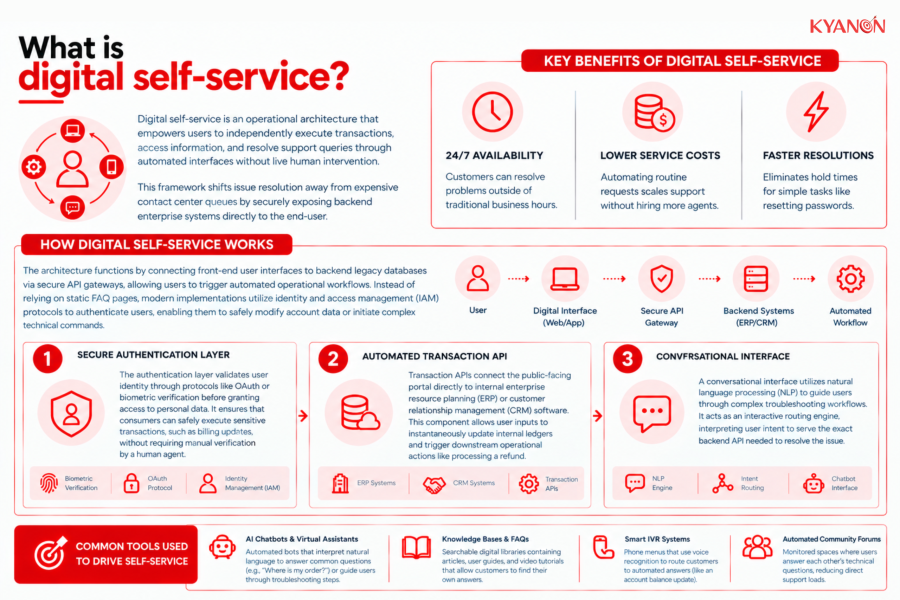
Digital self-service is an operational architecture that empowers users to independently execute transactions, access information, and resolve support queries through automated interfaces without live human intervention. This framework shifts issue resolution away from expensive contact center queues by securely exposing backend enterprise systems directly to the end-user.
Key Benefits of Digital Self-Service
- 24/7 Availability: Customers can resolve problems outside of traditional business hours.
- Lower Service Costs: Automating routine requests scales support without hiring more agents.
- Faster Resolutions: Eliminates hold times for simple tasks like resetting passwords.

How digital self-service works
The architecture functions by connecting front-end user interfaces to backend legacy databases via secure API gateways, allowing users to trigger automated operational workflows. Instead of relying on static FAQ pages, modern implementations utilize identity and access management (IAM) protocols to authenticate users, enabling them to safely modify account data or initiate complex technical commands.
Secure Authentication Layer
The authentication layer validates user identity through protocols like OAuth or biometric verification before granting access to personal data. It ensures that consumers can safely execute sensitive transactions, such as billing updates, without requiring manual verification by a human agent.
Automated Transaction API
Transaction APIs connect the public-facing portal directly to internal enterprise resource planning (ERP) or customer relationship management (CRM) software. This component allows user inputs to instantaneously update internal ledgers and trigger downstream operational actions like processing a refund.
Conversational Interface
A conversational interface utilizes natural language processing (NLP) to guide users through complex troubleshooting workflows. It acts as an interactive routing engine, interpreting user intent to serve the exact backend API needed to resolve the issue.
Digital self-service vs Customer Service Automation
Both methodologies aim to reduce manual contact center workloads, but they differ fundamentally in user autonomy and operational initiation.
Dimension | Digital self-service | Customer Service Automation |
| Initiation | User-driven (Customer initiates task) | System-driven (Agent initiates workflow) |
Primary interface | Web portals, mobile apps, chatbots | Backend ticketing and routing tools |
| Autonomy level | High (User executes independently) | Low (Agent relies on automated tools) |
Best for | Routine account updates, basic queries | Ticket triage, macro responses, routing |
| Cost model | Front-end CapEx | Backend OpEx |
When to consider digital self-service
Consider digital self-service if:
- Contact center wait times are escalating because human agents spend billable hours handling repetitive, low-tier queries like password resets or order status checks.
- You are expanding operations into multiple international time zones and require 24/7 issue resolution without scaling human headcount proportionally.
- High inbound ticket volumes during seasonal sales peaks regularly overload your legacy support infrastructure, leading to severe SLA breaches and abandoned calls.
It may not be the right priority if:
- Your enterprise strictly offers high-touch, premium advisory services where white-glove, human-to-human interaction represents the core, non-negotiable value proposition of your brand.
Why digital self-service matters for enterprise support
Unmanaged inbound query volume heavily inflates contact center operational expenditure (OpEx) and accelerates live agent burnout. Architecting structured, automated resolution pathways directly lowers the total cost of ownership (TCO) for support operations while allowing human staff to dedicate resources to high-value technical escalations.
Salesforce’s 2026 customer-service research identifies customer FAQs and order enquiries as the top AI-agent use cases, while 88% of service professionals surveyed said conversational AI accelerates resolution times.
Common misconceptions
If we build this portal, we can finally eliminate our entire tier-1 support team and cut costs entirely
Reality: Deflecting 100% of issues to automation results in catastrophic customer churn. Self-service strictly filters out repetitive, low-value tasks; it does not replace the requirement for human empathy in complex escalations or highly emotional billing disputes.
Throwing all of our internal PDF manuals onto a webpage counts as a self-service strategy
Reality: Static documents do not resolve transactional problems, they merely deflect questions. True self-service requires secure backend API integration so users can actively execute tasks, such as canceling an order or updating billing details, without placing a phone call.
How Kyanon Digital applies digital self-service
Kyanon Digital builds digital self-service platforms for enterprise clients to reduce contact center load and improve customer satisfaction. Operating across Vietnam, Singapore, Thailand, ANZ, and Malaysia, our engineering teams construct secure authentication layers and connect conversational interfaces directly into legacy CRM and ERP systems. We focus on outcome-driven implementations, ensuring your self-service architecture actively resolves transactional queries to lower TCO and streamline omnichannel support workflows.
Explore our Digital Experience services:

 Create project brief with AI