
What is a Self-Service Portal?
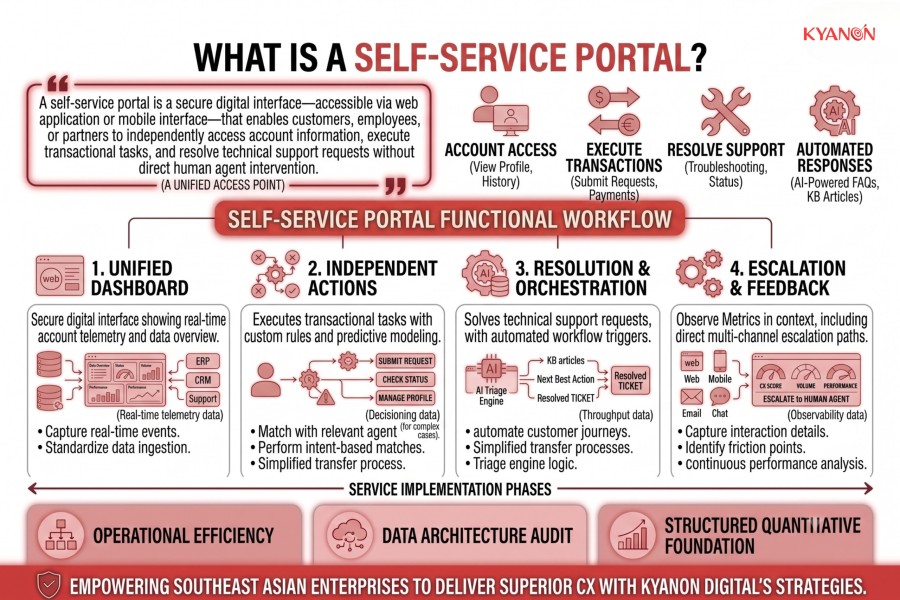
A self-service portal is a secure digital interface, accessible via web application or mobile interface, that enables customers, employees, or partners to independently access account information, execute transactional tasks, and resolve technical support requests without direct human agent intervention.
How a Self-Service Portal Works
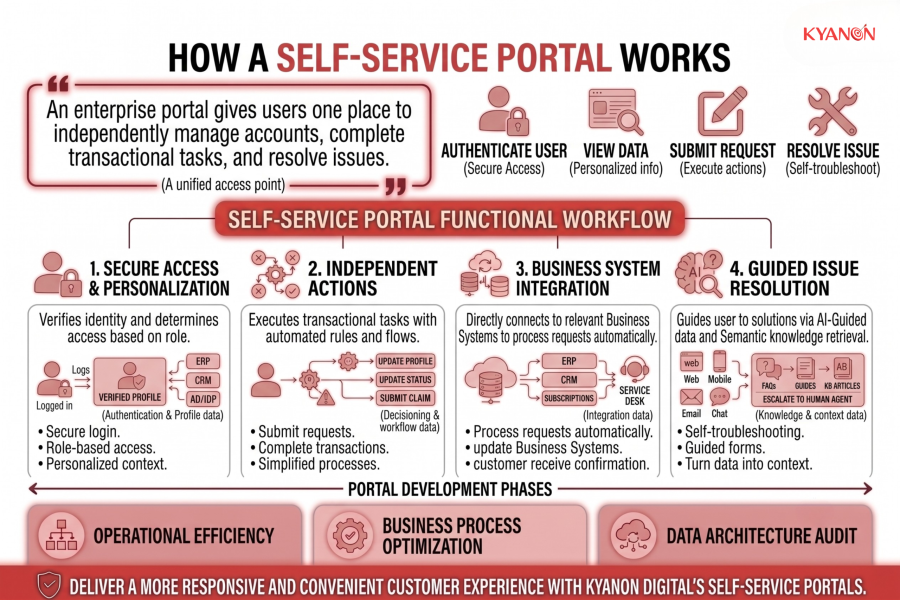
An enterprise self-service portal gives customers and employees one place to manage accounts, request services, and resolve common issues without always needing help from a support team.
Instead of simply providing information, the portal can also connect requests to business systems and complete actions automatically.
Secure Login and Personalized Access
When users log in, the portal verifies their identity and determines what they can access.
Based on their account or role, the portal can show relevant:
- Account information
- Services and subscriptions
- Available features
- Order or service history
- Support options
This creates a more personalized experience while keeping sensitive information protected.
Connecting Requests to Business Systems
When a user takes an action, such as upgrading a plan, requesting a return, updating account details, or submitting a service request, the portal sends the request to the relevant business system.
Many requests can then be completed automatically, reducing the need for employees to process them manually.
For example:
Customer submits request → Portal processes request → Business system is updated → Customer receives confirmation
Helping Users Resolve Issues
For common questions or problems, the portal can guide users toward relevant answers and troubleshooting steps.
It can provide:
- Help articles and FAQs
- Step-by-step troubleshooting
- Guided forms and self-service processes
- Recommended actions based on the user’s issue
If the customer still needs assistance, the portal can pass the issue to a support agent together with the relevant conversation and request details.
This means customers do not have to repeat everything they have already explained.
Turning Self-Service Into a Better CX
A well-designed self-service portal can help businesses:
- Reduce repetitive support requests
- Give customers faster access to services
- Make common processes easier to complete
- Reduce manual work for support teams
- Create a more consistent customer experience
The goal is not simply to let customers “find information,” but to help them complete tasks and solve problems with less friction.

Comparative Analysis: Self-Service Portal vs. Legacy Help Center
Dimension | Legacy Help Center | Enterprise Self-Service Portal |
| System Interaction | Static, read-only knowledge articles | Dynamic, bi-directional transactional APIs |
User Personalization | Generic, one-size-fits-all text | Contextual workspace based on account telemetry |
| Task Execution | Manual instructions (User does the work) | Programmatic workflows (System executes actions) |
Escalation Path | Disconnected “Contact Us” web forms | Integrated ticket creation preserving session context |
| Maintenance Model | Manual, ad-hoc content updates | Continuous optimization via telemetry analytics |
Why a Self-Service Portal Matters
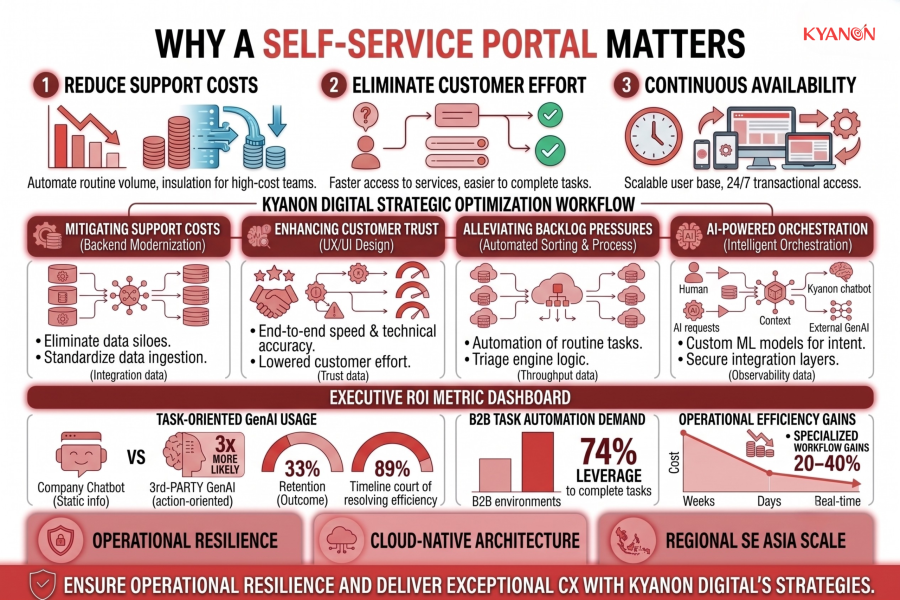
Deploying a modern self-service portal allows organizations to reduce support costs, eliminate customer effort, and maintain continuous operational availability as user bases scale. Modern enterprise portals shift digital interactions from static information-gathering tools into transactional, action-oriented customer touchpoints.
Recent enterprise trends highlight a shift in how customers leverage AI alongside brand platforms. According to a Gartner Survey, customers are three times more likely to use third-party generative AI tools than company-provided standalone chatbots to resolve service issues. Furthermore, Gartner reports that 58% of customers who use GenAI leverage it to complete tasks on their behalf, a figure that climbs to 74% in B2B environments. This shift requires engineering teams to build robust, API-driven self-service portals that serve both direct human interactions and secure third-party integrations.
From an operational standpoint, modern portal architectures drive significant efficiency across enterprise workflows. A global survey by McKinsey & Company reveals that organizations continue to achieve the highest cost reductions by deploying AI and automation within service operations, with leading implementations generating productivity gains of 20% to 40% in specialized workflows. Building structured, accessible self-service interfaces helps enterprises capture these efficiency gains while insulating high-cost human support teams from routine administrative volume.
Common Misconceptions
If we build it, they will stop calling us
A self-service portal alters the nature of inbound support interactions rather than eliminating customer contact entirely. While automated systems handle simple tasks like password resets or tracking updates, human support teams become dedicated to managing complex, high-stakes technical escalations. Support operations must adapt by training agents for longer, more involved troubleshooting sessions.
It is a one-time project we can launch and forget
A self-service portal requires active, continuous maintenance to prevent technical debt and content decay. As software products, pricing models, and operational policies evolve, unmaintained help centers accumulate inaccurate workflows and broken paths that increase customer frustration. Organizations must dedicate engineering and content resources to continuously audit and update platform assets based on user search telemetry.
Customers prefer it because they hate talking to humans
Users choose self-service portals for operational speed and convenience, not to avoid human interactions entirely. When panicked or facing a critical platform outage, forcing customers through rigid FAQ trees before revealing contact details damages brand trust. Portals must provide a clear escalation path that connects users to a live support representative when automated paths fail.
We should put every piece of company information in there
Dumping exhaustive product documentation into a portal creates a navigation bottleneck that hinders issue resolution. Customers seek rapid solutions to specific operational challenges rather than multi-page technical manuals. Knowledge assets must be delivered as visual, easily skimmable micro-guides paired with direct action buttons.
How Kyanon Digital Applies Self-Service Portal
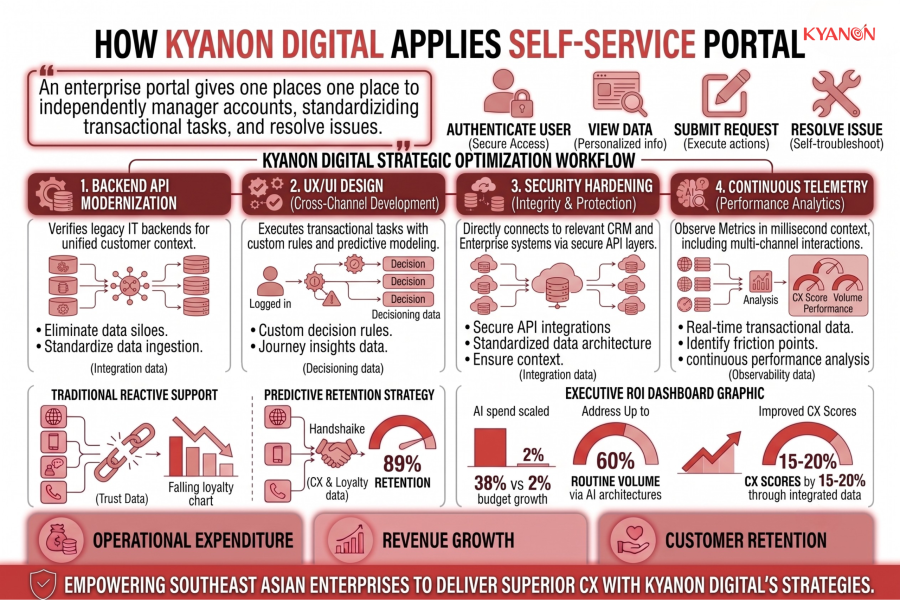
Kyanon Digital builds self-service portals for enterprise clients in financial services, utilities, and SaaS, reducing inbound support volume. We engineer secure API integrations, design intuitive desktop and mobile customer environments, and modernize legacy IT backends to ensure high availability and real-time transaction processing.
Explore our services:

 Create project brief with AI