
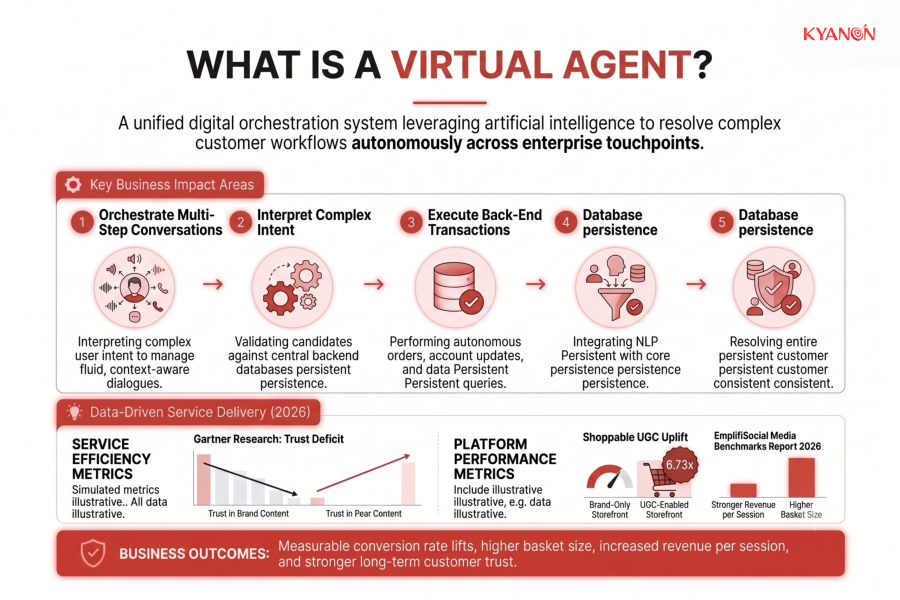
What is a Virtual Agent?
A virtual agent is an artificial intelligence-driven software system capable of orchestrating multi-step conversations, interpreting complex intent across messaging channels, and executing back-end business transactions autonomously. By unifying natural language processing with core database integration, it resolves end-to-end customer workflows without requiring ongoing human intervention.
How Virtual Agent Works
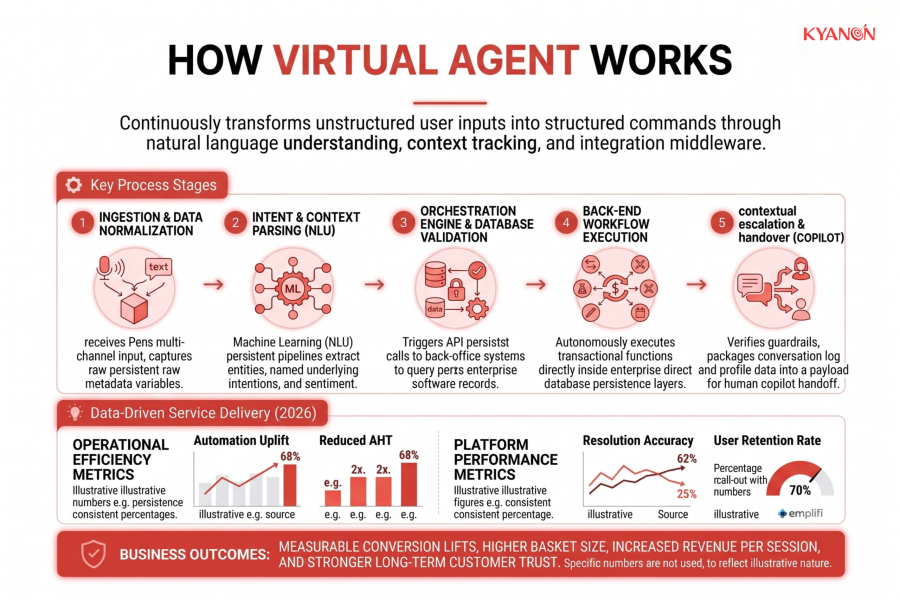
Enterprise virtual agents operate by continuously transforming unstructured user inputs into structured system commands. Rather than matching keywords against predefined scripts, modern virtual agents leverage natural language understanding (NLU), context-aware dialogue state tracking, and integration middleware to deliver dynamic interaction paths.
Intent & Context Parsing
Upon receiving a user input via voice or digital chat, the system passes the raw text through a machine learning-based NLU model. This pipeline extracts named entities, underlying intents, and sentiment attributes while cross-referencing past session state variables.
Back-End Workflow Orchestration
Once intent is established, the virtual agent triggers API calls to internal back-office systems to query records or post updates. This enables execution of transactional functions—such as balance adjustments, order cancellations, or appointment rescheduling—directly inside enterprise software layers.
Contextual Escalation & Copilot Handoff
If a transaction exceeds autonomous guardrails, the virtual agent packages the conversation log, verified customer profile data, and intent state into a unified payload. It then transfers the interaction to a live human representative, serving simultaneously as a real-time copilot for frontline support staff.

Comparative Analysis: Virtual Agent vs. Traditional AI Chatbot
Dimension | Traditional AI Chatbot | Modern Autonomous Virtual Agent |
| Interaction Logic | Rule-based decision trees and rigid conditional loops | Generative NLU, dynamic dialogue paths, and reasoning models |
System Integration | Read-only static queries (e.g., FAQ retrieval) | Bi-directional API integration across CRM, ERP, and core legacy layers |
| Problem Resolution | Deflects users to manual channels or static help pages | Executes full transactional workflows independently |
Context Retention | Resets session parameters across touchpoints | Maintains persistent omni-channel customer profile state |
| Scalability & Range | Limited to structured, narrow conversational flows | Dynamically scales across complex, multi-system enterprise operations |
Why Virtual Agent Matters
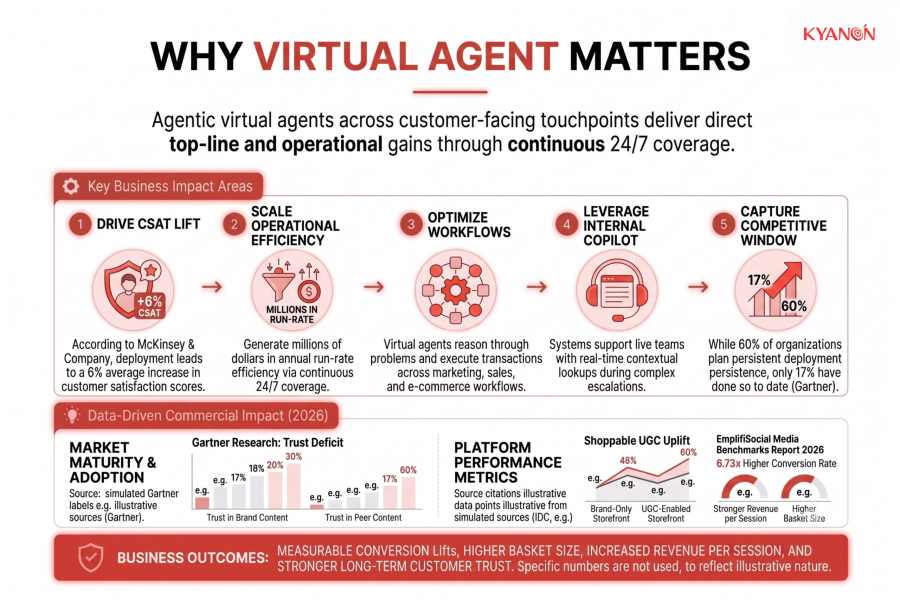
Deploying agentic virtual agents across customer-facing touchpoints delivers direct top-line and operational gains. According to McKinsey & Company, front-line deployment of autonomous virtual agents drives a 6% average increase in customer satisfaction (CSAT) scores while generating millions of dollars in annual run-rate efficiency through continuous 24/7 coverage. Rather than serving as passive chat boxes, these systems act as internal front-line copilot frameworks, supporting live teams with real-time contextual lookups during escalations.
This shift marks a structural evolution in enterprise service models. Market evaluations by IDC highlight that the traditional Contact Center as a Service (CCaaS) definition is rapidly approaching end-of-life as autonomous agents transform interaction management into unified customer experience platform hubs. By connecting directly to underlying enterprise databases, virtual agents reason through complex user problems and execute transactions across marketing, sales, and e-commerce workflows.
This transition creates a significant competitive window for technology executives. Market analysis from Gartner reveals that while more than 60% of organizations expect to deploy autonomous AI agents within two years, only 17% have successfully deployed fully operational AI agents to date. Organizations that overcome legacy integration bottlenecks can move past narrow task automation and scale multichannel virtual agents to capture durable market advantages.
Common Misconceptions
They are just glorified chatbots
Traditional chatbots rely on rigid, rule-based scripts, whereas AI virtual agents use natural language understanding to handle dynamic, complex inquiries. Modern agents process intent, reason through multi-step logic, and execute actions independently across enterprise databases.
They replace human staff entirely
Rather than eliminating jobs, virtual agents automate repetitive tasks and pass detailed conversation histories to human agents during escalation. This human-in-the-loop framework shifts employee workloads toward high-empathy, complex problem resolution.
They offer a frustrating, robotic experience
Modern tools understand context, everyday phrasing, and voice inflection, making interactions feel intuitive rather than restrictive. By retaining persistent user context across channels, they eliminate the need for customers to repeat information.
They are too complex and expensive to deploy
Unlike legacy systems requiring heavy custom middleware, modern virtual agents integrate directly into existing enterprise CRM platforms and API layers within weeks. Standardized connector frameworks significantly accelerate time-to-market while reducing total cost of ownership.
How Kyanon Digital Applies Virtual Agent
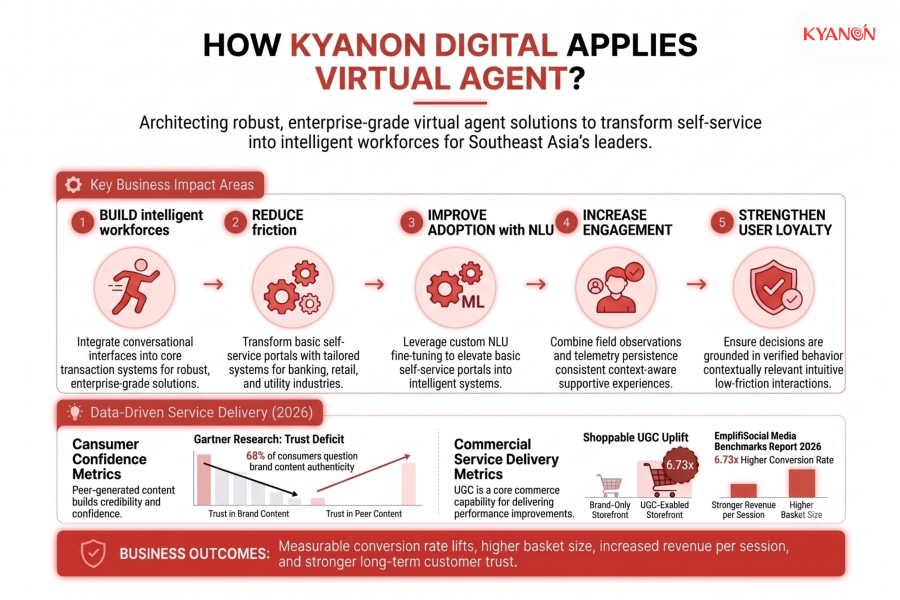
Kyanon Digital builds robust, enterprise-grade virtual agent solutions tailored for banking, retail, and utility leaders across Southeast Asia. By integrating conversational interfaces into core transaction systems, we transform basic self-service portals into intelligent digital workforces. Our engineering methodology emphasizes bi-directional API security, custom NLU fine-tuning, and human-in-the-loop escalation frameworks designed for complex compliance environments.
Explore our services:

 Create project brief with AI