
What is a digital shelf?
The digital shelf is the online environment where shoppers discover, compare, evaluate, and buy products across retailer websites, marketplaces, mobile apps, search engines, and digital commerce channels. It includes product pages, search visibility, pricing, availability, reviews, rich media, and product data quality.
NIQ describes the digital shelf as a core influence point across search, reviews, retailer apps, and in-aisle comparisons. At the same time, IBM notes that product discovery can happen across digital, virtual, or physical experiences.
How the digital shelf works
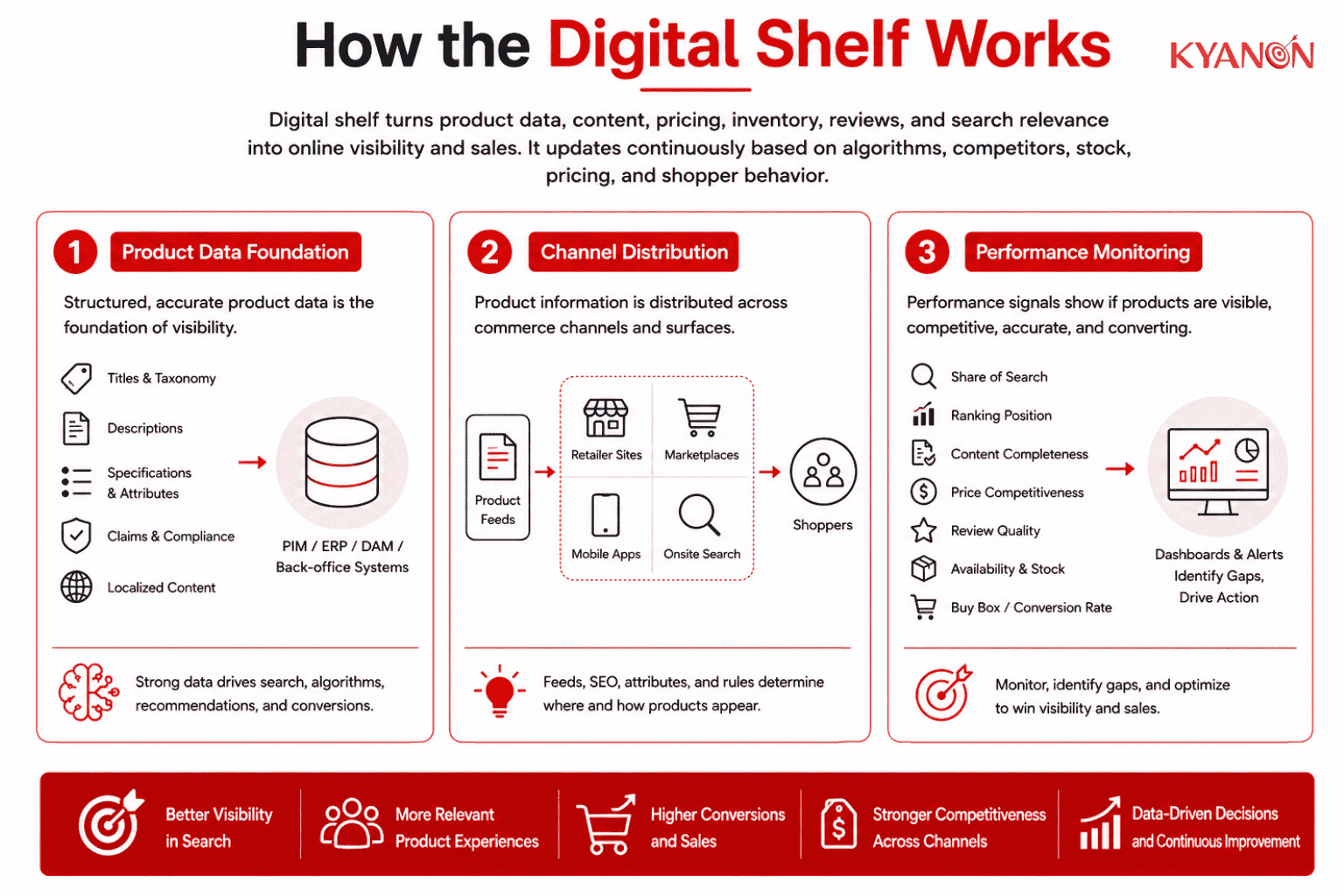
The digital shelf works by translating product data, product content, pricing, inventory, reviews, and search relevance into online visibility and conversion performance. Unlike a physical shelf, the digital shelf changes continuously because retailer algorithms, sponsored placements, stock status, competitor pricing, and shopper behavior can reshape product ranking at any time.
The mechanism is simple: product information is first structured in systems such as PIM, ERP, DAM, or ecommerce back-office tools; then it is distributed through product feeds, marketplaces, retailer sites, mobile apps, and onsite search; finally, performance data is monitored to identify visibility gaps, conversion blockers, and content issues.
Product data foundation
Product data is the foundation of the digital shelf because search engines, retailer algorithms, AI recommendations, and shoppers all depend on structured product information. This includes product titles, taxonomy, descriptions, specifications, attributes, claims, localized content, and compliance details. Weak product data can reduce visibility before a shopper reaches the product detail page.
Channel distribution
Channel distribution determines where product information appears and how each commerce channel interprets it. Product feed management, SEO metadata, marketplace attributes, category mapping, and retailer-specific rules affect whether a product appears in search results, category pages, recommendation modules, and sponsored placements.
IBM notes that AI-powered recommendation and search engines analyze large volumes of consumer behavior data to present relevant options across e-commerce journeys.
Performance monitoring
Performance monitoring tracks whether a product is visible, accurate, available, competitive, and converting across channels. Key signals include share of search, ranking position, content completeness, price competitiveness, review quality, availability, buy box status, and conversion rate. Digital shelf monitoring matters because a product can be listed online but still lose sales if it is out of stock, poorly ranked, incorrectly priced, or missing critical product content.

Core components
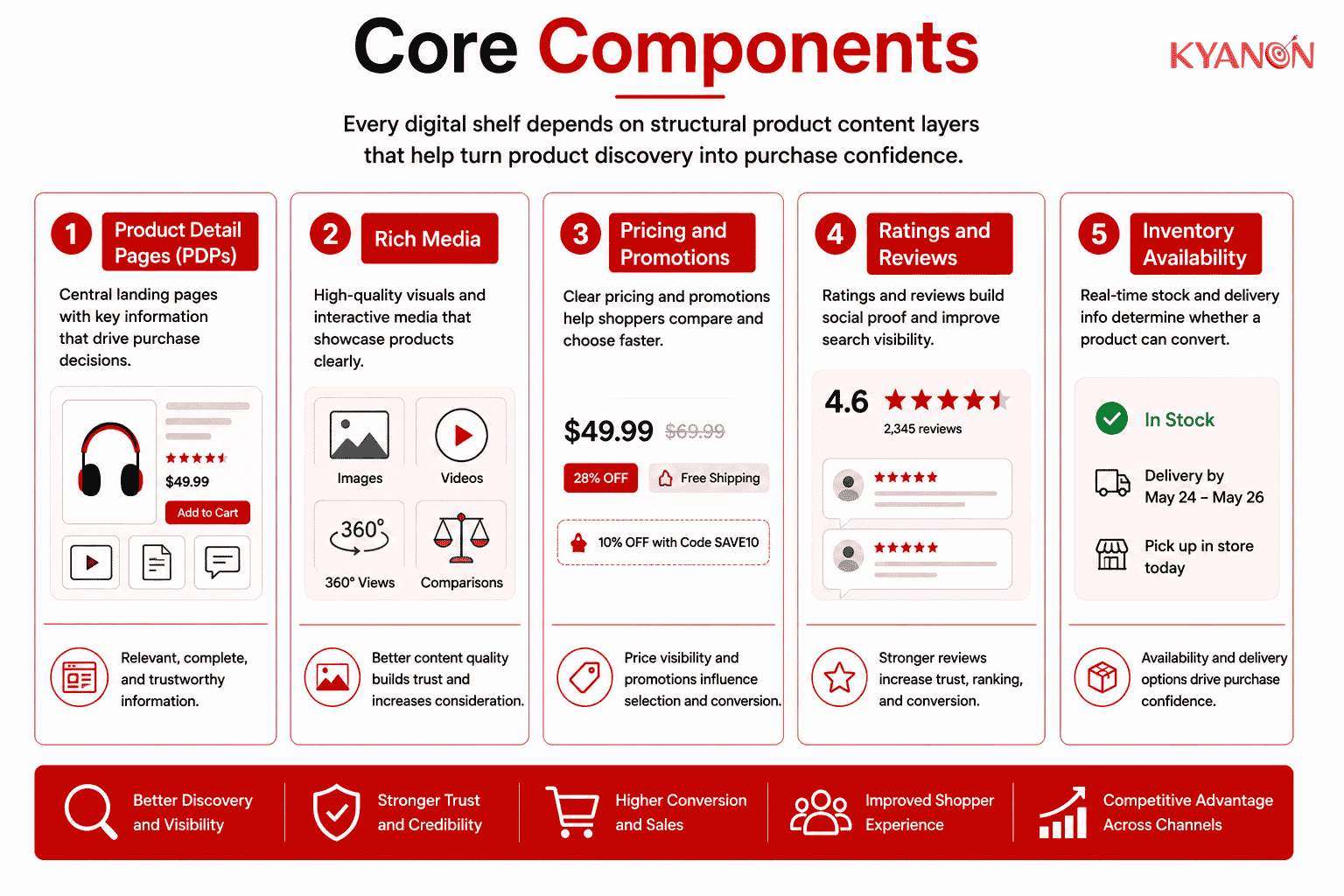
Every digital shelf depends on structural product content layers that help turn product discovery into purchase confidence.
- Product detail pages (PDPs): PDPs are the central product landing pages where titles, descriptions, technical details, claims, media, reviews, and purchase options come together. A PDP is often where the shopper decides whether a product is relevant, trustworthy, and worth buying.
- Rich media: Rich media includes hero images, product galleries, videos, 360-degree views, comparison visuals, and demonstration assets. NIQ identifies imagery and content quality as important signals that shape whether a shopper sees a product as trustworthy and worth selecting.
- Pricing and promotions: Pricing and promotional visibility affect how shoppers compare products across retailer sites, marketplaces, and mobile apps. Price visibility is one of the digital shelf signals NIQ highlights as part of shopper evaluation and product selection.
- Ratings and reviews: Ratings and reviews act as social proof and algorithmic signals. NIQ identifies ratings and reviews as factors that influence product trust, search visibility, and shopper decision-making.
- Inventory availability: Determines whether a visible product can actually convert. IBM’s retail technology guidance connects e-commerce experience quality with real-time inventory visibility, accurate delivery dates, and flexible fulfillment options.
How brands win
Brands win on the digital shelf by using Digital Shelf Analytics (DSA), Product Information Management (PIM), product feed management, SEO, and AI-powered search optimization to keep product listings visible, accurate, available, and competitive. Gartner states that DSA applications gather product data from third-party digital channels such as marketplaces and retailer commerce sites, then provide SaaS dashboards for product data optimization.
For enterprise teams, the most important digital shelf KPIs usually include share of search, organic rank, content completeness, PDP quality, review score, stock availability, pricing consistency, buy box performance, and conversion rate. NIQ reported in 2026 that 80% of in-basket products come from the top 10 search results for a given keyword, making search visibility a direct commercial priority rather than a reporting metric.
Digital shelf vs. product catalog
The digital shelf and product catalog are connected, but they are not the same: a product catalog is the source of product information, while the digital shelf is the live commerce environment where that information competes for visibility, trust, and sales.
Dimension | Digital shelf | Product catalog |
Primary purpose | Manage how products appear, rank, and convert across digital commerce channels | Store and organize product information in a structured system |
| Business question answered | “Can shoppers find, trust, and buy this product online?” | “Do we have accurate product data?” |
Main users | Ecommerce, digital marketing, merchandising, marketplace, retail media, revenue teams | Product, content, data, operations, and catalog management teams |
| Core data involved | Search rank, product content, price, availability, reviews, ratings, competitors, conversion signals | SKU, title, description, attributes, taxonomy, images, specifications, variants |
Change frequency | Continuous, because rankings, pricing, availability, and competitor context change often | Periodic or workflow-based, depending on product updates and governance rules |
| Best for | Improving product visibility, conversion, retail media efficiency, and marketplace performance | Creating a single source of truth for product information |
Main risk if ignored | Products become invisible, under-convert, or waste ad spend despite being listed online | Teams distribute inconsistent, incomplete, or outdated product information |
| Relationship to PIM | Consumes and tests PIM/catalog data in live channels | Often managed inside PIM, ERP, DAM, or e-commerce back-office systems |
When to consider digital shelf
Digital shelf becomes a priority when e-commerce performance depends on product visibility, content accuracy, channel consistency, and fast response to market changes. For enterprise retailers and brands, digital shelf management is not only a merchandising activity; it is a revenue protection discipline across product data, search, media spend, and availability.
Consider digital shelf if:
- Your e-commerce sales depend on marketplaces, retailer websites, social commerce, or search-driven product discovery, and product visibility varies heavily by channel.
- Your team is increasing retail media or paid search spend, but product pages still suffer from poor images, missing attributes, weak reviews, inconsistent pricing, or out-of-stock issues.
- Your product data is managed across multiple systems, markets, or teams, and inconsistencies are affecting search ranking, conversion, marketplace compliance, or customer trust.
It may not be the right priority if:
- Your business sells a very small product range through one owned website, with stable pricing, stable stock, and no marketplace, retailer, or paid search dependency.
Why the digital shelf matters for retail and digital commerce
Digital shelf matters for retail and digital commerce because product discovery, product trust, and purchase decisions increasingly happen across search results, product pages, reviews, social content, retailer apps, and AI-assisted recommendations. NIQ states that the digital shelf has become a defining force in how brands earn visibility, trust, and conversion across the shopper journey.
NIQ reported in 2026 that 80% of in-basket products come from the top 10 search results for a given keyword, which makes digital shelf visibility a direct driver of product selection rather than a secondary e-commerce metric. NIQ also notes that AI recommendations often surface only one or two products, increasing pressure on brands to maintain structured product data, strong reviews, and accurate content.
Deloitte’s 2026 Global Retail Industry Outlook found that 67% of surveyed retail executives expect to have AI-driven personalization capabilities within the next year. As AI-driven commerce grows, digital shelf readiness becomes more important because AI systems depend on structured, accurate, and available product data to recommend the right products across channels.
A regional retailer expanding across Southeast Asian marketplaces may manage different product titles, local descriptions, marketplace attributes, promotions, availability rules, delivery promises, and seller competition on every channel. Digital shelf management allows the business to monitor product visibility, PDP quality, inventory gaps, search rank, and conversion blockers by channel instead of treating ecommerce performance as one blended sales number.
Common misconceptions
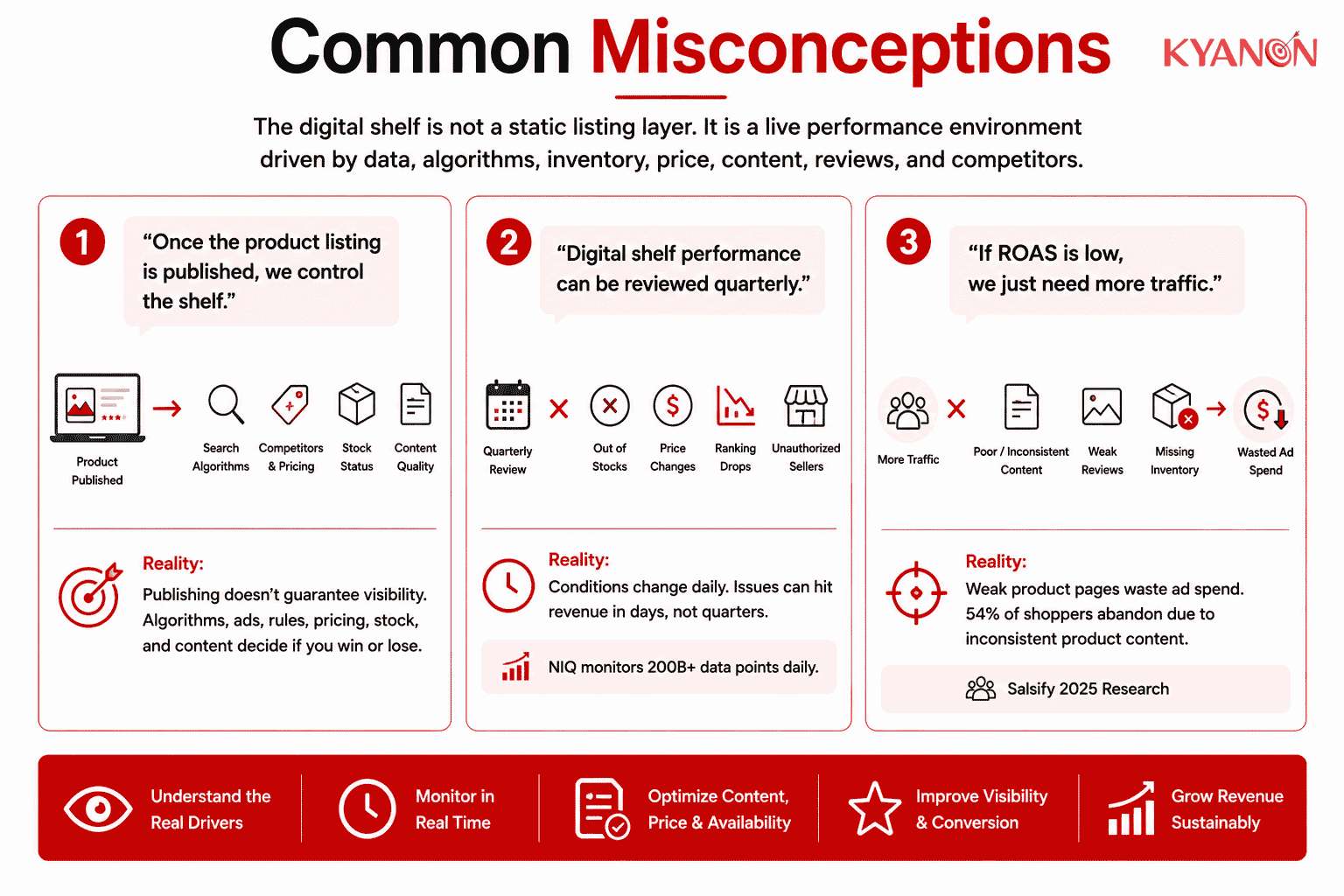
The biggest misconception is that the digital shelf is a static product listing layer, when it is actually a live performance environment shaped by algorithms, product data, inventory, price, content quality, reviews, and competitor actions. A product can be technically “listed” but still be commercially invisible if it does not rank, qualify, or convert in the channel where shoppers search.
“Once the product listing is published, we control the shelf.”
Reality: Publishing a product listing does not guarantee visibility. Search algorithms, sponsored placements, marketplace rules, competitor pricing, stock status, and content quality can determine whether the listing is shown, suppressed, or outranked.
“Digital shelf performance can be reviewed quarterly.”
Reality: Quarterly reviews are too slow for digital shelf management because out-of-stocks, price changes, unauthorized sellers, suppressed listings, and ranking drops can affect revenue within days. NIQ’s Digital Shelf product monitors more than 200 billion data points daily, which reflects how frequently digital commerce conditions change.
“If ROAS is low, we just need more traffic.”
Reality: More traffic cannot fix a weak product page. If product content is inconsistent, images are poor, reviews are weak, or inventory is missing, paid media can amplify waste instead of improving conversion; Salsify’s 2025 research found that 54% of shoppers abandoned a sale because product content was inconsistent across channels.
How Kyanon Digital applies digital shelf
Kyanon Digital applies digital shelf optimization through e-commerce architecture, PIM integration, product feed management, SEO, AI-powered search, and analytics workflows for enterprise retailers and brands across Southeast Asia and regional markets. In practice, this means connecting product data sources, improving product content governance, mapping channel requirements, optimizing on-site search and category discovery, and creating feedback loops between product visibility, conversion performance, and operational data.
Kyanon Digital’s e-commerce work covers omnichannel development, inventory and order management, AI-driven recommendations, and customer-facing digital commerce experiences.
→ Explore our omnichannel e-commerce development and big data services.

 Create project brief with AI