
What is Product Information Management (PIM)?
Product Information Management (PIM) is the process and software used to collect, centralize, enrich, govern, and distribute product information across sales and marketing channels. It provides a controlled product-data layer between source systems such as ERP, PLM, suppliers, and DAM and destinations such as eCommerce sites, marketplaces, mobile apps, and catalogs.
A PIM manages the information required to describe and sell products, including identifiers, specifications, categories, descriptions, localized content, and associated product assets.
In simple terms: PIM gives teams one governed place to prepare product information before publishing it across multiple customer channels.
How Product Information Management (PIM) works
The four core stages of product information management are collect, enrich, govern, and distribute: product data enters the PIM from source systems, is prepared under defined business rules, and is then published to the channels that need it.
A typical PIM flow is:
ERP / PLM / Suppliers / DAM → Collect → Enrich → Govern → Distribute → eCommerce / Marketplaces / Apps / Stores / Catalogs
These stages form a repeatable lifecycle rather than a one-time sequence because product attributes, markets, languages, assets, and channel requirements continue to change.
Collect
A PIM aggregates product information from ERP, PLM, suppliers, files, databases, DAM, and other source systems into a centralized product-data environment.
PIM commonly manages these product-data groups:
- Technical data: dimensions, weight, materials, ingredients, specifications, warranty information
- Product structure: SKU, GTIN/UPC/EAN, categories, product families, variants
- Marketing content: product names, descriptions, features, benefits, SEO fields
- Localization: languages, localized copy, market-specific attributes and units
- Digital assets: images, videos, manuals, certificates, or references to assets managed in DAM
PIM may receive pricing or inventory information from other systems, but dynamic pricing, live stock, tax, and transactional records are commonly governed by ERP, commerce, pricing, or inventory systems rather than PIM itself. Akeneo likewise distinguishes PIM from ERP, DAM, and MDM rather than treating them as interchangeable.
Enrich and govern
Enrichment turns raw product records into customer-facing product information, while governance determines whether that information is complete and approved for publication.
Marketing, merchandising, and product teams can add descriptions, technical attributes, translations, product benefits, classifications, and channel-specific content.
Governance adds controls such as:
- Required attributes
- Data validation
- Completeness rules
- Product taxonomy
- Ownership and permissions
- Review and approval workflows
- Localization requirements
This combination is what separates a PIM operating model from maintaining product information across independent spreadsheets.
Distribute
Distribution sends approved product information from the PIM to eCommerce platforms, marketplaces, mobile apps, retail channels, catalogs, and other destinations.
Each destination can require different attributes, languages, naming conventions, media, or content formats. The objective is therefore not to publish identical content everywhere, but to deliver controlled product information appropriate to each channel.

Product Information Management (PIM) vs. ERP
PIM and ERP both contain product-related data, but PIM prepares product information for sales and customer channels while ERP primarily manages operational and transactional business processes. Akeneo specifically distinguishes PIM from ERP, DAM, and MDM because the systems serve different core functions.
| Dimension | Product Information Management (PIM) | ERP |
Primary purpose | Manage and enrich product information for channels | Manage enterprise operations and transactions |
| Typical product data | Descriptions, attributes, categories, localization, rich content | Inventory, procurement, cost, operational pricing, transactions |
Primary users | eCommerce, merchandising, marketing, product-data teams | Finance, operations, procurement, supply chain |
| Product enrichment | Core capability | Usually limited |
Localization | Common multi-market capability | Not its primary role |
| Data governance | Product completeness, approval, taxonomy, channel readiness | Operational and transactional controls |
Channel distribution | Publishes product information to commerce destinations | Usually supplies operational data to downstream systems |
| Typical relationship | Consumes ERP product data and enriches it | Provides operational product records to PIM |
PIM therefore does not normally replace ERP; the architecture should define which system owns each data element and how that information moves between them.
When to consider Product Information Management (PIM)
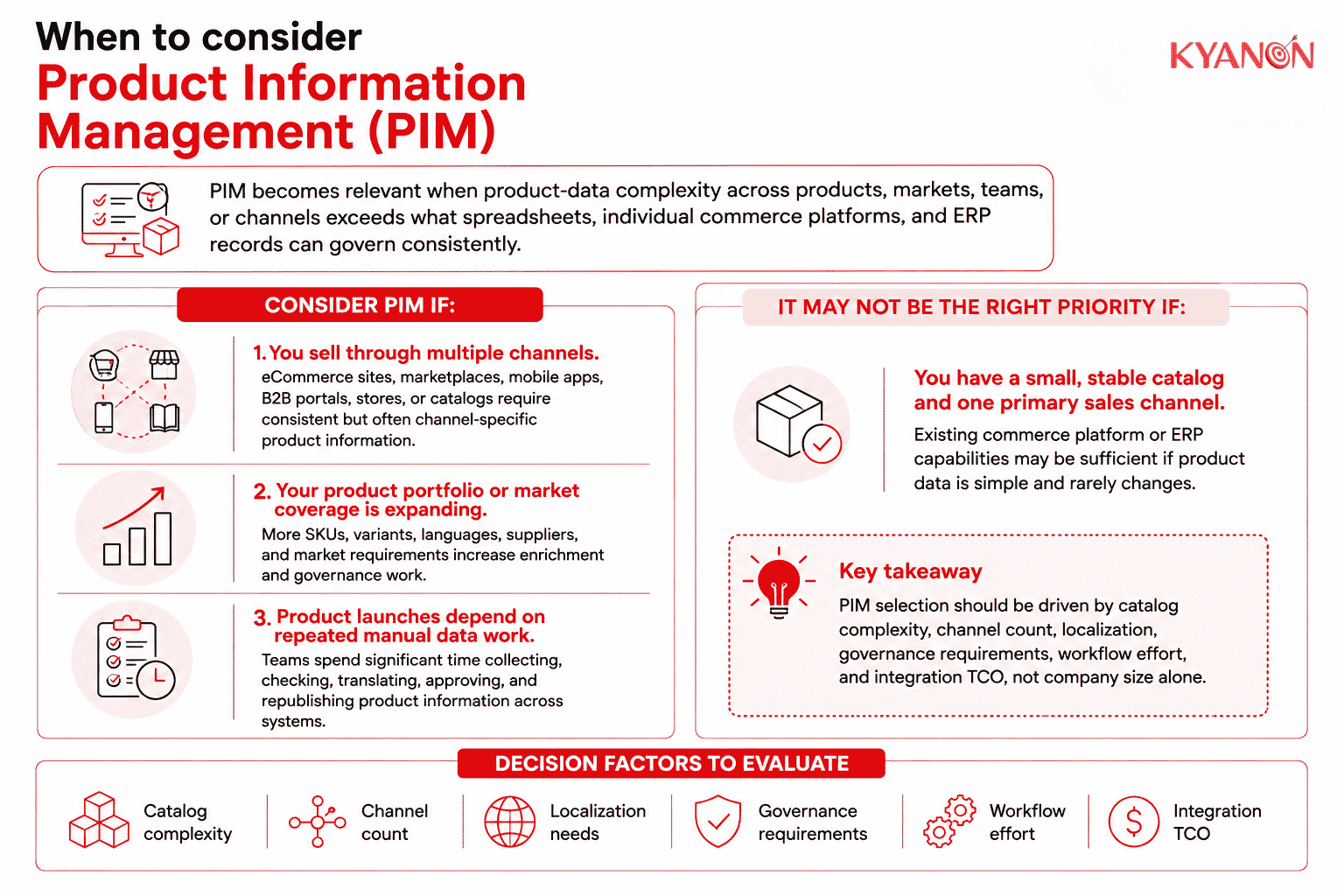
PIM becomes relevant when product-data complexity across products, markets, teams, or channels exceeds what spreadsheets, individual commerce platforms, and ERP records can govern consistently.
Consider Product Information Management (PIM) if:
- You sell through multiple channels. eCommerce sites, marketplaces, mobile apps, B2B portals, stores, or catalogs require consistent but often channel-specific product information.
- Your product portfolio or market coverage is expanding. More SKUs, variants, languages, suppliers, and market requirements increase enrichment and governance work.
- Product launches depend on repeated manual data work. Teams spend significant time collecting, checking, translating, approving, and republishing product information across systems.
It may not be the right priority if:
- You have a small, stable catalog and one primary sales channel. Existing commerce platform or ERP capabilities may be sufficient if product data is simple and rarely changes.
PIM selection should therefore be driven by catalog complexity, channel count, localization, governance requirements, workflow effort, and integration TCO, not company size alone.
Why Product Information Management (PIM) matters for eCommerce
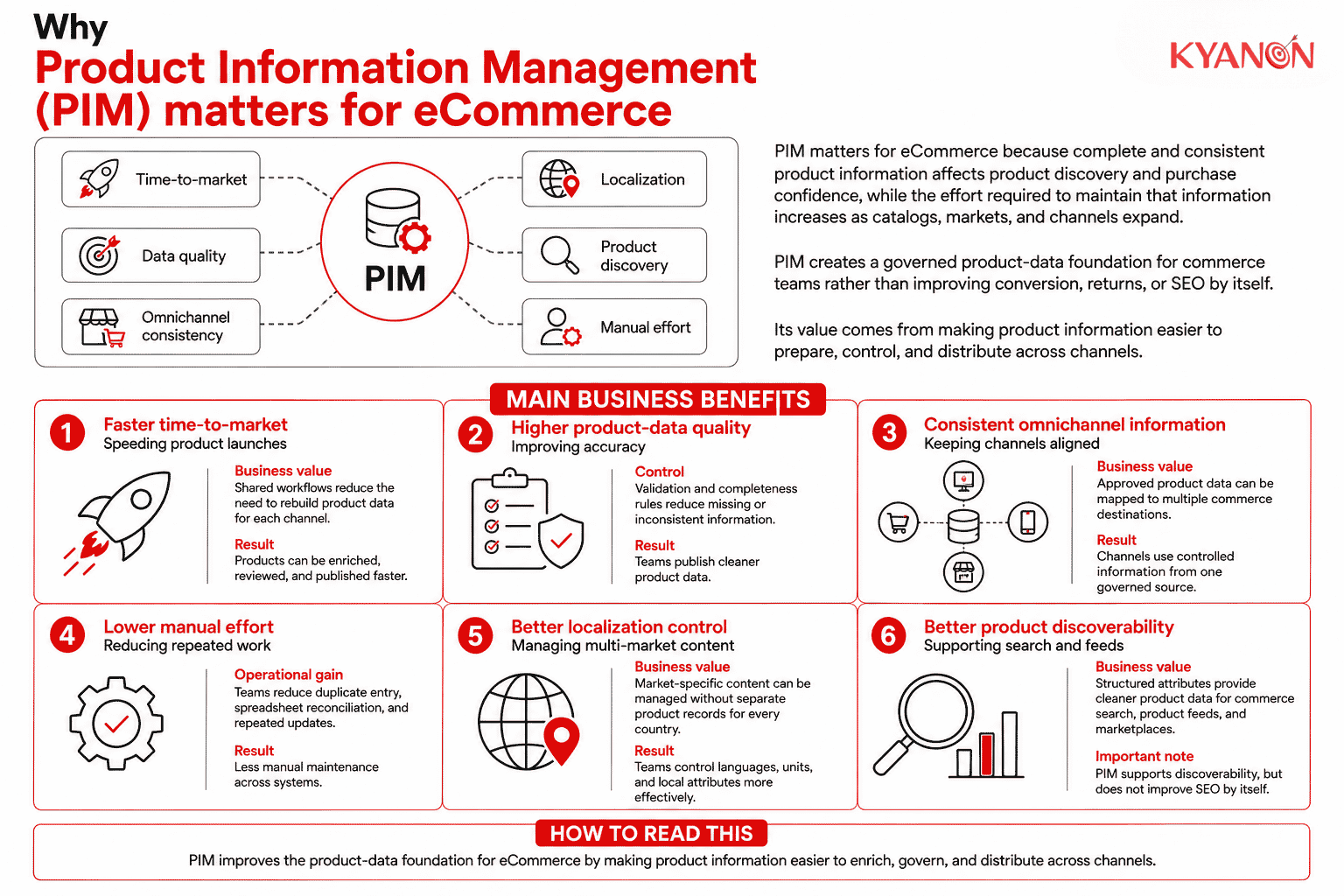
PIM matters for eCommerce because complete and consistent product information affects product discovery and purchase confidence, while the effort required to maintain that information increases as catalogs, markets, and channels expand.
The main business benefits of PIM are:
- Faster time-to-market: Product data can be enriched, reviewed, and distributed through shared workflows instead of being rebuilt for each channel.
- Higher product-data quality: Validation and completeness rules reduce missing or inconsistent information before publication.
- Consistent omnichannel information: Approved data can be mapped to multiple commerce destinations from a governed source.
- Lower manual effort: Teams reduce duplicate entry, spreadsheet reconciliation, and repeated channel updates.
- Better localization control: Market-specific content can be managed without creating independent product records for every country.
- Better product discoverability: Structured attributes give commerce search, product feeds, marketplaces, and other discovery systems cleaner product data to consume.
PIM does not automatically increase conversion, reduce returns, or improve SEO; it provides the product-data foundation on which those outcomes can be improved.
Common misconceptions about Product Information Management (PIM)
The main misconception about PIM is that it is simply a product database; PIM combines product-data centralization with enrichment, governance, workflow, localization, and channel distribution.
“PIM is only for large enterprises.”
Reality: Company size is not the primary qualification criterion. Product-data complexity can become difficult to manage when an organization adds SKUs, variants, suppliers, languages, marketplaces, or other sales channels.
PIM platforms can operate across widely different catalog scales; Akeneo has described PIM deployments ranging from hundreds to more than 60 million SKUs.
For a CTO or Head of eCommerce, the better question is “How complex is our product-information operation?”, not simply “How large is our company?”
“Spreadsheets are just as good and cheaper.”
Reality: Spreadsheets can store product attributes, but they do not inherently provide centralized completeness controls, validation rules, permissions, approval workflows, localization governance, and managed multichannel distribution. PIM systems are specifically designed to centralize and control these product-data workflows.
For IT leadership, the TCO comparison should include manual reconciliation, duplicate updates, data errors, localization effort, channel maintenance, and delayed product launches, not license cost alone.
“PIM, ERP, and MDM are basically the same thing.”
Reality: The systems overlap around product data but have different responsibilities. ERP manages operations and transactions; MDM governs master records across enterprise data domains; PIM enriches and prepares product information for customer-facing channels.
A business can therefore use ERP, MDM, PIM, and DAM together when each system has clearly defined data ownership.
“PIM is only for the eCommerce website.”
Reality: PIM can distribute product information beyond a website to marketplaces, mobile applications, retail touchpoints, catalogs, and other internal or external channels.
For omnichannel organizations, the PIM acts as the governed product-information layer feeding multiple destinations rather than the database behind a single storefront.
“PIM implementation is a one-time IT project.”
Reality: PIM requires an ongoing operating model because products, attributes, taxonomies, suppliers, languages, and channel requirements continue to change after go-live.
For an IT director, the operating model should define data owners, source-of-truth rules, taxonomy ownership, completeness criteria, approval workflows, localization ownership, and integration monitoring.
PIM should therefore be treated as both a technology integration and an ongoing product-data governance capability.

How Kyanon Digital applies Product Information Management (PIM)
Kyanon Digital integrates product information management into connected digital commerce architectures so product information can move from enterprise source systems through governed enrichment workflows to customer-facing channels. Kyanon Digital’s current digital commerce architecture explicitly includes PIM alongside ERP, CRM, OMS, WMS, POS, inventory, fulfillment, and customer-facing commerce systems.
For PIM platforms such as Akeneo and Salsify, a multichannel implementation can include:
- Product-data ownership and source-of-truth rules
- ERP, PIM, DAM, and commerce integration
- Product family, taxonomy, variant, and attribute modeling
- Enrichment and completeness workflows
- Localization and market-specific content
- Channel mapping and product-data distribution
- Product feed and marketplace integration
- Data-quality and integration monitoring
A typical architecture is:
ERP / PLM / Suppliers / DAM → PIM → eCommerce / Marketplace / Mobile / POS / Product Feeds
The implementation objective is not simply to centralize product records. It is to improve time-to-market, catalog consistency, localization control, channel scalability, and the TCO of maintaining product information across commerce ecosystems.
→ Explore Kyanon Digital’s Digital Commerce services for product data, eCommerce platforms, and enterprise system integration.

 Create project brief with AI