
What is dynamic personalization?
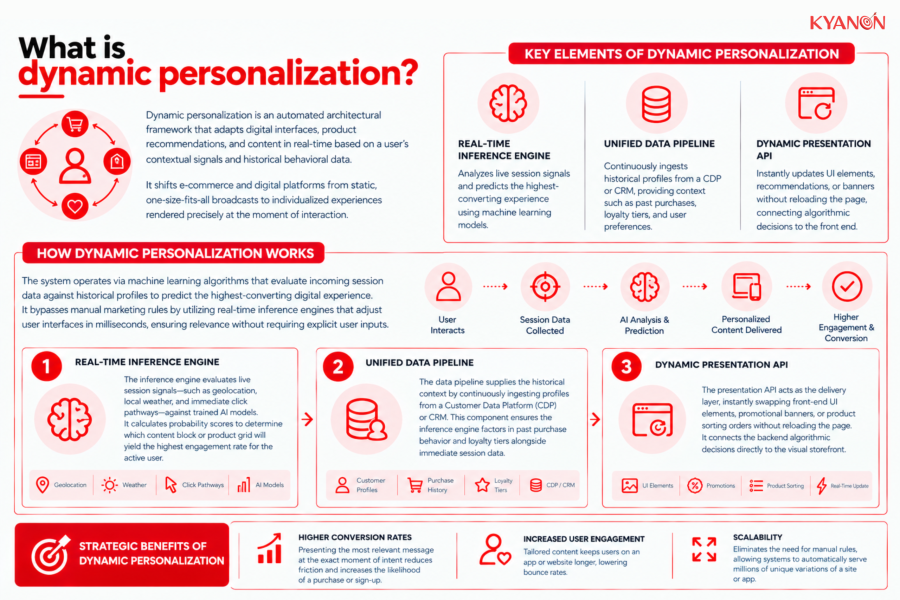
Dynamic personalization is an automated architectural framework that adapts digital interfaces, product recommendations, and content in real-time based on a user’s contextual signals and historical behavioral data. It shifts e-commerce and digital platforms from static, one-size-fits-all broadcasts to individualized experiences rendered precisely at the moment of interaction.
How dynamic personalization works
The system operates via machine learning algorithms that evaluate incoming session data against historical profiles to predict the highest-converting digital experience. It bypasses manual marketing rules by utilizing real-time inference engines that adjust user interfaces in milliseconds, ensuring relevance without requiring explicit user inputs.
Real-Time Inference Engine
The inference engine evaluates live session signals-such as geolocation, local weather, and immediate click pathways-against trained AI models. It calculates probability scores to determine which content block or product grid will yield the highest engagement rate for the active user.
Unified Data Pipeline
The data pipeline supplies the historical context by continuously ingesting profiles from a Customer Data Platform (CDP) or CRM. This component ensures the inference engine factors in past purchase behavior and loyalty tiers alongside immediate session data.
Dynamic Presentation API
The presentation API acts as the delivery layer, instantly swapping front-end UI elements, promotional banners, or product sorting orders without reloading the page. It connects the backend algorithmic decisions directly to the visual storefront.

Strategic benefits of Dynamic Personalization
- Higher conversion rates: Presenting the most relevant message at the exact moment of intent reduces friction and increases the likelihood of a purchase or sign-up.
- Increased user engagement: Tailored content keeps users on an app or website longer, lowering bounce rates.
- Scalability: Eliminates the need for manual rules, allowing systems to automatically serve millions of unique variations of a site or app.
Dynamic personalization vs Dynamic Pricing
While both rely on algorithmic adjustments, they serve fundamentally separate business strategies and optimize entirely different variables.
Dimension | Dynamic personalization | Dynamic Pricing |
| Core business objective | Enhancing user experience and conversion | Optimizing profit margins per transaction |
Primary data variable | Customer behavior and context | Market supply, demand, and competitor pricing |
| Trigger mechanism | Individual user actions | External market fluctuations |
User perception | Tailored content and relevant UI | Fluctuating transaction costs |
| Operational owner | E-commerce, Product, and Marketing teams | Finance, Pricing, and Yield Management teams |
When to consider dynamic personalization
Consider dynamic personalization if:
- Your merchandising team spends excessive operational hours manually configuring complex, rule-based product recommendation grids that quickly become outdated.
- High volumes of top-of-funnel traffic from targeted paid advertising bounce immediately because your landing pages fail to reflect the specific context of the referral link.
- You have deployed a Customer Data Platform (CDP) but lack the presentation-layer architecture required to activate that data in real-time across your digital storefront.
It may not be the right priority if:
- Your enterprise offers a highly regulated, single-tier B2B compliance service where every client requires the exact same standardized interface and rigid documentation.
Why dynamic personalization matters for enterprise E-commerce
Relying on static user experiences inflates customer acquisition costs (CAC) because generic interfaces fail to convert high-intent traffic. Transitioning to algorithmic adaptation directly improves conversion rates by removing navigational friction, ultimately lowering the total cost of ownership (TCO) associated with manual campaign management.
Adobe’s 2025 research on personalization at scale found that retailers using personalization reported exceeding targets for revenue and conversion at 68%, while 63% reported exceeding customer-experience targets.
Common misconceptions
We can’t use this yet because our data warehouse isn’t perfectly clean and unified
Reality: Waiting for flawless, impeccably organized datasets leads to severe lost revenue opportunity. Modern machine learning and transformer models excel at processing imperfect or incomplete datasets by learning underlying contextual patterns, allowing brands to scale faster by starting with specific use cases and improving their data pipeline progressively.
We only track anonymous users right now, so we can’t personalize anything until they create an account and log in
Reality: True dynamic personalization relies heavily on real-time contextual signals. Even for first-time anonymous visitors, tools tailor content instantly using metadata like local weather, referral sources, or immediate session behavior, meaning you do not need a fully populated profile to provide immediate relevance.
If we implement this, we’ll need a massive engineering team to constantly write and update targeting rules
Reality: Many companies mistakenly rely on legacy, rule-based systems that require endless manual tuning, but modern AI-native systems automate the heaviest lifting using real-time inference engines. They shift components in under 80 milliseconds purely based on algorithmic feedback loops rather than manual developer adjustments.
More personalization is always better; we should customize every single pixel of the user’s journey
Reality: Flooding a user with dozens of hyper-targeted journeys creates digital noise, which can frustrate users or trigger feelings of being invasively watched. Successful frameworks prioritize clarity and convenience over maximum customization, ensuring data privacy and transparency remain fully intact.
How Kyanon Digital applies dynamic personalization
Kyanon Digital implements dynamic personalization engines for enterprise ecommerce and digital platform clients using AI-powered recommendation systems. Operating across Vietnam, Singapore, Thailand, ANZ, and Malaysia, our engineering teams integrate algorithmic decision engines directly into composable architectures. We focus on bridging the gap between raw customer data pipelines and front-end presentation layers, delivering measurable outcomes that decrease TCO and accelerate time-to-market.
Explore our Ecommerce & Digital Platform services:

 Create project brief with AI