
What is a Personalization Engine?
A personalization engine is a software system using data, rules, and AI to deliver individually tailored content, product offers, and experiences to each customer in real time across digital touchpoints. It orchestrates behavioral context, historical interaction data, and machine learning models to dynamically modify the user interface and messaging per interaction.

How Personalization Engine Works
A personalization engine combines real-time customer signals, predictive models, and business rules to determine the most relevant experience for each customer.
Instead of relying only on static audience segments, it evaluates behavior and context during active sessions to dynamically adapt content, offers, and messaging.

Real-Time Data and Context Ingestion
Customer Data Platforms (CDPs), CRM systems, and digital touchpoints continuously capture signals to maintain an up-to-date view of customer intent.
Key inputs include:
- Clickstream and browsing behavior
- Transaction and interaction history
- Device, location, and time context
- Customer profile and lifecycle data
- Current-session engagement
This provides the context needed to personalize experiences based on what customers are doing now.
AI Decisioning and Next-Best-Action Selection
The decisioning layer evaluates customer profiles and real-time signals using machine learning models and business rules.
Machine learning predicts customer interests or likely actions, while business rules ensure recommendations align with commercial and customer requirements.
Decisioning Output Examples
Decision | Example output |
| Content | Relevant product or content recommendations |
Offer | Personalized promotion or incentive |
| Experience | Context-specific layout or interface |
Action | Next-best-action or engagement strategy |
Next-best-action selects the most relevant action for a customer at a specific moment.
Dynamic Experience and Channel Delivery
Selected experiences are distributed through headless APIs and an API gateway to web, mobile, messaging, and other customer touchpoints.
Headless APIs keep personalization logic separate from individual front-end applications, making it easier to deliver consistent experiences across channels.
Decision → API Orchestration → Channel Activation → Experience Update
The outcome is a personalization architecture that continuously responds to customer intent while delivering relevant and consistent experiences across digital touchpoints.

Comparative Analysis: Personalization Engine vs. Product Recommendation Engine
Both systems optimize customer experiences, but they differ fundamentally in operational scope, algorithmic orchestration, and cross-channel execution capabilities.
Personalization Engine vs. Product Recommendation Engine Comparison
Dimension | Legacy Product Recommendation Engine | Enterprise Personalization Engine |
| Operational Scope | Narrow; limited to item suggestions (e.g., “You may also like”). | Holistic; dynamically alters UI layouts, messaging, navigation, and offers. |
Data Processing | Reactive; relies primarily on purchase history and browsing clickstreams. | Proactive; ingests live session intent, zero-party preferences, and real-time CDP signals. |
| Channel Orchestration | Isolated to single touchpoints like checkout pages or promotional emails. | Omnichannel; coordinates real-time triggers across web, in-app, push, and SMS. |
Decisioning Engine | Basic collaborative filtering and co-occurrence algorithms. | Advanced Machine Learning, agentic automation models, and real-time business logic. |
| Business Impact | Incremental cross-sell and up-sell transaction lift. | Complete customer journey transformation, improved conversion, and long-term LTV retention. |
Why Personalization Engine Matters
Enterprise digital ecosystems require modern software architectures capable of translating vast streams of customer data into immediate, context-aware digital interactions. According to the Gartner Magic Quadrant for Personalization Engines, the personalization engine market expanded by 26.1% to reach $1.2 billion, highlighting sustained enterprise demand for core digital marketing stacks that act as primary engines for real-time customer engagement. Modern engines provide the foundational decisioning required to move beyond fragmented interactions and deliver cohesive customer experiences across complex omni-channel environments.
Without a dedicated decisioning engine, organizations struggle with execution barriers and fragmented technology investments. McKinsey & Company reports that while 90% of CMOs are actively experimenting with AI use cases, less than 10% have successfully scaled or captured repeatable value across their marketing workflows, largely due to structural deficiencies like relying on “bolt-on” tools rather than core integration. Adopting an integrated architecture directly addresses this execution gap by creating centralized, repeatable data-to-execution pipelines.
This structural evolution becomes critical as global cloud capabilities scale to handle zero-latency computing workloads. IDC reports that worldwide public cloud infrastructure spending will cross the $1 trillion threshold in 2026, heavily accelerated by enterprise adoption of specialized AI platforms and PaaS models in banking, retail, and digital-first industries. Concurrently, research from StartUs Insights projects the global personalization software market to scale to USD 5.14 billion by 2030 at a 23.7% CAGR, backed by massive patent momentum and deep investment. These structural investments confirm that personalization engines have evolved from basic marketing add-ons into critical enterprise infrastructure required to drive long-term digital growth.

Common Misconceptions
A personalization engine is synonymous with a product recommendation engine
While both technologies aim to improve relevance, a product recommendation engine is narrow and reactive, analyzing browsing or purchase history to suggest items. A personalization engine is holistic and proactive, dynamically altering the entire customer experience across multiple touchpoints in real time, including site layouts, landing page copy, omnichannel orchestration, pricing incentives, and navigation structures based on user intent.
More volume means better results
Deploying dozens of automated flows creates user fatigue and digital noise. High-impact personalization focuses on one specific objective at a time, such as first-purchase conversion or targeted churn prevention, rather than overwhelming users with continuous micro-interactions.
Data must be perfectly clean to start
Organizations frequently stall waiting for pristine data foundations. Modern AI engines leverage real-time session behaviors and contextual signals to personal experiences effectively without requiring deep, historically perfect datasets.
It is just a marketing tool
Treating a personalization engine as a basic campaign feature severely limits its business value. It requires a cross-functional product mindset spanning data infrastructure, engineering, and customer support to solve operational friction across the entire user lifecycle.
It requires massive content libraries
Teams often fear they need thousands of unique content variations. Effective personalization is achieved by dynamically tweaking and contextualizing existing core assets rather than manufacturing entirely new content blocks from scratch.
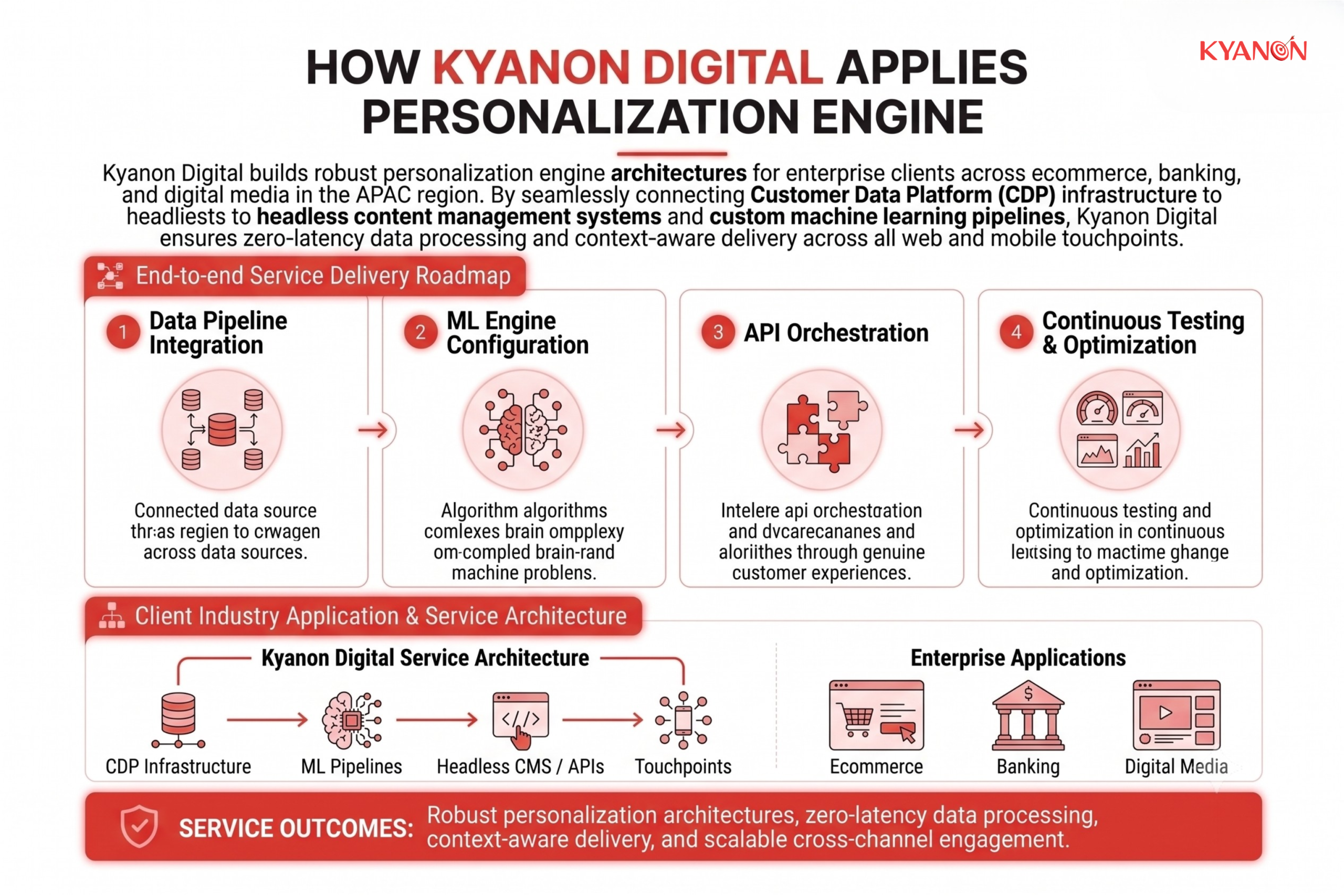
How Kyanon Digital Applies Personalization Engine
Kyanon Digital builds robust personalization engine architectures for enterprise clients across ecommerce, banking, and digital media in the APAC region. By seamlessly connecting Customer Data Platform (CDP) infrastructure to headless content management systems and custom machine learning pipelines, Kyanon Digital ensures zero-latency data processing and context-aware delivery across all web and mobile touchpoints.
Explore our services:

 Create project brief with AI