
What is Real-Time Personalization?
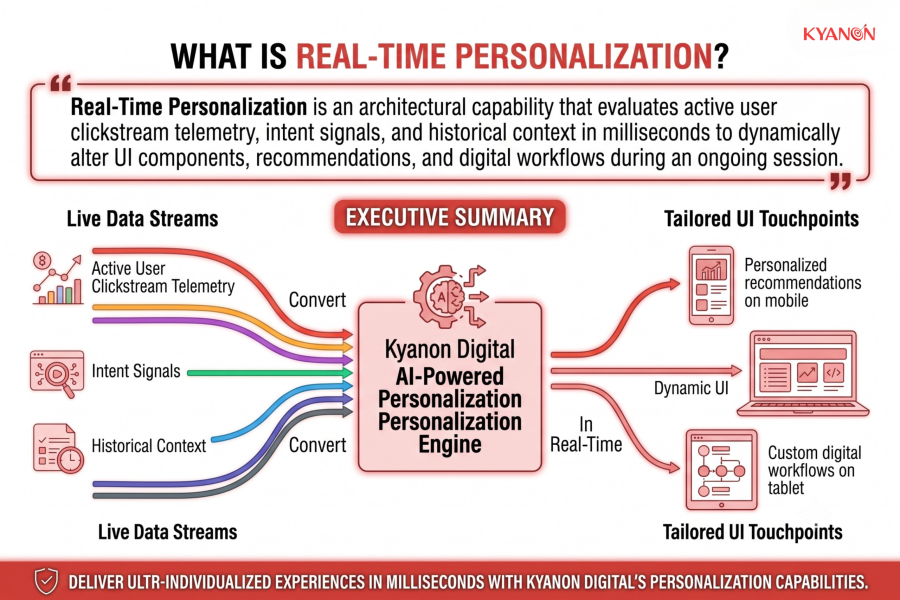
Real-Time Personalization is an architectural capability that evaluates active user clickstream telemetry, intent signals, and historical context in milliseconds to dynamically alter UI components, recommendations, and digital workflows during an ongoing session.
How Real-Time Personalization Works
Real-time personalization uses streaming data and real-time decisioning to adapt the customer experience while an interaction is still happening.
Unlike batch processing, which analyzes customer activity at scheduled intervals, real-time personalization evaluates behavioral signals as they occur. This allows businesses to respond to changes in customer intent during the current session.
For example, if a customer repeatedly searches for a product, views related products, and spends more time on a particular category, the experience can adapt while the customer is still browsing.
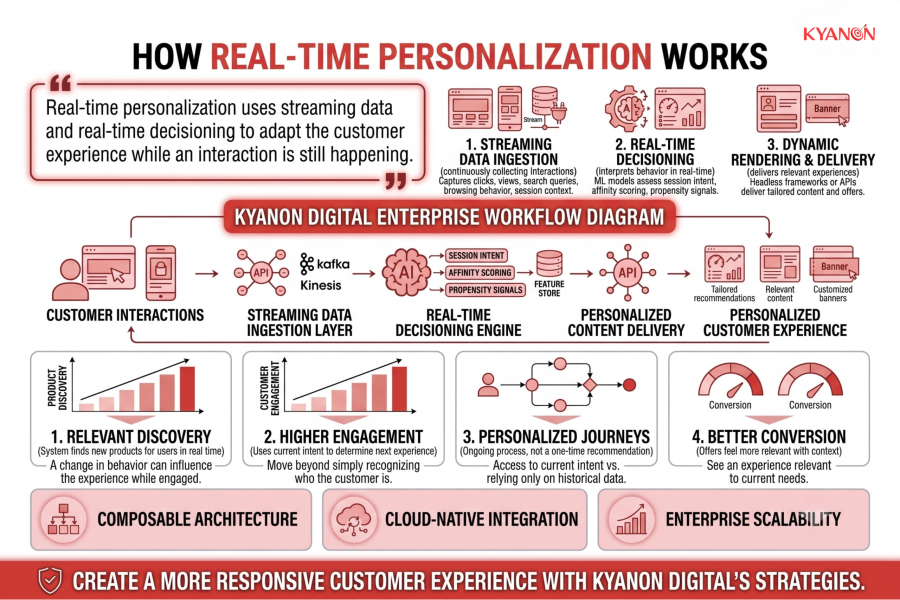
Streaming Data Ingestion Layer
The streaming data ingestion layer continuously collects customer interactions from websites, mobile apps, and other digital touchpoints.
It can capture signals such as:
- Clicks and product views
- Search queries
- Browsing behavior
- Time spent on specific content
- Device and session context
Technologies such as Apache Kafka or AWS Kinesis can be used to move these events into the personalization system in real time.
From a business perspective, this gives teams access to current customer intent rather than relying only on historical customer data. A change in behavior can therefore influence the experience while the customer is still engaged.
Real-Time Decisioning Engine
The real-time decisioning engine evaluates current customer behavior together with historical customer data to determine the most relevant next experience.
Machine learning models can assess signals such as:
- Session intent, which indicates what the customer appears to be looking for during the current visit
- Affinity scoring, which estimates a customer’s interest in specific products, services, or content
- Propensity signals, which indicate the likelihood of a customer taking a particular action
These signals can be combined with information stored in a feature store, which provides the data needed for real-time personalization decisions.
For businesses, this means the system can move beyond simply recognizing who the customer is. It can also determine what the customer may need or respond to at that specific moment.
Dynamic Rendering and Delivery
Once the decision is made, dynamic rendering delivers the selected experience to the customer’s digital touchpoint.
This can include:
- Personalized product recommendations
- Relevant content
- Targeted offers or promotions
- Customized banners or calls to action
- Different experiences based on customer context
The personalized content can be delivered across websites, mobile apps, and other digital channels through technologies such as headless frameworks, API gateways, or edge delivery networks.
From a CX perspective, the customer sees an experience that feels more relevant to their current needs without having to manually search for the next step.
Creating a More Responsive Customer Experience
When streaming data ingestion, real-time decisioning, and dynamic rendering work together, personalization becomes an ongoing process rather than a one-time recommendation.
The system continuously learns from customer interactions and adjusts the experience accordingly.
For businesses, this can support:
- More relevant product discovery
- Higher customer engagement
- More personalized digital journeys
- Better conversion opportunities
- A more responsive customer experience

Comparative Analysis: Real-Time Personalization vs. Batch Segment Personalization
| Dimension | Real-Time Personalization | Batch Segment Personalization |
| Data Processing Latency | Sub-second streaming event ingestion | Overnight or hourly batch ETL processing |
| Trigger Mechanism | Active session behavior and intent changes | Static rule triggers based on historical profile tags |
| Contextual Accuracy | High adaptation to immediate, active user intent | Moderate; relies on past purchase and browse history |
| Infrastructure Overhead | Streaming message brokers and low-latency feature stores | Standard SQL databases and periodic data warehouse syncs |
| Content Velocity Needs | Requires high-volume dynamic digital asset management | Managed via fixed, scheduled campaign creative assets |
Why Real-Time Personalization Matters
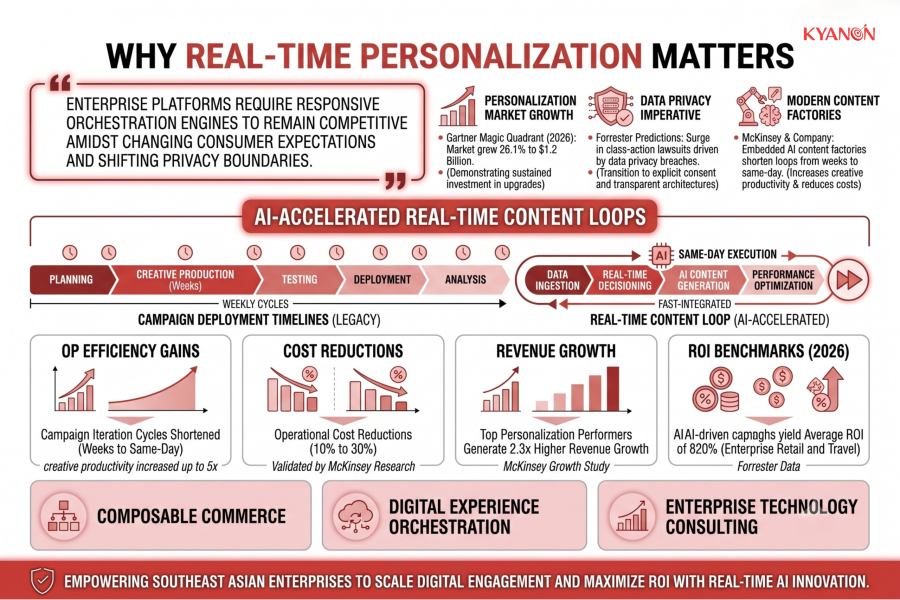
Enterprise platforms require responsive orchestration engines to remain competitive amidst changing consumer expectations and shifting privacy boundaries. The Gartner Magic Quadrant for Personalization Engines shows the personalization engine market grew 26.1% to reach $1.2 billion, demonstrating sustained investment as enterprises upgrade core digital architectures. Selecting platforms with advanced real-time modeling capabilities is essential for scaling digital engagement while avoiding the functional disconnects common in legacy systems.
At the same time, static and shallow personalization techniques are facing declining engagement as consumer scrutiny increases. Forrester’s Predictions Guide for B2C Marketing, CX, & Digital projects a 20% surge in class-action lawsuits driven by AI-related data privacy breaches, forcing technical leaders to transition away from aggressive third-party data scraping toward explicit consent guardrails and transparent streaming architectures.
To support the asset volume needed for instant dynamic rendering, backend operations must modernize alongside decisioning engines. Research from McKinsey & Company reveals that embedding AI content factories into digital operations shortens campaign iteration cycles from weeks to same-day execution, yielding two- to fivefold increases in creative productivity alongside 10% to 30% cost reductions. Furthermore, McKinsey’s Growth Through Customer Experience Study indicates that top-quartile personalization performers generate 2.3 times higher revenue growth than industry peers, with AI-driven personalization campaigns delivering an average ROI of 820% across enterprise retail and travel sectors.
Common Misconceptions
We need to personalize absolutely everything, instantly
Over-personalizing every interface element based on a single action creates intrusive and jarring user experiences. Altering an entire homepage layout because a user clicked a single gift item causes confusion rather than convenience. Effective personalization applies subtle, high-utility adjustments—such as saving preferred checkout methods or filtering nearby store inventory—rather than trying to predict complex psychological shifts from isolated clicks.
The software does it all, so it’s zero effort for us
Acquiring an advanced personalization engine does not yield business outcomes without an underlying content engine. While algorithms determine optimal offer distribution, human teams must create the underlying matrix of copy variations, promotional assets, and design layouts. Real-time personalization requires a scalable digital asset architecture; without varied creative inputs, automated engines default to repetitive generic messaging.
Customers always want us to show them what they just looked at
Retargeting users with items they have already viewed or purchased creates redundant interface friction. Prompting returning visitors with products they recently acquired wastes prime digital space and fails to assist their next action. Modern personalization focuses on forward intent, recommending cross-category accessories, replenishment schedules, or contextual support tools based on completed transactions.
If we have their name and data, they will feel connected to us
Inserting personalized name tags into generic digital layouts does not create meaningful customer relationships. Simple variable insertion like greeting users by name represents basic string rendering rather than true personalization. Valuable interaction design delivers functional assistance—such as localized store availability, streamlined authentication steps, and auto-populated transaction details.
How Kyanon Digital Applies Real-Time Personalization
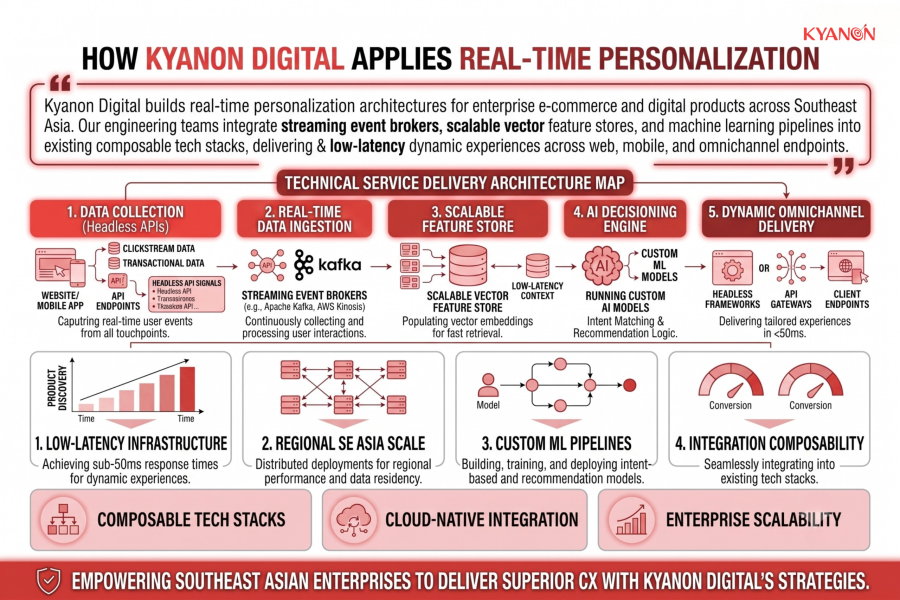
Kyanon Digital builds real-time personalization architectures for enterprise e-commerce platforms and digital products across Southeast Asia. Our engineering teams integrate streaming event brokers, scalable vector feature stores, and machine learning pipelines into existing composable tech stacks, delivering low-latency dynamic experiences across web, mobile, and omnichannel endpoints.
Explore our services:

 Create project brief with AI