
What is Web Personalization?
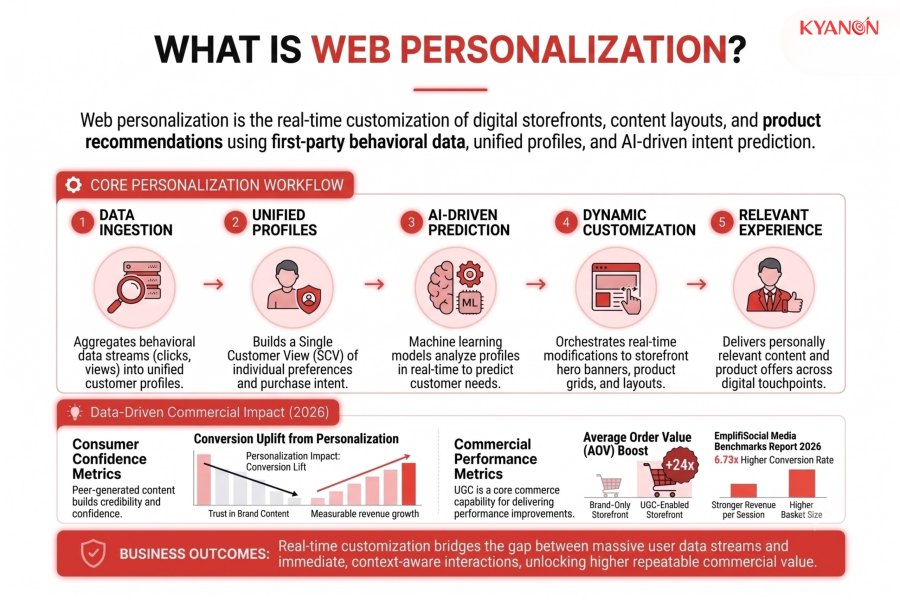
Web personalization is the real-time customization of digital storefronts, content layouts, and product recommendations using first-party behavioral data, unified profiles, and AI-driven intent prediction.
How Web Personalization Works
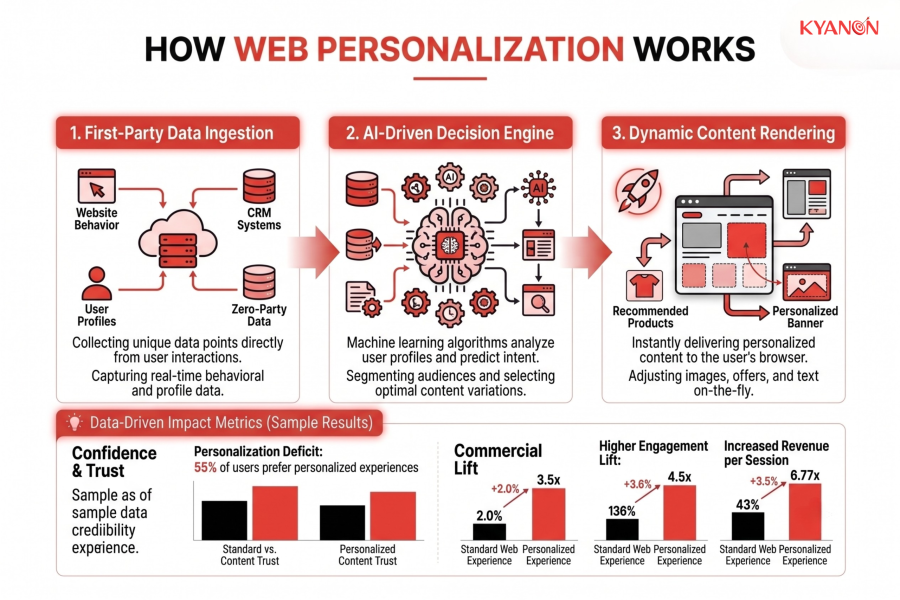
Modern web personalization bypasses static, rule-based workflows by establishing a continuous, low-latency loop between data ingestion, algorithmic decision-making, and frontend content rendering. This pipeline processes user signals within milliseconds to adjust the customer experience before page load completion.
First-Party Data Ingestion & Unified Profiles
Systems collect zero-party inputs (e.g., quizzes) and first-party behavioral signals (e.g., scroll depth, cart additions) in real-time. This raw data streams into a Customer Data Platform (CDP) to instantly update a unified customer profile, bypassing slow overnight batch syncs.
AI-Driven Decision Engine
Machine learning algorithms process the updated profile against historical patterns and current session context. The engine predicts the user’s buying stage and selects the most relevant content layout, pricing tier, or product recommendation with millisecond latency.
Dynamic Content Rendering (CMS Integration)
The decision engine communicates via APIs with a headless or integrated Content Management System (CMS). Instead of rendering a single static page, the CMS dynamically assembles the webpage at the edge, injecting the personalized components into the user’s viewport without causing layout shifts or latency.

Comparative Analysis: Web Personalization vs. Static Rules-Based Customization
Dimension | Modern Web Personalization | Static Rules-Based Customization |
| Trigger Mechanism | Real-time algorithmic intent prediction | Manual “if/then” demographic triggers |
Data Reliance | First-party behavioral & zero-party data | Third-party cookies & static batch data |
| Scalability | High (machine learning optimizes variations) | Low (requires manual rules and maintenance) |
Latency | Millisecond API response at the edge | Slower overnight database syncs |
| Maintenance Burden | Guardrail management and A/B testing oversight | High engineering overhead for every campaign |
Why Web Personalization Matters
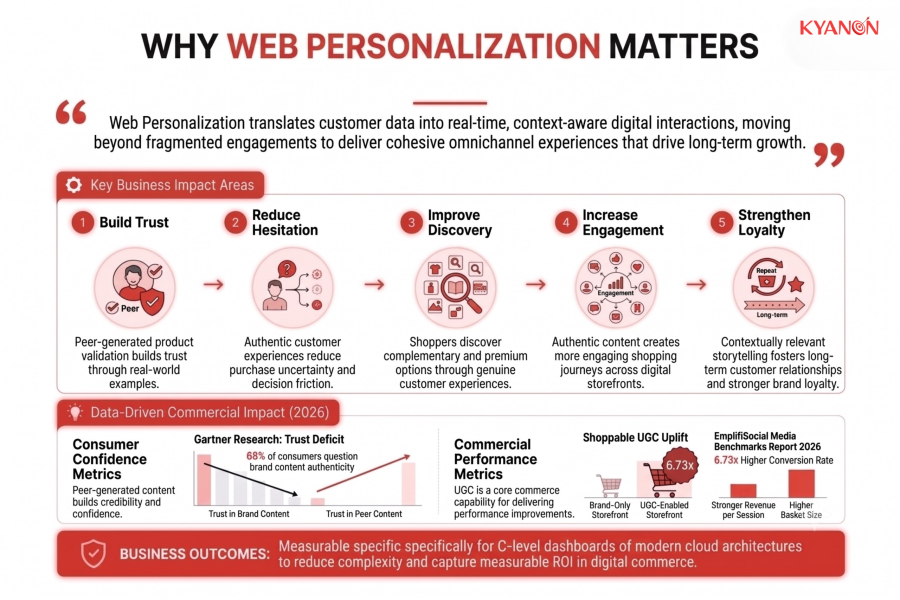
The deprecation of third-party cookies and open-web tracking signals has forced a foundational shift in enterprise digital commerce architecture. According to Gartner, the global personalization engine market achieved an aggressive growth surge of 26.1% to reach a $1.2 billion valuation. To capitalize on this, 87% of major brands plan to expand their overall personalization budgets in 2026, allocating nearly 40% of total marketing budgets to these capabilities. This massive reallocation of capital is heavily influenced by the fact that advertisers are projected to cut traditional open-web display budgets by 30%, redirecting funds directly into owned digital real estate.
Investing in owned-channel personalization resolves a critical customer experience failure point. Legacy batch exports refreshed overnight are causing these strategies to fail, as autonomous web agents require current context to prevent errors.
Common Misconceptions
The “First Name” Delusion
Tokenization, such as adding a user’s first name to a banner, is not personalization. Modern web personalization fundamentally alters the actual user journey, dynamically adjusting product recommendations, pricing tiers, and content layouts based on intent and behavior rather than static demographic data.
Assuming More Personalization Always Equals a Better Experience
Over-personalizing every webpage element can alienate users and fragment the navigation experience. Effective personalization feels seamless and helpful, utilizing targeted modifications rather than highly invasive, “creepy” overhauls that make standard information difficult to find.
Believing It Requires an Empty-Canvas Rebuild
High-impact personalization relies on incremental, strategic modifications rather than building dozens of completely separate website versions. Modifying a single call-to-action (CTA), reordering a resource feed, or adapting a hero image for specific segments consistently drives better ROI than maintaining massive, disjointed page catalogs.
Relying Solely on Third-Party Data
With the tightening of privacy laws and the deprecation of third-party cookies, massive third-party data profiles are obsolete. Sustainable personalization architectures are powered exclusively by zero-party data (explicitly shared information) and first-party behavioral data (live, on-site actions).
Treating Personalization as a “Set It and Forget It” Tool
Personalization algorithms do not automatically generate revenue indefinitely without oversight. They require continuous human intervention, rigorous A/B testing, structured guardrails, and fresh creative content to prevent algorithmic degradation as user behaviors and market segments shift over time.
How Kyanon Digital Applies Web Personalization
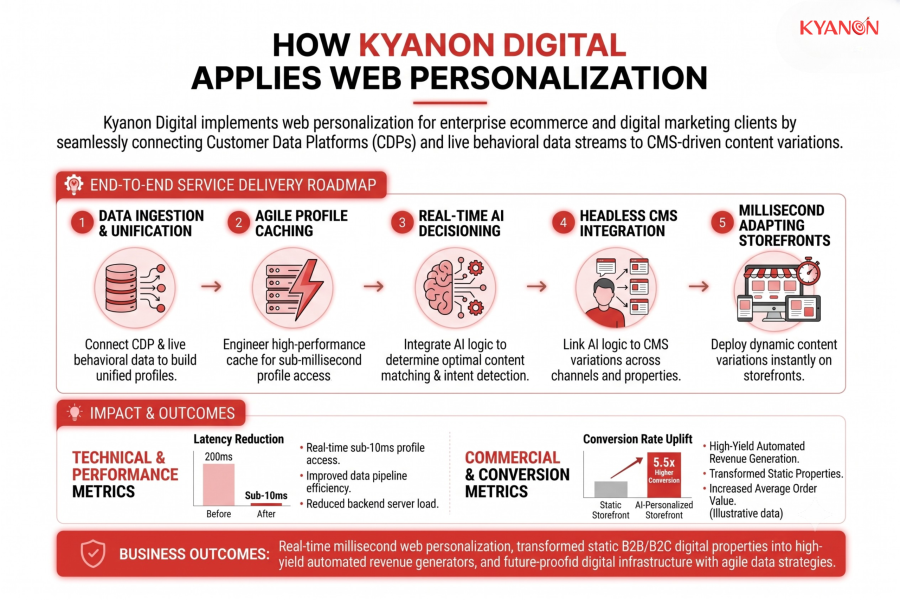
Kyanon Digital implements web personalization for enterprise ecommerce and digital marketing clients by seamlessly connecting Customer Data Platforms (CDPs) and live behavioral data streams to CMS-driven content variations. By engineering agile profile cache layers and integrating real-time AI decision engines, we ensure digital storefronts adapt to user intent within milliseconds. Our approach prevents data latency and empowers technical leaders to transform static B2B and B2C digital properties into high-yield, automated revenue generators.
Explore our services:

 Create project brief with AI