
What is escalation management?
Escalation management is the governed process for transferring a customer service issue to a higher-authority, more specialized, or differently empowered resolver when defined conditions show that the current handling tier should not continue alone. It establishes when escalation occurs, where the issue goes, what context is transferred, who owns the next action, and how resolution is tracked.
How escalation management works
Escalation management evaluates an issue against predefined service and business conditions, routes it to the appropriate resolver, and transfers enough context and ownership for work to continue without restarting the case.
The process is not limited to sending a difficult ticket to a manager. Enterprise escalation can be functional, hierarchical, or automated depending on whether the issue requires different expertise, additional authority, or intervention after a defined condition is reached. Atlassian, for example, distinguishes functional, hierarchical, and automatic escalation paths in incident-management policies.
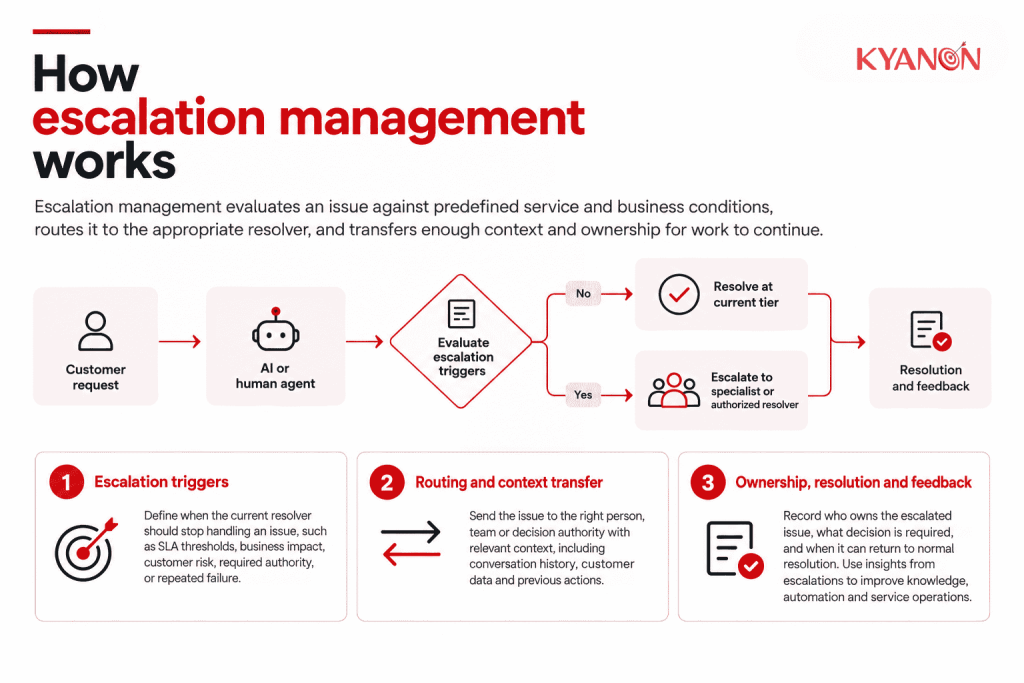
Escalation triggers
Escalation triggers define the conditions under which the current resolver should stop handling an issue alone. They can include SLA thresholds, business impact, customer or transaction risk, required approval authority, repeated resolution failure, security or compliance conditions, or an AI agent reaching a defined confidence or action boundary.
The objective is to replace vague instructions such as “escalate anything urgent” with decision criteria that can be applied consistently.
Routing and context transfer
Routing determines which person, team, or decision authority should receive the escalation. A functional escalation may send an issue to a specialist team, while a hierarchical escalation may involve a manager or business owner with authority the first-line agent does not have.
The handoff should carry the relevant conversation history, customer information, previous actions, issue classification, supporting evidence, and reason for escalation so the next resolver does not have to reconstruct the case.
Ownership, resolution and feedback
Escalation changes the handling path; it should not make accountability ambiguous. An effective escalation workflow records who accepted the escalated issue, what action or decision is required, and when the case can return to normal resolution or be closed.
The outcome should also feed back into service operations. Repeated escalations can expose missing knowledge, inadequate automation rules, unclear authority limits, product defects, or recurring customer-journey friction.

Escalation management vs. ticket management
Ticket management organizes service work from intake through closure, while escalation management governs when a ticket must move beyond its current handling path because of expertise, authority, risk, or time constraints.
| Dimension | Escalation management | Ticket management |
Primary purpose | Govern exceptions and transfers requiring another level of intervention | Capture, assign, track and close service requests |
| Trigger | Defined risk, authority, expertise, SLA or automation condition | Creation of a customer request, issue or service case |
Decision basis | Whether the current resolver should continue handling the issue | Who should initially own and process the ticket |
| Routing | Specialist, manager, authorized team or human agent | Standard queue, category, agent or service team |
Ownership focus | Explicit accountability during and after the handoff | Accountability across the ticket lifecycle |
| Automation role | Detect escalation conditions and execute routing or AI-to-human handoffs | Automate assignment, status changes, notifications and ticket processing |
Typical measures | Escalation rate, escalation response time, SLA exposure, repeat escalation | Ticket volume, backlog, first response time, resolution time |
The two capabilities therefore complement rather than replace each other: escalation rules are commonly executed within a wider ticket or service-management workflow.
When to consider escalation management
Escalation management becomes a priority when service operations cannot reliably determine which cases require specialist, managerial, or human intervention before customer impact or SLA exposure increases.
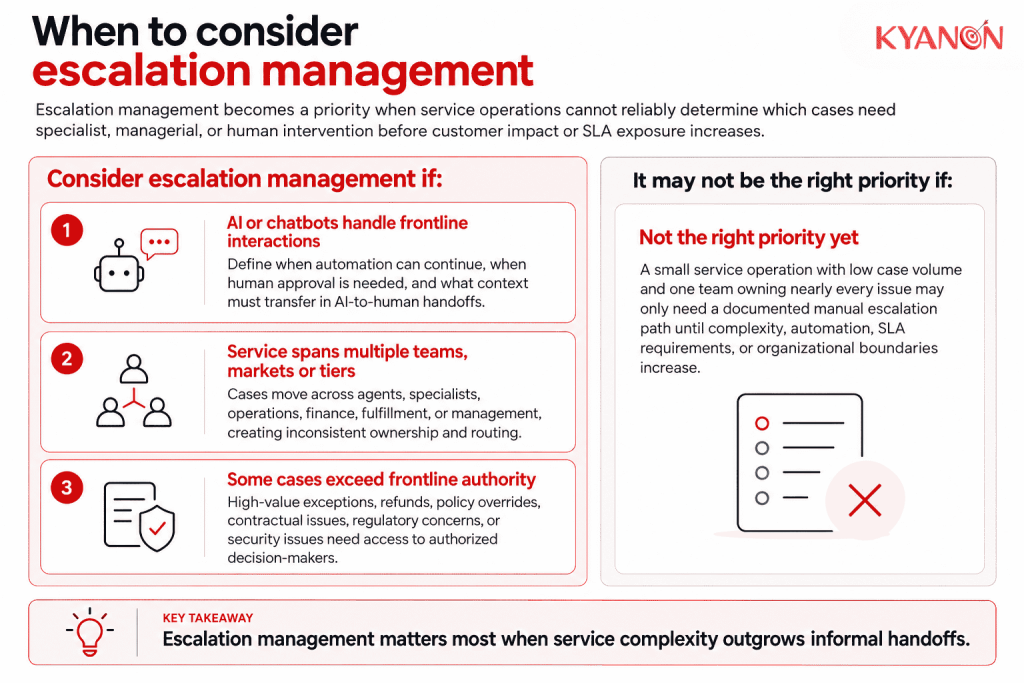
Consider escalation management if:
- AI or chatbots handle frontline customer interactions. The organization needs explicit boundaries for when automation can continue, when human approval is required, and what conversation context must accompany an AI-to-human handoff.
- Customer service spans several teams, markets or support tiers. Cases regularly move between frontline agents, technical specialists, operations, finance, fulfillment or management, creating inconsistent ownership and routing.
- Some cases exceed frontline decision authority. High-value customer exceptions, refunds, policy overrides, contractual questions, regulatory concerns or security issues require controlled access to people with the appropriate authority.
It may not be the right priority if:
- A small service operation has low case volume and one team owns nearly every issue. A documented manual escalation path may provide sufficient control until service complexity, automation, SLA requirements or organizational boundaries increase.
Why escalation management matters for enterprise customer service
Escalation management matters because it gives enterprises a controlled way to move customer issues from AI or frontline agents to the right human authority when automation, expertise, or decision rights reach their limits.
The need is increasing as AI becomes more embedded in service operations. Salesforce found that 66% of customer service organizations were using agentic AI, up from 39% in 2025, based on a survey of 3,075 service professionals worldwide.
At the same time, human access remains critical. Gartner reported in August 2026 that 87% of 3,566 surveyed customers considered access to a human agent essential when companies use generative AI for customer service.
Together, these findings make escalation management a governance requirement for AI-enabled service: enterprises need clear rules for when AI continues, when humans intervene, and how context and ownership transfer between them.
Common misconceptions
Effective escalation separates the business problem from individual blame: the purpose is to move an issue through an appropriate decision or resolution path, not to identify someone as the problem. PMI’s escalation guidance similarly distinguishes escalating the problem from escalating the person.
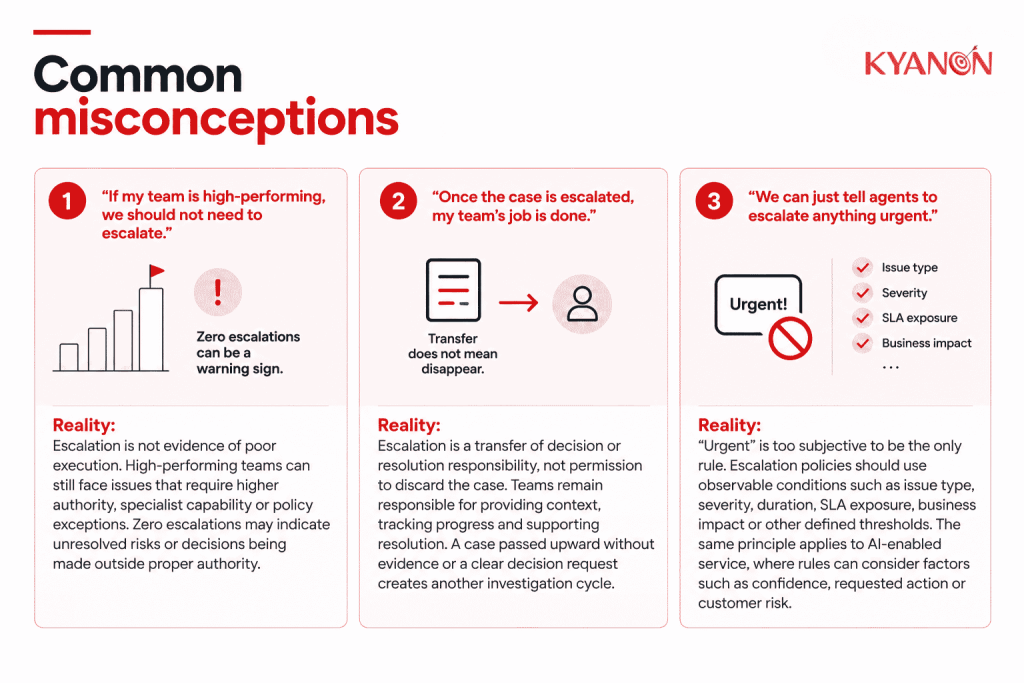
“If my team is high-performing, we should not need to escalate.”
Reality: Escalation is not automatically evidence of poor execution. A frontline team can fully understand an issue and still lack the authority, specialist capability, risk ownership or policy mandate required to resolve it.
For a CTO or service leader, zero escalations can therefore be a warning sign if teams are making decisions outside their authority or leaving high-risk cases unresolved rather than invoking the correct governance path.
“Once the case is escalated, my team’s job is done.”
Reality: Escalation is a transfer of decision or resolution responsibility, not permission to discard the case. The workflow still needs traceable ownership, transferred context, confirmation that the escalation has been accepted, and visibility through final resolution.
A case passed upward without evidence, history or a clear decision request creates another investigation cycle instead of accelerating resolution.
“We can just tell agents to escalate anything urgent.”
Reality: “Urgent” is too subjective to serve as the only operating rule. Escalation policies should define observable conditions such as issue type, severity, duration, SLA exposure, business impact or other relevant thresholds; Atlassian likewise recommends accounting for factors including incident type, severity, duration and scope.
For AI-enabled service, the same principle applies to automated handoffs: rules can consider factors such as confidence, requested action, customer risk, authentication state or repeated failure rather than relying on a generic fallback.
How Kyanon Digital applies escalation management
Kyanon Digital designs escalation management within enterprise customer-service automation, defining when AI or frontline agents should continue handling a case and when it should move to a human, specialist, or higher decision authority.
The workflow can connect AI agents, CRM or service platforms, knowledge bases, and agent desktops, with clear rules for escalation triggers, routing, SLA control, context transfer, and ownership. The goal is to improve resolution speed, reduce manual handling, and maintain consistent governance across global service operations.
→ Explore Kyanon Digital’s Customer Experience Service

 Create project brief with AI