
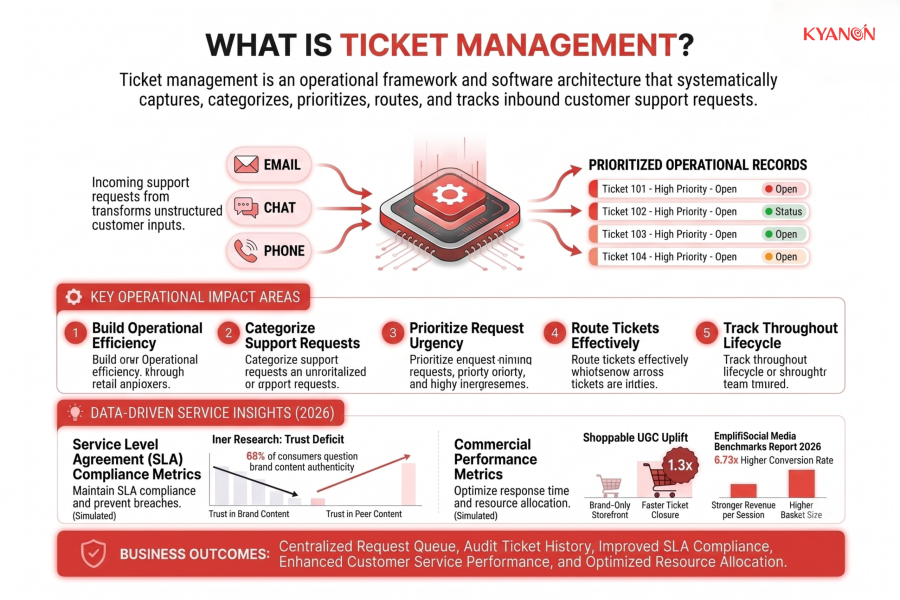
What is Ticket Management?
Ticket management is an operational framework and software architecture that systematically captures, categorizes, prioritizes, routes, and tracks inbound customer support requests throughout their lifecycle. By centralizing requests from disparate channels into unified record queues, it enables enterprise teams to maintain service level agreement compliance and audit ticket history.
How Ticket Management Works
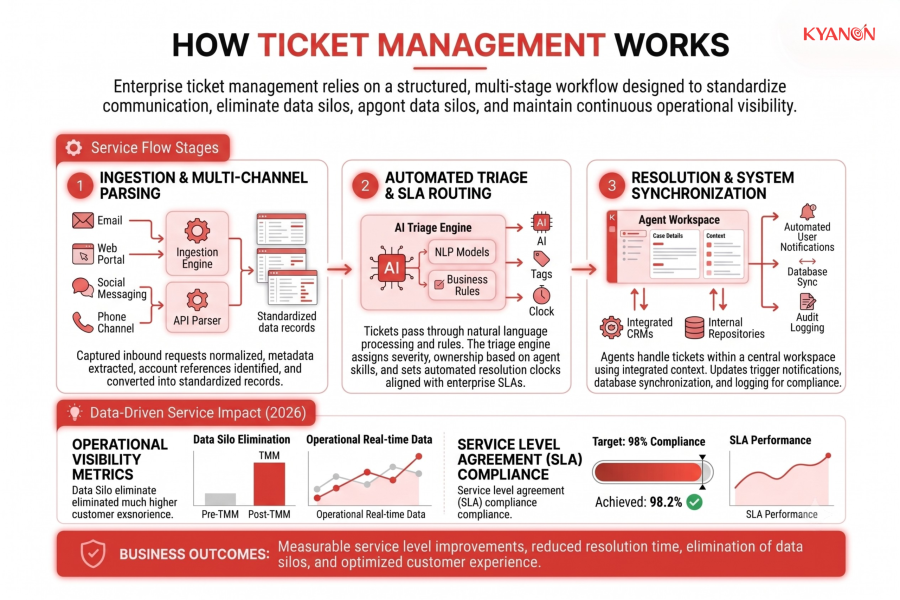
Enterprise ticket management relies on a structured, multi-stage workflow designed to standardize communication, eliminate data silos, and maintain continuous operational visibility.
Ingestion & Multi-Channel Parsing
Inbound requests from email, web portals, social messaging, and phone channels are captured by ingestion engines. The system normalizes raw text, extracts metadata, identifies account references, and converts each submission into a standardized record.
Automated Triage & SLA Routing
Once created, tickets pass through business rules and natural language processing models. The triage engine assigns severity tags, assigns ownership based on agent skills, and sets automated resolution clocks aligned with enterprise Service Level Agreements (SLAs).
Resolution & System Synchronization
Agents handle tickets within a central workspace, drawing on context from integrated CRMs and internal repositories. Updates trigger automated user notifications, bi-directional database synchronization, and audit logging to ensure regulatory compliance.

Comparative Analysis: Traditional Ticket Management vs. AI-Driven Ticket Orchestration
Dimension | Traditional Ticket Management | Modern AI-Driven Ticket Orchestration |
| Work Assignment | Manual distribution or static FIFO (First-In, First-Out) queuing | Dynamic SLA-driven triage based on customer intent and agent availability |
Data Visibility | Isolated ticket history isolated within the support desk application | Unified cross-departmental view with deep CRM and ERP integration |
| Issue Categorization | Manual tag selection by front-line agents during initial intake | Automated taxonomy assignment using real-time Natural Language Processing |
Escalation Mechanics | Static time-elapsed triggers without contextual urgency rules | Predictive routing based on customer sentiment, account value, and SLA thresholds |
| Metric Optimization | Focused primarily on speed and volume (e.g., Average Resolution Time) | Focused on root-cause resolution, CSAT retention, and First Contact Resolution |
Why Ticket Management Matters
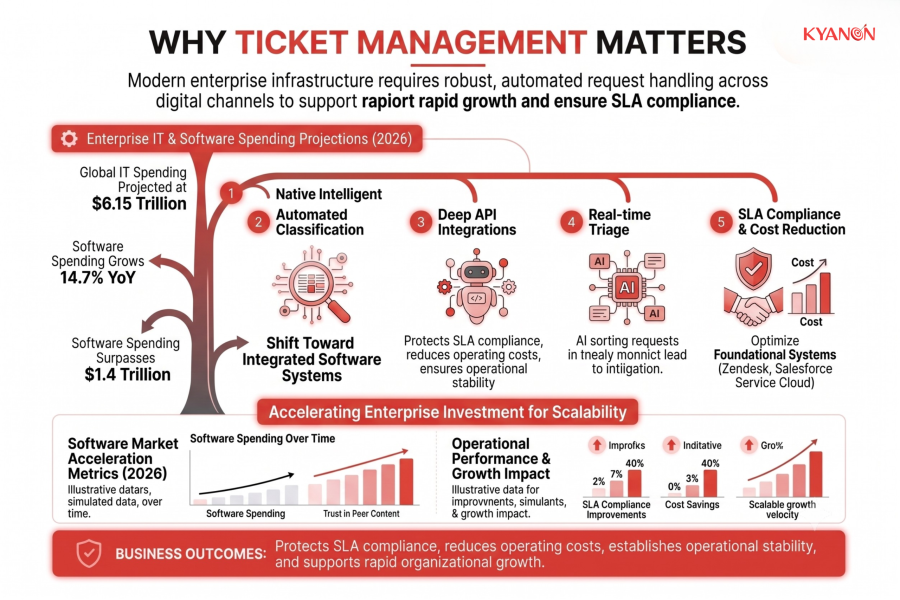
Modern enterprise technology infrastructure requires robust request handling to handle increasing interaction volumes across digital channels. According to market research from Gartner, global IT spending is projected to reach $6.15 trillion in 2026, with software spending growing 14.7% year-over-year to surpass $1.4 trillion. This deployment of capital highlights how organizations are prioritizing software architectures that natively embed intelligent tracking, automated classification, and deep API integrations into their core interaction pipelines.
As enterprise software spending accelerates, optimizing foundational systems like Zendesk and Salesforce Service Cloud directly influences operational scalability. Rather than relying on isolated pilot applications, technology leaders are structuring their data ecosystems to ensure inbound customer requests flow through automated triage engines without manual intervention. Aligning ticket routing with enterprise-wide data layers protects SLA compliance, reduces operating costs, and establishes the operational stability necessary to support rapid organization growth.
Common Misconceptions
It is Just an IT Support Tool
Ticket management systems are not exclusively for IT departments fixing broken computers. Modern ticketing infrastructure benefits any enterprise function managing inbound requests, including Human Resources for onboarding workflows, Legal for contract reviews, Facilities for maintenance tasks, and Finance for invoice processing.
Resolving Tickets Faster is the Ultimate Metric
Optimizing strictly for speed encourages agents to rush through interactions, leading to low resolution quality. This results in reopened cases and declining customer satisfaction scores; meaningful, high-accuracy problem resolution always outweighs raw handling speed.
All Tickets Must Be Handled First-In, First-Out (FIFO)
Treating a minor password reset with the same urgency as an enterprise-wide system outage severely impairs business operations. Effective management relies on automated triage and urgency-based SLA routing rather than simple chronological queueing.
Automation Automatically Fixes a Broken Workflow
Automating an unorganized process simply creates automated chaos at scale. Routing rules, categorization hierarchies, and escalation paths must be manually streamlined and structured before applying automated triggers.
Self-Service Menus Deflect Everyone
Knowledge bases and AI chatbots require continuous maintenance and user-centric content to remain effective. If documentation is outdated or confusing, users will bypass self-service channels entirely or open duplicate tickets out of frustration.
How Kyanon Digital Applies Ticket Management
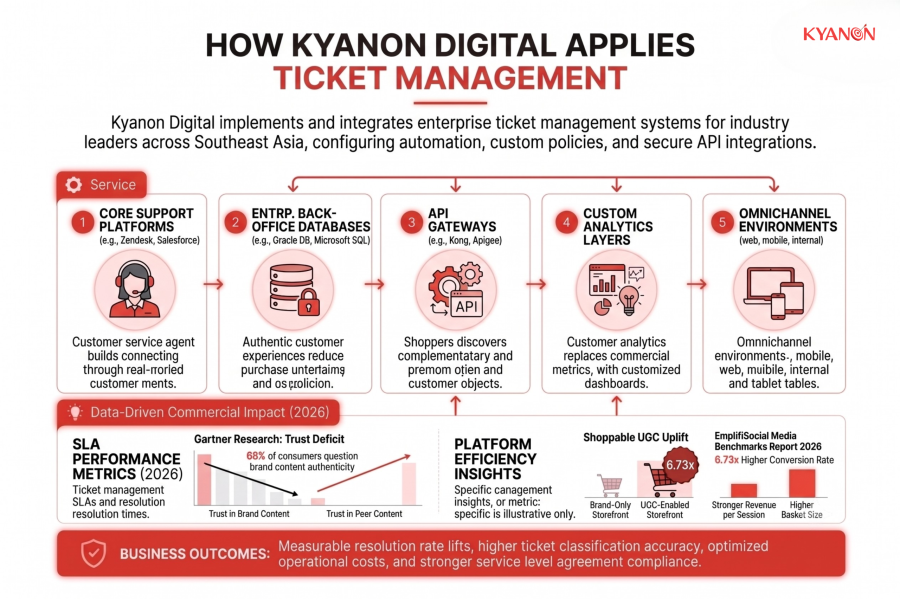
Kyanon Digital implements and integrates enterprise ticket management systems for industry leaders across Southeast Asia. We configure intelligent automation frameworks, custom SLA policies, and secure API integrations to ensure seamless platform performance across web, mobile, and internal environments.
Explore our services:

 Create project brief with AI