
What is Resolution Time?
Resolution time is an operational customer experience metric that measures the total elapsed duration from the moment a customer submits an issue until it is fully resolved. It reflects the end-to-end speed, accuracy, and technical efficiency of an organization’s support architecture.
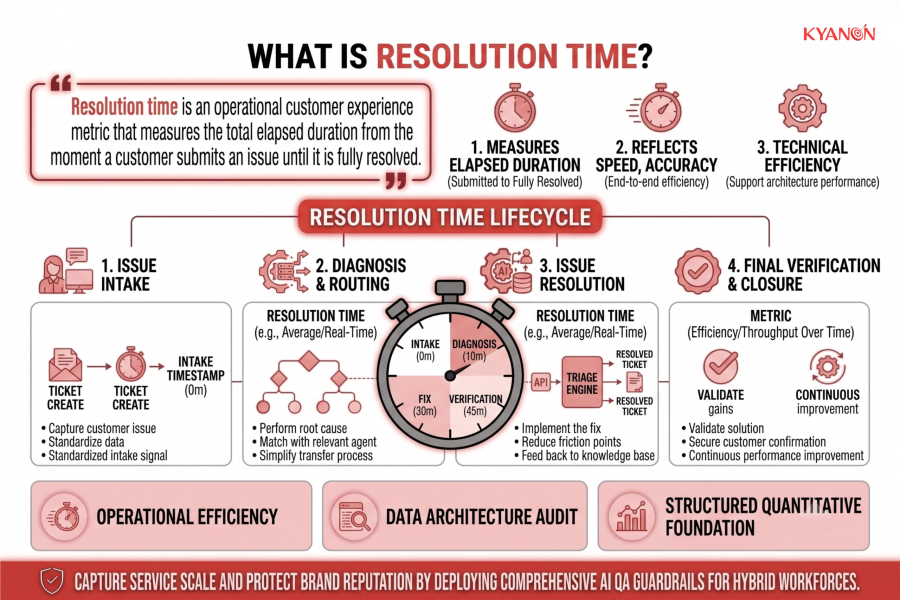
How Resolution Time Works
Resolution time is influenced by more than how quickly a support agent responds. It also depends on how quickly the right issue is identified, the right team is assigned, relevant customer information is available, and the right solution can be found.
An enterprise support workflow combines automation, customer data, and AI-assisted tools to reduce delays throughout the issue resolution process.
Connected workflows combine AI triage, contextual data sync, and guided search to accelerate issue resolution.
Automated Triage and Dynamic Routing
AI triage automatically reviews incoming support tickets to understand what the customer needs and how urgent the issue is.
The system can:
- Intent & metadata extraction: Identify what the customer is asking about and collect relevant account or service information.
- Urgency evaluation: Assess the severity and priority of the issue so urgent cases can be handled first.
- Dynamic routing: Send complex issues to the appropriate specialist team, while common requests can be handled through self-service or automated workflows.
This reduces the time spent manually reviewing and assigning tickets, while helping issues reach the right team sooner.
Contextual Data Synchronization
Contextual data synchronization brings relevant customer information into a single agent desktop before the support agent starts working on an issue.
This may include:
- Customer and account history
- Previous support interactions
- Transaction records
- Product or service usage
- Relevant system activity
Instead of asking customers to repeat information or searching across multiple systems, agents can see the context they need in one place.
This helps teams understand the issue faster and reduces unnecessary back-and-forth with the customer.
AI-Guided Knowledge Retrieval
AI-guided knowledge retrieval uses semantic search to find relevant information based on the meaning and context of a customer’s issue, rather than relying only on exact keywords.
During a support interaction, the system can surface:
- Relevant knowledge base articles
- Troubleshooting guides
- Recommended next best actions
- Previous solutions for similar issues
This allows agents to spend less time searching for information and more time resolving the customer’s problem.
Faster Resolution Through Connected Workflows
When these capabilities work together, resolution time can improve across the entire support journey.
The focus shifts from simply making agents work faster to removing the delays that happen before, during, and after an issue reaches an agent.
The result is a support experience where customers reach the right team faster, agents have the context they need, and common issues can be resolved with less manual effort.

Comparative Analysis: Resolution Time Frameworks
Dimension | Legacy Manual Support | Modern AI-Augmented Platform |
| Data Ingestion | Disconnected channels & manual logging | Unified real-time ingestion engines |
Initial Routing | Static queues & manual triage | Intent-based automated agentic routing |
| Agent Context | Fragmented tools & siloed databases | Single-pane-of-glass context synchronization |
Troubleshooting Speed | Manual article lookup & guessing | AI-guided real-time knowledge surfacing |
| Post-Resolution Tracking | Premature ticket closing | Multi-touch persistence & automated follow-up |
Why Resolution Time Matters
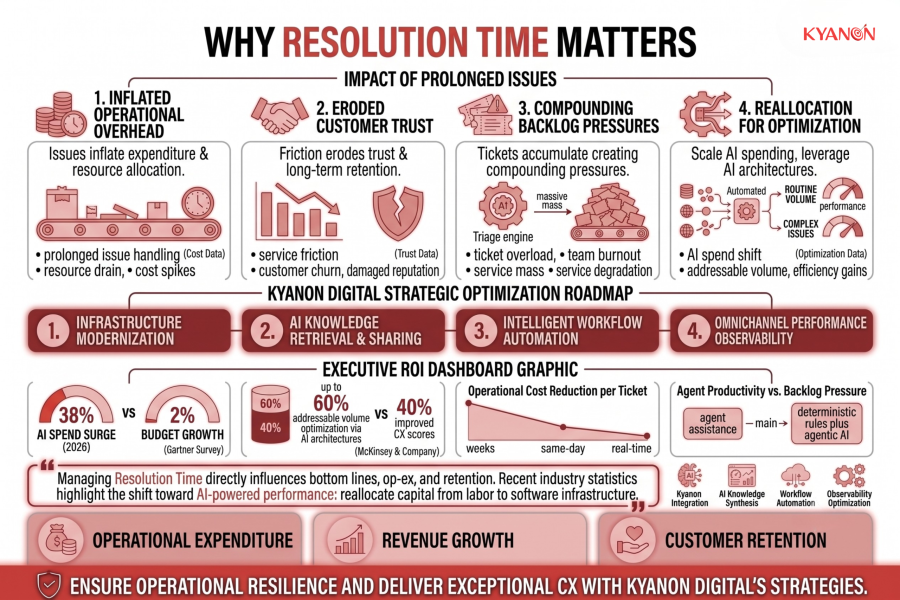
Managing resolution time directly influences enterprise bottom lines, operational expenditure, and long-term customer retention. Unnecessary support delays introduce major friction across technical teams:
- Operational Overhead: Prolonged issues inflate operational expenditure and resource allocation.
- Customer Trust: Unnecessary support friction erodes long-term trust and customer retention.
- Backlog Pressures: Unresolved tickets accumulate and create compounding workload pressures.
Common Misconceptions
Faster resolution always means happier customers
A fast wrong answer is worse than a slow right answer. Leaders often obsess over cutting down the minutes spent on a customer ticket, but rushing to close a chat to hit a speed goal misses the core issue. The customer receives a sloppy response, remains unresolved, and reaches back out. True optimization prioritizes accuracy and thoroughness over rushed dismissals.
If a ticket is closed, the problem is solved
‘Closed’ simply means your team stopped communicating; it does not mean the customer is satisfied. In many organizations, the clock stops prematurely after sending a generic article before the customer replies. Enterprises must measure issue persistence rather than superficial closing rates.
Low resolution times mean our support team is doing amazing
Low resolution times might simply indicate a broken underlying product experience. If a support team boasts rapid speeds because they manually reset forgotten passwords thousands of times a day, it points to a flawed interface rather than operational excellence. Organizations must investigate root causes to fix recurring product flaws at the source.
We should set the exact same speed goals for every single issue
Treating a minor glitch the same as a major enterprise outage alienates high-value customers. Blanket resolution targets misallocate critical engineering and support resources. Teams need impact-based routing protocols that grant agents flexibility for high-stakes crises without compromising standard performance targets.
How Kyanon Digital Applies Resolution Time
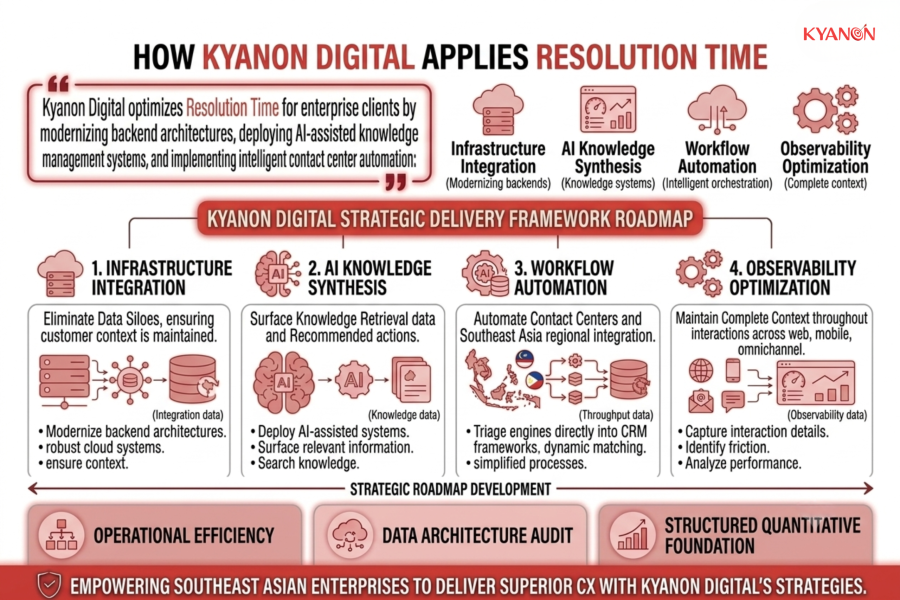
Kyanon Digital optimizes resolution time for enterprise clients by modernizing backend architectures, deploying AI-assisted knowledge management systems, and implementing intelligent contact center automation. We integrate robust cloud systems with custom agent desktop environments to eliminate data siloes, ensuring engineering and support teams maintain complete customer context throughout every interaction.
Explore our services:

 Create project brief with AI