
What is first contact resolution (FCR)?
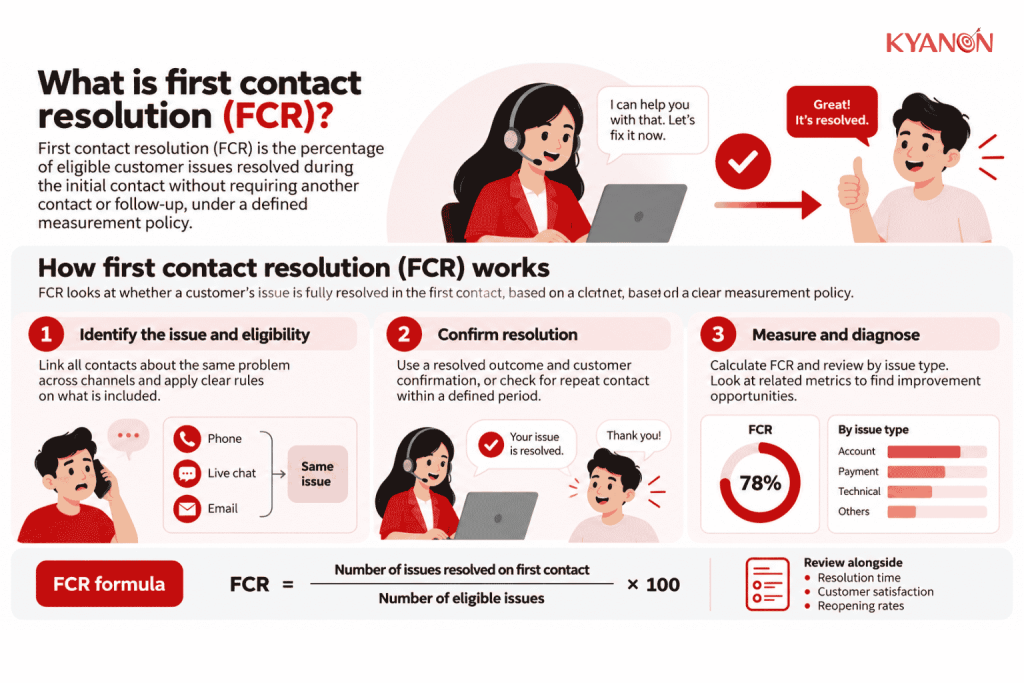
First contact resolution (FCR) is the percentage of eligible customer issues resolved during the initial contact without requiring another contact or follow-up for the same issue, under a defined measurement policy.
How first contact resolution (FCR) works
FCR measures resolution at the issue level rather than simply counting closed tickets. A credible policy defines the initial interaction, exclusions, transfers, confirmation method, and observation window used to detect repeat contact.
Issue identity and eligibility
Link contacts about the same problem across channels and tickets. Document whether scheduled follow-ups, transfers within one session, and cases requiring external action are eligible, so teams cannot improve the score by changing classifications.
Resolution evidence
Combine recorded outcomes with customer confirmation or an appropriate repeat-contact check. A ticket marked closed is insufficient if the customer returns because the original problem persists.
Measurement and diagnosis
Calculate FCR as issues resolved on first contact divided by eligible issues, multiplied by 100. Segment results by issue type and complexity, and review them alongside resolution time, satisfaction, and reopening rates.

How do you calculate FCR?
FCR = eligible issues resolved during the first contact ÷ total eligible issues first contacted in the measurement cohort × 100. First-call resolution is the phone-specific version; first-contact resolution can include chat, email and other channels.
Illustrative calculation: 160 of 200 eligible issues are resolved in the first interaction, producing an FCR of 80%. This is an example, not an industry benchmark. Define whether a transfer within the same interaction qualifies, how email threads are counted, and how long you check for repeat contact. Use a consistent issue-level denominator and allow the follow-up window to finish before reporting.
There is no single useful target for every queue. Compare like-for-like issue types and verify resolution with customer feedback or repeat-contact checks. Closing a ticket does not, by itself, prove resolution.
What can distort the first contact resolution rate?
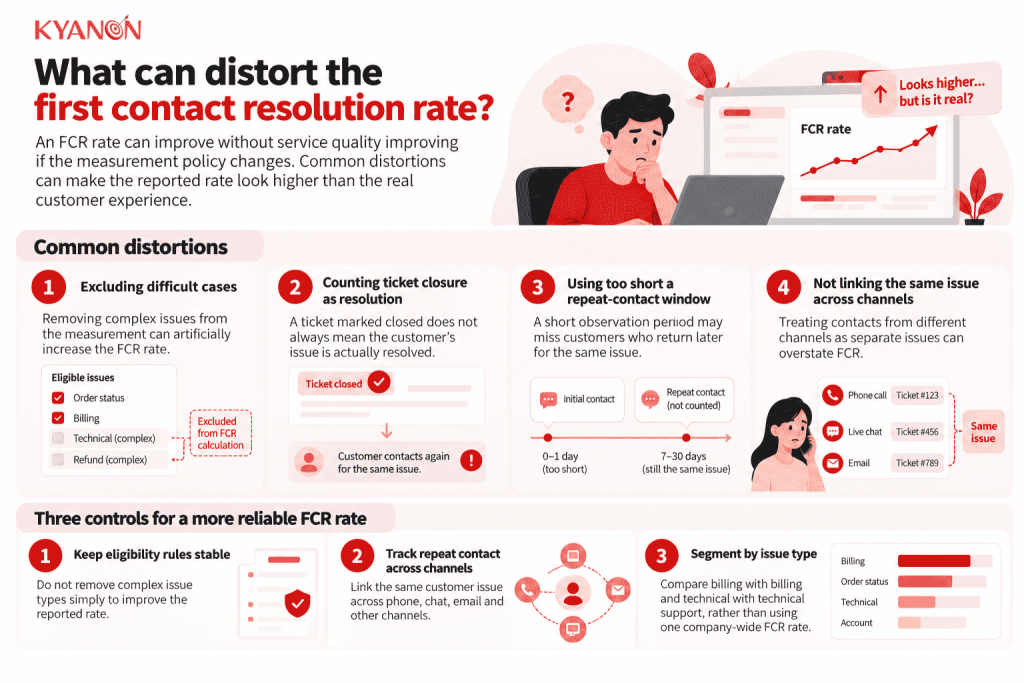
An FCR rate can improve without service quality improving if the measurement policy changes. Common distortions include excluding difficult cases, treating ticket closure as resolution, using too short a repeat-contact window, or failing to link the same customer issue across channels.
For business leaders, three controls make FCR more reliable:
- Keep eligibility rules stable: Do not remove complex issue types simply to improve the reported rate.
- Track repeat contact across channels: A customer who calls after an unresolved chat should not appear as two unrelated issues.
- Segment by issue type: Compare billing with billing or technical support with technical support rather than using one company-wide FCR rate to judge every service workflow.
The objective is not the highest possible FCR percentage. It is a higher proportion of issues genuinely resolved without unnecessary customer effort or repeat operational work.
First contact resolution (FCR) vs. resolution time
FCR measures whether an issue needs another contact; resolution time measures how long resolution takes.
Dimension | First Contact Resolution (FCR) | Resolution Time |
Unit | Percentage of eligible issues | Elapsed time per issue |
| Focus | Avoiding repeat contact | Speed of reaching resolution |
Clock or window | Defined repeat-contact observation window | Defined start and resolution timestamps |
| Main limitation | Closure can be misclassified as resolution | A fast closure can leave the issue unresolved |
Best use | Improve knowledge, authority, and handoffs | Identify queues, delays, and bottlenecks |
When to consider first contact resolution (FCR)
Consider first contact resolution (fcr) when the following conditions affect customer outcomes or operational control:
- Customers repeatedly contact support about the same delivery, billing, or account problem.
- Agents lack access or authority to complete common requests during the first interaction.
- Support costs rise even though average handling time is falling.
It may not be the right priority if:
Do not use FCR as the sole target for complex investigations that legitimately require follow-up. Measure clear ownership and progress as well as speed.
Why first contact resolution (FCR) matters for service operations
FCR connects customer experience with operational efficiency. When an issue is not resolved during the first interaction, the customer may need to repeat information, contact another channel, or wait for another team, while the business absorbs additional handling and queue volume. Qualtrics identifies repeated interactions as a source of higher operating costs and customer dissatisfaction.
For business leaders, FCR can therefore reveal problems beyond frontline agent performance. Low FCR in a specific issue category may indicate fragmented customer data, insufficient agent authority, outdated knowledge, poor routing, or a workflow that depends on manual handoffs.
The metric is most useful when teams investigate these underlying causes rather than treating a higher FCR percentage as the objective itself.
What causes low first contact resolution?
Low FCR is not always an agent-performance problem. It often indicates that the service operation cannot complete the customer’s task during the first interaction.
Common causes include:
| FCR problem | Operational cause | What to investigate |
Agents repeatedly ask for information | Fragmented customer data | CRM, order, billing and service-data access |
| Customers are frequently transferred | Poor routing or limited agent authority | Skills, routing rules and approval policies |
Agents provide inconsistent answers | Knowledge gaps | Knowledge ownership, search and update processes |
| Cases wait for another team | Broken workflow | Handoffs, approvals and system integration |
Customers contact support again | False or incomplete resolution | Reopen and repeat-contact tracking |
A useful diagnosis therefore starts with why customers need another contact, not simply which agents have the lowest FCR.
How can businesses improve FCR?
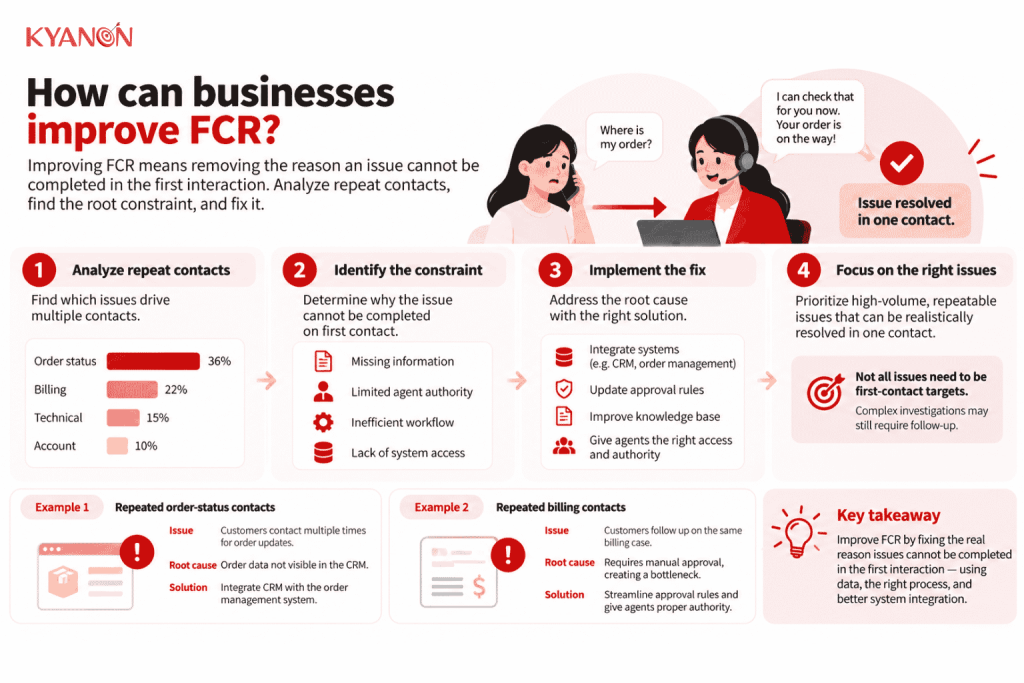
Improving FCR requires removing the reason an issue cannot be completed during the first interaction. Start by analyzing repeat contacts by issue type, then identify whether the constraint is information, agent authority, workflow, or system access.
For example, repeated order-status contacts may require better CRM and order-management integration, while repeated billing cases may indicate an approval bottleneck rather than a knowledge problem.
Prioritize high-volume, repeatable issues where agents can realistically complete the customer task in one interaction. Complex investigations may still require follow-up and should not be forced into a first-contact target.
Common misconceptions
A closed ticket counts as a resolved issue.
Reality: Ticket status records a workflow decision, not necessarily a customer outcome. Check for reopening, duplicate tickets, or repeated contact about the same problem.
The shortest call gives us the best FCR.
Reality: A longer initial conversation can prevent another call. Evaluate resolution quality alongside handling time instead of rewarding speed alone.
How Kyanon Digital applies first contact resolution (FCR)
Kyanon Digital improves first-contact resolution through agent desktop integration, knowledge management, and AI-assisted service workflows. CRM, ticketing, and operational records can be connected so agents have the information and permitted actions needed to resolve common issues. Clear escalation and outcome tracking help distinguish completed resolution from a case that still needs work.
Explore Kyanon Digital’s custom software development services.

 Create project brief with AI