
What is a frictionless experience?
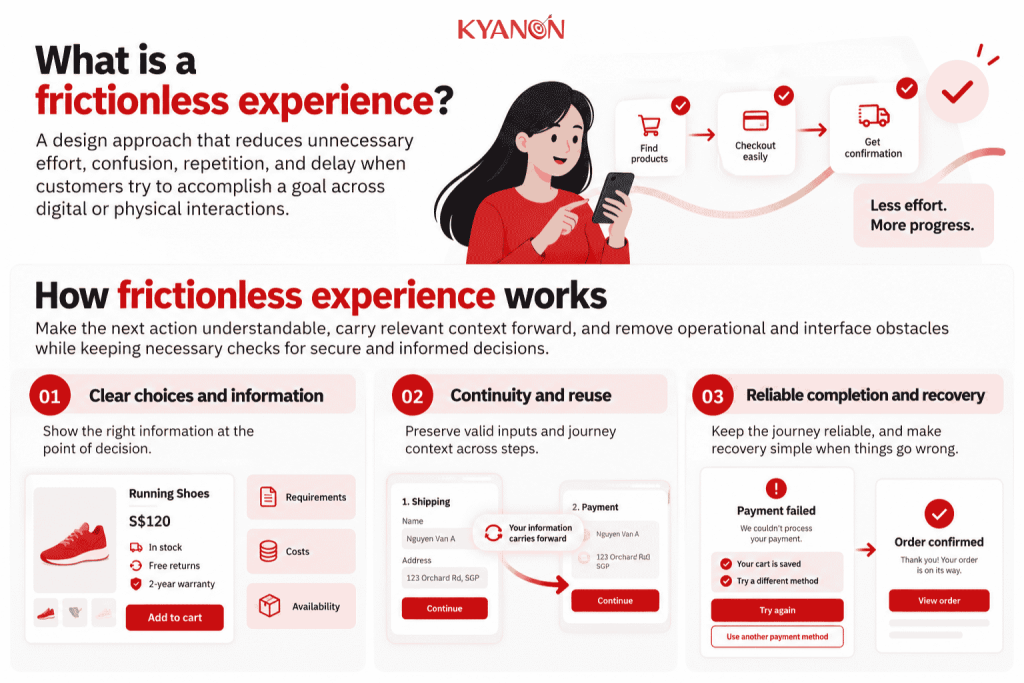
Frictionless experience is a design approach that reduces unnecessary effort, confusion, repetition, and delay when customers try to accomplish a goal across digital or physical interactions.
How frictionless experience works
Frictionless experience works by making the next action understandable and allowing relevant context to carry forward. It addresses cognitive effort and operational obstacles as well as interface steps while retaining checks needed for informed and secure decisions.
Clear choices and information
Show the information customers need at the point of decision, including requirements, costs, and availability. Familiar labels and understandable errors reduce the mental work of interpreting the interface.
Continuity and reuse
Preserve valid inputs and relevant journey state across screens or handoffs. Customers should not repeatedly enter information that the organization can appropriately reuse.
Reliable completion and recovery
A simple interface still fails if payment, identity, or fulfillment services are unreliable. Recovery paths should explain what happened, preserve progress, and offer a usable alternative when a step cannot complete.

How do you identify unnecessary friction?
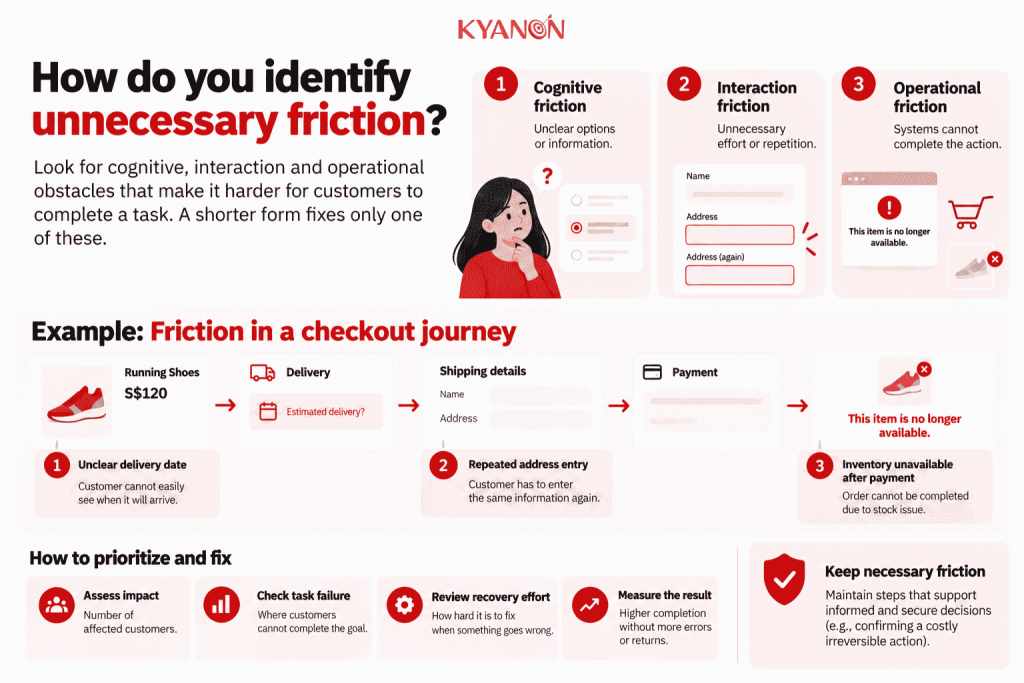
Look for three different obstacles: cognitive friction when customers cannot understand an option, interaction friction when a task requires unnecessary effort, and operational friction when systems cannot complete the promised action. A shorter form fixes only one of these.
An illustrative checkout review might find an unclear delivery date, repeated address entry and inventory that becomes unavailable after payment. Each problem needs a different owner. Prioritize by affected customers, task failure and recovery effort, then observe whether the change improves completion without increasing errors or returns. Keep friction that supports informed choice, such as confirming a costly irreversible action. The goal is less avoidable effort across the journey, not the fewest possible clicks.
What causes friction in the customer experience?
CX friction often comes from more than interface design. It can emerge when customer-facing journeys depend on disconnected data, restrictive policies, manual approvals, or systems that cannot carry context between steps.
| Customer symptom | Likely source of friction | What to investigate |
Abandonment during forms or checkout | Interaction or cognitive friction | Required fields, unclear costs and instructions |
| Customers repeat information | Data or channel friction | CRM integration and journey-state transfer |
Digital journeys stop at approval | Process friction | Manual workflows and decision authority |
| Customers contact support after self-service | Completion friction | Whether self-service actually resolves the task |
Customers restart after an error | Technical friction | State preservation and recovery design |
The key question is therefore not simply “Where do customers click too much?” but “What prevents them from reaching the intended outcome with reasonable effort?”
Which customer friction should businesses remove?
Not every form of customer effort should be eliminated. The priority is to remove friction that creates effort without adding enough customer or business value. Research distinguishes frustrating friction from forms of effort that can be constructive or valuable to the customer.
| Usually reduce | Usually retain or improve |
Re-entering known information | Confirming a high-value transaction |
| Unexplained waiting | Reviewing important terms |
Broken handoffs between channels | Identity and security verification |
| Hidden costs revealed late | Comparing meaningful options |
Restarting after a system error | Confirming irreversible actions |
For business leaders, the decision should be whether the effort serves a necessary purpose, not whether the journey contains the fewest possible steps. Where a control is necessary, improve its clarity and execution instead of removing it.
How can businesses reduce customer effort?
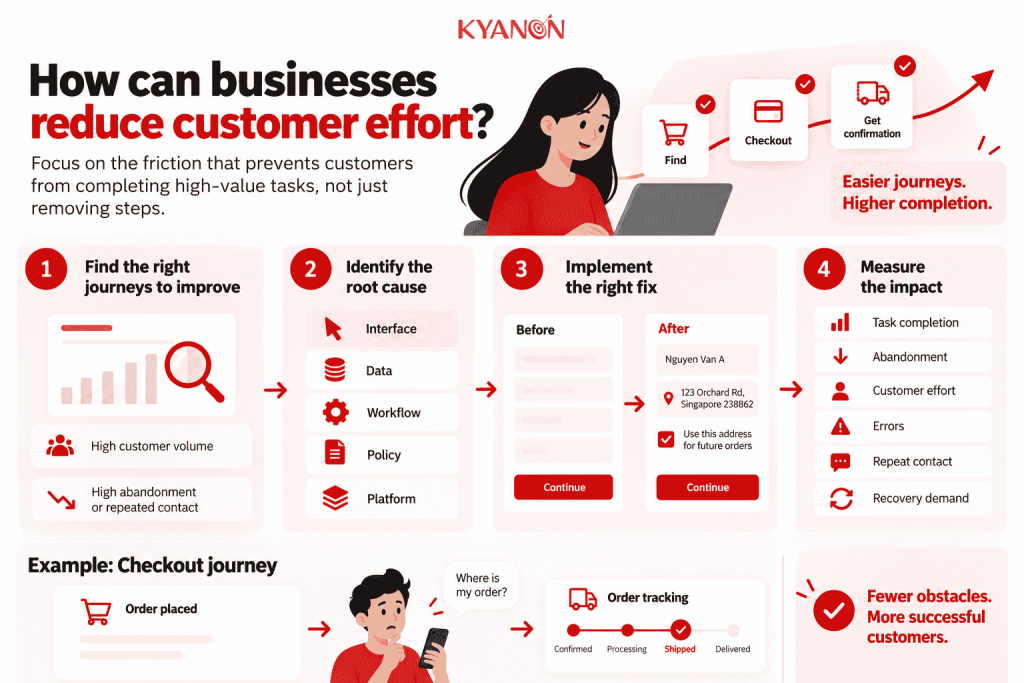
Reduce customer effort by fixing friction that prevents customers from completing high-value tasks, rather than removing steps indiscriminately.
Start with journeys that combine high customer volume with high abandonment, repeated contact, errors, or manual recovery. Then identify whether the root cause sits in the interface, data, workflow, policy, or underlying platform.
For example, repeated address entry may require better data reuse, while customers repeatedly contacting support after checkout may indicate poor order visibility or disconnected systems.
Measure the change through task completion, abandonment, customer effort, errors, repeat contact, and recovery demand. A shorter journey is useful only when customers can still complete it accurately and confidently.
Frictionless experience vs. minimalist UI
Frictionless experience evaluates the effort required to complete a goal; minimalist UI focuses on reducing visible interface complexity.
Dimension | Frictionless Experience | Minimalist UI |
Scope | End-to-end task and service | Visual interface |
| Main objective | Reduce unnecessary customer effort | Reduce visual clutter |
Information | Enough detail for a confident decision | Restrained presentation |
| Dependencies | UX, policies, data, and operations | Layout and interaction choices |
Success measure | Task success, effort, errors, abandonment | Readability, hierarchy, interaction usability |
When to consider frictionless experience
Consider frictionless experience when the following conditions affect customer outcomes or operational control:
- Customers abandon forms or check out after repeated input, unclear requirements, or unexpected costs
- A channel change forces customers to restart a task or explain their problem again
- A redesign looks simpler, but task completion and support demand have not improved
It may not be the right priority if:
Do not remove confirmations or verification solely to reduce clicks where they prevent meaningful harm. Improve the clarity and proportionality of those controls.
Why frictionless experience matters for e-commerce and digital platforms
Frictionless experience protects conversion by helping customers complete intended tasks with less avoidable effort. The business case should identify a specific failure point and measure completion quality, rather than assume every shorter journey is better.
For example, Kyanon Digital helped a large Thailand retail group unify inventory, pricing, promotions, and order routing across six digital channels and nine stores, supporting 26,000+ SKUs and more than 8,000 orders per day. The case shows why reducing customer-facing friction can require fixing the underlying commerce architecture, not only simplifying the interface.
Explore how Kyanon Digital built an integrated commerce platform for Thailand’s largest retail group
Common misconceptions
Frictionless means removing every step
Reality: Some steps help customers understand consequences or correct mistakes. Remove unnecessary effort while preserving useful explanations and proportionate safeguards.
This is just a website redesign
Reality: Inventory errors, disconnected service records, and restrictive policies also create friction. UX changes need operational support to produce a consistent improvement.
How Kyanon Digital applies frictionless experience
Kyanon Digital applies frictionless experience design through UX audits, customer journey analysis, and platform implementation. The work can address forms, navigation, checkout, error recovery, and system handoffs, connecting interface improvements with the operational capabilities needed to complete the journey. Success is assessed through task completion, customer effort, and the specific conversion bottleneck being addressed.
Explore Kyanon Digital’s UX design services.

 Create project brief with AI