
What is Zero-Effort Experience?
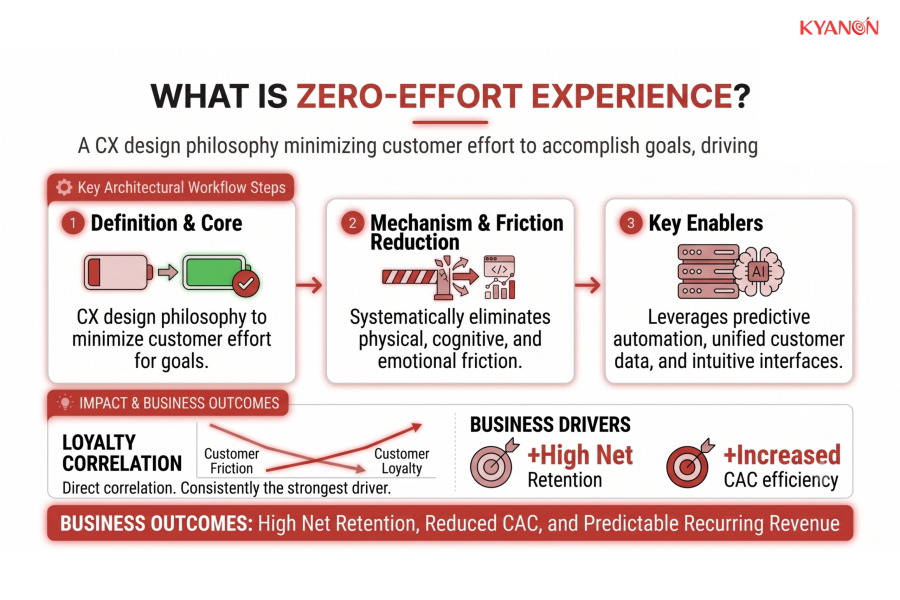
A CX design philosophy minimizing the effort required from customers to accomplish their goals, consistently the strongest driver of customer loyalty. It systematically eliminates physical, cognitive, and emotional friction across touchpoints by leveraging predictive automation, unified customer data, and intuitive interface design.
How Zero-Effort Experience Works
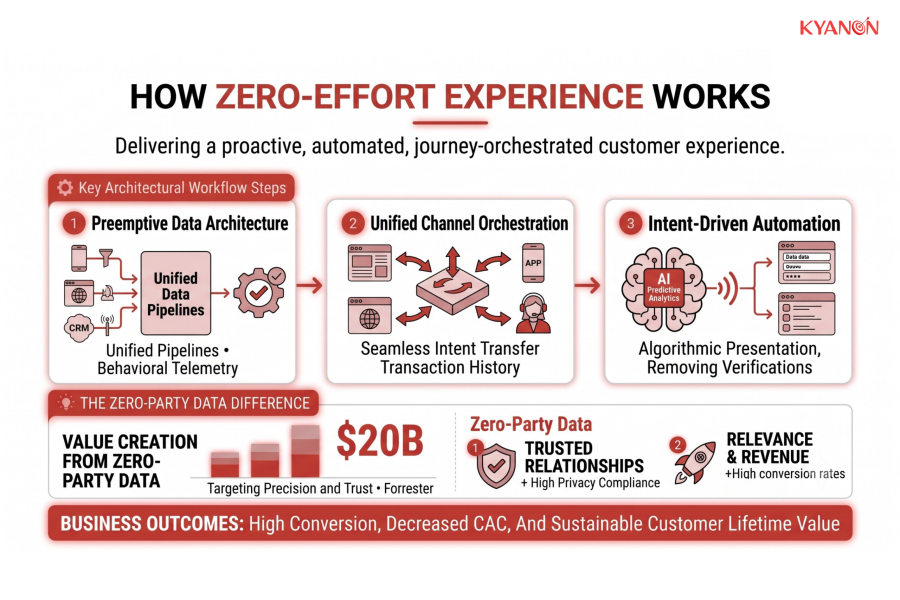
Delivering a Zero-Effort Experience requires shifting from reactive issue resolution to automated, proactive journey orchestration across every customer touchpoint.
Preemptive Data Architecture
Unified data pipelines capture contextual preferences and behavioral telemetry in real time. By continually evaluating interaction data, underlying systems identify emerging friction points and resolve background errors autonomously before users experience service degradation.
Unified Channel Orchestration
Cross-channel integration ensures that interaction state, transaction history, and user intent flow seamlessly between digital self-service tools, mobile applications, and human service channels. Eliminating redundant data requests reduces cognitive load and operational drag across the customer journey.
Intent-Driven Automation
Algorithmic engines process behavioral signals to dynamically present relevant actions and options. Streamlining menu depths, pre-filling form inputs, and removing unnecessary verification steps allow users to achieve complex outcomes with minimal physical interaction.

Comparative Analysis: Zero-Effort Experience vs. Traditional Reactive Service
Traditional customer service models rely on post-incident troubleshooting and reactive ticket management, whereas a Zero-Effort Experience embeds real-time telemetry into platform architecture to mitigate user friction proactively.
Dimension | Traditional Reactive Service | Zero-Effort Experience Architecture |
| Operational Focus | Resolving inbound issues post-incident | Autonomous detection and proactive friction mitigation |
Data Utilization | Historical, siloed CRM logs | Continuous real-time behavioral telemetry and event streams |
| Customer Journey | Disjointed cross-channel handoffs | Context-aware, continuous journey orchestration |
Core CX Metric | CSAT and Net Promoter Score (NPS) | Customer Effort Score (CES) and task completion velocity |
| Cost Dynamics | Linear cost growth tied to support headcount | Scalable software automation with optimized long-term TCO |
Why Zero-Effort Experience Matters
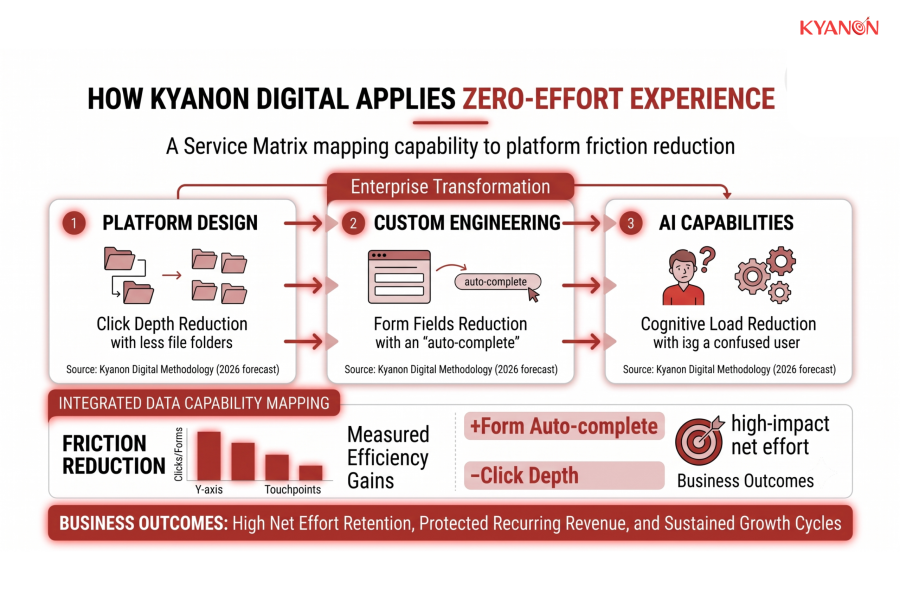
Modern enterprise CX architectures are shifting away from legacy troubleshooting models toward autonomous, preemptive operations. According to Gartner, market competitiveness depends on platform capabilities that autonomously identify and resolve system friction points before consumers ever encounter them. Building proactive data pipelines enables technical leaders to gather customer intent natively, eliminating traditional support friction at the root.
Achieving low-friction service requires clean data governance and structured execution across all digital interfaces. Gartner notes that while service organizations increased technical AI spending by 38% in 2026, only 24% of support leaders have demonstrated positive financial returns due to fragmented execution. Deploying poorly integrated self-service tools onto legacy systems damages customer trust and operational efficiency. This structural challenge is reinforced by Forrester Research, which forecasts that 30% of enterprise firms will actively damage total-experience growth by deploying frustrating, poorly-governed AI self-service interfaces, while an over-reliance on legacy measurement metrics will push 15% of underprepared CX teams into an operational death spiral.
Common Misconceptions
Conflating Zero Effort with Delighting the Customer
Creating an effortless experience does not require going above and beyond to delight customers with extraordinary gestures. Research demonstrates that attempting to delight customers rarely drives marginal loyalty while significantly increasing operational overhead. True loyalty is driven by consistently meeting expectations and removing baseline obstacles, such as eliminating repeated data entry and fixing broken workflow links.
Believing Zero Effort Means No Human Interaction (100% Self-Service)
An effortless experience does not require migrating every single workflow to digital self-service, chatbots, or AI. While customers prefer self-service for basic tasks, forcing complex issues into automated tools increases overall friction. Low effort requires providing smooth, context-aware handoffs to knowledgeable human specialists whenever an issue requires nuance.
Assuming Speed is the Only Component of Effort
Minimizing effort is not solely about lowering Average Handle Time (AHT) or closing support interactions in record seconds. A fast but incorrect or incomplete answer frustrates customers far more than a slightly longer, comprehensive interaction. True low effort prioritizes first-contact resolution and uses positive experience engineering to guide customers comfortably through every step.
Thinking Zero Effort Means a Total Lack of Governance
Making internal processes effortless for employees or service partners does not mean completely removing rules, controls, and oversight. Removing all structure creates operational chaos, which ultimately increases customer-facing friction. Effortless backend workflows rely on governance designed to flow, establishing clear accountabilities and fewer, smarter checkpoints to ensure teams move forward without unnecessary paperwork.
Evaluating Effort Solely by the Absence of Complaints
Low customer complaint volumes do not indicate that a digital experience is effortless. Customer silence does not equal satisfaction; a sudden drop in feedback often indicates that a system is so high-effort and frustrating that users have silently abandoned the platform altogether rather than navigating complex feedback forms.
How Kyanon Digital Applies Zero-Effort Experience
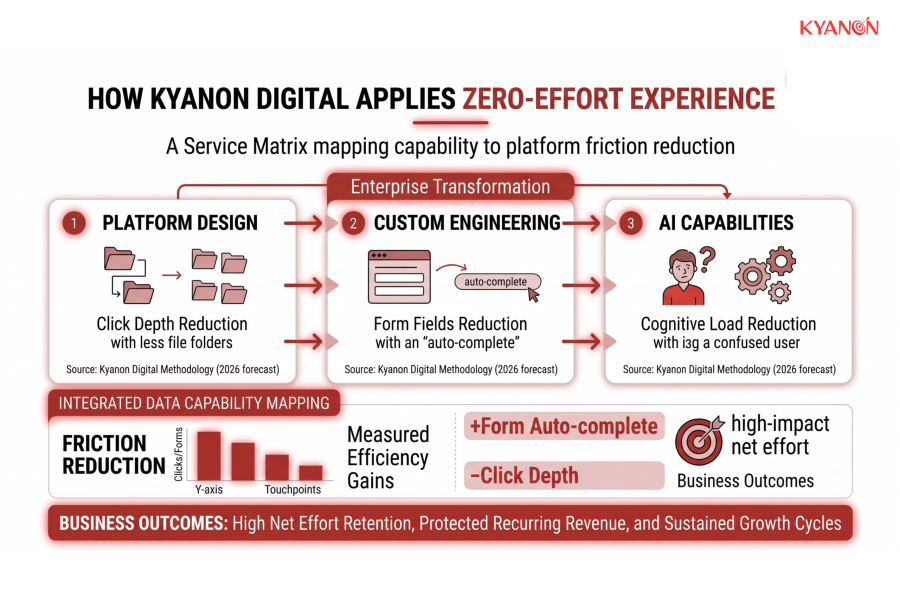
Kyanon Digital applies zero-effort experience principles in enterprise digital platform design, reducing click depth, form fields, and cognitive load at critical journey touchpoints. By integrating predictive automation, real-time data integration, and intuitive user interface architectures, we help organizations eliminate friction, streamline complex workflows, and deliver proactive, high-performance customer journeys that drive long-term loyalty.
Explore our services:

 Create project brief with AI