
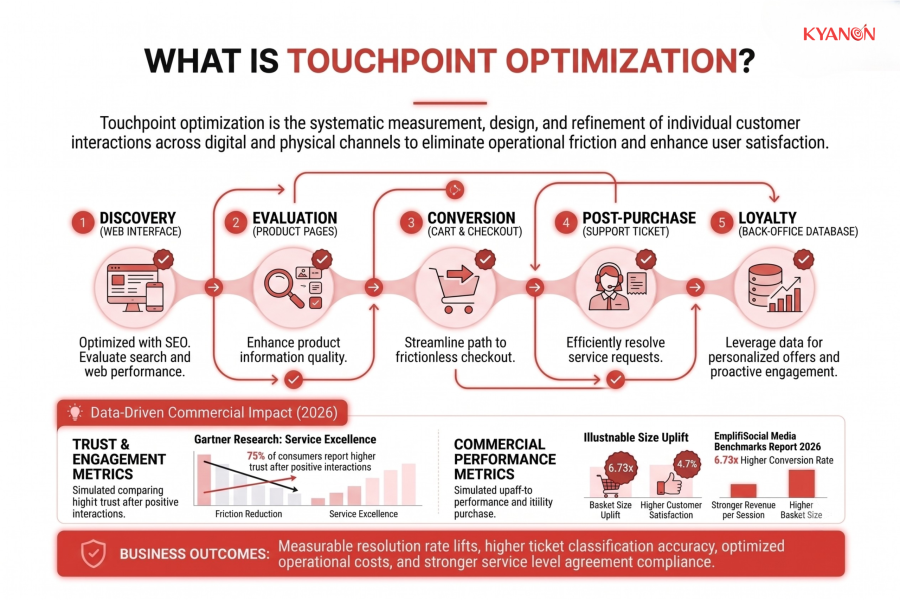
What is Touchpoint Optimization?
Touchpoint optimization is the systematic measurement, design, and refinement of individual customer interactions across digital and physical channels to eliminate operational friction and enhance overall user satisfaction. By evaluating discrete touchpoints within end-to-end customer journeys, enterprises align touchpoint performance with core business outcomes.
How Touchpoint Optimization Works
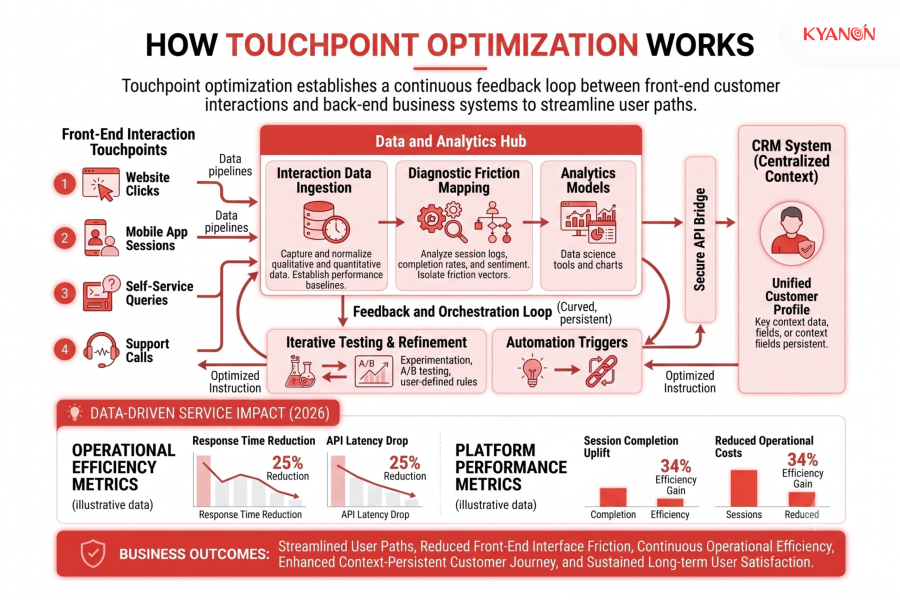
Touchpoint optimization establishes a continuous feedback loop between front-end customer interactions and back-end business systems to streamline user paths.
Interaction Data Ingestion
The process begins by capturing qualitative and quantitative interaction data across all active touchpoints, including website clicks, mobile app sessions, self-service queries, and support calls. This data is ingested into central data environments to establish baseline performance metrics.
Diagnostic Friction Mapping
Analytics models examine session logs, completion rates, and user sentiment at each touchpoint to isolate specific friction vectors. This diagnostic phase separates front-end interface issues from underlying operational bottlenecks like legacy database latency or broken API triggers.
Iterative Testing and Orchestration
Teams deploy targeted refinements using A/B experimentation, usability testing, and dynamic content adaptation. Optimized interaction logic is then deployed back into digital channels, ensuring context persists seamlessly when customers move across touchpoints.

Comparative Analysis: Isolated Touchpoint Refinement vs. Holistic Journey Optimization
Dimension | Isolated Touchpoint Refinement | Holistic Journey Optimization |
| Operational Focus | Localized metric tweaks (e.g., page load speed, form fields) | End-to-end process continuity and cross-channel context retention |
Primary Objective | Single-interaction conversion or completion rate | Total customer experience quality and long-term lifetime value |
| Data Architecture | Siloed channel metrics and isolated tool analytics | Unified customer data platform integration across all touchpoints |
Escalation Handling | Rigid local self-service reset or deflection | Context-aware, automated transfer to live assistance with full history |
| Business Impact | Short-term local efficiency gains with potential disconnects | Sustained reduction in total customer effort and churn mitigation |
Why Touchpoint Optimization Matters
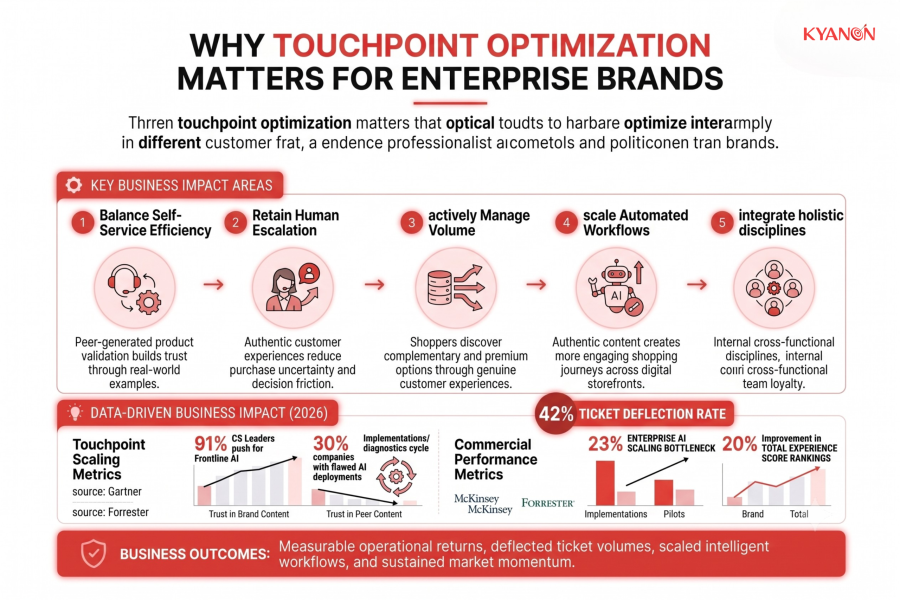
Optimizing customer interaction touchpoints requires balancing automated self-service efficiency with accessible human support. Executive pressure is driving rapid technology deployment, with Gartner reporting that 91% of customer service leaders face strong corporate push to implement AI tools into frontline ticketing. However, technology deployment must account for consumer preferences, as 87% of customers state that companies using generative AI for service must retain seamless human escalation paths, and only 27% are willing to retry an automated service tool after experiencing a single negative resolution outcome.
Resolving operational friction across digital self-service channels yields measurable operational returns for top-performing organizations. Research from McKinsey & Company indicates that leading care organizations actively manage inbound volume, with 42% of customer care leaders successfully deflecting tickets through intelligent, integrated self-service workflows. Moreover, 40% of market leaders report significant gains in customer experience scores by scaling automated workflows. Despite these results, an implementation gap persists across the market: while 62% of companies pilot AI agents, only 23% have scaled them into core business workflows due to system integration hurdles.
Misaligning touchpoint metrics with holistic customer outcomes creates serious retention risks for enterprise brands. Market predictions from Forrester Research indicate that premature, cost-driven rollouts of virtual agents will backfire, with 30% of companies expected to damage customer experiences via flawed AI self-service deployments. Furthermore, misaligned metrics are creating structural vulnerabilities that push roughly 15% of underfunded customer experience teams into diagnostic cycles that prioritize survey tracking over root-cause problem resolution. Conversely, enterprise organizations that integrate internal disciplines achieve market momentum, supported by a 20% improvement in global Total Experience Score rankings among leading brands.
Common Misconceptions
Conflating Touchpoint Satisfaction with Journey Satisfaction
High satisfaction rates across individual touchpoints do not guarantee a successful overall customer experience. A customer can rate a website visit, store environment, and support agent positively, yet still abandon the brand if forced to navigate all three touchpoints to resolve a single billing discrepancy.
Over-Automating at the Expense of Empathy
Optimizing a touchpoint does not always mean making it completely automated or hands-off. Forcing customers through an automated bot during high-stress financial or technical emergencies damages trust; genuine optimization requires providing fast, direct human access during critical moments.
Fixing the Surface Instead of the Root Cause
Redesigning a user interface or updating a support script rarely resolves recurring touchpoint complaints. If customers repeatedly contact support about a product feature, the true optimization opportunity lies in improving core product design or onboarding workflows rather than patching the customer service channel.
Ignoring the Employee Experience (EX)
Human-to-human touchpoints cannot be optimized without streamlining the internal tools supporting staff operations. Equipping employees with slow, fragmented software or rigid internal policies caps their ability to deliver seamless customer experiences.
Designing for the Average Customer
Standardized touchpoint workflows fail to accommodate varying user fluencies, accessibility needs, and emotional contexts. True optimization requires building adaptive pathways for distinct customer segments rather than deploying a rigid self-service model.
How Kyanon Digital Applies Touchpoint Optimization
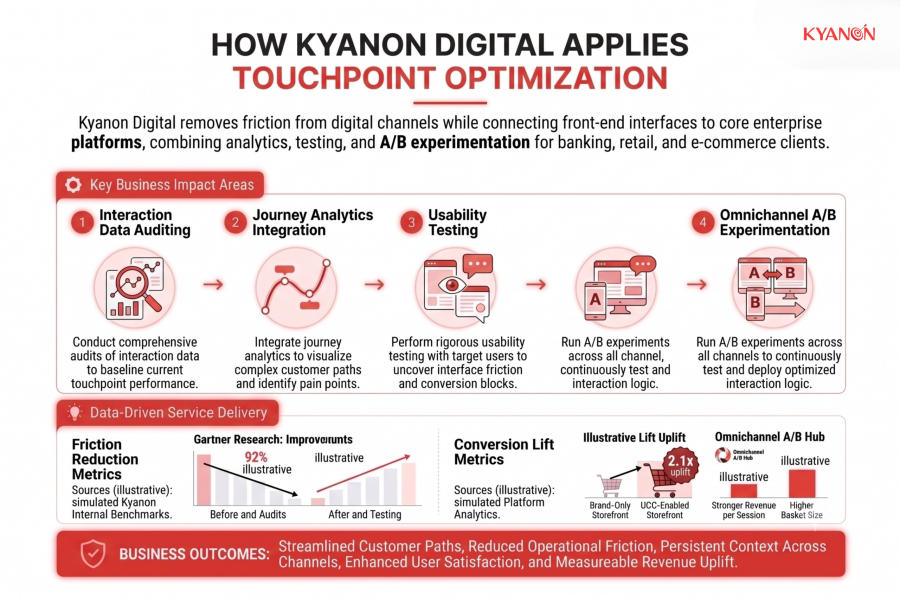
Kyanon Digital conducts comprehensive touchpoint optimization engagements for enterprise clients across banking, retail, and e-commerce sectors. By combining journey analytics, usability testing, and rigorous A/B experimentation, we remove friction from digital channels while connecting front-end interfaces to core enterprise platforms.
Explore our services: Enterprise Software Development

 Create project brief with AI