
What is gamification (CX)?
Gamification (CX) is the use of game design elements, such as challenges, progress indicators, badges, or rewards, within customer interactions to encourage participation and goal completion.
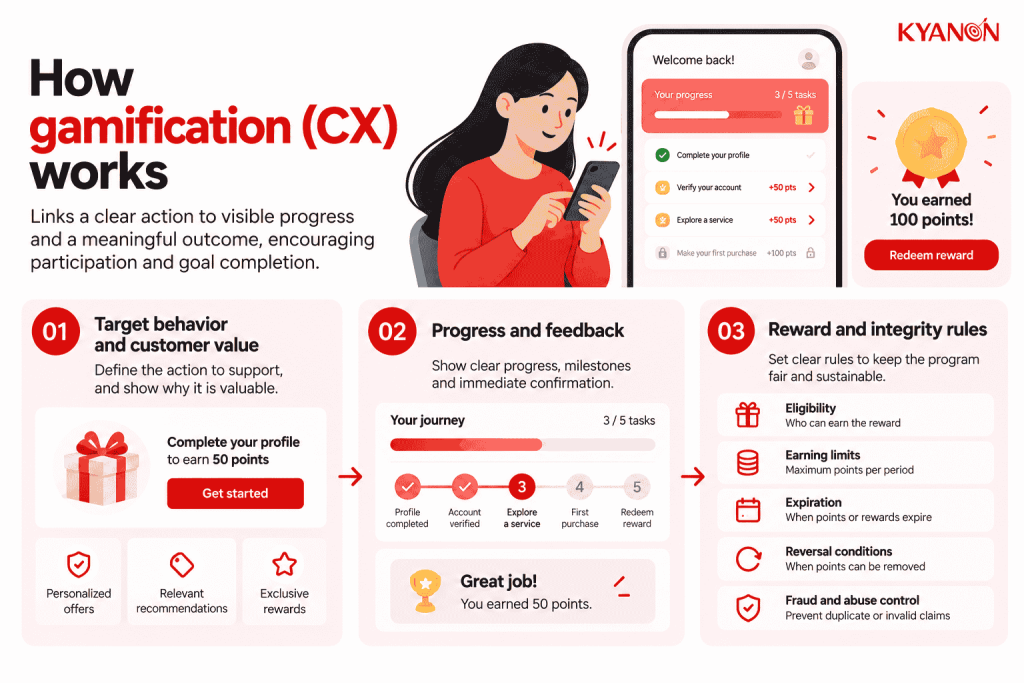
How gamification (CX) works
Gamification links a clear action to visible progress and a meaningful outcome. Its effectiveness depends on whether the activity supports a customer goal and sustainable business value, rather than merely increasing clicks or reward collection.
Target behavior and customer value
Define the action the program should support, such as completing onboarding or exploring a relevant service. The customer should understand why participation is worthwhile without needing to decode complicated rules.
Progress and feedback
Challenges, milestones, and immediate confirmation help participants understand their status. Mechanics should accommodate different abilities and participation patterns rather than punish customers who cannot engage frequently.
Reward and integrity rules
Specify eligibility, earning limits, expiration, and reversal conditions. Reward budgets and abuse controls matter because participation can increase while margin deteriorates or duplicate claims consume the available allocation.

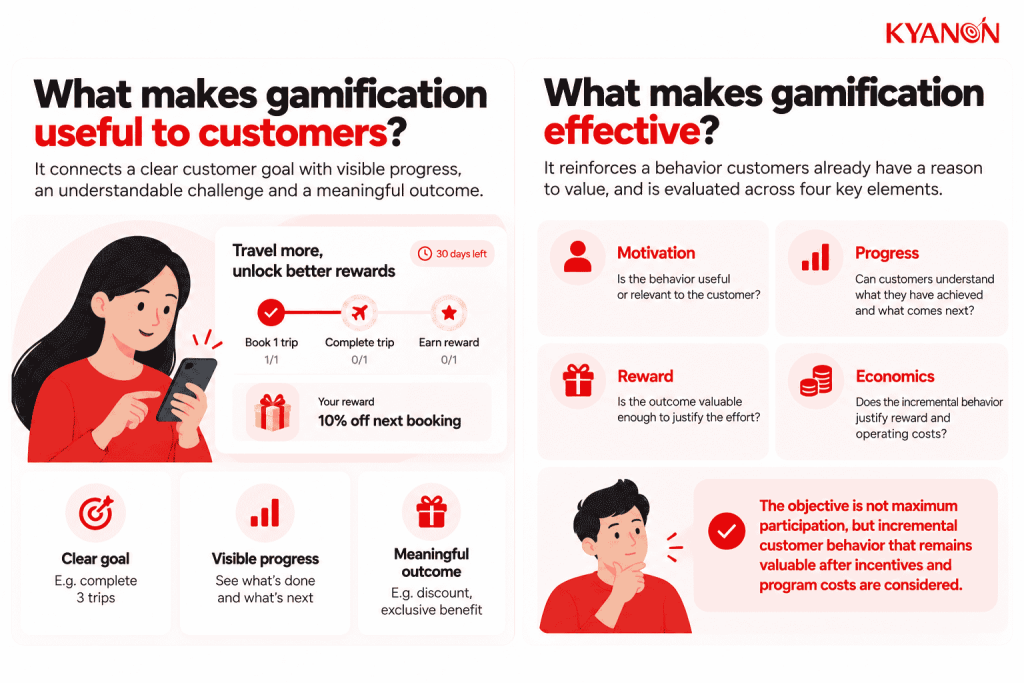
What makes gamification useful to customers?
Useful gamification connects a clear customer goal with visible progress, an understandable challenge and a meaningful outcome. A loyalty challenge might show progress toward a benefit, while onboarding might mark meaningful setup milestones. Points alone do not establish that customers find an activity worthwhile.
Before launching, define the behavior you want to support and the cost of rewarding it. Compare eligible participants with an appropriate control where feasible, and look beyond participation to repeat behavior, reward cost and complaints. Make eligibility, expiry and progress visible. A customer who completes the task but cannot understand why a reward was withheld experiences the mechanics as friction rather than engagement.
What makes gamification effective?
Gamification works when the mechanic reinforces a behavior customers already have a reason to value. Adding points, badges, or challenges to a weak proposition does not automatically create meaningful engagement.
For business teams, evaluate four elements:
- Motivation: Is the target behavior useful or relevant to the customer?
- Progress: Can customers understand what they have achieved and what comes next?
- Reward: Is the outcome valuable enough to justify the required effort?
- Economics: Does the incremental behavior justify reward and operating costs?
The objective is not maximum participation. It is incremental customer behavior that remains valuable after incentives and program costs are considered.
How should businesses measure gamification?
Measure gamification beyond participation. Challenge starts, badge collection, or reward claims show activity, but they do not establish that the program changed customer behavior.
A useful measurement hierarchy is:
| Level | What to measure |
Participation | Challenge starts, completion, active participants |
| Behavior | Repeat purchase, onboarding completion, product discovery |
Incrementality | Behavior compared with a control or suitable baseline |
| Economics | Incremental value minus rewards and operating costs |
Experience | Complaints, reward disputes, abandonment, satisfaction |
Where feasible, compare participants with a control group to determine whether the mechanic created behavior that would not otherwise have occurred. A successful gamification program should improve the intended customer behavior without making reward economics or customer experience worse.
Gamification (CX) vs. loyalty program architecture
Gamification shapes participation through game mechanics; loyalty program architecture manages the wider membership, earning, redemption, and operational system.
Dimension | Gamification (CX) | Loyalty Program Architecture |
Primary role | Motivate participation | Operate a loyalty program |
| Typical elements | Challenges, badges, progress | Membership, points ledger, tiers, redemption |
Required rewards | Can use recognition without monetary value | Depends on the program model |
| Control focus | Fairness, abuse, behavior quality | Balances, eligibility, reconciliation, liability |
Success measure | Incremental useful behavior | Incremental retention and program economics |
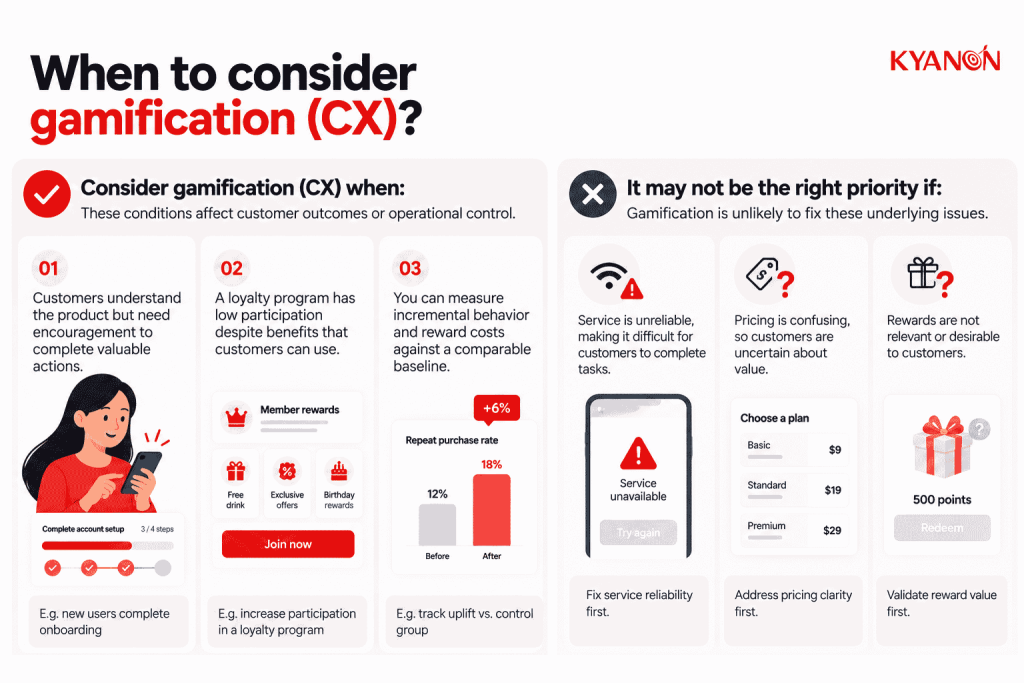
When to consider gamification (CX)
Consider gamification (cx) when the following conditions affect customer outcomes or operational control:
- Customers understand the product but need encouragement to complete valuable actions
- A loyalty program has low participation despite benefits that customers can use
- You can measure incremental behavior and reward costs against a comparable baseline
It may not be the right priority if:
Gamification is unlikely to fix unreliable service, confusing pricing, or rewards customers do not value. Address those conditions before adding mechanics.
Why gamification (CX) matters for retail and consumer services
Gamification can connect everyday customer interactions with progress, recognition, and rewards, giving customers another reason to participate beyond individual transactions. Its business value, however, depends on whether those mechanics support meaningful behaviors rather than simply increasing activity.
Case study: How did Kyanon Digital apply gamification to a large-scale shopping mall?

For a large shopping mall in Thailand, Kyanon Digital developed a phygital engagement platform connecting offline purchases with digital loyalty and gamification.
- Challenges: Create cross-tenant engagement while validating purchases, controlling reward eligibility, and supporting campaigns at mall scale.
- Solutions: Built tiered spending thresholds, reward milestones, spend boosters, loyalty points, and gamified mechanics, including lucky draws within a centralized campaign engine.
- Results & impacts: Achieved full tenant participation, supported higher average order value, and reduced fraud exposure while enabling cross-tenant rewards.
Effective CX gamification is not about adding more game mechanics; it is about designing measurable participation that creates meaningful customer value while remaining operationally and economically sustainable as engagement scales.
Common misconceptions
“Adding points will make customers loyal.”
Reality: Points are only a mechanism. Loyalty also depends on service quality, relevant benefits, and a clear exchange of value.
“More engagement always means more revenue.”
Reality: Customers may optimize their behavior to collect incentives without creating incremental value. Measure margin and retention alongside activity, using control groups where practical.
How Kyanon Digital applies gamification (CX)
Kyanon Digital incorporates gamification into loyalty and engagement platforms for retail and FMCG organizations. The work connects customer-facing challenges and progress with eligibility rules, reward availability, transaction validation, and campaign reporting. This makes the engagement experience manageable for the business as participation scales.
Explore Kyanon Digital’s loyalty and rewards services.

 Create project brief with AI