
What is GDPR compliance (CX data)?
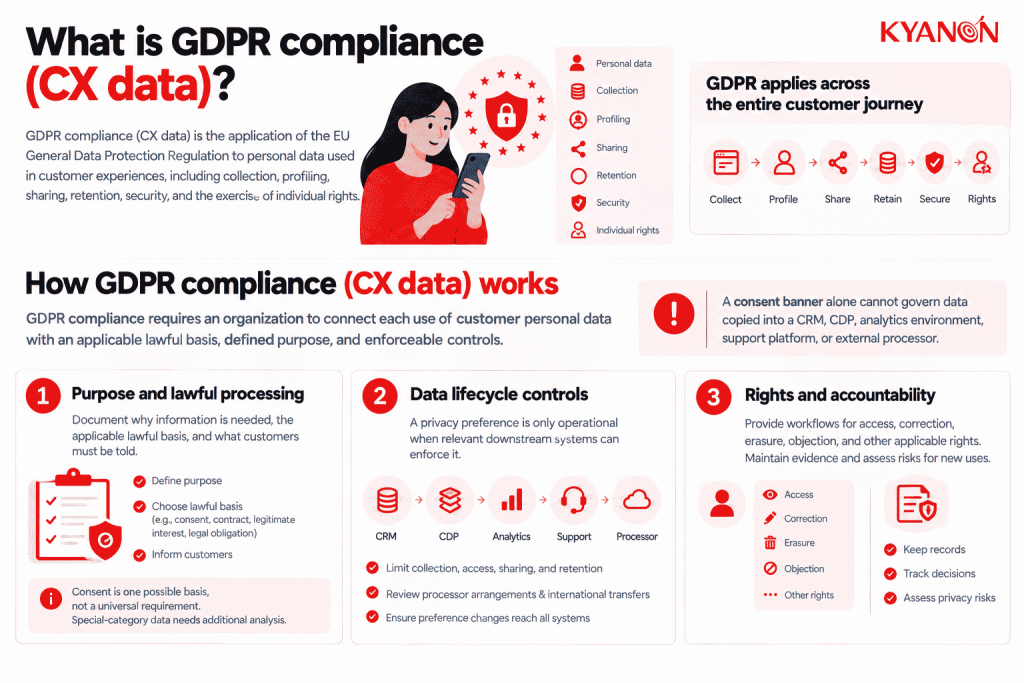
GDPR compliance (CX data) is the application of the EU General Data Protection Regulation to personal data used in customer experiences, including collection, profiling, sharing, retention, security, and the exercise of individual rights.
How GDPR compliance (CX data) works
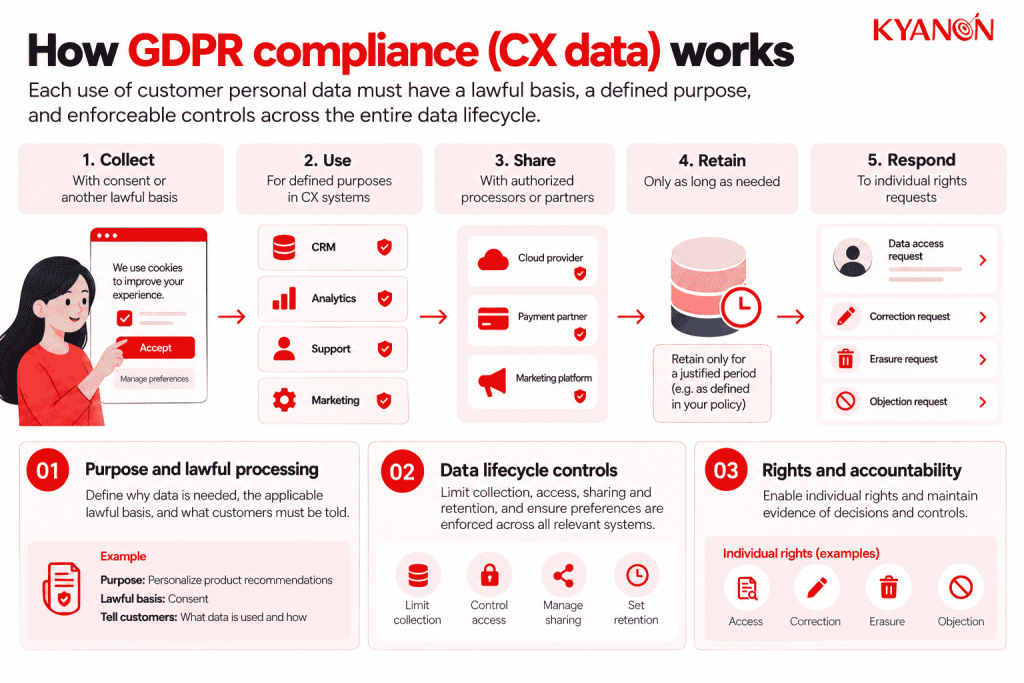
GDPR compliance requires an organization to connect each use of customer personal data with an applicable lawful basis, defined purpose, and enforceable controls. A consent banner alone cannot govern data copied into a CRM, CDP, analytics environment, support platform, or external processor.
Purpose and lawful processing
Document why information is needed, the applicable lawful basis, and what customers must be told. Consent is one possible basis, not a universal requirement for every processing activity; special-category data requires additional analysis.
Data lifecycle controls
A privacy preference is only operational when relevant downstream systems can enforce it.
Limit collection, access, sharing, and retention to justified needs. Review processor arrangements and international transfers, and ensure relevant changes in customer preferences reach the systems that activate customer data.
Rights and accountability
Provide workflows for access, correction, erasure, objection, and other applicable rights. Maintain evidence of decisions and controls, and assess privacy risks when introducing profiling or new customer data uses.

What should a CX data review cover?
Start with one data flow, such as a support conversation becoming a customer-profile attribute. Record the purpose, personal data involved, applicable lawful basis, recipients, access permissions, and retention rule.
Then check whether downstream systems can honor relevant customer rights and changes to permissions. GDPR applicability depends on the organization’s activities and territorial scope, not simply whether a database is hosted in Europe.
Consent is one lawful basis, not a universal requirement for every activity. Where consent is used, it must meet the applicable conditions and be withdrawable. Do not assume permission to resolve a service issue also permits unrelated marketing or AI training. Map each purpose separately, and have the responsible privacy team approve the legal interpretation before translating it into platform controls.
The same purpose analysis matters when customer data enters AI or advanced personalization workflows. Data collected for service, support, or transaction purposes should not automatically be treated as available for unrelated model development or profiling. Assess the proposed purpose, lawful basis, necessity, transparency, and applicable customer rights before translating the use case into technical implementation.
What makes GDPR compliance difficult across connected CX platforms?
The challenge is often not identifying a GDPR requirement but executing it consistently across connected systems. Customer data may exist in a CRM, CDP, analytics platform, marketing tools, support systems, data warehouses, and external processors, each with different retention and activation logic.
In its 2026 coordinated enforcement report on the right to erasure, the European Data Protection Board analyzed responses from 764 controllers across Europe. The participating Data Protection Authorities identified seven recurring challenges, including inadequate internal procedures for handling erasure requests.
For CX and technology leaders, this creates four practical control questions:
- Can we identify where relevant customer data exists?
- Can a valid erasure, objection, or preference change propagate to downstream systems?
- Can we distinguish data that should be deleted from data that must legitimately be retained?
- Can we demonstrate what action was taken and where?
Compliance, therefore, depends on data traceability and executable workflows, not only documented privacy policies.
GDPR compliance (CX data) vs. data security
GDPR compliance addresses lawful and accountable personal-data processing; data security protects information and systems from unauthorized access, loss, or disruption.
Dimension | GDPR Compliance (CX Data) | Data Security |
| Main question | May we process this data in this way? | Is the information adequately protected? |
Scope | Personal data and processing activities | Information, infrastructure, and services |
| Core controls | Lawful basis, transparency, rights, retention | Access, encryption, monitoring, recovery |
Evidence | Processing records and demonstrable compliance | Security configurations and control tests |
| Relationship | Includes security obligations | Supports compliance but does not establish it |
When to consider GDPR compliance (CX data)
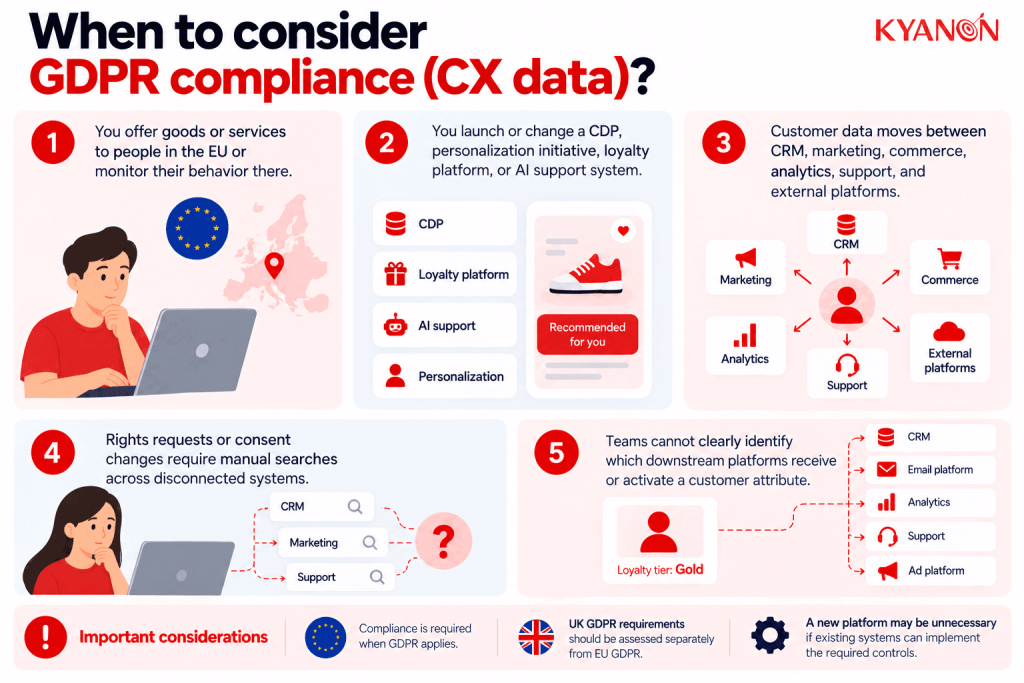
Consider GDPR compliance (CX data) when:
- You offer goods or services to people in the EU or monitor their behavior there and need to assess GDPR applicability.
- A CDP, personalization initiative, loyalty platform, or AI support system changes how customer personal data is used.
- Customer data moves between CRM, marketing, commerce, analytics, support, and external platforms.
- Rights requests or consent changes currently require manual searches across disconnected systems.
- Teams cannot clearly identify which downstream platforms receive or activate a customer attribute.
Where GDPR applies, compliance is not an optional investment priority. A new platform may be unnecessary if existing systems can implement the required controls. UK GDPR requirements should be assessed separately from EU GDPR.
Why GDPR compliance (CX data) matters for connected customer experiences
GDPR compliance affects whether and how customer data can be used across an experience, not simply where that data is stored. Technical architecture must make approved processing purposes, customer rights, and governance decisions executable across the full data flow.
This remains an active enforcement concern. In 2026, 25 Data Protection Authorities across Europe are participating in an EDPB-coordinated action focused on GDPR transparency and information obligations under Articles 12, 13, and 14.
The operational problem becomes particularly important when customer data is distributed across multiple CX systems. For example, a valid objection to direct marketing may need to affect the CRM, CDP, email platform, audience activation, and other relevant downstream systems. Updating one record while another system continues the same processing can leave the underlying governance problem unresolved.
For business and technology leaders, the question is therefore not simply “Do we have a privacy policy?” but “Can our customer-data architecture execute and demonstrate the approved privacy decision across every relevant system?”
Case study: How did Kyanon Digital unify customer data across a large retail ecosystem?
Explore the full case study of how Kyanon Digital unified customer data and loyalty across business units for a large Japanese retail group.
For one of the largest Japanese retail groups in Vietnam, Kyanon Digital addressed fragmented customer data and disconnected loyalty programs by designing and implementing a centralized customer data and loyalty ecosystem.
- Challenges: Customer information was distributed across business units and loyalty programs, limiting a unified view of customer behavior and making coordinated engagement difficult.
- Solutions: Designed a centralized Customer Data Platform (CDP) that aggregated customer information from multiple business units into a real-time customer-data foundation, supporting unified profiles, analytics, personalization, loyalty, and omnichannel engagement.
- Results & impacts: The retailer gained centralized customer insights and a unified loyalty experience across business units, enabling more targeted engagement and data-driven marketing.
This case is not presented as evidence of GDPR certification or legal compliance. It demonstrates the type of connected customer-data architecture in which approved privacy, access, retention, and preference requirements need to operate consistently across systems.
Effective GDPR implementation in CX therefore depends on connecting approved legal requirements, customer-data governance, system architecture, and operational workflows so that privacy decisions remain enforceable as data, channels, and customer use cases expand.
Common misconceptions
“Our vendor is compliant, so our business is compliant.”
Reality: A vendor’s controls do not determine the lawfulness of your purposes, configurations, or customer data uses. The organization still needs accountable decisions about how and why personal data is processed.
“We need consent for every customer data activity.”
Reality: The appropriate lawful basis depends on the processing purpose and circumstances. Do not bundle optional marketing permissions with processing needed to deliver a contracted service.
“Deleting customer data from the CRM completes an erasure request.”
Reality: Customer data may also exist in connected marketing, support, analytics, loyalty, commerce, and other systems. The organization needs to determine which relevant data falls within the valid request and ensure the required action reaches the appropriate systems.
“If customer data is secure, it is GDPR compliant.”
Reality: Security is an important GDPR obligation, but protecting data does not by itself establish that its collection, profiling, retention, or other processing is lawful.
How Kyanon Digital applies GDPR compliance (CX data)
Kyanon Digital translates approved customer-data governance requirements into technical controls across connected CX platforms. This can include access management, preference propagation, retention workflows, data traceability, and integration patterns that allow relevant customer-data decisions to reach downstream systems.
Technical implementation should follow the organization’s approved legal requirements and controller or processor responsibilities. Technology can make those requirements executable and auditable across the customer-data architecture; it does not, by itself, determine whether a processing activity is legally compliant.
Explore Kyanon Digital’s data and analytics services.

 Create project brief with AI