
What is a customer data platform (CDP)?
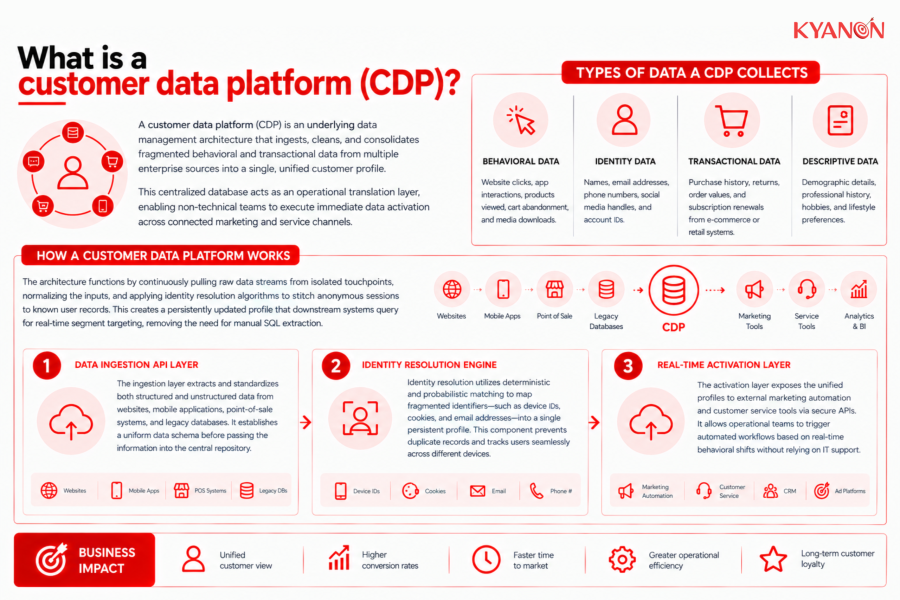
A customer data platform (CDP) is an underlying data management architecture that ingests, cleans, and consolidates fragmented behavioral and transactional data from multiple enterprise sources into a single, unified customer profile. This centralized database acts as an operational translation layer, enabling non-technical teams to execute immediate data activation across connected marketing and service channels.
How a customer data platform works
The architecture functions by continuously pulling raw data streams from isolated touchpoints, normalizing the inputs, and applying identity resolution algorithms to stitch anonymous sessions to known user records. This creates a persistently updated profile that downstream systems query for real-time segment targeting, removing the need for manual SQL extraction.
Data Ingestion API Layer
The ingestion layer extracts and standardizes both structured and unstructured data from websites, mobile applications, point-of-sale systems, and legacy databases. It establishes a uniform data schema before passing the information into the central repository.
Identity Resolution Engine
Identity resolution utilizes deterministic and probabilistic matching to map fragmented identifiers-such as device IDs, cookies, and email addresses-into a single persistent profile. This component prevents duplicate records and tracks users seamlessly across different devices.
Real-Time Activation Layer
The activation layer exposes the unified profiles to external marketing automation and customer service tools via secure APIs. It allows operational teams to trigger automated workflows based on real-time behavioral shifts without relying on IT support.

Types of data a CDP collects
- Behavioral data: Website clicks, app interactions, products viewed, cart abandonment, and media downloads.
- Identity data: Names, email addresses, phone numbers, social media handles, and account IDs.
- Transactional data: Purchase history, returns, order values, and subscription renewals from e-commerce or retail systems.
- Descriptive data: Demographic details, professional history, hobbies, and lifestyle preferences.
Customer data platform vs Customer Relationship Management (CRM)
Both systems manage customer information, but they differ fundamentally in data types, ingestion methods, and operational intent.
Dimension | Customer data platform (CDP) | Customer Relationship Management (CRM) |
| Primary data type | Behavioral, transactional, and anonymous | Transactional and known contact details |
Ingestion method | Automated API streams across all channels | Manual entry and direct sales logging |
| User profile scope | Unified multi-channel digital identity | Direct sales pipeline and account history |
System intent | Real-time data activation and segmentation | Direct sales relationship management |
| Target user | Marketing, Data, and CX teams | Sales representatives and Account managers |
When to consider a customer data platform
Consider a customer data platform if:
- Your engineering team spends excessive billable hours writing custom SQL queries just to pull basic behavioral segments for the marketing department.
- You operate multiple disconnected digital touchpoints, resulting in customers receiving promotional emails for products they already purchased in-store.
- Your organization plans to implement predictive AI personalization, but current data sets are too fragmented and polluted with duplicates to train models accurately.
It may not be the right priority if:
- Your business operates a strictly B2B, low-volume sales model where customer interactions are entirely managed through direct, 1-on-1 account executive relationships within a standard CRM.
Why a customer data platform Matters for Retail and FMCG
Relying on siloed data pipelines increases the total cost of ownership (TCO) for IT infrastructure while preventing product teams from deploying accurate, trigger-based personalization. Centralizing behavioral data drastically accelerates time-to-market for digital campaigns by removing the technical bottlenecks associated with manual data extraction and cross-system reconciliation.
McKinsey’s January 2025 research on personalized marketing highlights that retailers and brands are increasingly using AI and data to scale tailored customer interactions. Its October 2025 research also shows how integrated customer data and AI-powered decisioning can support personalized recommendations, reduce churn and increase cross-sell and upsell opportunities.
Common misconceptions
A CDP just replaces our CRM
Reality: CRMs manage active, direct customer relationships, sales pipelines, and manual communications. A customer data platform ingests vast quantities of multi-source behavioral data-like website clicks and app usage-to build a unified profile, feeding the CRM rather than replacing it.
We have a Data Warehouse/Lake, so we don’t need a CDP
Reality: Data lakes store massive historical data arrays but require extensive data engineering and SQL to query. This platform acts as an operational translation layer, letting non-technical users quickly segment and activate that data in real-time without writing code.
A CDP replaces our Marketing Automation software
Reality: Marketing automation software handles the operational execution of campaigns, such as sending an automated email flow. The customer data platform provides the rich background data and unified profile to dictate exactly who receives what message.
How Kyanon Digital applies a customer data platform (CDP)
Kyanon Digital implements customer data platform architectures for enterprise clients in retail and FMCG, replacing fragmented customer databases with a unified profile that powers personalization. Serving organizations across Vietnam, Singapore, Thailand, ANZ, and Malaysia, our engineering teams focus on deep technical implementation rather than just strategic consulting. We connect legacy data lakes and point-of-sale systems directly into centralized activation layers, prioritizing measurable outcomes such as reduced TCO, higher conversion rates, and accelerated time-to-market.
Explore our Customer Data Platform & Personalization services.

 Create project brief with AI