
What is Generative AI?
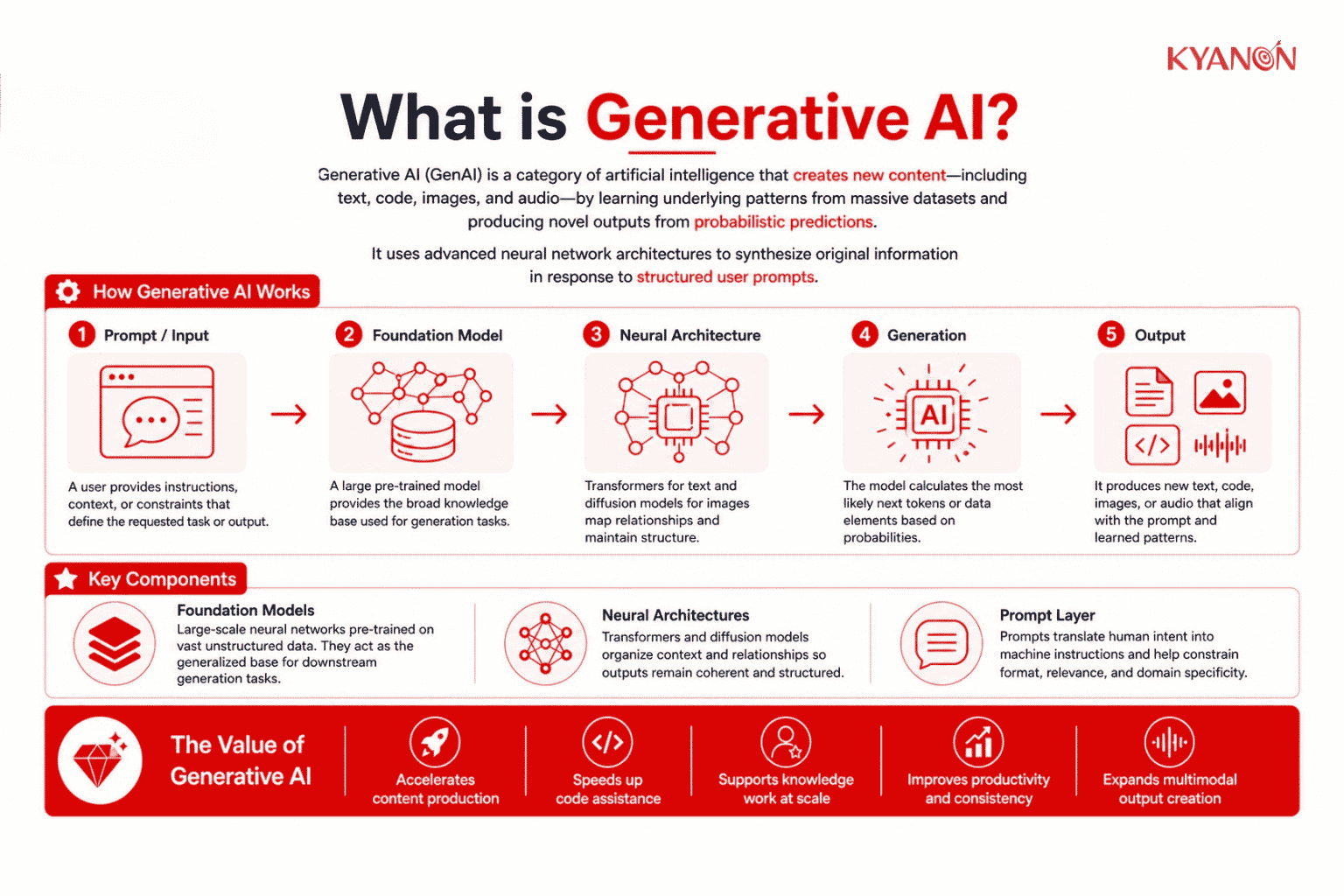
Generative AI (GenAI) is a category of artificial intelligence that creates new content, including text, code, images, and audio, by learning underlying patterns from massive datasets and generating novel outputs based on probabilistic predictions. It utilizes advanced neural network architectures to synthesize original information strings in response to structured user prompts.
How Generative AI Works
Generative AI functions through complex probability calculations, analyzing billions of parameters to predict the most statistically likely sequence of data elements based on a given input. This mechanism allows the system to synthesize entirely new combinations of information rather than retrieving pre-existing, static records from a database.
Foundation Models
Foundation models are large-scale neural networks pre-trained on vast amounts of unstructured data. They serve as the generalized knowledge and reasoning base that can be adapted for specific generation tasks.
Neural Network Architectures
Frameworks such as Transformers (for text) or diffusion models (for images) process inputs by mapping relationships between data points. They establish context and structure, allowing the model to maintain coherence over long outputs.
Prompt Layer
The prompt layer is the interface where human intent translates into machine instructions. Structured prompts constrain the model’s probabilistic outputs to ensure relevance, format compliance, and domain specificity.

Generative AI (GenAI) vs Large Language Model (LLM)
Generative AI is the broader category of AI systems that create new outputs, while a Large Language Model (LLM) is a model type mainly designed to process and generate language.
| Dimension | Generative AI (GenAI) |
Large Language Model (LLM) |
|
Core meaning |
A category of AI that generates new content |
A model architecture focused on language tasks |
|
Output types |
Text, image, code, audio, video, synthetic data |
Primarily text and language-based outputs |
|
Business role |
Supports content creation, knowledge access, workflow assistance, and automation | Powers chatbots, summarization, search, reasoning, and text generation |
| Model examples | Text generators, image generators, code generators, video generators |
GPT-style models, Claude-style models, Llama-style models |
|
Enterprise risk |
Hallucination, bias, data leakage, IP exposure, and misuse of generated content | Hallucination, prompt injection, weak retrieval grounding, context limits |
| Best fit | Multimodal business use cases across functions |
Knowledge work, support, documentation, search, analysis, and copilots |
|
Governance priority |
Output controls, data provenance, usage policy, human review |
Retrieval accuracy, prompt controls, model evaluation, access permissions |
When to Consider Generative AI
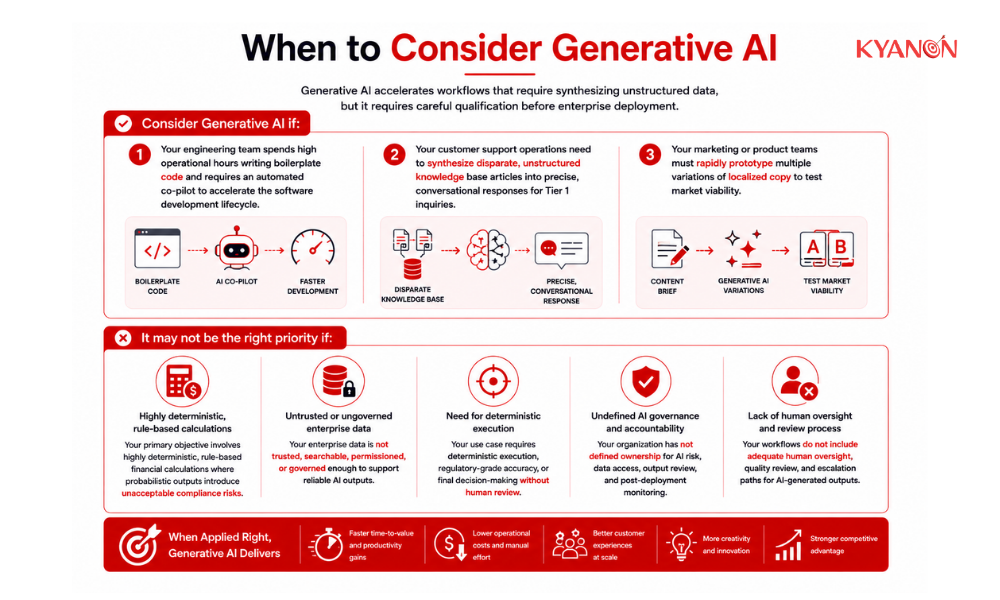
Generative AI accelerates workflows that require synthesizing unstructured data, but it requires careful qualification before enterprise deployment.
Consider Generative AI if:
- Your engineering team spends high operational hours writing boilerplate code and requires an automated co-pilot to accelerate the software development lifecycle.
- Your customer support operations need to synthesize disparate, unstructured knowledge base articles into precise, conversational responses for Tier 1 inquiries.
- Your marketing or product teams must rapidly prototype multiple variations of localized copy to test market viability.
It may not be the right priority if:
- Your primary objective involves highly deterministic, rule-based financial calculations where probabilistic outputs introduce unacceptable compliance risks.
- Your enterprise data is not trusted, searchable, permissioned, or governed enough to support reliable AI outputs.
- Your use case requires deterministic execution, regulatory-grade accuracy, or final decision-making without human review.
- Your organization has not defined ownership for AI risk, data access, output review, and post-deployment monitoring.
Why Generative AI (GenAI) Matters for Enterprise Technology
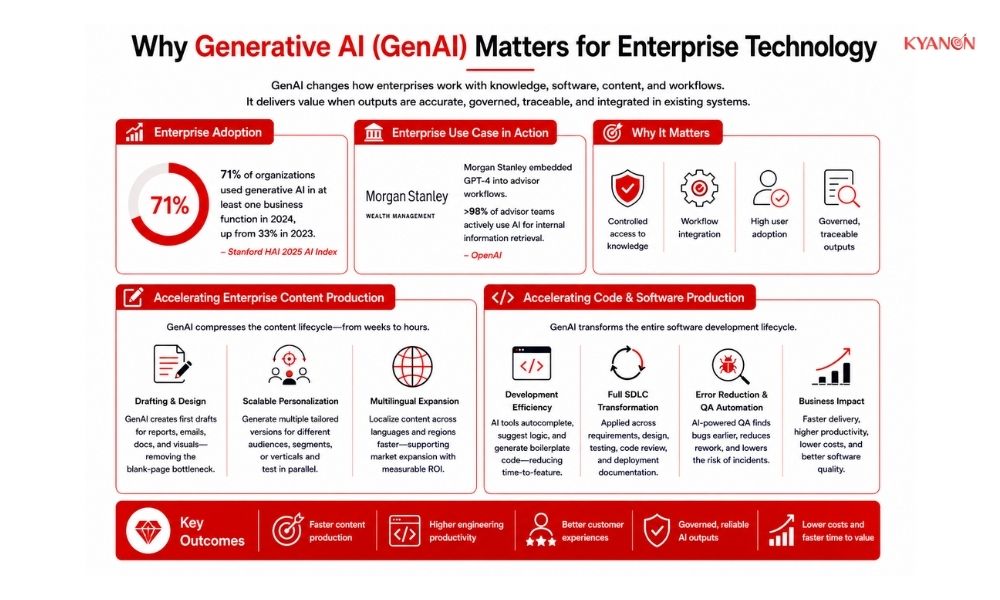
Generative AI matters for enterprise technology because it changes how organizations interact with knowledge, software, content, and operational workflows. For CTOs and IT leaders, the main issue is not whether GenAI can produce content; the issue is whether the enterprise can make that output accurate, governed, traceable, and usable inside existing systems.
Stanford HAI’s 2025 AI Index reported that 71% of surveyed organizations used generative AI in at least one business function in 2024, up from 33% in 2023.
Morgan Stanley Wealth Management embedded GPT-4 into advisor workflows to improve access to internal knowledge, and OpenAI reported that more than 98% of advisor teams actively used the AI for internal information retrieval. This shows why enterprise GenAI depends on controlled access to knowledge, workflow integration, and user adoption rather than on model selection alone.
Accelerating Enterprise Content Production
Generative AI changes the economics of content at scale. What previously required dedicated creative cycles, brief, draft, review, localize, and publish, can now be compressed into hours.
- Drafting and design GenAI tools produce first drafts of business reports, client-facing emails, product documentation, and advertising visuals. This removes the blank-page bottleneck for content teams and allows human reviewers to focus on refinement and brand alignment rather than raw creation.
- Scalable personalization. Enterprises use GenAI to dynamically generate tailored content, job descriptions, marketing copy, and customer communications calibrated to specific audiences, segments, or verticals. Instead of producing one version and adapting it manually, teams can prompt for multiple variants and test performance in parallel.
- Multilingual expansion localization, historically: One of the most resource-intensive content operations is now a GenAI use case with measurable ROI. Organizations use GenAI to adapt content across languages and regional contexts, supporting faster entry into new markets without building local content teams from scratch.
Accelerating Code and Software Production
Software development has emerged as one of the highest-impact application areas for GenAI, with coding representing a significant share of enterprise AI investment across technology-intensive industries.
- Development efficiency: AI-assisted coding tools allow engineers to complete tasks significantly faster by auto-completing functions, suggesting logic blocks, and generating boilerplate code based on context. The productivity gain is not theoretical: these tools are now embedded in active engineering workflows at scale, reducing time-to-feature for product teams.
- Full SDLC transformation: GenAI’s impact extends beyond code writing. It is being applied across the entire software development lifecycle, from requirement gathering and technical specification drafting to automated test generation, code review assistance, and deployment documentation. Teams that have only applied GenAI to one phase of the SDLC are underutilizing its potential.
- Error reduction and QA automation: Automated quality assurance processes powered by GenAI can surface bugs earlier in the development cycle, before they reach staging or production environments. Early detection reduces rework costs and lowers the risk of post-launch incidents, a meaningful operational improvement for engineering teams managing complex, fast-moving codebases.
Common Misconceptions
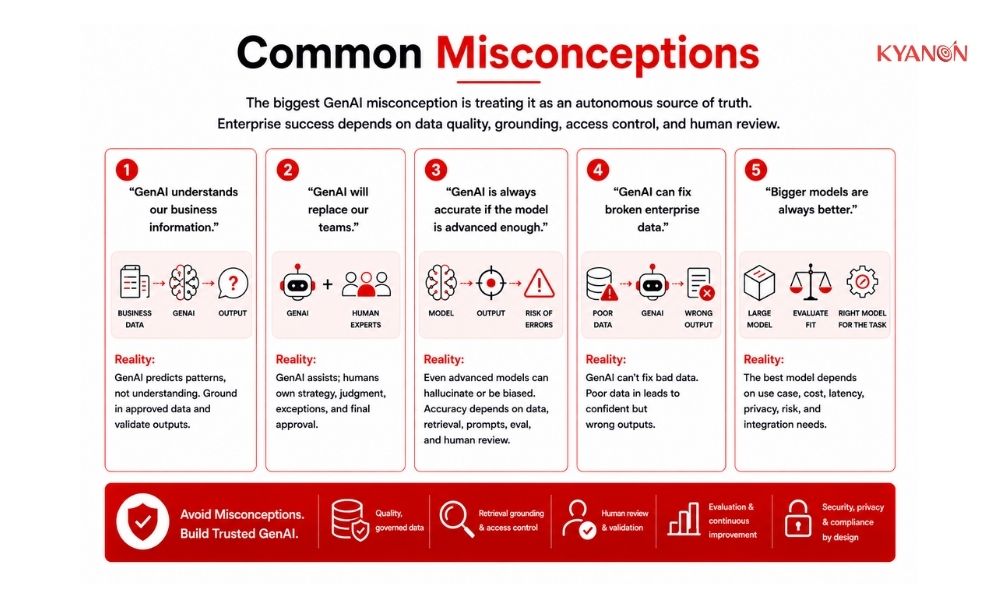
The most critical enterprise misconception about Generative AI (GenAI) is that it can operate as an autonomous source of truth without data quality, retrieval grounding, access control, and human review.
“GenAI understands our business information.”
Reality: GenAI does not understand business context the way a domain expert does. It predicts likely outputs from patterns, so enterprise teams must ground responses in approved data sources and validate outputs before operational use.
“GenAI will replace our teams.”
Reality: GenAI is more practical as a productivity layer than a full replacement for human judgment. It can draft, summarize, classify, and assist, but strategy, accountability, exception handling, and final approval still belong to humans.
“GenAI is always accurate if the model is advanced enough.”
Reality: Larger models can still hallucinate, misread context, or reproduce bias from training data. Accuracy depends on data quality, retrieval design, prompt control, evaluation, and human-in-the-loop review.
“GenAI can fix broken enterprise data.”
Reality: GenAI can make poor data problems more visible, but it does not repair inconsistent definitions, missing metadata, duplicate records, or weak governance by itself. If the input data is fragmented or unreliable, the output can become confidently wrong.
“Bigger models are always better.”
Reality: Smaller or specialized models can be more suitable for specific enterprise tasks when cost, latency, privacy, or domain accuracy matters. CTOs should evaluate model fit by use case, risk profile, operating cost, and integration requirements.
Key Business Benefits and Emerging Challenges
Enterprises adopting GenAI at scale are gaining measurable advantages, but they are also navigating a new category of operational risk that traditional IT governance frameworks were not designed to address.
|
Impact area |
What it means in practice |
|
Speed to market |
Compresses the journey from strategy to deployment, content ships faster, features release sooner, decisions are informed by synthesized data rather than manual research |
|
Cost optimization |
Reduces operational overhead in repetitive, high-volume tasks, support documentation, content drafting, code boilerplate, freeing teams for higher-judgment work |
| Workforce shift |
Creates new roles (prompt engineers, AI output reviewers, AI governance leads) while requiring baseline AI literacy across functions. The risk is not headcount loss, it is capability mismatch |
| Risk management |
Enterprises must actively manage proprietary data exposure, model hallucinations producing confident but incorrect outputs, and AI bias embedded in training data. These are not edge cases; they are default risks requiring defined ownership and controls |
How Kyanon Digital Applies Generative AI (GenAI)
Kyanon Digital applies Generative AI (GenAI) by designing use cases around business value, data readiness, architecture fit, and production governance for enterprise clients across Vietnam, Singapore, Malaysia, Thailand, ANZ, the US, and Nordic Europe. Its GenAI implementation approach includes use-case discovery, model selection, custom RAG architecture, secure data ingestion, deployment into client-controlled environments, and post-launch monitoring.
For enterprise teams, this means GenAI is treated as an integrated business system rather than a standalone chatbot. Kyanon Digital’s implementation work typically connects foundation models or LLMs with enterprise data sources, APIs, workflow tools, permission models, evaluation pipelines, and user feedback loops so that outcomes can be measured against time-to-market, conversion, cost, and operational efficiency.
→ Explore our Generative AI consulting and implementation services.

 Create project brief with AI