
What is guided selling?
Guided selling is an approach that uses customer needs, product information and decision logic to help buyers or sales representatives identify suitable products and next steps toward a purchase.
How guided selling works
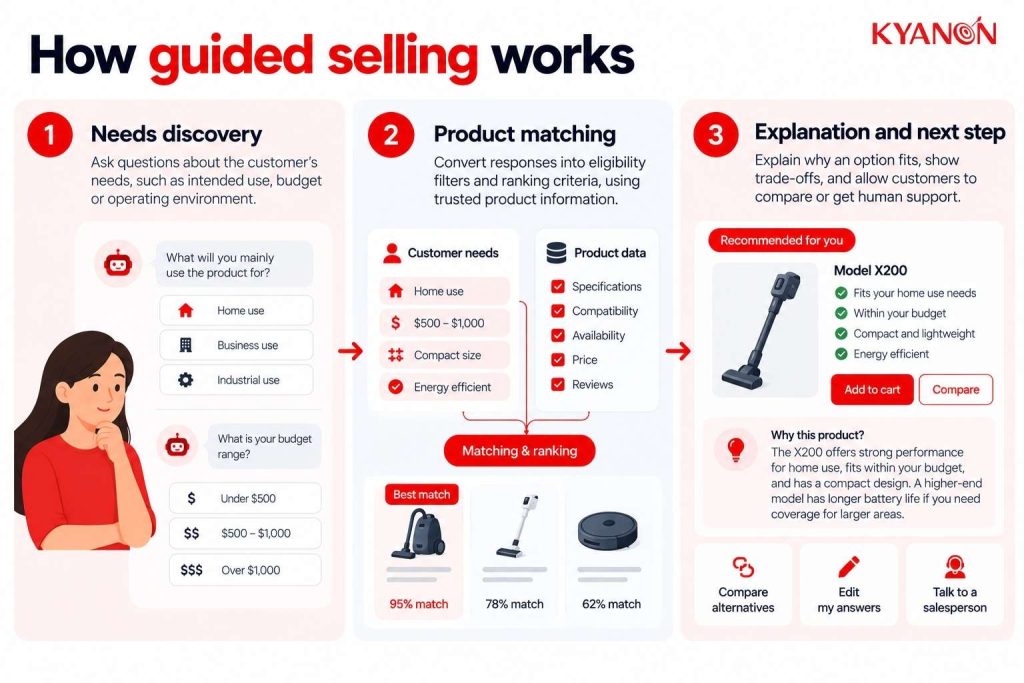
Guided selling converts a customer problem into selection criteria, then applies those criteria to trusted product information. The guidance can use explicit rules, AI, or both, but the recommendation must respect compatibility, availability, and commercial constraints.
Needs discovery
Ask questions customers can answer, such as intended use, budget, or operating environment. Avoid requiring specialist specifications before the customer understands which specifications matter.
Product matching
Translate responses into eligibility filters and ranking criteria. Accurate product attributes are essential because an engaging conversation cannot compensate for missing compatibility or availability data.
Explanation and next step
Explain why an option fits and what trade-offs remain. Allow customers to revise answers, compare alternatives, or involve a salesperson when the decision exceeds the system’s scope.

What makes guided selling effective?
Guided selling works when recommendation logic reduces uncertainty without introducing more effort than the decision requires. The experience depends on four elements:
- Relevant questions: Ask only for information that materially changes the recommendation
- Reliable product data: Attributes, compatibility, availability, and constraints must be accurate enough to support the decision
- Explainable matching: Customers should understand why an option fits and which trade-offs remain
- Recovery paths: Allow customers to change answers, compare alternatives, search directly, or involve a salesperson when the system cannot confidently resolve the need
A longer product recommendation quiz is not necessarily better. If a question does not change eligibility, ranking, or the next step, it may simply add friction.
What data does guided selling need?
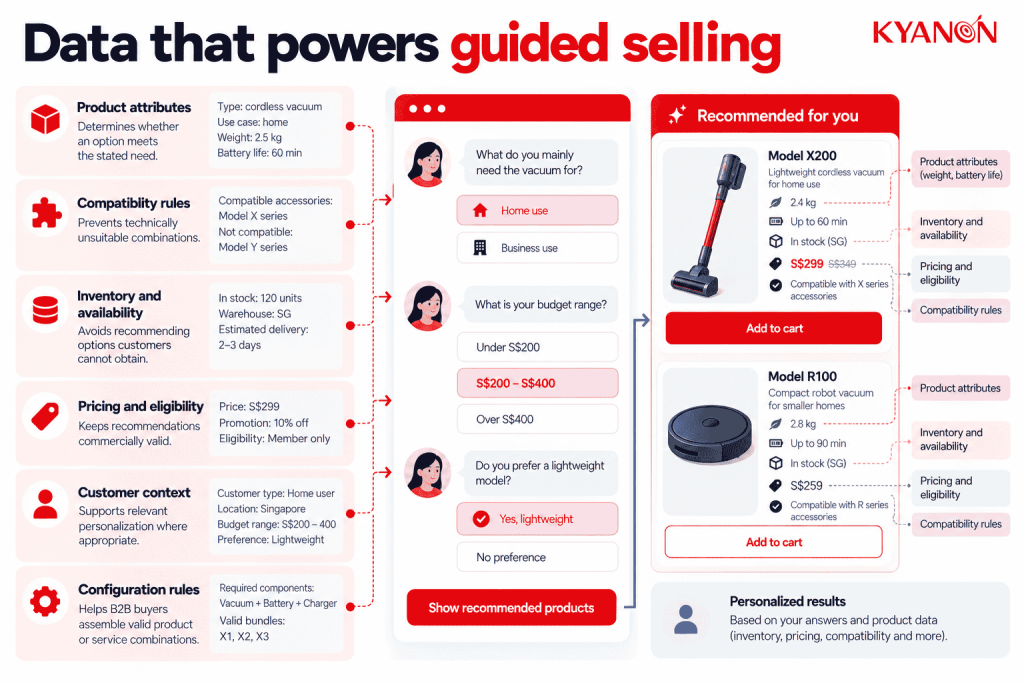
A guided-selling interface is only as dependable as the information behind its recommendations. Before adding AI or a product recommendation quiz, verify that the platform can access the attributes that actually determine product fit.
These may include:
Data | Why it matters |
Product attributes | Determines whether an option meets the stated need |
| Compatibility rules | Prevents technically unsuitable combinations |
| Inventory and availability | Avoids recommending options customers cannot obtain |
Pricing and eligibility | Keeps recommendations commercially valid |
Customer context | Supports relevant personalization where appropriate |
| Configuration rules | Helps B2B buyers assemble valid product or service combinations |
If these inputs are incomplete or inconsistent, improving the conversational interface will not solve the underlying recommendation problem. Product-data quality should therefore be assessed before investing in more sophisticated guided-selling logic.
Guided selling vs. product filtering
Guided selling interprets a customer’s needs; product filtering lets the customer directly select known product attributes.
Dimension | Guided Selling | Product Filtering |
Starting point | Goal, situation, or problem | Known attributes |
Customer knowledge | Can support non-specialists | Assumes familiarity with relevant filters |
| Interaction | Questions and contextual guidance | Facet selection and sorting |
| Output | Explained shortlist or recommendation | Matching product set |
Best use | Complex or unfamiliar decisions | Known-item or specification-led shopping |
How should businesses measure guided selling?
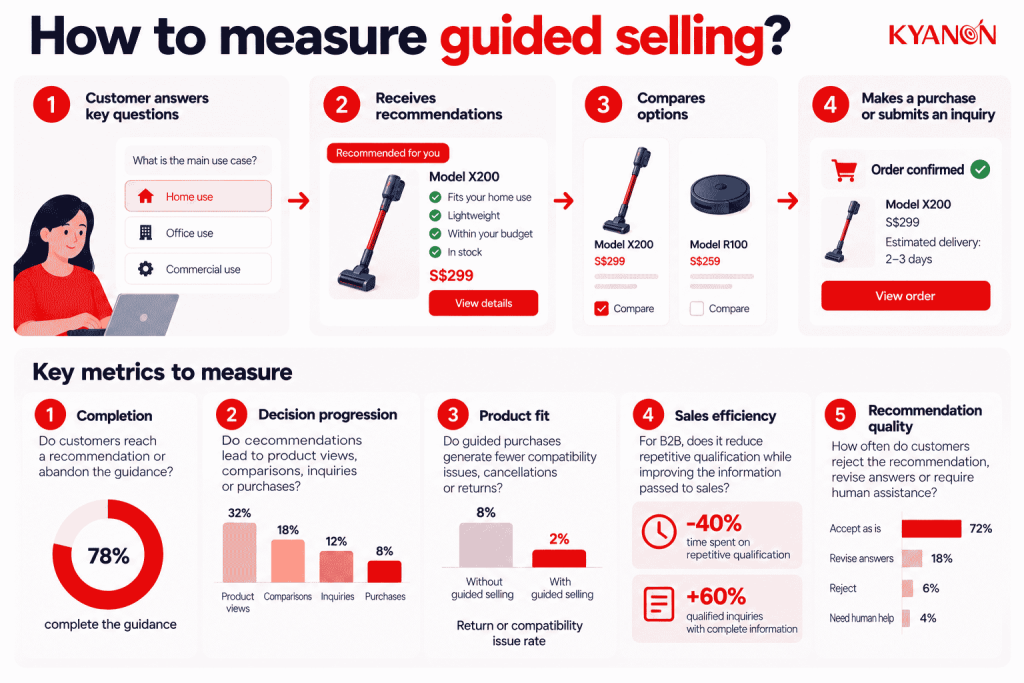
Measure whether guidance improves the quality of the buying decision, not simply whether customers interact with the tool.
Useful signals include:
- Completion: Do customers reach a recommendation or abandon the guidance?
- Decision progression: Do recommendations lead to product views, comparisons, qualified inquiries, or purchases?
- Product fit: Do guided purchases generate fewer compatibility issues, cancellations, or returns?
- Sales efficiency: For B2B guided selling, does the experience reduce repetitive qualification while improving the information passed to sales?
- Recommendation quality: How often do customers reject the recommendation, revise their answers, or require human assistance?
The strongest measurement connects guidance → recommendation → purchase or qualified lead → downstream outcome. A high quiz-completion rate alone does not prove that guided selling is helping customers make better decisions.
When to consider guided selling
Consider guided selling when the following conditions affect customer outcomes or operational control:
- Customers struggle to choose between technically similar products or service packages.
- Sales teams repeatedly ask the same qualification questions before recommending an option.
- Wrong-fit purchases create returns, cancellations, or avoidable support work.
It may not be the right priority if:
Guided selling may add unnecessary effort when customers already know the exact SKU and need a fast search or reorder. Preserve that direct path.
Why guided selling matters for e-commerce and B2B sales
Guided selling becomes valuable when the main conversion problem is not product availability but decision complexity. A large assortment can still create a poor buying experience when customers do not know which attributes matter, which products are compatible, or what trade-offs they are making.
In e-commerce, guidance can translate needs such as intended use, budget, environment, or preferences into a manageable shortlist. In B2B sales, the same approach can capture requirements before a salesperson becomes involved, reducing repetitive qualification and giving the sales team more structured context.
The business case should therefore be evaluated beyond recommendation clicks. Track whether guided customers progress toward suitable purchases or qualified inquiries, whether wrong-fit purchases and support demand decline, and whether sales teams spend less time resolving questions that reliable decision logic could handle.
Case study: How did Kyanon Digital build the data foundation for guided product discovery?

Kyanon Digital helped an iconic Singaporean retailer connect the product, customer, and operational data needed to support more relevant digital shopping journeys.
- Challenges: Disconnected product, customer, inventory, and commerce systems limited product discovery and consistent shopping experiences across channels.
- Solutions: KD integrated PIM, CRM, OMS, WMS, inventory, fulfillment, e-commerce, and mobile systems while improving product discovery and personalized product displays.
- Results & impacts: The retailer gained a more connected foundation for product discovery and personalization across digital and physical journeys.
This was not a standalone guided-selling implementation, but it demonstrates an important prerequisite: guided selling depends on reliable product, customer, and operational data before recommendation logic can effectively match customer needs with suitable options.
Explore Kyanon Digital’s retail transformation for an iconic Singaporean retailer.
Common misconceptions
“We need generative AI to offer guided selling.”
Reality: A structured questionnaire with dependable rules can support many buying decisions. AI is useful only where it improves interpretation or selection within controlled boundaries.
“The highest-margin product should always rank first.”
Reality: A recommendation that ignores suitability can increase returns and undermine trust. Commercial ranking should operate only within the customer’s requirements and applicable eligibility rules.
How Kyanon Digital applies guided selling
Kyanon Digital approaches guided selling as a decision layer connected to the wider commerce architecture. Depending on the buying journey, this can combine needs-based questions, product and compatibility data, recommendation logic, customer context, real-time availability, and salesperson handoff.
Explore Kyanon Digital’s omnichannel e-commerce services.

 Create project brief with AI