
What is human-assisted AI (CX)?
Human-assisted AI (CX) is a customer-service model in which AI performs defined tasks while people supervise, review, or take over interactions that require judgment, authority, or additional care.
How human-assisted AI (CX) works
Human-assisted AI works by defining the boundaries of automated action and preserving continuity when a person becomes involved. Human support can be requested by the customer or triggered by uncertainty, risk, repeated failure, policy, or permissions.
Bounded AI responsibilities
Specify which questions the AI may answer and which actions it may execute. Ground responses in approved information, and check authorization before changing accounts, issuing refunds, or accessing sensitive records.
Escalation and context transfer
Transfer the customer goal, conversation, attempted actions, and relevant records to the appropriate person. The handoff must identify who owns the next step and what the customer can expect.
Human control and feedback
Allow staff to correct the system and review uncertain or consequential decisions. Capture those outcomes for evaluation and content improvement without assuming every agent correction should automatically retrain a model.
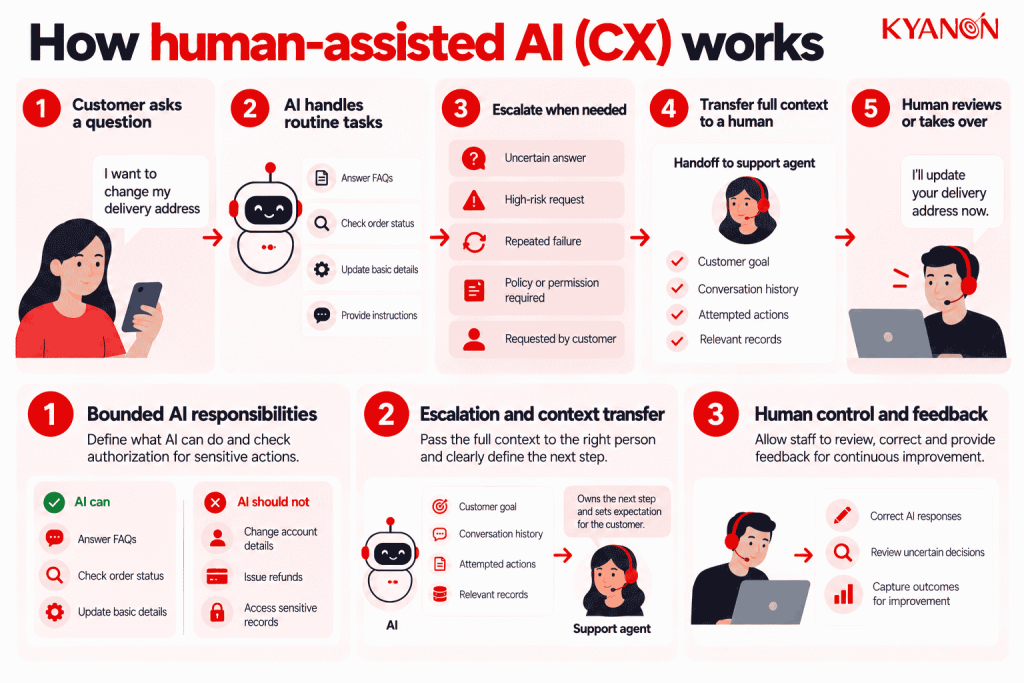

Where does the human participate?
Separate three operating models. In agent assist, AI supports a person who owns the customer interaction. In human-reviewed automation, a person approves selected outputs or actions before execution. In an escalation model, AI handles routine work and transfers exceptions to a person. Human-assisted AI in CX can describe combinations of these models, so specify the arrangement rather than relying on the label.
An illustrative refund flow might let AI retrieve policy and collect order details, while an authorized agent approves an exception. Define who can intervene, what context transfers and what happens when no reviewer is available. Evaluate resolution quality and failed handoffs alongside agent time saved. Human involvement is useful only when the person has the information and authority to act.
When should AI hand off to a human?
Human handoff should be based on defined service and risk conditions rather than waiting until the AI completely fails.
Common triggers include:
| Trigger | Why human involvement may be needed |
Low confidence or insufficient information | AI cannot support a reliable answer or action |
| Repeated failed attempts | Continuing automation adds customer effort |
Policy exception | Resolution requires judgment outside standard rules |
| High-impact action | Refunds, account changes, or other consequential actions may require additional authority |
Sensitive or distressed interaction | The situation requires greater care or contextual judgment |
| Customer requests a person | Automation should not become a barrier to appropriate human support |
Specialist knowledge required | The issue exceeds the approved knowledge or action scope |
The objective is not to minimize escalation. It is to route each interaction to the lowest level of intervention that can resolve it reliably, while escalating early enough to avoid unnecessary customer effort.
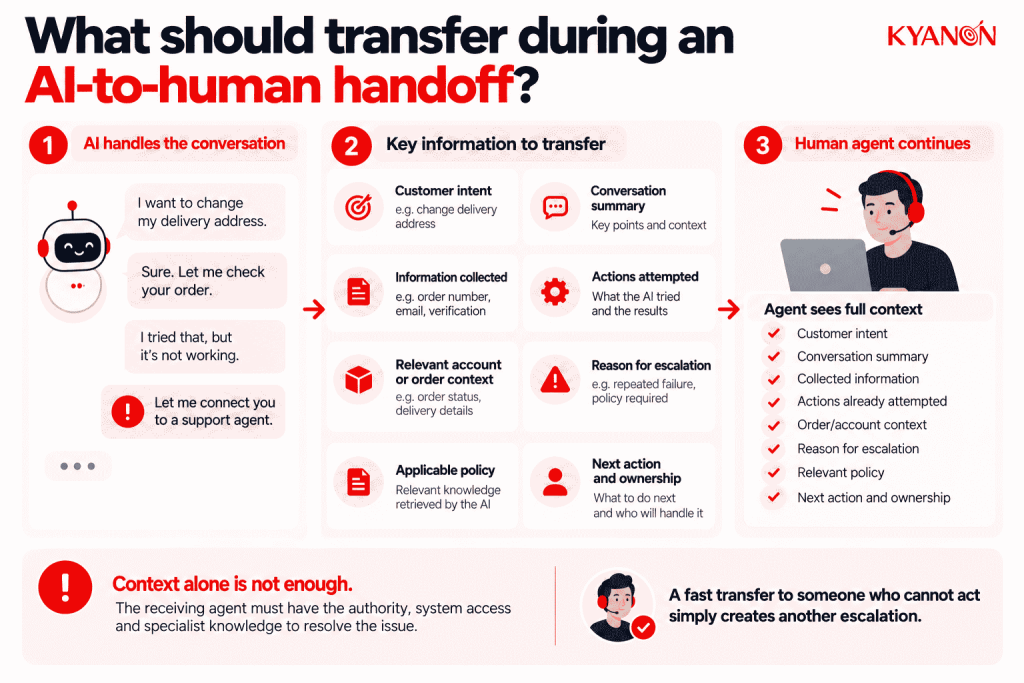
What should transfer during an AI-to-human handoff?
A successful handoff transfers enough context for the human to continue the resolution rather than restart discovery.
Depending on the service workflow, this can include:
- Customer intent and requested outcome
- Conversation history and relevant summary
- Information already collected or verified
- Actions the AI attempted and their results
- Relevant account, order, or case context
- Reason for escalation
- Applicable policy or knowledge retrieved
- Required next action and ownership
Context alone is not enough. The receiving agent must also have the authority, system access, and specialist knowledge required to resolve the issue.
A fast transfer to someone who cannot act simply creates another escalation.
Human-assisted AI (CX) vs. fully automated support
Human-assisted AI explicitly designs for human intervention; fully automated support completes its intended workflow without a human decision within that workflow.
| Dimension | Human-Assisted AI (CX) | Fully Automated Support |
Decision authority | Shared through defined boundaries | Delegated within automated scope |
| Uncertainty handling | Clarify, review, or escalate | Use supported automated fallback or stop |
Service design | Includes human capacity and handoff | Requires a tightly bounded task |
| Primary risk | Poor handoff or overloaded reviewers | Uncorrected errors or unsupported actions |
Success measure | Resolution quality across AI and people | Reliable completion within permitted scope |
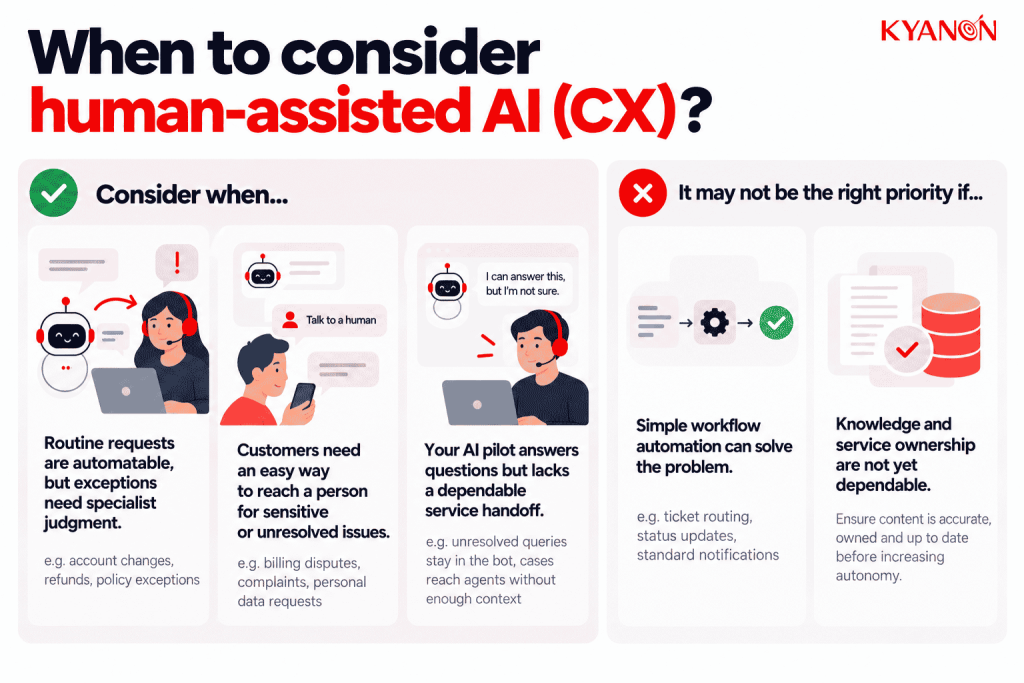
When to consider human-assisted AI (CX)
Consider human-assisted AI (CX) when the following conditions affect customer outcomes or operational control:
- Routine requests are automatable, but exceptions require specialist judgment or approval
- Customers need an accessible route to a person during sensitive or unresolved interactions
- Your AI pilot answers questions but lacks a dependable service handoff
It may not be the right priority if:
A complex AI layer may not be justified when simple workflow automation solves the problem. Establish dependable knowledge and service ownership before increasing autonomy.
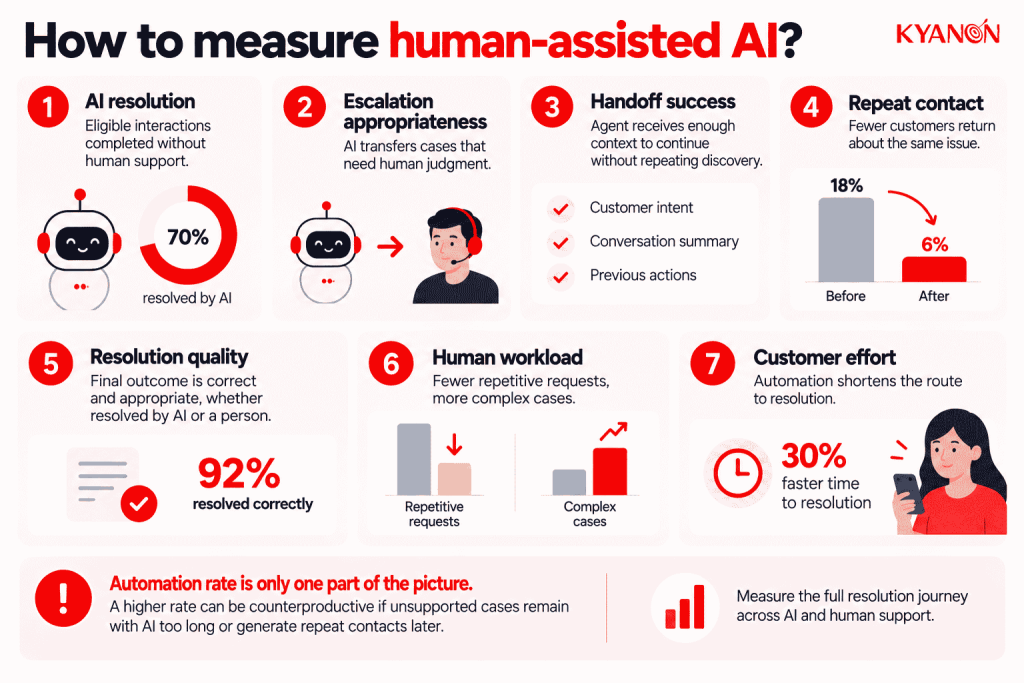
How should businesses measure human-assisted AI?
Measure the complete resolution journey across AI and human support rather than treating automation and agent performance as separate systems.
Useful signals include:
- AI resolution: Which eligible interactions are completed correctly without human intervention?
- Escalation appropriateness: Did AI transfer cases that genuinely required additional judgment or authority?
- Handoff success: Did the receiving agent have enough context to continue without repeating discovery?
- Repeat contact: Did the customer return about the same unresolved issue?
- Resolution quality: Was the final outcome correct and appropriate, regardless of whether AI or a person completed it?
- Human workload: Are agents receiving fewer repetitive requests but more complex cases?
- Customer effort: Does automation shorten the route to resolution or create additional steps before customers reach the right support?
Automation rate should not be optimized in isolation. A higher rate can be counterproductive if unsupported interactions remain with AI too long or generate repeat contacts later.
Why human-assisted AI (CX) matters for customer service
Human-assisted AI allows organizations to automate routine service without making automation a barrier when customers need judgment, authority, or additional care.
That balance increasingly matters as AI takes on more than simple question answering. A 2026 Gartner survey of 3,566 B2B and B2C customers found that 58% of GenAI users had used it to complete a task on their behalf, rising to 74% in B2B. At the same time, 87% said companies using GenAI for customer service must provide an option to reach a human agent.
The operating model must therefore answer two questions at once: What can AI resolve safely and efficiently? And when does a person need to take control?
The goal is not maximum automation. It is reliable resolution across AI and human support, with each interaction handled at the appropriate level of judgment and authority.
Case study: How did Kyanon Digital combine AI assistance with human review and escalation?
Explore Kyanon Digital’s AI-powered LegalTech platform case study.
For a legal tech platform, Kyanon Digital developed an AI-powered experience using Retrieval-Augmented Generation (RAG) and a curated legal knowledge base to support information retrieval, guided Q&A, and document workflows.
- Challenges: Provide fast AI-assisted legal information and document support while operating in a domain where complex or consequential cases may require additional verification or expert involvement.
- Solutions: Built a domain-specific AI chatbot, multi-step Q&A, AI-assisted document drafting and verification, continuous monitoring, and tiered escalation pathways supporting expert intervention.
- Results & impacts: Created a service model that combines AI-powered assistance with structured review and escalation rather than relying on unrestricted automation for every interaction.
Effective human-assisted AI does not simply place a person behind an automated experience. It defines where AI acts, where human authority begins, what context transfers between them, and how the complete resolution journey is measured.
Common misconceptions
“A human escalation means the AI failed.”
Reality: Escalation can be the correct outcome when a request exceeds the AI’s approved scope, confidence, or decision authority. Measure whether the case was routed at the right time and whether the handoff contributed to successful resolution, rather than treating every escalation as automation failure.
“Putting a person in the loop makes every AI action safe.”
Reality: Human review only adds control when reviewers have sufficient context, time, expertise, and authority to challenge or correct the AI. A mandatory approval step can become a rubber stamp if reviewers cannot meaningfully evaluate the proposed action.
“A higher automation rate means the AI is performing better.”
Reality: Automation rate measures how much work remains with AI, not whether customers receive the right outcome. Increasing automation can be counterproductive if complex cases stay with AI too long, handoffs occur late, or customers return because the original issue was not resolved.
How Kyanon Digital applies human-assisted AI (CX)
Kyanon Digital designs AI-assisted service workflows that define what automation can handle, when human judgment or approval is required, and what context should move with the interaction. The architecture can connect AI, trusted knowledge, business systems, agent tools, monitoring, and escalation rules so automation operates within defined service boundaries.
Explore Kyanon Digital’s AI integration services.

 Create project brief with AI