
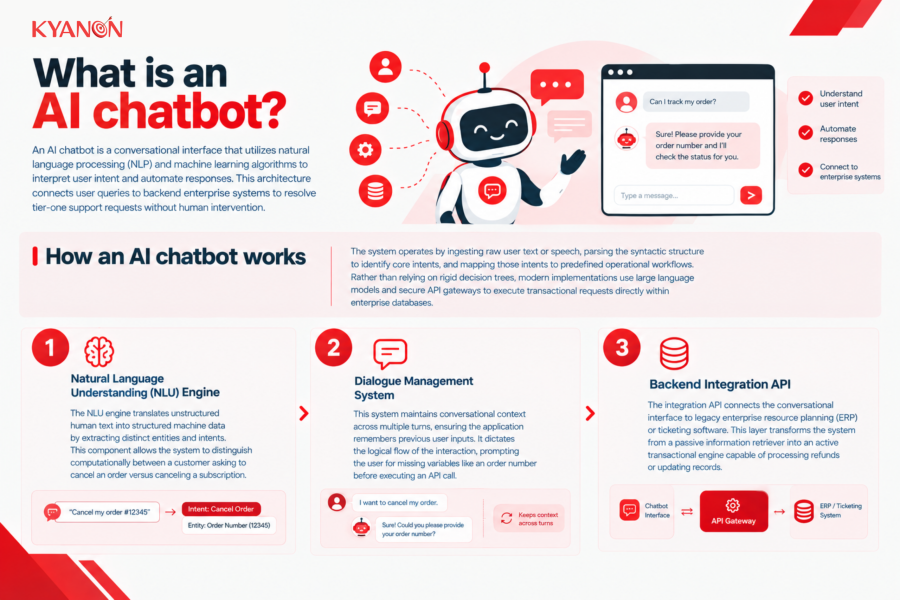
What is an AI chatbot?
An AI chatbot is a conversational interface that utilizes natural language processing (NLP) and machine learning algorithms to interpret user intent and automate responses. This architecture connects user queries to backend enterprise systems to resolve tier-one support requests without human intervention.
How an AI chatbot works
The system operates by ingesting raw user text or speech, parsing the syntactic structure to identify core intents, and mapping those intents to predefined operational workflows. Rather than relying on rigid decision trees, modern implementations use large language models and secure API gateways to execute transactional requests directly within enterprise databases.
Natural Language Understanding (NLU) Engine
The NLU engine translates unstructured human text into structured machine data by extracting distinct entities and intents. This component allows the system to distinguish computationally between a customer asking to cancel an order versus canceling a subscription.
Dialogue Management System
This system maintains conversational context across multiple turns, ensuring the application remembers previous user inputs. It dictates the logical flow of the interaction, prompting the user for missing variables like an order number before executing an API call.
Backend Integration API
The integration API connects the conversational interface to legacy enterprise resource planning (ERP) or ticketing software. This layer transforms the system from a passive information retriever into an active transactional engine capable of processing refunds or updating records.

AI chatbot vs Rules-Based Bot
Both approaches handle automated customer interactions, but differ entirely in routing logic and backend execution.
Dimension | AI chatbot | Rules-Based Bot |
| Routing logic | Probabilistic (Machine Learning) | Deterministic (Decision Trees) |
Upfront complexity | High (Training data & API mapping) | Low (Simple script building) |
| Context retention | Multi-turn conversational memory | Single-turn static memory |
Best for | Complex tier-one transactional support | Basic FAQ deflection |
| Maintenance model | Continuous reinforcement tuning | Static script updates |
When to consider an AI chatbot
Consider an AI chatbot if:
- Your contact center experiences high abandonment rates due to an overwhelming volume of repetitive, low-complexity queries regarding order status or password resets.
- You plan to scale operational hours to 24/7 support across multiple time zones without drastically increasing human headcount.
- Your customer support data shows users frequently drop off when forced to navigate rigid, multi-layered interactive voice response (IVR) menus.
It may not be the right priority if:
- Your service model handles strictly high-emotion, complex tier-three technical escalations where compliance mandates require immediate human mediation.
Why an AI chatbot matters for enterprise retail & banking
Relying entirely on human agents for repetitive transactional requests inflates operational expenditure (OpEx) and restricts scalability during seasonal demand spikes. Deploying automated conversational architecture reduces total cost of ownership (TCO) for contact centers while accelerating response times for standard inquiries.
AI can handle high-volume, repetitive interactions such as account inquiries, order or transaction status, FAQs, and basic troubleshooting, allowing human agents to focus on complex or high-value cases. McKinsey’s 2026 research on banking customer care found that well-integrated AI initiatives can reduce call volumes by 25–40%, average handling time by 10–20%, and quality assurance costs by 20–30%.
Common misconceptions
Once we connect the model to our knowledge base, we can set it and forget it
Reality: AI models suffer from data drift as product lines evolve and promotions expire. Without continuous human tuning and regular knowledge-base updates, a bot’s accuracy degrades rapidly over time.
Because the LLM speaks articulately and politely, the information it provides must be factual
Reality: Large language models predict statistically probable words rather than verifying absolute truth. Without strict guardrails, they are highly prone to hallucinations, frequently fabricating pricing policies or promising unauthorized discounts.
We can use this to completely eliminate our human contact center agents and cut costs
Reality: Deflecting 100% of calls to a machine results in catastrophic customer satisfaction drops. Successful deployments change the nature of human work by filtering out repetitive queries, leaving human agents to handle highly emotional or complex escalations.
This tool will instantly execute complex backend tasks right out of the box
Reality: A conversational interface holds limited value without secure, complex API integrations into legacy CRMs and ticketing infrastructure. System integrations dictate whether the architecture can actually process a refund or update a billing address.
How Kyanon Digital Applies AI chatbot
Kyanon Digital delivers enterprise ai chatbot solutions for clients in banking, retail, and ecommerce, focusing on reducing contact center volume and enabling 24/7 self-service. We engineer secure API pipelines that connect conversational interfaces directly to legacy enterprise databases for clients across Vietnam, Singapore, Thailand, ANZ, and Malaysia. Our implementation teams prioritize deep backend integration over surface-level fluency, ensuring your automated systems execute complex transactions while lowering overall TCO.
Explore our AI services:

 Create project brief with AI