
What is Image Classification?
Image classification is a computer vision technique where a machine learning model analyzes an entire visual input and assigns it a specific category label based on mathematical pixel patterns. This process translates unstructured image data into structured, actionable classifications for automated decision-making.
How Image Classification Works
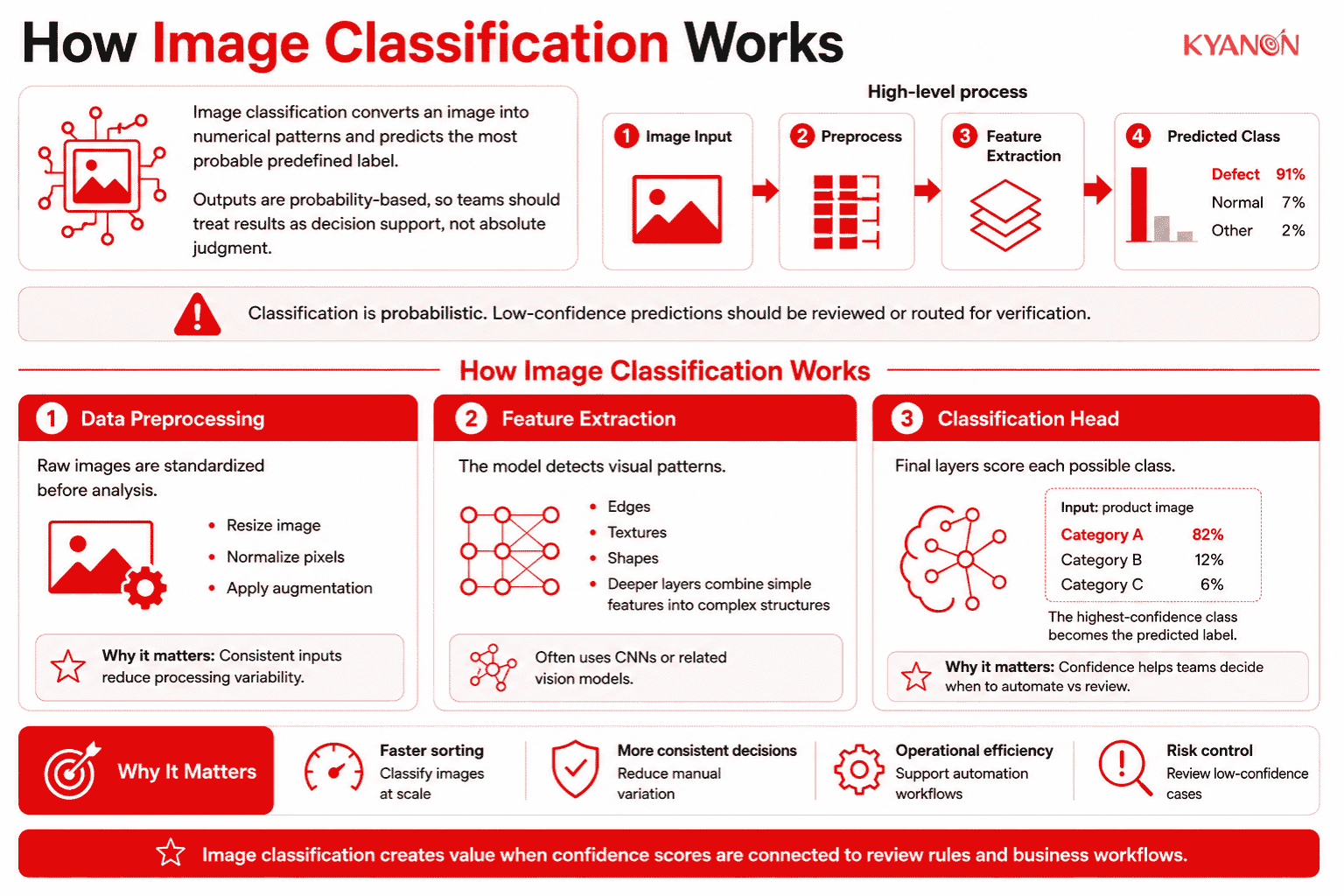
An image classification model works by converting an image into numerical data, extracting visual features, and calculating which predefined label is most probable. The model’s output is a confidence score for each possible class, so business teams should treat classification as probability-based decision support rather than absolute visual judgment.
Data Preprocessing
The system standardizes raw visual inputs by resizing them, normalizing pixel values, and applying augmentations. This ensures the neural network evaluates consistent mathematical formats, reducing processing variability.
Feature Extraction
Using architectures like Convolutional Neural Networks (CNNs), the model applies mathematical filters to identify elemental patterns, such as edges and textures. These lower-level features are progressively combined in deeper layers to recognize complex visual structures.
Classification Head
The final layers of the network flatten the extracted features and generate a mathematical probability distribution across all possible categories. The system selects the category with the highest confidence score as the definitive label for the image.
Types of Image Classification
Image classification can be structured as binary, multiclass, multilabel, or hierarchical classification depending on how many labels the model can assign and how the categories are organized. The right classification type depends on the business workflow, label structure, and level of decision granularity required.
Binary Classification
Binary classification categorizes an image into one of two possible classes. For example, a manufacturing classifier may label an image as “Defective” or “Not Defective,” while a document classifier may label a file as “Invoice” or “Not Invoice.”
Multiclass Classification
Multiclass classification assigns an image to one category from several mutually exclusive options. For example, a retail model may classify a product image as “Dog Food,” “Cat Food,” or “Bird Feed,” but only one final category is selected.
Multilabel Classification
Multilabel classification allows one image to receive multiple labels at the same time. For example, an eCommerce image may be tagged as “Outdoor,” “Waterproof,” and “Running Shoes” if those attributes are all visible or relevant.
Hierarchical Classification
Hierarchical classification organizes labels into parent-child category levels. For example, a product image may first be classified as “Apparel,” then “Footwear,” then “Sneakers,” allowing businesses to support layered catalog structures.
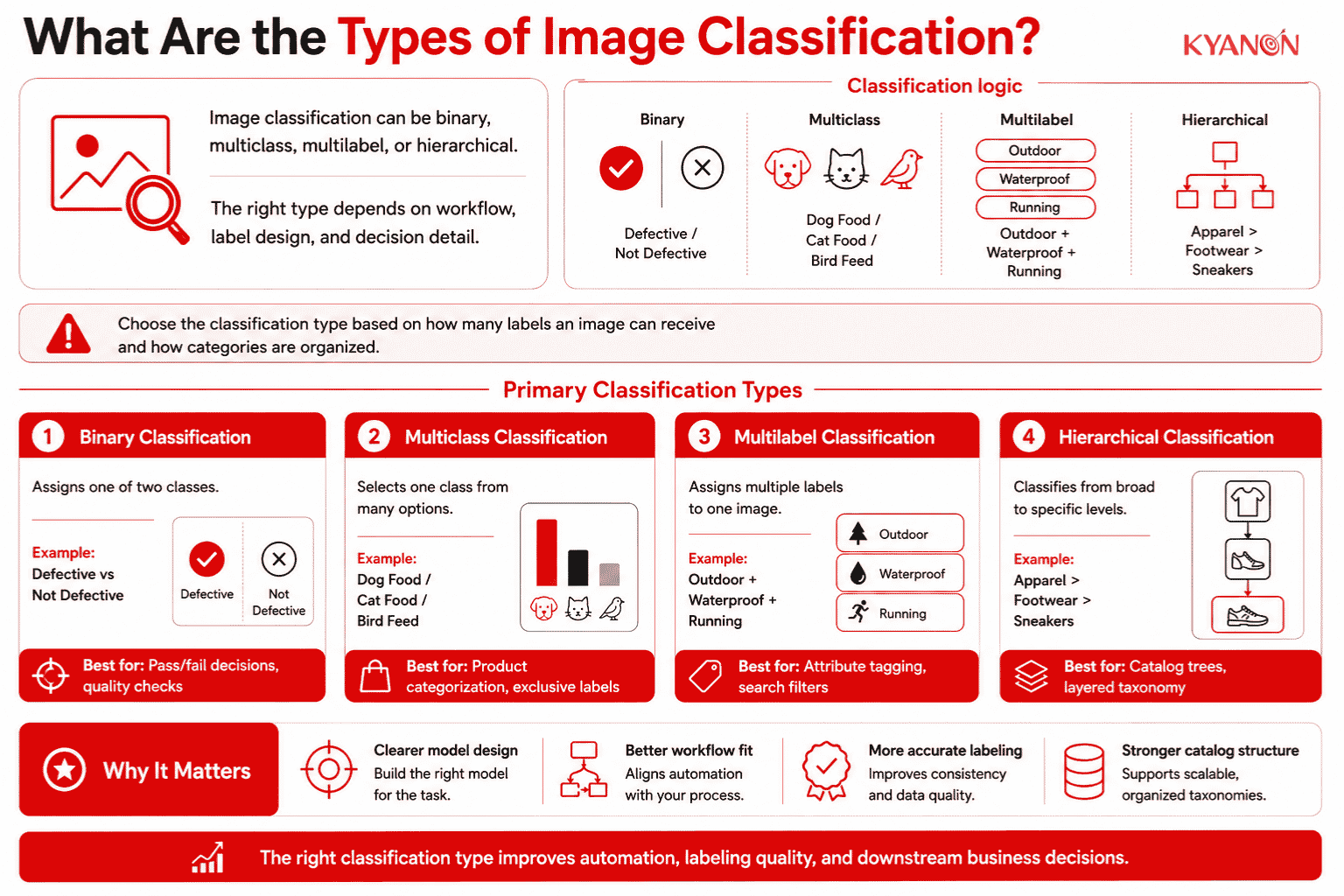

Image Classification vs Object Detection
Both approaches analyze visual data to identify elements, but they differ fundamentally in whether they categorize the entire scene or locate specific items within it.
Dimension | Image Classification | Object Detection |
Core function | Categorizes the entire image with a single label | Locates and labels multiple distinct items within an image |
| Output type | Probability score and category label | Bounding boxes and category labels |
Computational cost | Lower | Higher |
| Best for | Document sorting, basic quality grading | Inventory tracking, autonomous navigation |
Upfront complexity | Low | High |
When to Consider Image Classification
Image classification is relevant when a business needs to turn large volumes of visual data into structured categories for routing, quality control, search, or workflow automation. It is most useful when the visual decision is repeatable, label-based, and tied to a measurable operational outcome.
Consider image classification if:
- Your retail team manages large product catalogs and needs faster product categorization across SKUs, marketplaces, or content systems.
- Your manufacturing team needs to classify product images into acceptable, defective, or review-required categories before items move further downstream.
- Your logistics or back-office team receives high document volumes and needs to identify document types such as invoices, delivery notes, customs forms, or proof-of-delivery images.
It may not be the right priority if:
- Your business problem requires locating multiple objects, counting items, or measuring object positions inside the image. In that case, object detection or image segmentation may be a better fit.
- Your image data is inconsistent, unlabeled, or too narrow to represent real operating conditions. A classifier trained only on clean sample images can underperform when exposed to dark, blurry, cropped, or unusual-angle images.
Why Image Classification Matters for Retail, Manufacturing, and Logistics
Image classification matters because it converts unstructured visual inputs into machine-readable categories that enterprise systems can use for automation, routing, and decision support. In retail, manufacturing, and logistics, this can reduce manual review effort, improve process consistency, and shorten the time between image capture and operational action.
According to NVIDIA’s 2026 State of AI in Retail and CPG survey, nine in 10 retailers plan to increase AI budgets in 2026, showing that computer vision and AI-enabled operations are moving from experimentation into budgeted enterprise programs.
A regional retailer can use image classification to map supplier product images into catalog categories before publishing them across eCommerce channels. A manufacturer can classify inspection images into defect classes before quality engineers review exceptions, while a logistics operator can classify uploaded documents before routing them to the correct workflow queue.
Real-World Applications of Image Classification
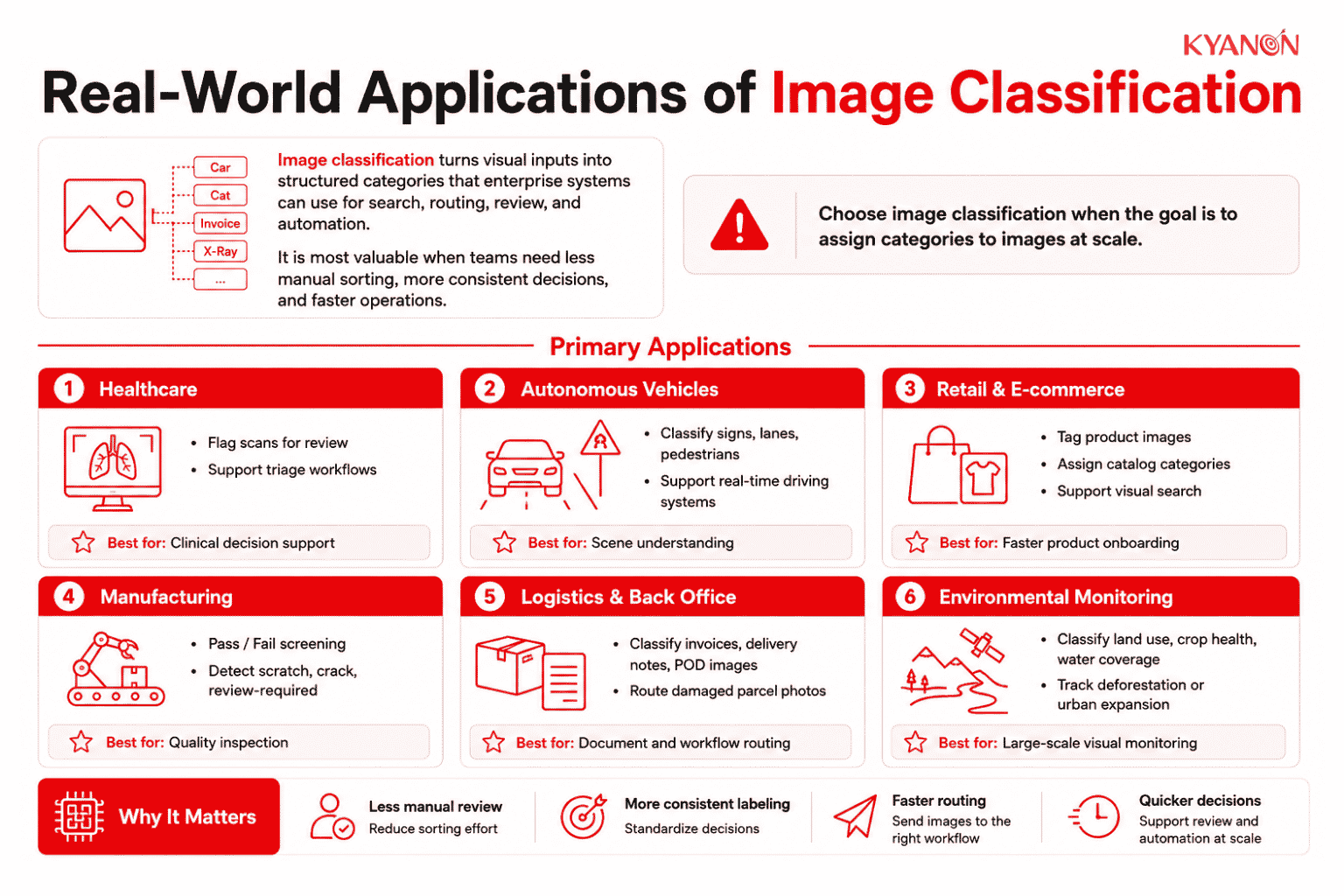
Image classification is most valuable when visual inputs need to be converted into structured categories that enterprise systems can use for search, routing, review, or automation. In B2B environments, the strongest use cases are usually tied to reducing manual classification work, improving process consistency, or accelerating operational decisions.
Healthcare
Image classification can support medical imaging workflows by flagging scans that may require further review. It should be treated as clinical decision support rather than a replacement for medical professionals, especially when false negatives or false positives carry high risk.
Autonomous Vehicles
Image classification helps autonomous systems categorize visual inputs such as traffic signs, lanes, pedestrians, vehicles, and road conditions. In this context, classification must be combined with object detection, sensor fusion, and real-time decision systems because category labels alone are not enough for safe navigation.
Retail & E-commerce
Image classification can automatically tag product images, assign catalog categories, support visual search, and route product content for review. For eCommerce teams, this can shorten product onboarding time and improve category consistency across marketplaces, websites, and internal product information systems.
Manufacturing
Image classification can classify inspection images into categories such as “Pass,” “Fail,” “Scratch,” “Crack,” or “Review Required.” For manufacturers, the business value comes from faster quality screening, more consistent inspection workflows, and earlier detection of recurring defect patterns.
Logistics and Back Office Operations
Image classification can identify document types such as invoices, delivery notes, customs forms, proof-of-delivery images, and damaged parcel photos. For logistics teams, this helps route documents to the right workflow and reduce manual sorting effort.
Environmental Monitoring
Image classification can analyze satellite or drone imagery to categorize land use, crop health, deforestation patterns, water coverage, or urban expansion. These applications are useful when organizations need to monitor large visual datasets that would be costly to review manually.
Common Misconceptions
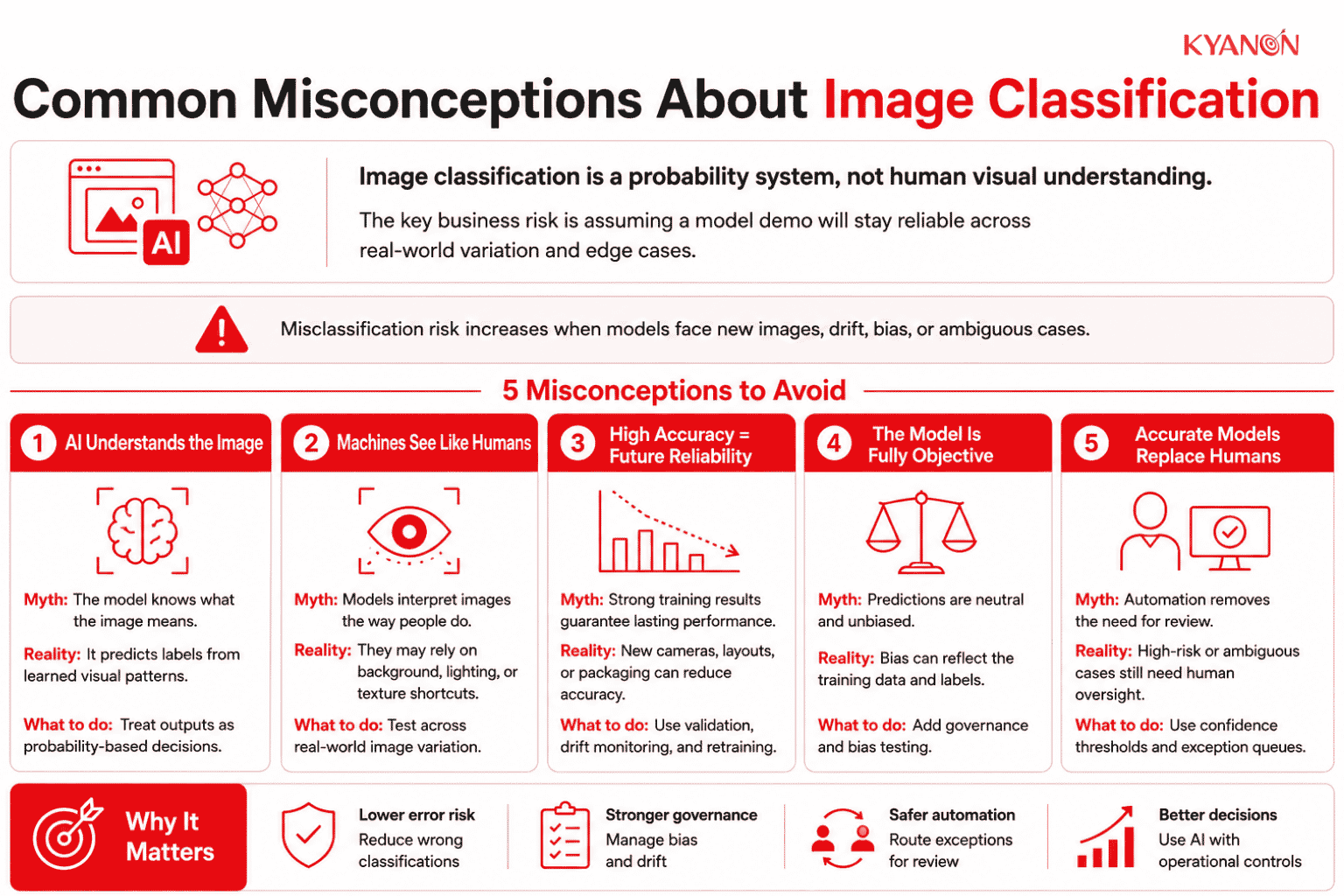
A high-performing image classification model is still a probability system, not a human visual understanding system. For CTOs and IT leaders, the practical risk is not whether the model looks intelligent in a demo, but whether it remains reliable under real-world image variation, new data, and edge cases.
“The AI actually understands the image.”
Reality: An image classifier does not know what a product, defect, invoice, dog, or tree is in the human sense. It converts visual inputs into numbers and predicts the most likely label based on statistical patterns learned from past examples.
“Machines perceive images the same way humans do.”
Reality: Image classification models may rely on background, texture, lighting, or shortcuts that humans would ignore. A model may classify an image incorrectly if it learned the wrong correlation, such as associating snow with “wolf” instead of learning the animal’s actual visual features.
“High training accuracy means the model will perform perfectly forever.”
Reality: Training accuracy does not guarantee future performance when the model sees new cameras, lighting conditions, packaging designs, document layouts, or product angles. Image classification systems need validation datasets, drift monitoring, retraining plans, and confidence thresholds before they can support enterprise workflows.
“The model is completely objective and unbiased.”
Reality: Image classifiers reflect the data used to train them. NIST’s 2019 face recognition evaluation found that false positive rates varied by factors of 10 to 100 across demographic groups for some algorithms, showing why enterprise vision systems require bias testing and governance when people-related images are involved.
“If the model is accurate, it can replace humans entirely.”
Reality: Image classification can automate repetitive visual sorting, but it should not replace human judgment in high-risk or ambiguous cases. A practical enterprise design uses confidence thresholds, exception queues, and human-in-the-loop review for cases where the cost of a false decision is high.
How Kyanon Digital Applies Image Classification
Kyanon Digital builds image classification models for enterprise use cases where visual data must be translated into operational decisions, such as retail product categorization, manufacturing defect detection, and logistics document type identification. ` implementation approach typically covers data preparation, model training, workflow integration, confidence threshold design, exception handling, and performance monitoring across markets such as Vietnam, Singapore, Malaysia, Thailand, ANZ, the US, and Nordic Europe.
→ Explore our Computer Vision services.

 Create project brief with AI