
What is object detection?
Object Detection is a computer vision technique that uses neural networks to both identify what objects are present in an image and determine where they are located. Unlike image classification, which assigns a single label to an entire image, object detection simultaneously performs object localization and classification by drawing bounding boxes around individual objects and assigning them semantic categories such as people, vehicles, animals, or products. This enables AI systems to understand both the type and position of multiple objects within a scene, making object detection a foundational capability for applications such as autonomous vehicles, medical imaging, surveillance, and retail analytics. (IBM)
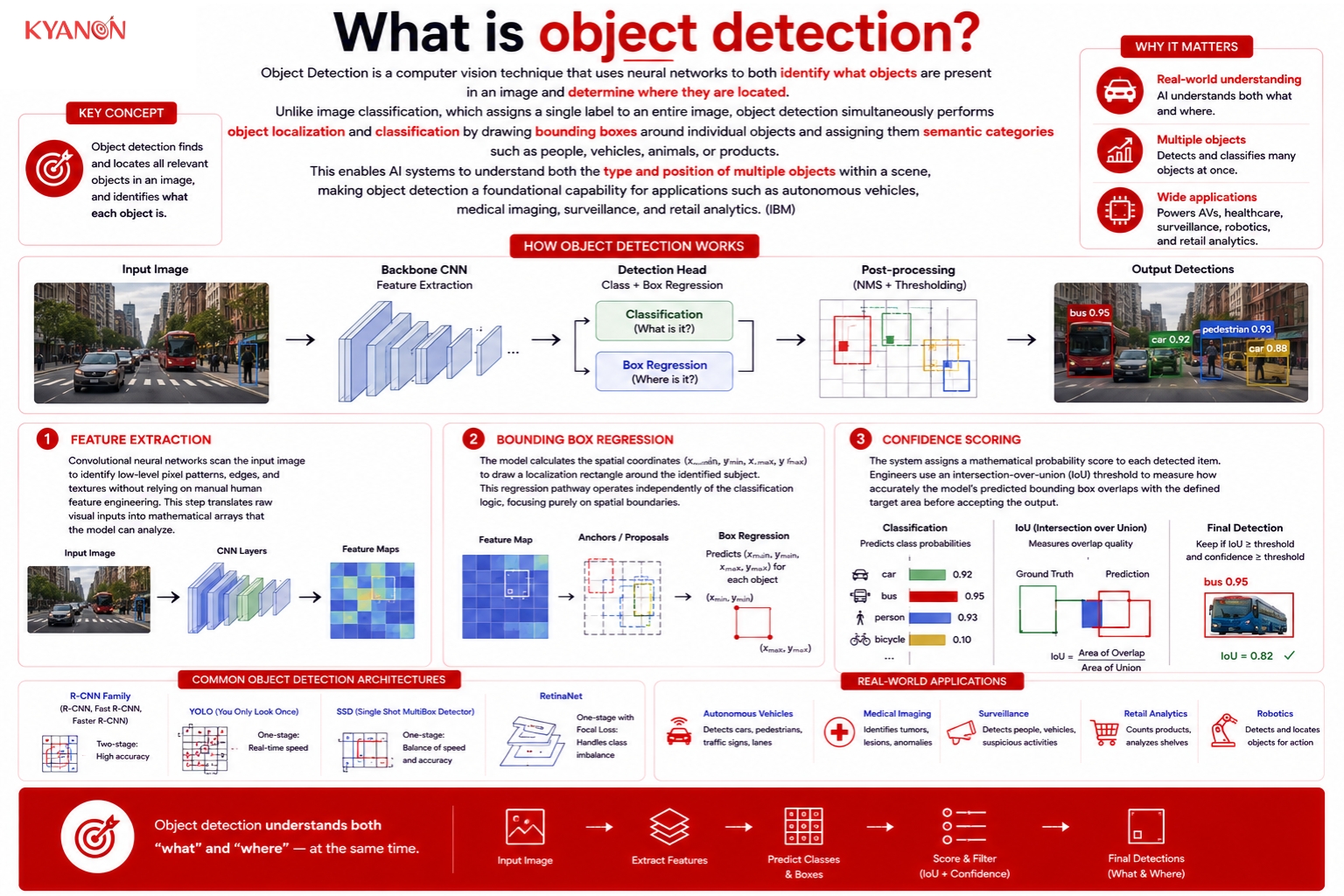
How object detection works
Object detection architectures process visual data by running parallel algorithmic pathways to classify pixel clusters and execute bounding box regression independently. The underlying mathematical logic separates the probability of an item’s existence from the physical coordinates of its boundaries.
Feature Extraction
Convolutional neural networks scan the input image to identify low-level pixel patterns, edges, and textures without relying on manual human feature engineering. This step translates raw visual inputs into mathematical arrays that the model can analyze.
Bounding Box Regression
The model calculates the spatial coordinates (x_min, y_min, x_max, y_max) to draw a localization rectangle around the identified subject. This regression pathway operates independently of the classification logic, focusing purely on spatial boundaries.
Confidence Scoring
The system assigns a mathematical probability score to each detected item. Engineers use an intersection-over-union threshold to measure how accurately the model’s predicted bounding box overlaps with the defined target area before accepting the output.

Common real-world use cases of object detection
- Autonomous Driving: Instantly mapping out pedestrians, lane markings, traffic signs, and surrounding vehicles to calculate safe navigation paths.
- Retail and Logistics: Monitoring automated assembly lines to count manufacturing inventory, detect defective products, or enable cashierless checkout systems.
- Security & Surveillance: Scanning live CCTV feeds to detect unauthorized intrusions, count crowds, or track suspicious unattended baggage in airports.
Object Detection vs Image Classification
While image classification algorithms assign a single label to an entire picture, object detection localizes and classifies multiple distinct entities within the same visual frame.
Dimension | Object Detection | Image Classification |
| Primary Output | Multiple bounding boxes and labels | Single global category label |
Spatial Awareness | Exact pixel coordinates provided | No location data generated |
| Multi-Subject Capability | Tracks numerous items simultaneously | Limited to one dominant subject |
Algorithmic Complexity | High (regression plus classification) | Moderate (classification only) |
| Enterprise Use Case | Assembly line defect tracking | Medical scan categorization |
When to consider object detection
Engineering teams should implement object detection when operational workflows require precise spatial tracking of physical assets within unstructured visual environments.
Consider object detection if:
- Your manufacturing process requires automated defect localization on moving assembly lines.
- Your retail operations demand real-time inventory tracking and gap analysis across physical store shelves.
- Your logistics centers need to verify package dimensions and barcode placement simultaneously.
It may not be the right priority if:
- Your application only requires identifying the primary subject of a user-uploaded photo without mapping its spatial coordinates.
Why object detection matters for enterprise operations
Object detection matters for enterprise operations because it converts raw, unstructured video and image data into automated, real-time business intelligence. Instead of relying on manual human monitoring, which is slow, expensive, and prone to fatigue, enterprises use object detection to automate quality control, enforce workplace safety, and optimize supply chains at scale.
Common misconceptions
Technical leadership often miscalculates the operational requirements of computer vision models, assuming high algorithmic complexity automatically resolves real-world edge cases.
Deploying the heaviest, most complex model guarantees the highest detection accuracy for our operations
Reality: Stacking deeper neural network layers often creates unacceptable processing latency without meaningfully improving bounding box placement. In live deployment environments like logistics sorting, real-time inference speed is mandatory. Single-stage architectures intentionally trade a fractional percentage of pixel-perfect accuracy to achieve the massive processing speed boosts required for production timelines.
If we miss labeling a few items in our training data, the model will just ignore them
Reality: Incomplete annotations actively corrupt the algorithm by forcing the model to treat unlabeled targets as negative examples. If your QA team labels three out of five defects in a training image, the architecture mathematically penalizes itself for detecting the remaining two, permanently degrading its reliability in production due to human data error.
How Kyanon Digital applies object detection
Kyanon Digital engineers object detection architectures to automate physical verification processes across the manufacturing, retail, and logistics sectors. We implement specialized single-stage models, utilizing architectures like YOLO, for enterprise clients across Southeast Asia, ANZ, and the US. Our data engineering teams develop complete MLOps pipelines tailored for high-speed manufacturing quality control, retail shelf analytics, and logistics package verification. By optimizing intersection-over-union thresholds and inference latency, our solutions achieve measurable outcomes, reducing total cost of ownership and accelerating time-to-market for automated visual inspection systems.
Explore our AI services:

 Create project brief with AI