
What is Image Recognition?
Image recognition is a computer vision technique that uses machine learning models to identify, classify, and extract objects, features, or patterns from digital images and video frames. This technology translates visual inputs into mathematical data arrays, allowing systems to assign predefined labels to visual content based on learned pixel configurations.
How Image Recognition Works
Image recognition works by converting image pixels into numerical patterns, then using trained AI models to compare those patterns with learned visual features. A production-grade image recognition system usually requires image capture, preprocessing, model inference, confidence scoring, exception handling, and human review for low-confidence or high-risk decisions.
Image Input and Preprocessing
Image input comes from cameras, scanners, mobile devices, CCTV systems, warehouse gates, or uploaded files. Preprocessing standardizes image size, lighting, orientation, noise, and format so the model receives more consistent visual data.
Feature Extraction and Model Inference
Feature extraction identifies visual signals such as edges, shapes, textures, colors, defects, labels, packaging marks, or object boundaries. Model inference compares these signals against learned patterns and returns a prediction, such as product category, defect type, package status, or object presence.
Confidence Scoring and Human Review
Confidence scoring indicates how certain the system is about a prediction, but it is not the same as business certainty. In operational use cases, low-confidence results should be routed to human review, business rules, or exception workflows before action is taken.
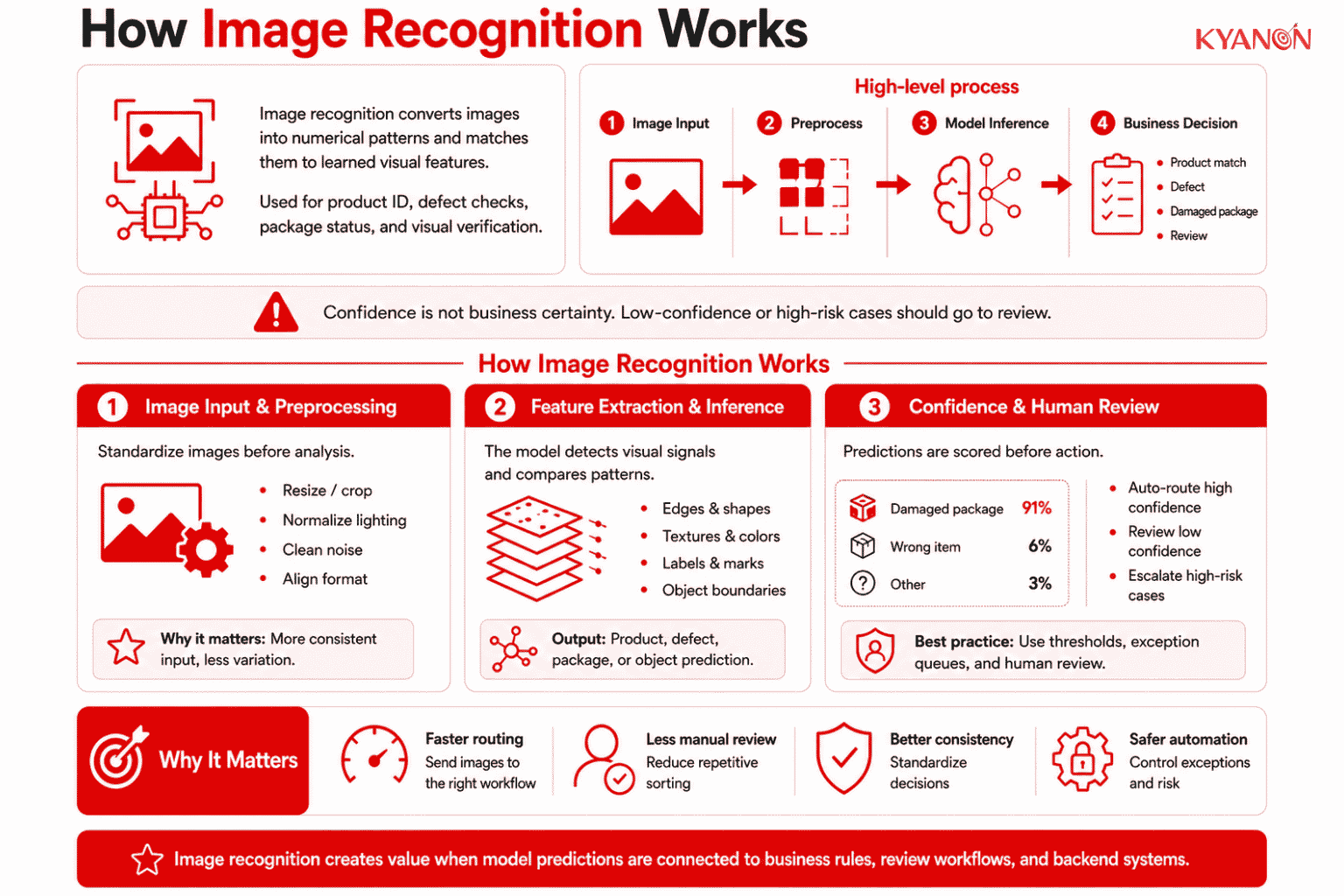

Image Recognition vs Facial Recognition
Both technologies process visual data, but image recognition classifies general objects while facial recognition maps specific human biometric points to verify identity.
Dimension | Image Recognition | Facial Recognition |
Primary question answered | “What is this object?” | “Whose face is this?” |
| Core mechanism | Analyzes learned visual features such as edges, shapes, textures, labels, and object patterns. | Maps unique biometric nodal points |
Regulatory scrutiny | Moderate | High |
| Typical business outcome | Automated inventory tracking / QA | Security access / Identity verification |
Human-in-the-loop requirement | Highly recommended | Mandatory for investigative applications |
When to Consider Image Recognition
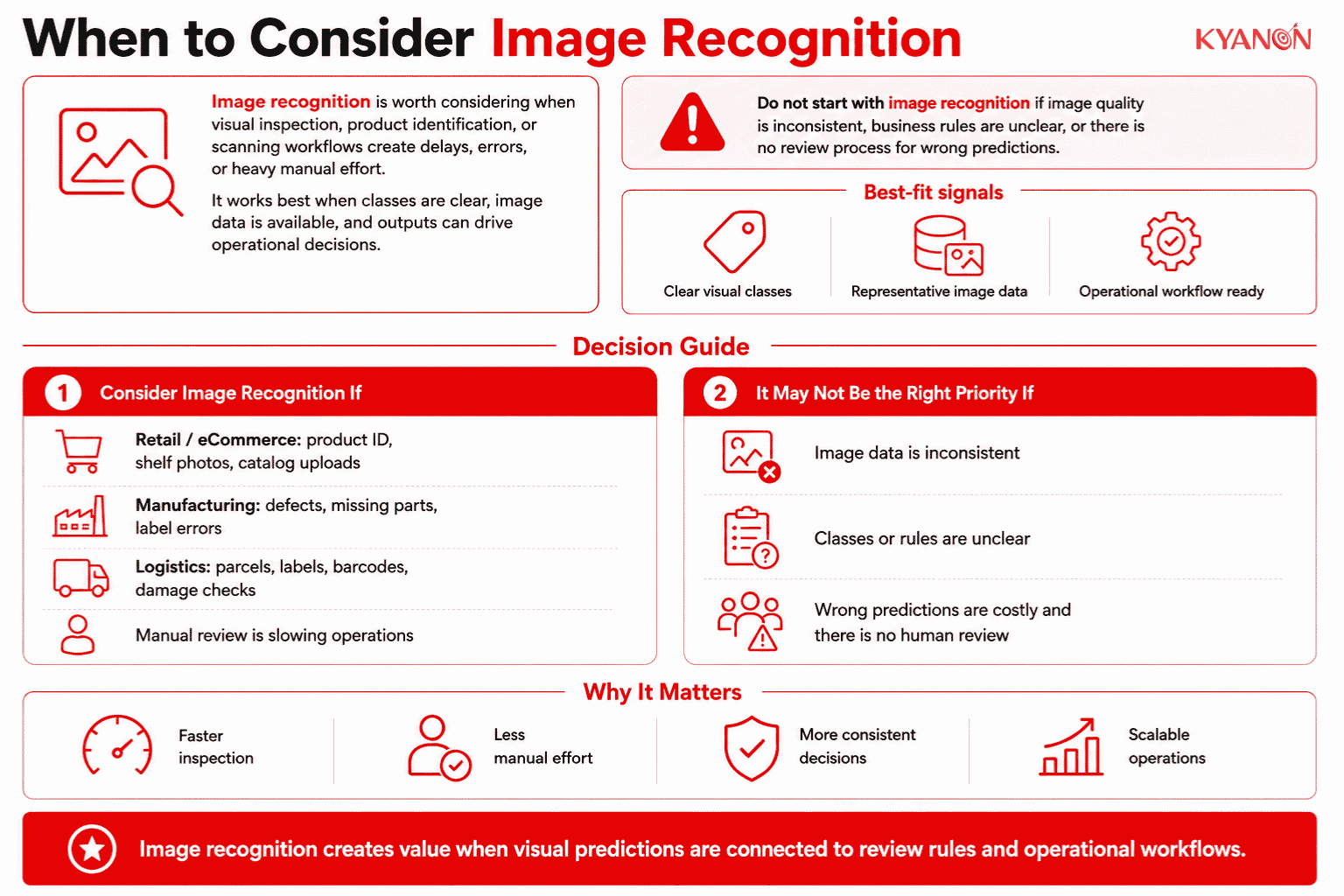
Image recognition is worth considering when visual inspection, product identification, or scanning workflows create measurable delays, error rates, or labor dependency. It is most relevant when the business can define clear classes, collect representative image data, and connect model outputs to operational decisions.
Consider image recognition if:
- Your retail or eCommerce team needs to identify products from images, shelf photos, packaging, or catalog uploads to improve product tagging, search relevance, or catalog quality.
- Your manufacturing team needs to detect surface defects, missing parts, incorrect assembly, label errors, or quality deviations faster than manual inspection can scale.
- Your logistics team needs to scan parcels, labels, barcodes, damaged packages, or loading conditions across the warehouse, sorting, and last-mile workflows.
It may not be the right priority if:
- Your visual data is too inconsistent, your business rules are unclear, or the cost of a wrong prediction is high but there is no human review process in place.
Why Image Recognition Matters for Retail, Manufacturing, and Logistics
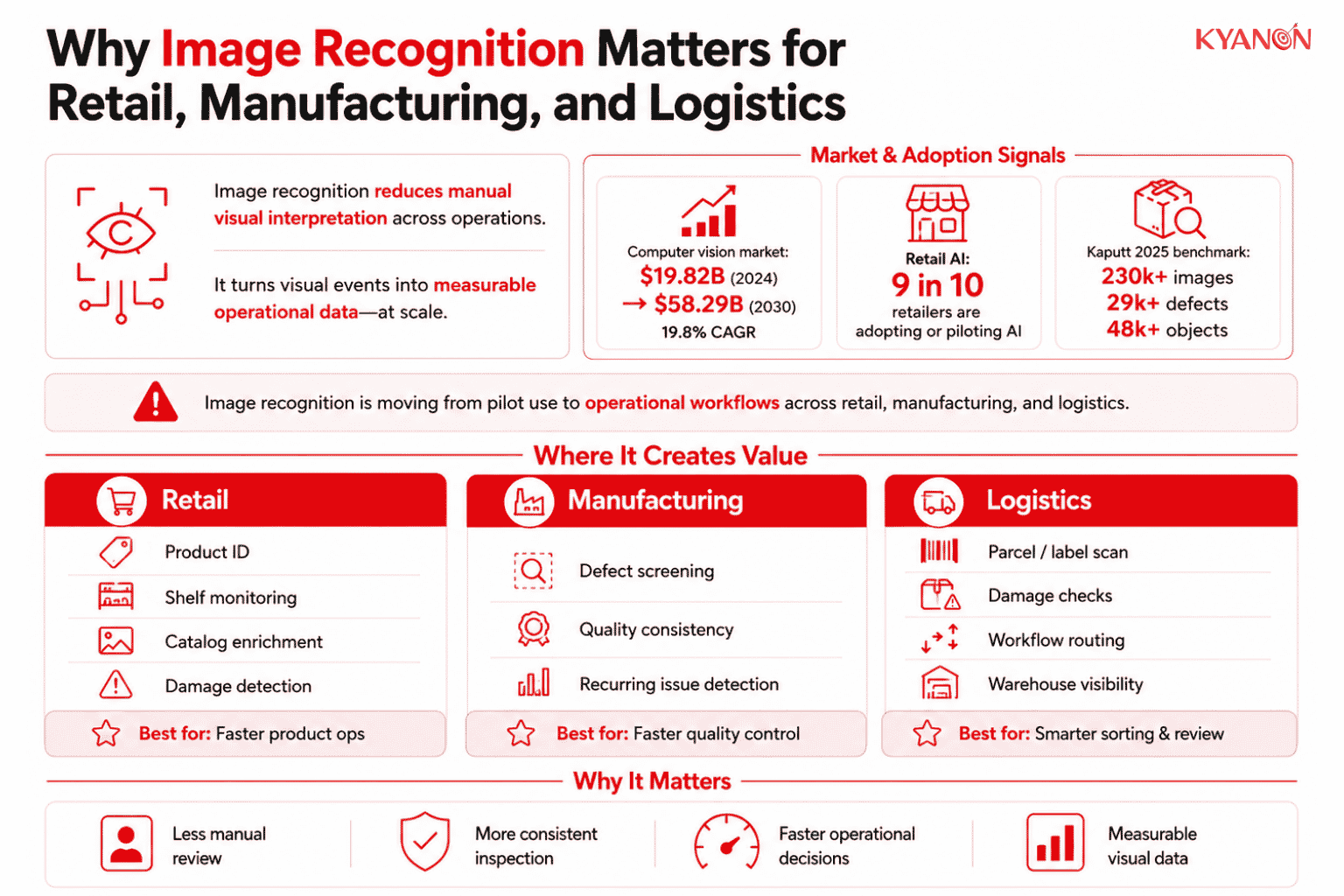
Image recognition matters because many enterprise workflows still depend on people manually interpreting visual information at scale. For CTOs and IT leaders, the business case is strongest when image recognition reduces inspection bottlenecks, improves process consistency, or turns visual events into data that can be measured across systems.
According to Grand View Research, the global computer vision market was valued at USD 19.82 billion in 2024 and is projected to reach USD 58.29 billion by 2030, growing at a 19.8% CAGR from 2025 to 2030. This signals that image recognition is becoming an operational technology for automation, quality control, inventory visibility, and visual data capture, not only a research or pilot-stage AI capability.
In retail, NVIDIA’s 2025 State of AI in Retail and CPG survey found that 9 out of 10 retailers are adopting or piloting AI, especially across marketing, customer engagement, and supply chain operations. For image recognition, this trend supports practical use cases such as product identification, shelf monitoring, catalog enrichment, damaged-goods detection, and store operations visibility.
For manufacturing and logistics, recent research shows that visual inspection is moving from controlled factory environments into more variable real-world settings. The 2025 Kaputt visual defect detection benchmark includes over 230,000 images, more than 29,000 defective instances, and 48,000 distinct objects, highlighting why logistics image recognition systems must handle changing packaging, object poses, lighting, and defect patterns.
Common Real-World Applications
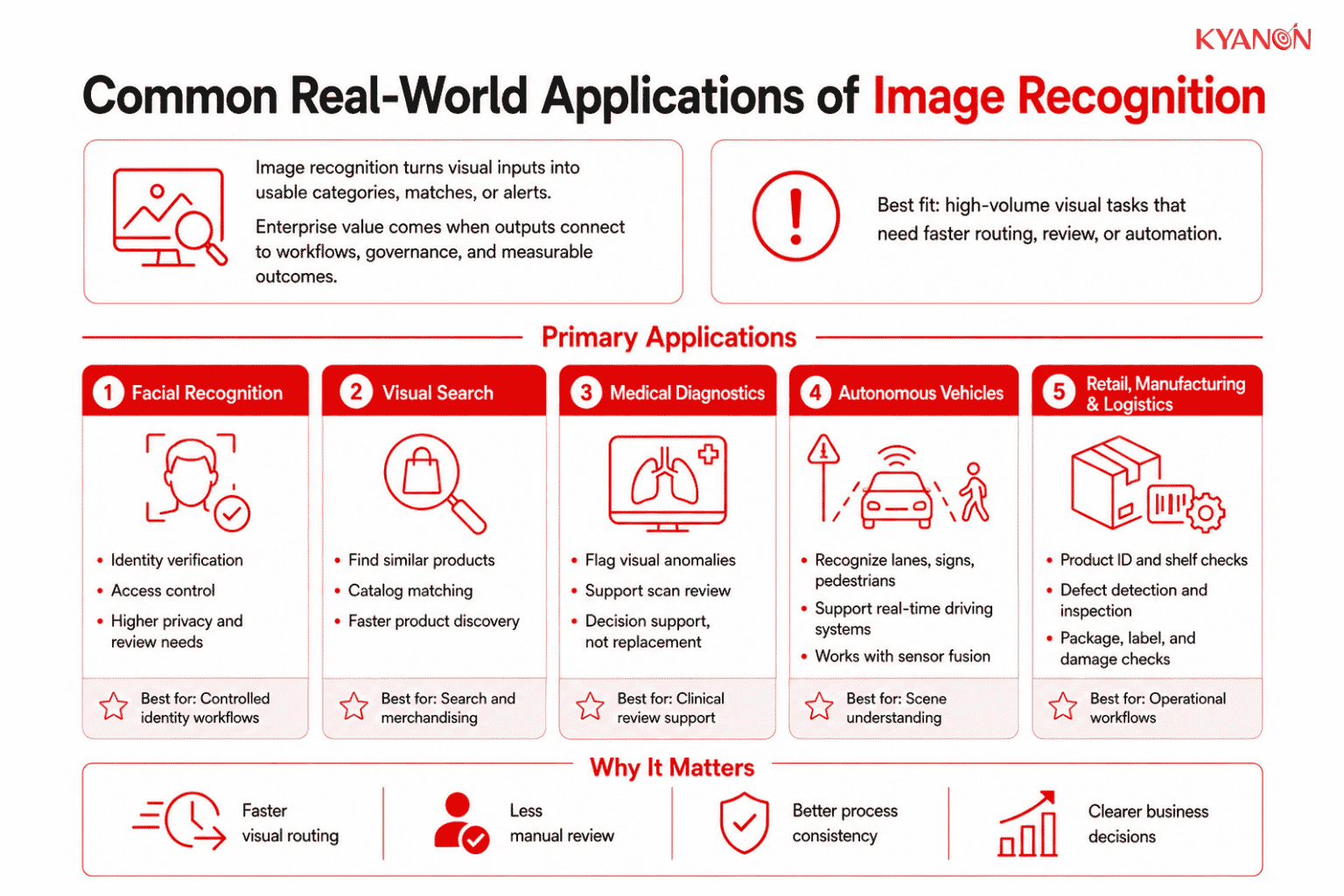
Image recognition is used across consumer, industrial, healthcare, and mobility environments, but its enterprise value depends on whether visual outputs can be connected to operational workflows, governance rules, and measurable business outcomes.
Facial Recognition
Facial recognition is used for identity verification, access control, smartphone unlocking, and selected security or law-enforcement workflows. Unlike general image recognition, facial recognition compares a detected face against enrolled biometric templates or a defined database, so it carries higher privacy, compliance, and human-review requirements.
Visual Search and Reverse Image Search
Visual search allows users to upload or capture an image to find similar products, identify objects, recognize plants, or locate the original source of an image online. In retail and eCommerce, visual search can support product discovery, catalog matching, similar-item recommendations, and faster product onboarding.
Medical Diagnostics
Image recognition can support healthcare professionals by detecting visual anomalies such as tumors, fractures, lesions, or abnormal tissue patterns in X-rays, CT scans, MRI scans, and pathology images. In clinical settings, image recognition should be treated as decision support, not a replacement for qualified medical judgment.
Autonomous Vehicles
Autonomous vehicles use image recognition to identify pedestrians, traffic signs, lane markings, vehicles, cyclists, road conditions, and obstacles in real time. Because driving decisions are safety-critical, image recognition in autonomous systems is usually combined with object detection, sensor fusion, mapping, and real-time control systems.
Retail, Manufacturing, and Logistics Operations
For enterprises, the strongest image recognition use cases are often operational rather than consumer-facing. Retailers can use image recognition for product identification, shelf monitoring, catalog enrichment, and damaged-goods detection; manufacturers can use it for defect detection and quality inspection; logistics operators can use it for package scanning, label recognition, sorting exceptions, and shipment condition checks.
Common Misconceptions
“Image recognition means facial recognition that tracks everyone.”
Reality: Image recognition is a broader computer vision capability that can identify products, defects, packages, labels, or objects without identifying a person. Facial recognition is a specific biometric use case that compares a face against enrolled facial templates or a watchlist.
“If the model is accurate in testing, we can let it operate without review.”
Reality: Image recognition models can degrade when lighting, camera angle, packaging, background, or product mix changes. For high-risk workflows such as security, quality control, medical review, or compliance, human-in-the-loop validation is required for ambiguous or high-impact results.
“AI sees images the same way people do.”
Reality: AI models process mathematical patterns from pixels; they do not understand context the same way humans do. A model may perform well on familiar image conditions but fail when the image distribution shifts, such as new packaging, low resolution, glare, occlusion, or unusual object placement.
How Kyanon Digital Applies Image Recognition
Kyanon Digital applies image recognition in enterprise systems where visual data needs to connect with commerce, operations, quality control, or logistics workflows. For retail clients, this can include product identification and catalog enrichment; for manufacturing clients, defect detection and quality inspection; for logistics clients, package scanning, label detection, and exception handling across warehouse or fulfillment operations.
Kyanon Digital implements image recognition using computer vision models, data pipelines, integration layers, and human review workflows for enterprise clients across Vietnam, Singapore, Malaysia, Thailand, ANZ, the US, and Nordic Europe. The implementation focus is on measurable outcomes such as faster inspection cycles, lower manual review effort, better data quality, reduced rework, and improved total cost of ownership.
→ Explore our Image Analysis Software Development Services.

 Create project brief with AI