
What is Just-in-Time Inference?
Just-in-Time Inference is an on-demand AI serving pattern where model-serving resources are activated or scaled only when inference requests occur. It is best suited for bursty or unpredictable workloads because it reduces idle compute cost, but it must be designed around cold-start latency and response-time requirements (AWS Documentation).
How Just-in-Time Inference Works
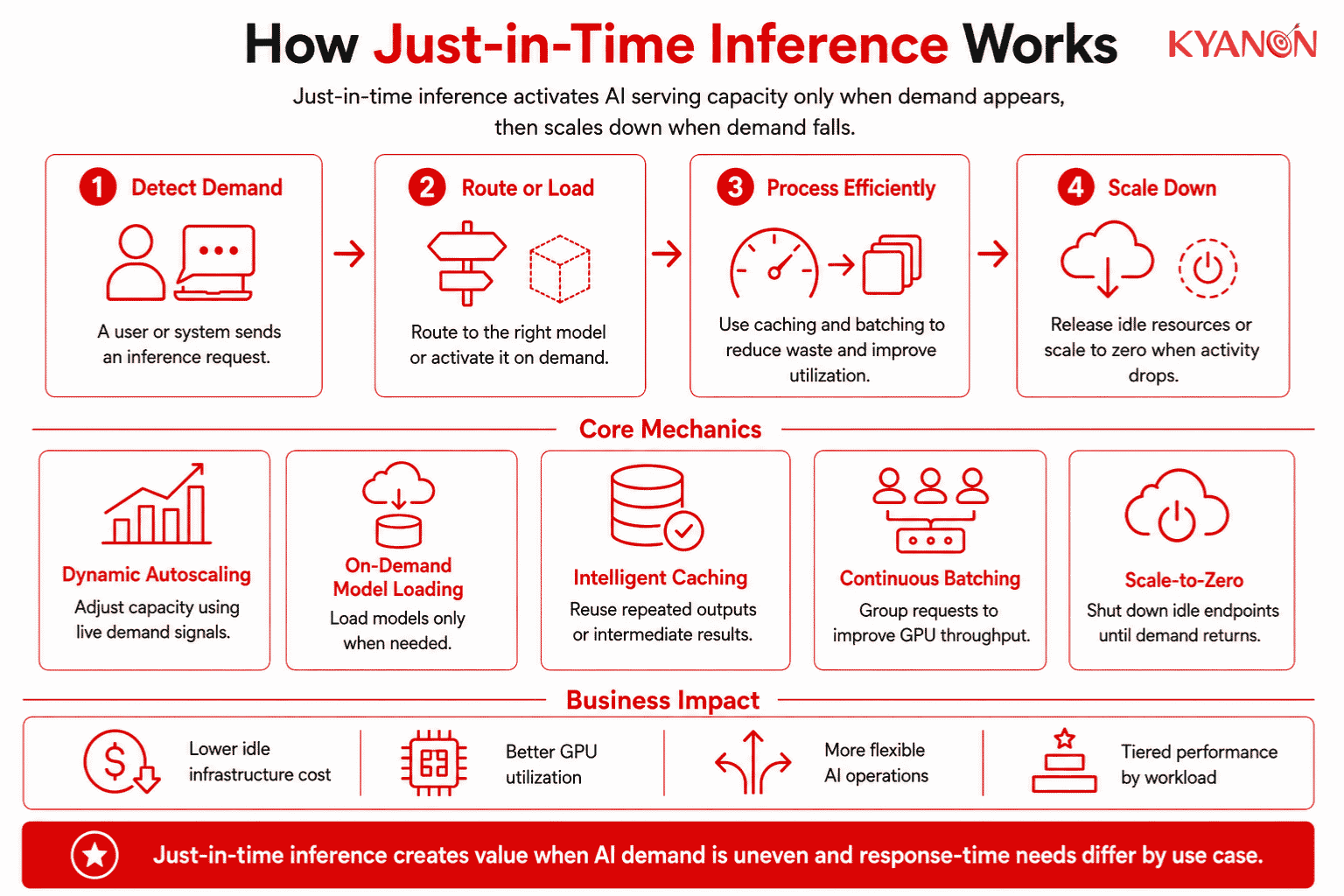
Just-in-Time Inference works by separating AI demand from fixed AI capacity. Instead of reserving model-serving infrastructure for every possible request, the system detects incoming demand, loads or routes the right model, allocates compute, returns the response, and then scales capacity down when demand falls.
A just-in-time inference system treats inference capacity as elastic infrastructure, not as a permanently running application layer.
Dynamic Autoscaling
Dynamic autoscaling adjusts inference capacity based on live demand signals such as request volume, queue depth, CPU/GPU utilization, latency thresholds, or custom business metrics. The Kubernetes Horizontal Pod Autoscaler supports scaling workloads using built-in or custom metrics, making it a common orchestration layer for elastic AI serving environments.
For enterprise AI teams, autoscaling reduces the cost of keeping excess inference capacity idle during low-demand periods.
On-Demand Model Loading
On-demand model loading activates model-serving resources only when a request requires them, instead of keeping every model resident in memory at all times. This is especially relevant for enterprises running multiple LLMs, embedding models, rerankers, classification models, or domain-specific models with different usage frequencies.
This mechanism can reduce idle GPU memory usage, but it must be balanced against cold-start latency when a model needs to be loaded after inactivity.
Intelligent Caching and Request Reuse
Intelligent caching stores reusable outputs, intermediate results, embeddings, or retrieval responses so the system does not recompute the same work unnecessarily. In enterprise AI workflows, caching is most useful for repeated prompts, frequently accessed documents, stable product information, common support questions, or repeated analytical requests.
Caching should be governed carefully because stale, user-specific, or permission-sensitive data can create accuracy and access-control risks.
Dynamic and Continuous Batching
Dynamic batching groups multiple inference requests together so GPU resources can process them more efficiently. NVIDIA Triton Inference Server describes dynamic batching as a way to combine inference requests at the server level, typically increasing throughput for suitable models.
For LLM workloads, continuous batching can improve utilization by adding and removing requests from the active batch as sequences finish. vLLM identifies continuous batching and memory-efficient attention management as core techniques for high-throughput LLM serving.
Scale-to-Zero and Sleep States
Scale-to-zero allows inference endpoints or serving nodes to shut down when no requests are present. AWS SageMaker Serverless Inference states that serverless endpoints can scale down to zero during periods without requests, which helps reduce cost for infrequent or unpredictable traffic patterns.
The trade-off is that the first request after an idle period may experience cold-start latency, so scale-to-zero is better suited to workloads where occasional startup delay is acceptable.

Just-in-Time Inference vs Always-On Inference
Both approaches serve AI model responses in production, but they differ in how much capacity is kept running before demand appears.
| Dimension | Just-in-Time Inference | Always-On Inference |
Capacity model | Activated or scaled when requests arrive | Kept continuously available |
| Latency profile | May include cold-start latency | Usually lower first-token latency |
Cost model | Better for bursty or irregular demand | Better for high, steady demand |
| Infrastructure utilization | Designed to reduce idle compute | Can waste capacity during quiet periods |
Operational complexity | Requires routing, autoscaling, and observability | Simpler capacity planning, higher baseline cost |
| Best for | Seasonal campaigns, internal AI tools, batch-like copilots, low-frequency enterprise workflows | Customer-facing chat, checkout support, fraud decisions, high-volume real-time personalization |
Risk trade-off | Cost savings may come with delayed first response | Faster responses may come with idle GPU or cloud spend |
When to Consider Just-in-Time Inference
Consider Just-in-Time Inference if:
- Your AI workload is bursty, for example, traffic spikes during retail campaigns, monthly reporting cycles, customer service peaks, or internal knowledge search usage.
- Your team is paying for model-serving infrastructure that sits idle for long periods between requests.
- You need to launch AI features without committing to always-on GPU capacity before usage patterns are proven.
It may not be the right priority if:
- Your AI system supports a latency-critical workflow where delayed first responses directly affect revenue, safety, or customer trust.
- Your request volume is consistently high enough that always-on capacity is cheaper and simpler to operate.
- Your organization has not yet defined model SLAs, observability, fallback logic, or cost ownership for production AI workloads.
Just-in-time inference is most relevant when the business problem is not model accuracy alone, but the operating cost of serving AI at unpredictable demand levels.
Why Just-in-Time Inference Matters for Enterprise AI
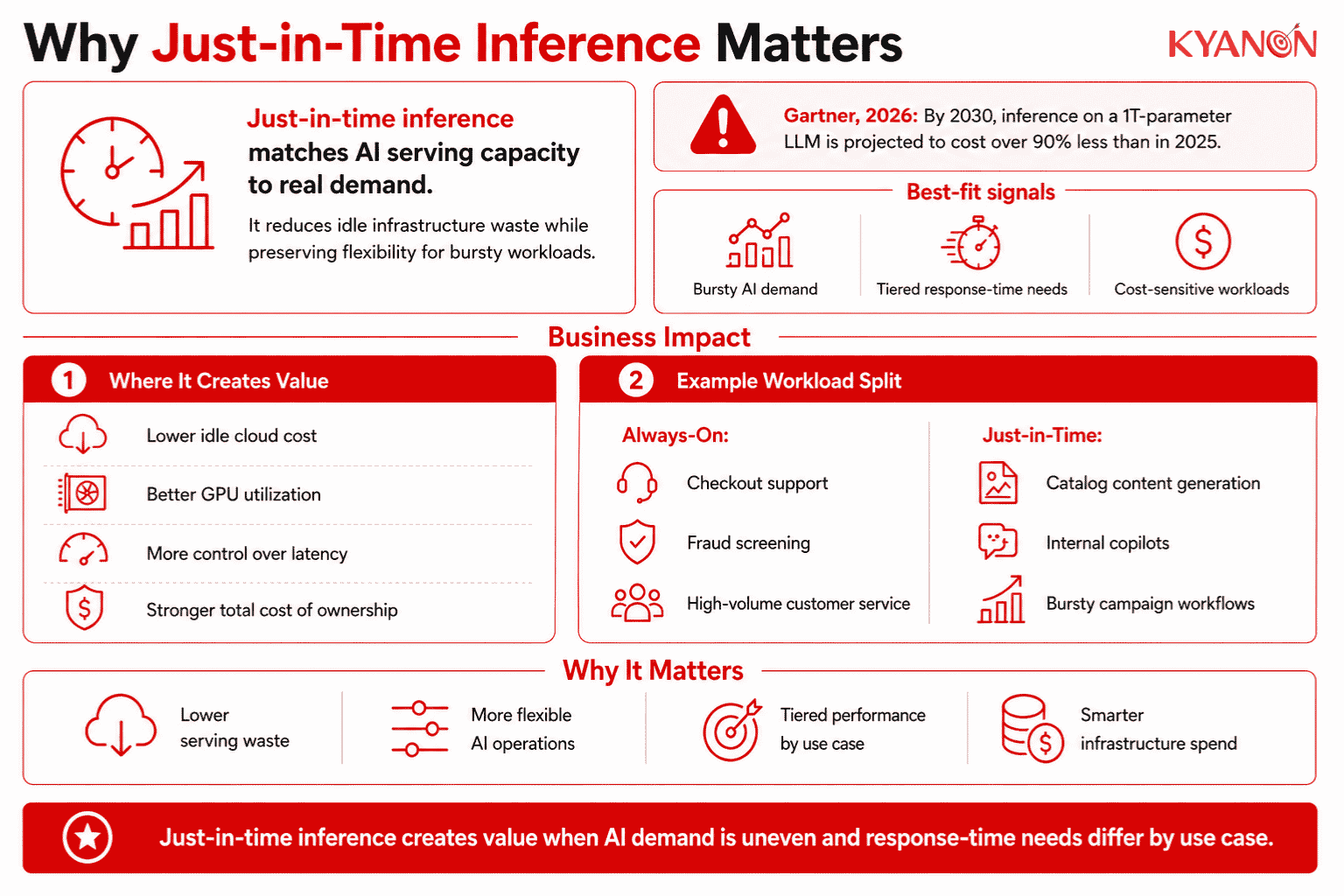
Just-in-time inference matters because it helps organizations reduce idle AI infrastructure by matching compute capacity to actual inference demand.
Gartner predicted in 2026 that by 2030, performing inference on a 1-trillion-parameter LLM will cost GenAI providers over 90% less than in 2025, showing that inference economics are improving but still remain a strategic infrastructure concern.
For enterprises with bursty AI workloads, Just-in-Time Inference can reduce idle infrastructure waste by combining autoscaling, on-demand model activation, caching, batching, and scale-to-zero policies. The business value is not only lower cloud spend; it is better control over latency, GPU utilization, model-serving capacity, and total cost of ownership.
A retail enterprise, for example, may use just-in-time capacity for product-description generation during catalog updates while keeping always-on inference for checkout assistance, fraud screening, or high-volume customer support. This separation allows high-SLA workloads to stay responsive while lower-frequency AI tasks avoid unnecessary always-on infrastructure costs.
Common Misconceptions
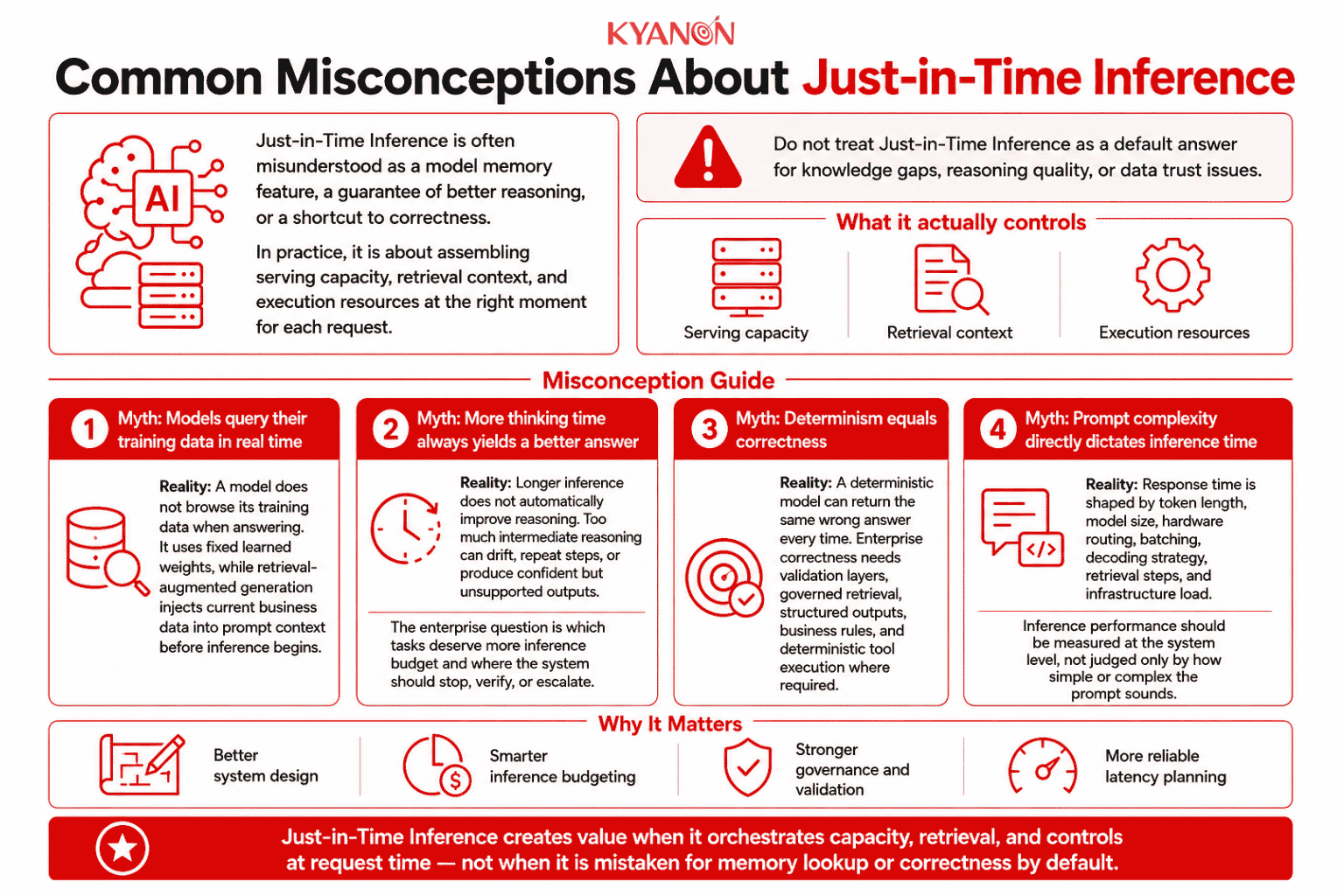
“Models query their training data in real time.”
Reality: A model does not browse its training data when it answers a prompt. It uses fixed learned weights to predict the next token, while systems such as retrieval-augmented generation inject current business data into the prompt context before inference begins.
For CTOs, the implication is clear: Just-in-Time Inference does not make a model “look up” its memory; it controls when serving capacity, retrieval context, and execution resources are assembled for a request.
“More thinking time always yields a better answer.”
Reality: Longer inference does not automatically mean better reasoning. If intermediate reasoning grows too long, the model can lose track of the objective, repeat steps, or generate confident but unsupported outputs.
The enterprise control question is not “Can the model think longer?” but “Which tasks deserve more inference budget, and where should the system stop, verify, or escalate?”
“Determinism equals correctness.”
Reality: A deterministic model can return the same incorrect answer every time. Correctness in enterprise AI requires validation layers, governed retrieval, structured outputs, business rules, and deterministic tool or function execution where needed.
For regulated or revenue-impacting workflows, repeatability is only useful when the underlying answer is constrained by trusted data and operational controls.
“Prompt complexity directly dictates inference time.”
Reality: Standard models do not understand elapsed wall-clock time. Response time is shaped by token length, model size, hardware routing, batching, decoding strategy, retrieval steps, and infrastructure load.
This means inference performance should be measured at the system level, not judged only by whether the prompt sounds simple or complex.
How Kyanon Digital Applies Just-in-Time Inference
Kyanon Digital implements just-in-time inference for enterprise AI systems where workload demand is uneven, cost control matters, and response-time expectations differ by use case. In practice, this can involve workload segmentation, retrieval-aware inference pipelines, model routing, autoscaling policies, observability dashboards, fallback logic, and cost-performance governance across cloud or hybrid environments.
For enterprise clients across Vietnam, Singapore, Malaysia, Thailand, ANZ, the US, and Nordic Europe, Kyanon Digital focuses on implementation decisions that affect measurable outcomes: time-to-market, infrastructure cost, conversion impact, operational reliability, and total cost of ownership.
→ Explore our AI, GenAI & ML implementation services.

 Create project brief with AI