
What is K-Means Clustering?
K-means clustering is an unsupervised machine learning algorithm that partitions unlabeled data into K groups by assigning each data point to the nearest centroid. It is commonly used in customer analytics, product grouping, image compression, document categorization, and anomaly detection.
K-means clustering is best suited for numeric datasets where the expected groups are compact, separated, and measurable by distance.
How K-Means Clustering Works
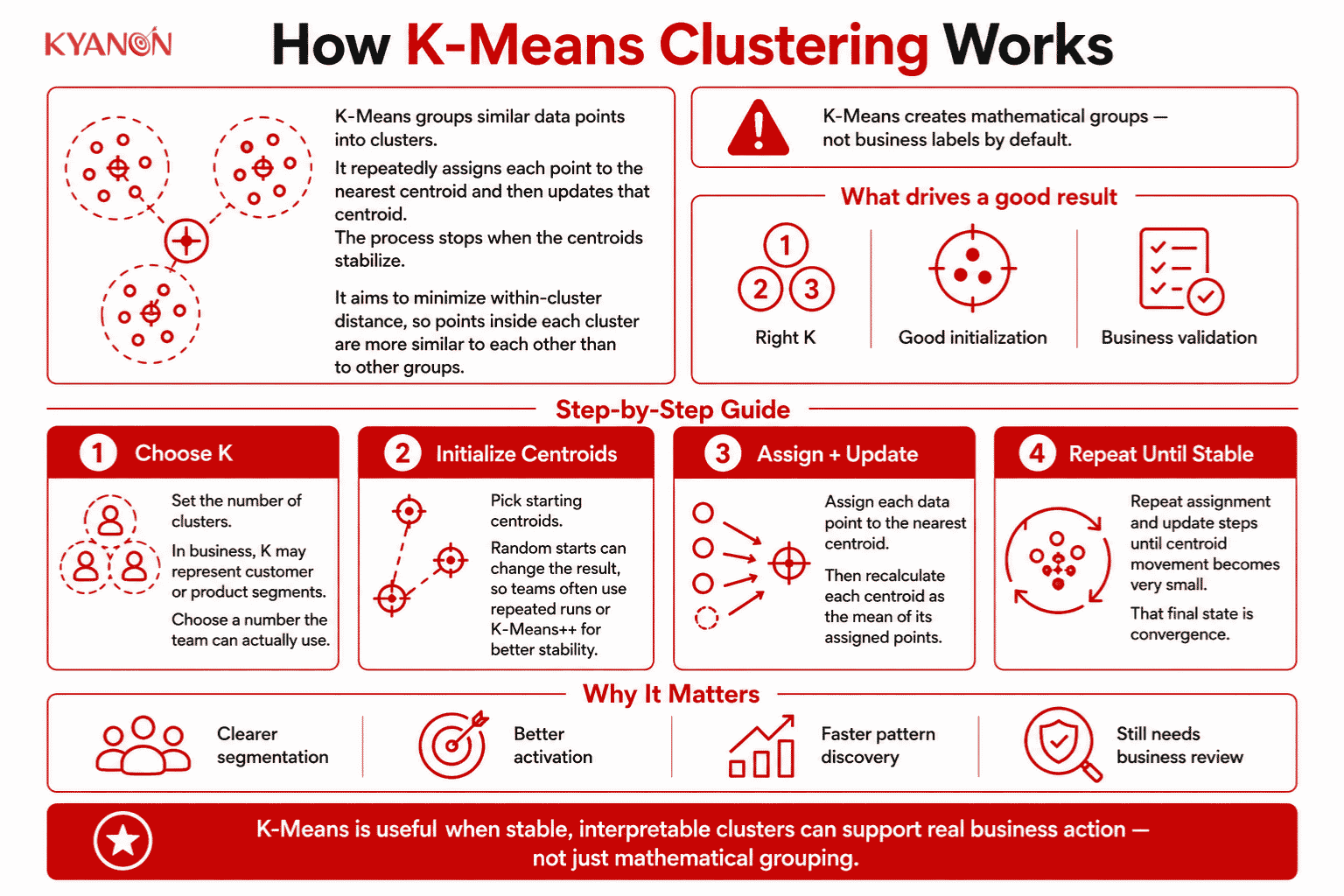
K-means clustering works through an iterative optimization process that repeatedly assigns data points to the nearest centroid and updates each centroid based on the mean of its assigned points. The algorithm continues until the centroids stop moving significantly, which means the clusters have converged.
K-Means clustering minimizes within-cluster distance, so each final cluster should contain data points that are more similar to one another than to points in other clusters.
Choosing K
K is the number of clusters the user wants the algorithm to create. In a retail or e-commerce use case, K may represent customer groups such as loyal buyers, discount-driven buyers, seasonal shoppers, high-value customers, or low-engagement customers.
The number of clusters should reflect both the data pattern and the number of segments the business can realistically activate.
Initializing Centroids
The algorithm starts by selecting K initial centroids, which act as temporary cluster centers. Standard K-Means often initializes these centroids randomly, meaning different runs can produce different results.
Because centroid initialization affects cluster quality, enterprise analytics teams often use repeated runs or K-Means++ initialization to improve stability.
Assigning Data Points
Each data point is evaluated against all centroids and assigned to the nearest one based on distance. In customer analytics, this means customers with similar behavior, purchase patterns, or engagement signals are grouped.
K-Means clustering groups data by mathematical similarity, not by predefined business labels.
Updating Centroids
After the assignment, the algorithm recalculates each centroid by taking the average value of all points in that cluster. The centroid then moves to the new center of the assigned group.
This update step is what allows K-Means clustering to improve the cluster structure over each iteration.
Repeating Until Convergence
K-Means repeats the assignment and update steps until the centroid positions stop changing significantly. This final state is called convergence.
A converged K-Means result means the clusters are mathematically stable, but business teams must still validate whether the segments are understandable, measurable, and actionable.

K-Means Clustering vs DBSCAN
K-Means Clustering and DBSCAN both group similar data points, but they define clusters differently: K-Means uses distance from centroids, while DBSCAN uses density and neighborhood structure.
Dimension | K-Means Clustering | DBSCAN |
Cluster logic | Groups points around centroids | Groups points by density |
| Need to define cluster count | Requires K before running | Does not require a predefined number of clusters |
Cluster shape | Works best with compact, spherical clusters | Handles irregular, elongated, or dense clusters |
| Outlier handling | Sensitive to outliers because centroids use means | Can classify outliers as noise |
Best for | Customer segmentation, product grouping, campaign targeting | Anomaly-heavy data, fraud patterns, location clusters |
| Business interpretability | Easier to explain through segment averages and centroids | Harder to explain because density rules drive the result |
Enterprise activation fit | Strong when teams need a manageable number of stable segments | Strong when the goal is anomaly discovery or natural cluster detection |
When to Consider K-Means Clustering
Consider K-Means Clustering if:
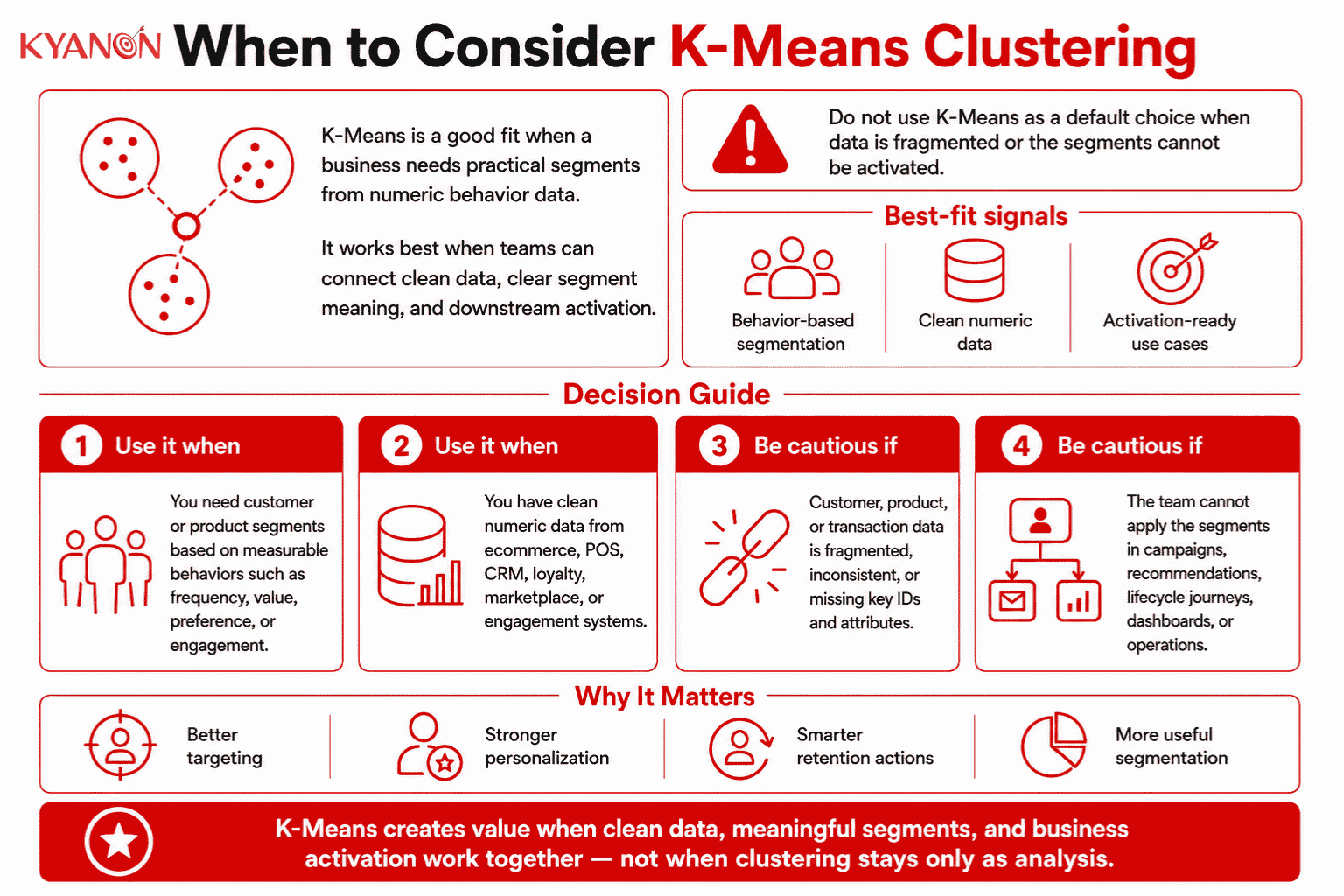
- Your retail or e-commerce team needs customer segments based on measurable behaviors such as purchase frequency, average order value, product preference, discount sensitivity, or engagement level.
- Your marketing, CRM, or merchandising team needs a practical segmentation layer for personalization, loyalty programs, product recommendations, campaign targeting, or churn prevention.
- Your organization has clean numeric data from e-commerce, POS, CRM, loyalty, marketplace, or customer engagement systems.
It may not be the right priority if:
- Your customer data is still fragmented across systems and lacks consistent customer IDs, product IDs, transaction history, or behavioral attributes.
- Your expected clusters are irregular, overlapping, highly imbalanced, or shaped by density rather than distance from a center.
- Your team cannot activate the resulting segments in campaigns, recommendations, lifecycle journeys, dashboards, or operational workflows.
K-Means Clustering should be considered when the organization can connect data preparation, segment interpretation, and downstream activation into one operating workflow.
Why K-Means Clustering Matters for Retail and Ecommerce
K-Means clustering matters for retail and e-commerce because it turns large volumes of customer, product, and behavioral data into usable groups for personalization, targeting, and decision-making. For enterprise teams, its business value comes from making segmentation more measurable and repeatable.
In customer analytics, K-means clustering can help teams move from broad demographic grouping to behavior-based segmentation.
IBM Institute for Business Value and NRF reported in 2026 that 45% of surveyed consumers use AI during their buying journeys, based on Q3 2025 surveys of more than 18,000 consumers across 23 countries.
A retail enterprise in Southeast Asia may use K-Means clustering to identify loyal buyers, discount-sensitive shoppers, seasonal customers, premium product buyers, and low-engagement customers. These segments can then support personalized campaigns, recommendation logic, loyalty journeys, churn prevention, and customer lifetime value analysis.
Real-World Applications of K-Means Clustering
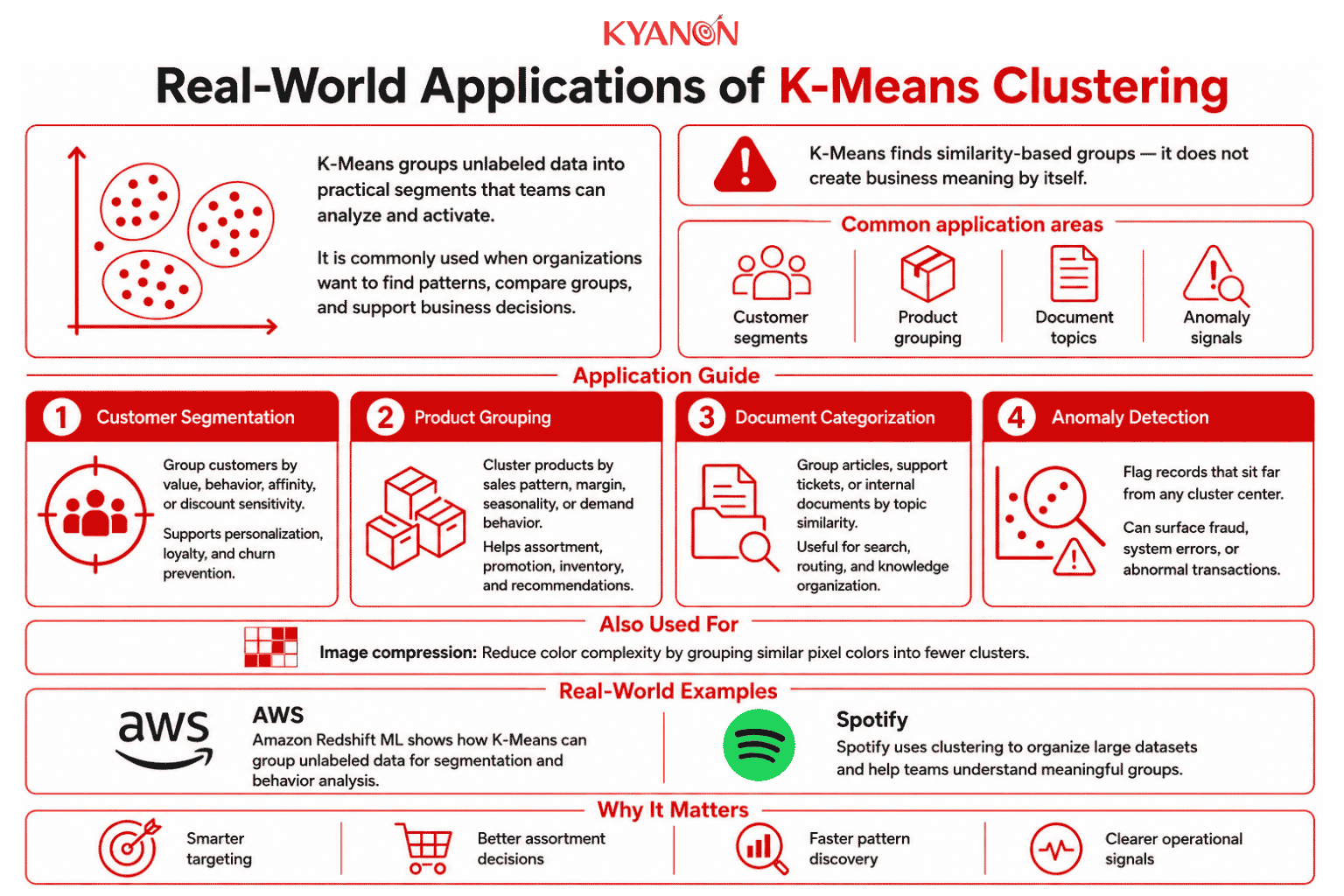
K-means clustering is used to group unlabeled data into practical segments that business teams can analyze, compare, and activate.
- Customer segmentation: Retail and e-commerce teams use K-Means Clustering to group customers by purchase behavior, average order value, product affinity, engagement level, and discount sensitivity. These segments can support personalized campaigns, loyalty programs, recommendations, and churn prevention.
- Product grouping: Merchandising teams use K-means clustering to group products with similar sales patterns, margins, seasonality, or demand behavior. Product clustering can improve assortment planning, promotion strategy, inventory allocation, and recommendation logic.
- Image compression: K-Means clustering can group similar pixel colors into fewer color clusters. This reduces image complexity for storage, processing, or delivery workflows.
- Document categorization: K-Means clustering can group articles, support tickets, search results, or internal documents by topic similarity. This supports knowledge management, internal search, support routing, and content organization.
- Anomaly detection: K-Means clustering can flag unusual data points that sit far from any cluster center. These signals may indicate fraud, system errors, abnormal transactions, or operational exceptions.
Real-World Examples
- Amazon Web Services: AWS uses K-Means clustering in Amazon Redshift ML to show how unlabeled data can be grouped by similarity, making it relevant for customer segmentation, product grouping, and behavior analysis.
- Spotify: Spotify Engineering uses clustering to organize large datasets and help data scientists understand why certain groups exist, showing how clustering supports analysis in large-scale digital platforms.
Key Limitations of K-Means Clustering
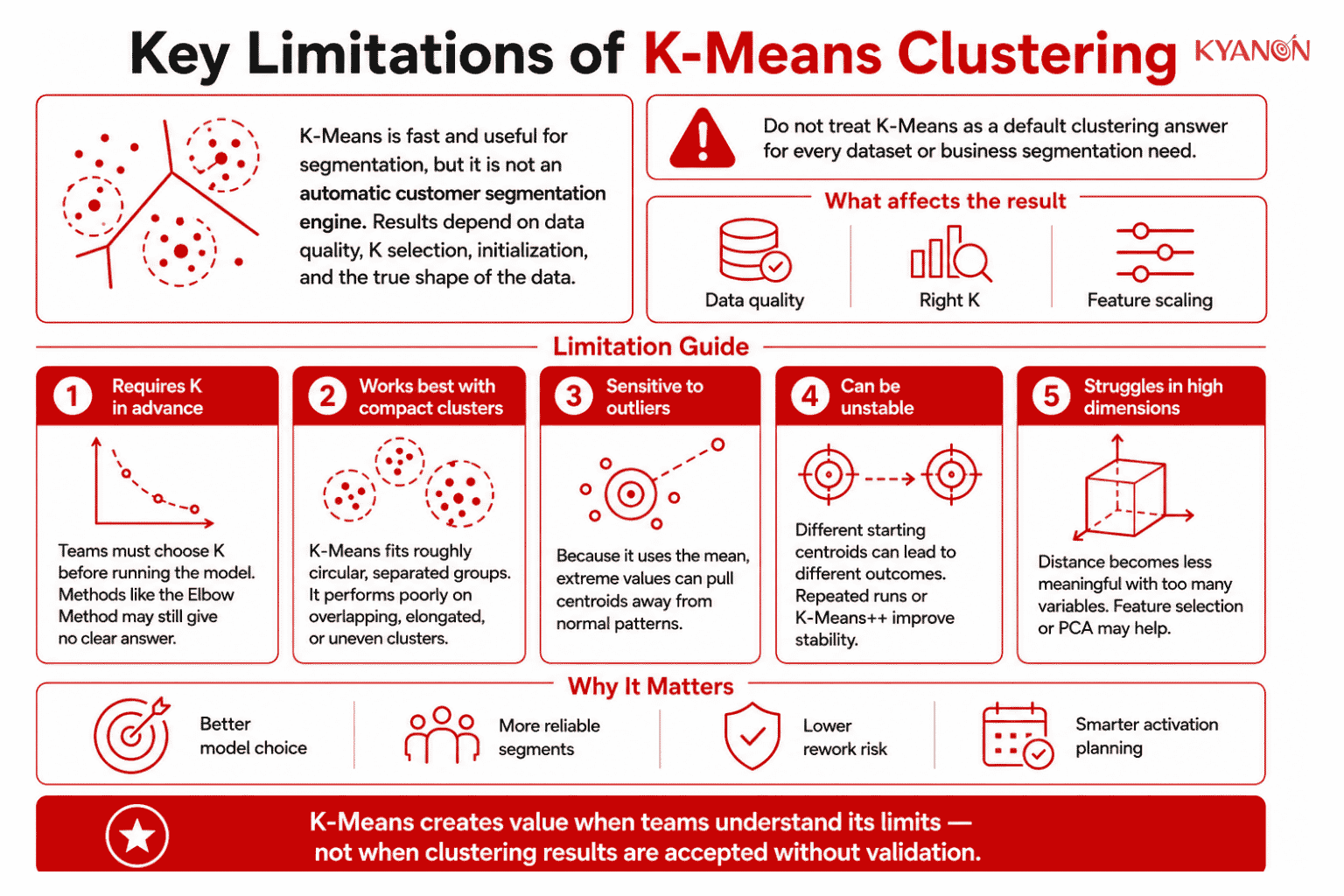
K-means clustering is fast and useful for segmentation, but it should not be treated as an automatic customer segmentation engine. Its results depend on data quality, feature scaling, K selection, centroid initialization, and the real shape of the data.
- Requires K in advance: K-Means does not automatically decide how many clusters exist. Business teams must define K before running the algorithm, and methods like the Elbow Method may not always show a clear answer.
- Works best with compact clusters: K-Means assumes clusters are roughly circular, separated, and similar in size. It can perform poorly when customer or product groups are elongated, overlapping, uneven, or irregular.
- Sensitive to outliers: K-Means calculates cluster centers using the mean, so extreme values can distort the result. In customer analytics, unusual bulk orders, bot activity, test accounts, or fraud signals should be reviewed before clustering.
- Can produce unstable results: K-Means can converge to different outcomes depending on the starting centroid positions. Running the algorithm multiple times or using K-Means++ can improve cluster stability.
- Struggles with high-dimensional data: K-Means relies on distance, but distance becomes less meaningful when too many variables are used. Feature selection or PCA can help before applying K-Means to complex behavioral datasets.
For enterprise teams, the main limitation of K-means clustering is not speed; it is whether the resulting segments are accurate, stable, and useful enough to activate in marketing, merchandising, analytics, or customer experience workflows.
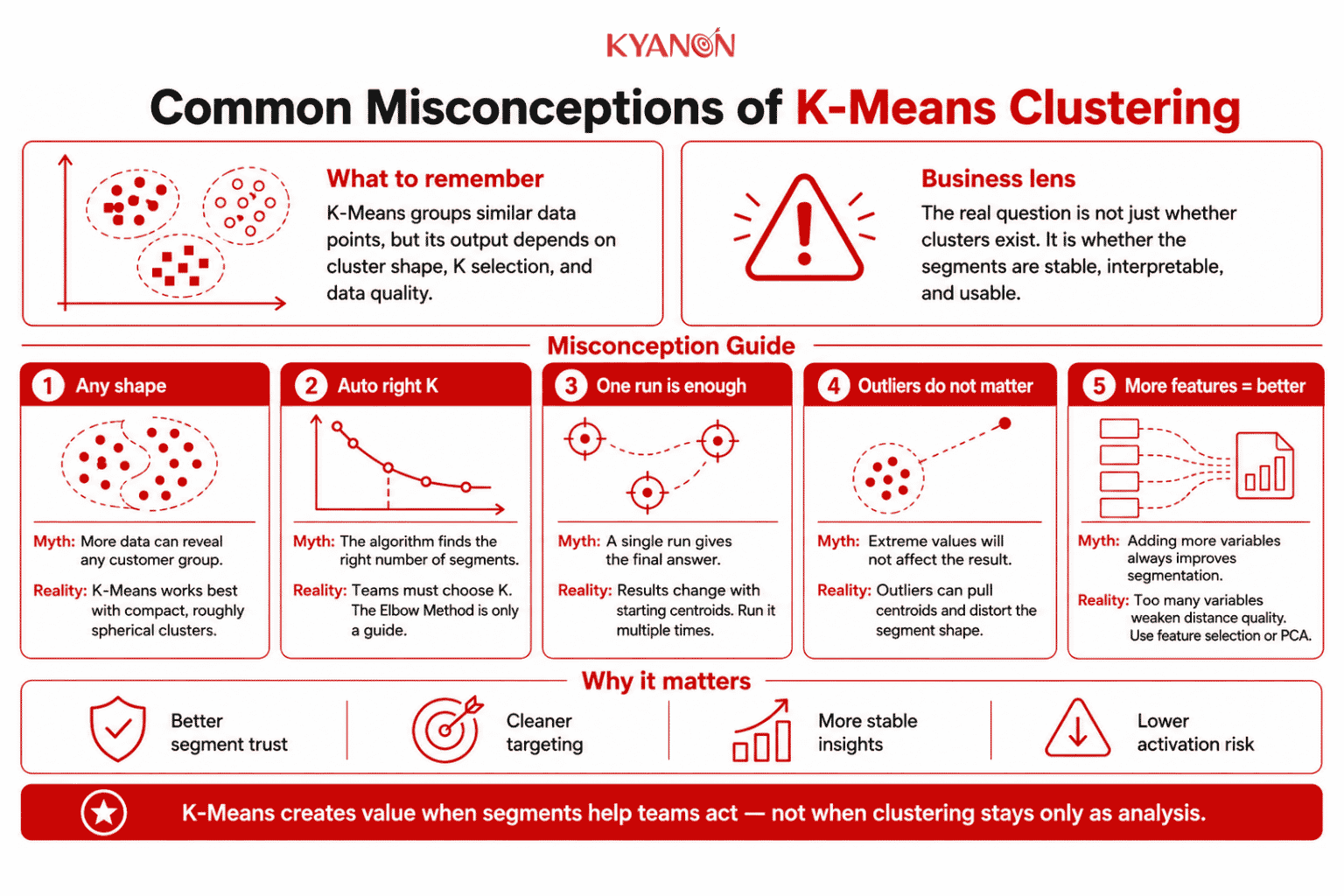
Common Misconceptions
“K-Means can find any kind of customer group if we give it enough data.”
Reality: K-Means does not identify clusters of any shape. It works best when clusters are compact and roughly spherical, so it can fail on elongated, ring-shaped, crescent-shaped, or highly irregular customer behavior patterns.
For CTOs and e-commerce leaders, the decision is not “Can we cluster the data?” but “Does the shape and quality of the data match the assumptions of the algorithm?”
“The algorithm will automatically find the correct number of customer segments.”
Reality: K-Means requires the number of clusters to be selected before the algorithm runs. Methods such as the Elbow Method can support the decision, but they do not always produce one obvious answer.
The right K should balance mathematical fit, segment stability, business interpretability, and operational usability.
“Running K-Means once is enough.”
Reality: K-Means can converge to different results because the starting centroid positions influence the final clusters. Enterprise analytics teams should run the algorithm multiple times and compare whether the segments remain stable.
A segmentation model should not be moved into campaign or recommendation workflows until the clusters are stable enough to trust.
“Outliers do not affect clustering.”
Reality: K-Means is sensitive to outliers because centroids are calculated using the mean. Extreme customer behavior, such as unusually large bulk orders or bot-driven activity, can pull centroids away from normal customer patterns.
Outlier detection and feature scaling should happen before K-Means is used for business segmentation.
“More data dimensions always improve segmentation.”
Reality: More dimensions can reduce the usefulness of distance-based clustering because many points start to appear similarly distant from one another. In high-dimensional customer data, dimensionality reduction or feature selection is often needed before K-Means produces meaningful segments.
For enterprise personalization, fewer high-quality features often outperform many weak or noisy attributes.
How Kyanon Digital Applies K-Means Clustering
Kyanon Digital applies K-means clustering in customer analytics engagements for retail and e-commerce clients that need segmentation-based personalization. The work typically includes data readiness assessment, feature engineering, identity resolution support, clustering model design, segment validation, dashboarding, and integration with CRM, CDP, e-commerce, or campaign activation systems.
Kyanon Digital’s approach focuses on turning clusters into measurable business actions, such as personalized journeys, retention campaigns, product recommendation rules, merchandising insights, and customer lifetime value analysis.
For enterprise clients across Vietnam, Singapore, Malaysia, Thailand, ANZ, the US, and Nordic Europe, K-means clustering is most useful when paired with implementation work across data pipelines, analytics layers, and operational systems. This keeps segmentation from becoming a one-off analysis and makes it usable for time-to-market, conversion, and TCO improvement.
→ Explore our AI and data analytics services for customer segmentation.

 Create project brief with AI