
What is K-Nearest Neighbor (KNN)?
K-Nearest Neighbor (KNN) is a supervised machine learning algorithm that predicts a new data point by comparing it with the most similar labeled examples in a stored dataset (IBM).
KNN is called a lazy learner because it does not build a mathematical model during training; it stores the dataset and performs distance calculations only when a prediction is requested.
How K-Nearest Neighbor (KNN) Works
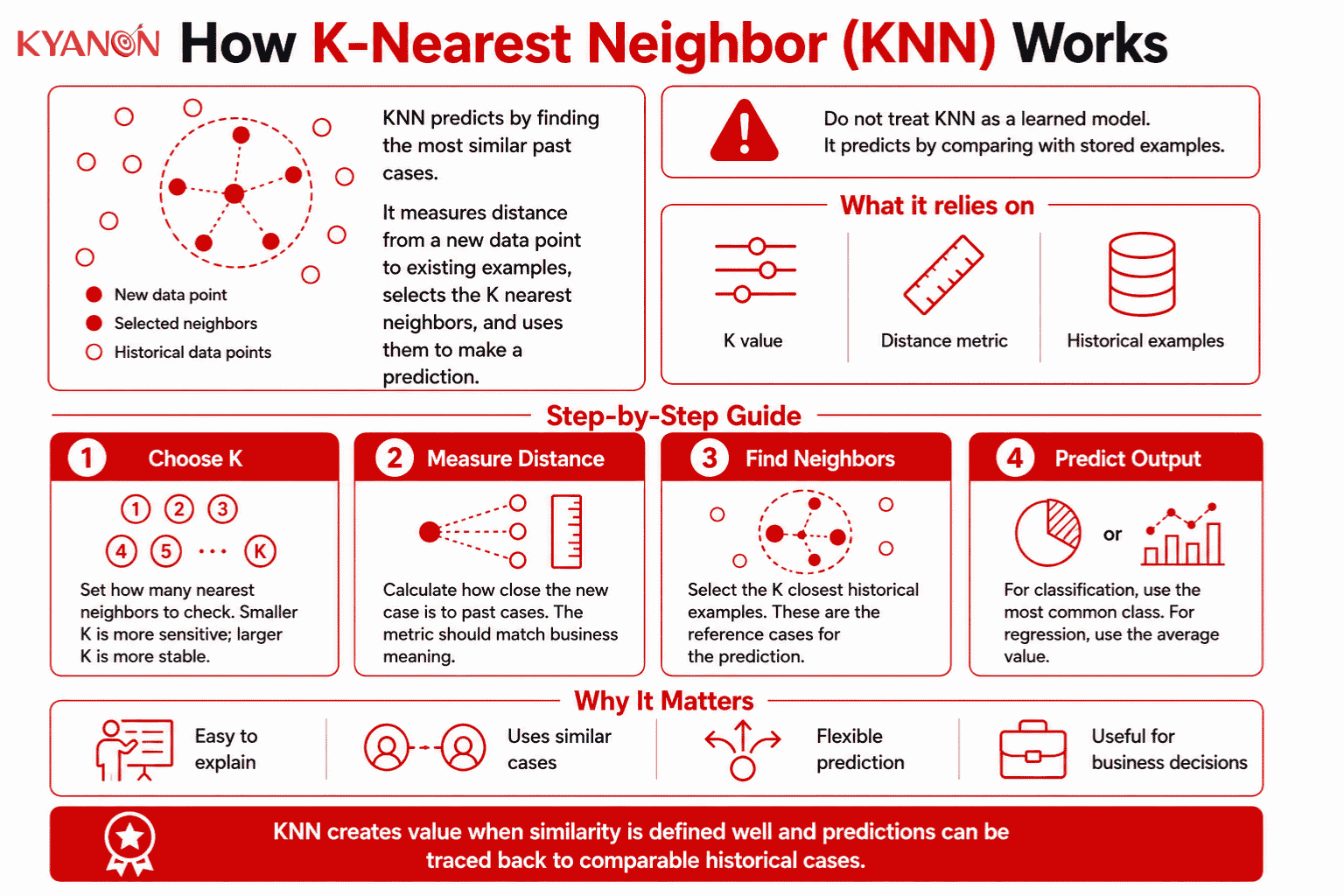
K-Nearest Neighbor (KNN) works by calculating the distance between a new data point and existing data points, selecting the K closest neighbors, and using those neighbors to make a prediction.
In business terms, KNN answers one question: “Which historical cases are most similar to this new case?”
The “K” Parameter
K is the number of nearest neighbors the algorithm checks before making a decision. If K = 5, the algorithm looks at the five closest historical examples.
The K value affects stability: a small K can react strongly to local patterns, while a large K can smooth out noise but reduce specificity.
Distance Metrics
A distance metric defines how “near” or “similar” two data points are. Euclidean distance is commonly used for numerical data, while Manhattan, Hamming, cosine similarity, or other metrics may fit different data types.
For enterprise use cases, the distance metric must reflect the business meaning of similarity, not just mathematical closeness.
Prediction Logic
For classification, KNN usually predicts the most common class among the nearest neighbors. For regression, KNN usually predicts the average value of the nearest neighbors.
This makes KNN easy to explain because the output can be traced back to similar historical examples.

K-Nearest Neighbor (KNN) vs K-Means Clustering
KNN and K-Means both use distance calculations, but KNN predicts outcomes from labeled data while K-Means groups unlabeled data into clusters.
Dimension | K-Nearest Neighbor (KNN) | K-Means Clustering |
Learning type | Supervised learning | Unsupervised learning |
| Main goal | Predict a class, score, value, or recommendation | Group similar data points into clusters |
Meaning of K | Number of neighbors used for prediction | Number of clusters to create |
| Data requirement | Requires labeled historical data | Works with unlabeled data |
Training behavior | Lazy learner; stores data and computes at prediction time | Iteratively updates cluster centroids |
| Common business use | Product recommendation, anomaly detection, classification, regression | Customer segmentation, market grouping, behavior clustering |
Explainability | High, because predictions can show nearest examples | Medium, because clusters need business interpretation |
| Scalability concern | Slow prediction on large datasets without optimization | Sensitive to chosen K and starting centroids |
When to Consider K-Nearest Neighbor (KNN)
Consider K-Nearest Neighbor (KNN) if:
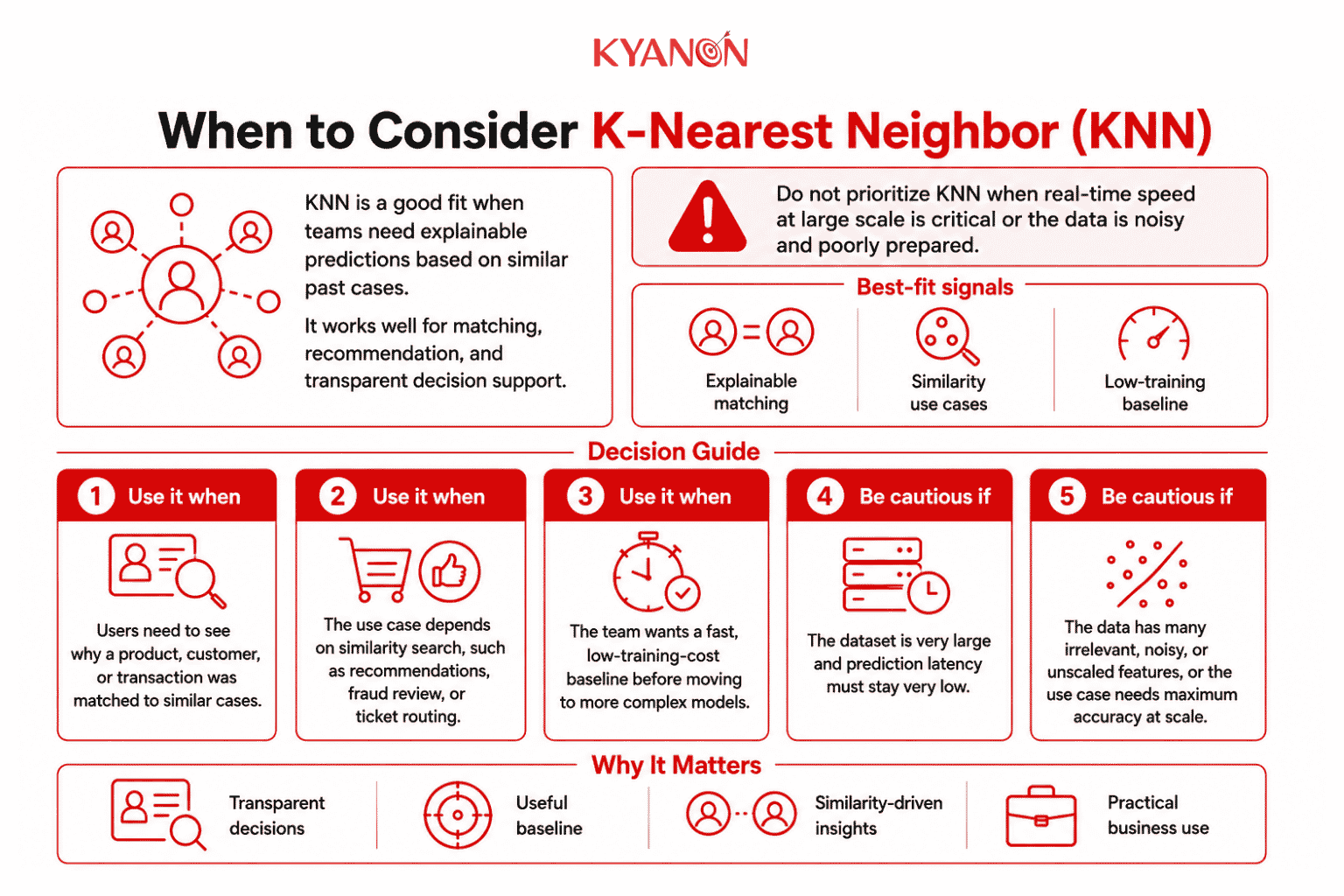
- Your team needs explainable recommendations where users can see why a product, customer, or transaction was matched to similar cases.
- Your AI use case depends on similarity search, such as similar product recommendation, fraud review, customer behavior matching, or support ticket routing.
- Your team wants a low-training-cost baseline before investing in more complex machine learning models.
KNN may not be the right priority if:
- Your dataset is very large and prediction latency is critical.
- Your data has many irrelevant, noisy, or unscaled features.
- Your use case requires maximum accuracy at scale rather than transparent similarity-based reasoning.
Why K-Nearest Neighbor (KNN) Matters for Enterprise AI
K-Nearest Neighbor (KNN) matters for enterprise AI because it offers a transparent way to build similarity-based prediction systems without a heavy training cycle.
For CTOs and eCommerce leaders, KNN is useful when explainability, fast experimentation, and low training cost are more important than model complexity.
According to Gartner (2025), negative personalization experiences made customers 3.2x more likely to regret a purchase and 44% less likely to purchase again in the future.
This matters for KNN because recommendation quality depends on how well a system defines “similarity” between customers, products, behaviors, or transactions.
For example, a retail enterprise can use KNN to recommend similar products based on product attributes, browsing behavior, or purchase history. The business value is not that KNN is always the most accurate model, but that its prediction can be reviewed through the nearest examples behind the recommendation.
Common Misconceptions
“KNN learns a model during training.”
Reality: KNN does not learn weights, rules, or a fixed formula during training. It stores historical data and performs the main work only when a new prediction is requested.
For business leaders, this means KNN is fast to prepare but can become slow in production if the dataset is large.
“KNN scales well to massive datasets by default.”
Reality: KNN can be slow because each prediction may require distance comparison against many stored examples. Large-scale systems often need indexing, caching, dimensionality reduction, or approximate nearest neighbor search.
KNN should be evaluated against production latency, infrastructure cost, and user experience.
“Raw business data can go directly into KNN.”
Reality: KNN relies on distance calculations, so feature scaling is required. A large-range feature such as income or transaction value can dominate a smaller-range feature such as age, rating, or frequency.
Before using KNN, teams need feature scaling, feature selection, and data quality checks.
“KNN and K-Means are the same thing.”
Reality: KNN predicts outcomes from labeled examples, while K-Means groups unlabeled data into clusters. They both use distance, but they solve different business problems.
A product recommendation system may use KNN to find similar items, while a customer segmentation project may use K-Means to group customers.
Pros and Cons of K-Nearest Neighbor (KNN)
KNN is easy to explain and fast to prepare, but it can become expensive at prediction time when datasets grow.
Dimension | Advantage | Limitation |
| Training cost | No heavy training phase | Stores the dataset instead of learning a compact model |
Explainability | Easy to explain through nearest examples | Explanation quality depends on clean features |
| Flexibility | Works for classification and regression | Sensitive to noisy or irrelevant features |
Data assumptions | Makes few assumptions about data distribution | Performance drops in high-dimensional datasets |
| Production cost | Useful for small or moderate datasets | Can be slow and memory-intensive at scale |
Common Applications of K-Nearest Neighbor (KNN)
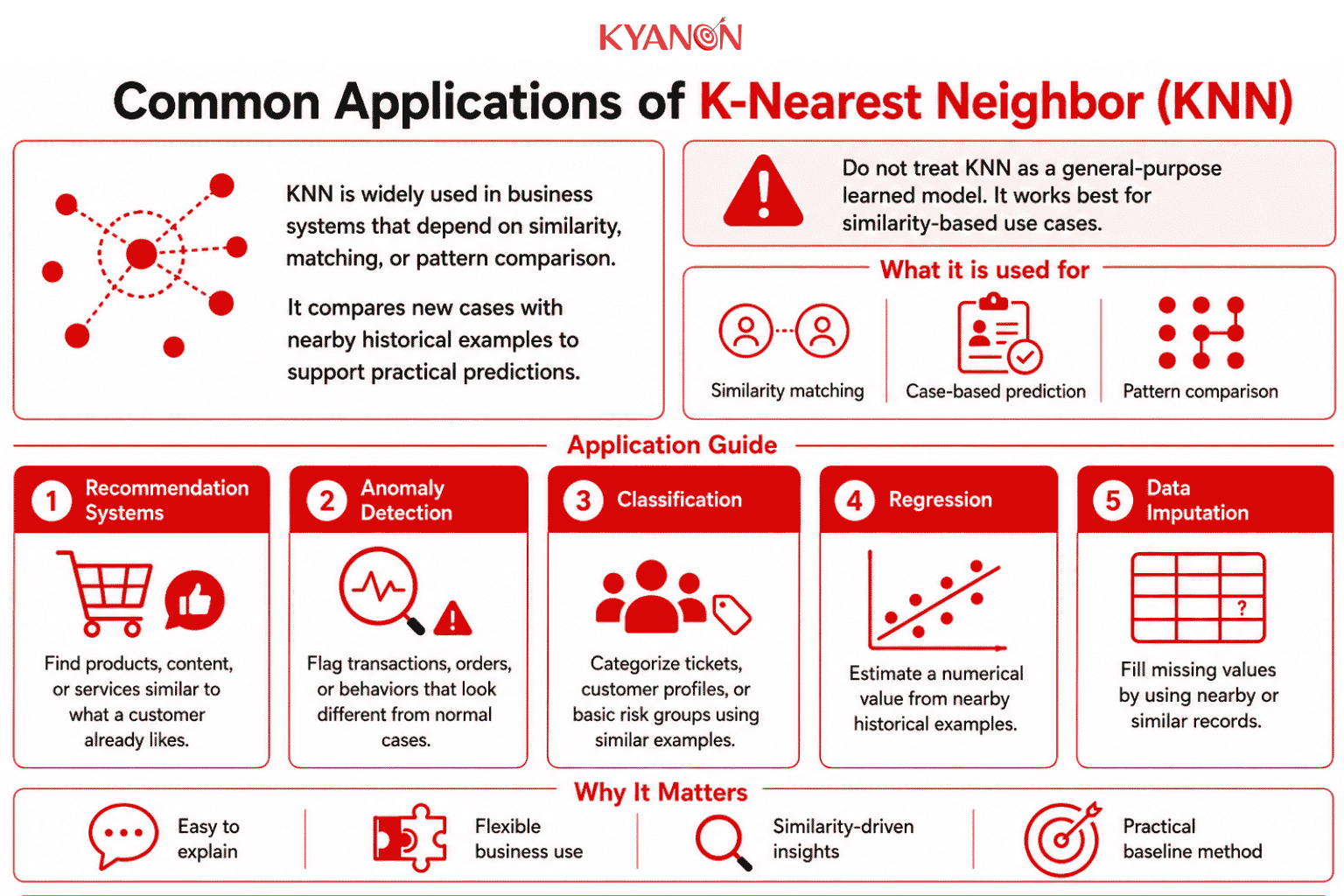
KNN is commonly used in business systems that depend on similarity, matching, or pattern comparison.
Common applications include:
- Recommendation systems: finding products, content, or services similar to what a customer already likes.
- Anomaly detection: identifying transactions, orders, or behaviors that look different from normal historical cases.
- Classification: categorizing data points such as support tickets, customer profiles, or basic risk groups.
- Regression: predicting a numerical value based on similar historical examples.
- Data imputation: estimating missing values based on nearby or similar records.
How Kyanon Digital Applies K-Nearest Neighbor (KNN)
Kyanon Digital applies K-Nearest Neighbor (KNN) in recommendation and anomaly detection systems for clients where interpretability and low training cost are priorities over maximum model complexity.
In practical delivery, Kyanon Digital combines KNN with data preparation, feature scaling, similarity metric design, model evaluation, and production monitoring. For retail and eCommerce clients, this can support similar product recommendations, customer behavior matching, abnormal transaction review, and explainable AI workflows across commerce, CRM, and data platforms.
→ Explore our Machine Learning Services.

 Create project brief with AI