
What is Unsupervised Learning?
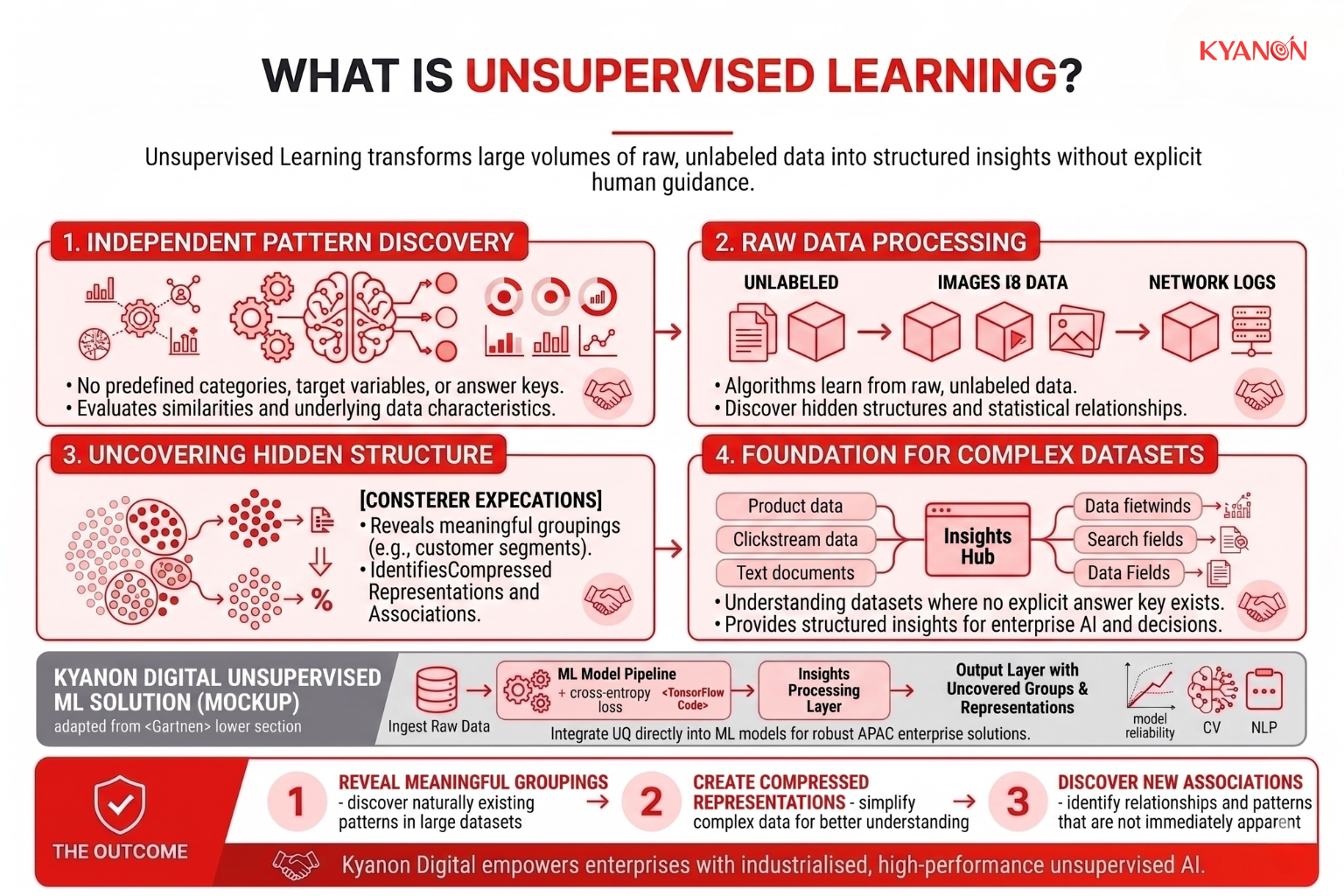
Unsupervised Learning is a machine learning paradigm in which algorithms learn from raw, unlabeled data without predefined categories, target variables, or human-annotated answers. Instead of being trained to predict known outcomes, the model independently analyzes the data to discover hidden structures, statistical relationships, and patterns that naturally exist within the dataset.
By evaluating the similarities, differences, distributions, and underlying characteristics of data points, unsupervised learning identifies how information is organized without external guidance. Its primary purpose is to uncover the intrinsic structure of data, revealing meaningful groupings, compressed representations, and associations that may not be immediately apparent.
As a result, unsupervised learning enables machines to transform large volumes of unlabeled data into structured insights, providing a foundation for understanding complex datasets where no explicit answer key exists.
How Unsupervised Learning Works
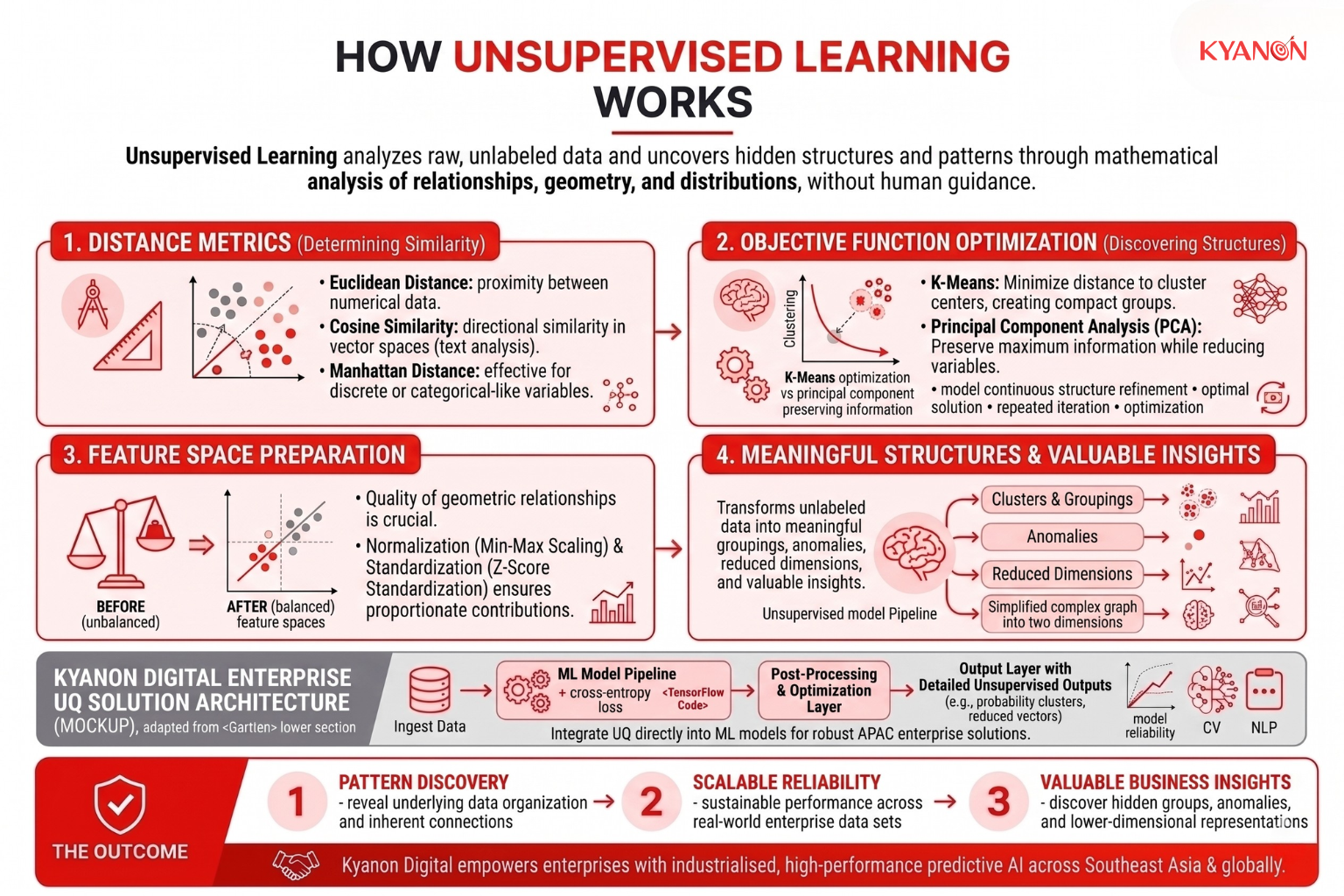
Unsupervised Learning works by analyzing raw, unlabeled data and identifying hidden structures based on the mathematical relationships between data points. Because no predefined labels or target outcomes exist, the algorithm must determine how observations relate to one another using measures of similarity, distance, density, and statistical distribution. Through iterative optimization, it uncovers patterns, groupings, anomalies, or lower-dimensional representations that reveal the underlying organization of the dataset.
Distance Metrics
The first step involves measuring the similarity or dissimilarity between data points within a multidimensional feature space. Since there are no labels to guide the learning process, distance metrics provide the mathematical foundation for determining which observations are closely related.
Common approaches include Euclidean Distance, which measures straight-line proximity between numerical data points, Cosine Similarity, which evaluates directional similarity between vectors and is widely used in text analysis, and Manhattan Distance, which is effective for datasets containing discrete or categorical-like variables. These metrics allow the algorithm to identify natural relationships and patterns within the data.
Objective Function Optimization
Once relationships between data points have been established, the algorithm optimizes an objective function to discover meaningful structures. The objective function serves as the mathematical criterion that determines whether the model’s representation of the data is improving.
For clustering algorithms such as K-Means, the objective is typically to minimize the distance between data points and their assigned cluster centers, creating compact and well-defined groups. For dimensionality reduction techniques such as Principal Component Analysis (PCA), the objective is to preserve as much information as possible while reducing the number of variables required to represent the dataset. Through repeated iterations, the model continuously refines its structure until it reaches an optimal solution.
Feature Space Preparation
The effectiveness of unsupervised learning depends heavily on the quality and structure of the feature space in which data points are represented. Because the algorithm relies on geometric relationships to identify patterns, variables with significantly different scales can distort the results.
To address this, data is typically normalized or standardized before processing. Techniques such as Min-Max Scaling and Z-Score Standardization ensure that all variables contribute proportionally to the analysis rather than allowing large numerical values to dominate the calculations. This creates a balanced feature space that enables the algorithm to uncover genuine structural relationships within the data.
By combining distance calculations, objective function optimization, and carefully prepared feature spaces, unsupervised learning transforms unlabeled datasets into meaningful structures that can reveal hidden patterns, natural groupings, anomalies, and valuable insights without requiring human-provided answers.

Unsupervised Learning vs Supervised Learning
While both Unsupervised Learning and Supervised Learning help organizations extract value from data, Unsupervised Learning offers a unique advantage: it can uncover insights without requiring labeled datasets. This makes it particularly valuable in enterprise environments where data volumes are growing rapidly, but annotated examples are scarce, expensive, or impractical to create.
Unlike Supervised Learning, which depends on predefined answers to learn predictive relationships, Unsupervised Learning independently explores data to identify hidden patterns, natural groupings, anomalies, and structural relationships. As a result, it is often the preferred approach for exploratory analytics, customer segmentation, anomaly detection, and other use cases where the objective is discovery rather than prediction.
Dimension | Unsupervised Learning | Supervised Learning |
| Data requirement | Raw, unlabeled data | Annotated, labeled data |
Primary objective | Pattern discovery and structure identification | Prediction and classification mapping |
| Human intervention | High during feature engineering, zero in labeling | High during data annotation and target definition |
Evaluation complexity | High (relies on intrinsic metrics like Silhouette Score) | Low (relies on objective metrics like Precision/Recall) |
| Common enterprise use case | Customer segmentation, anomaly detection | Churn prediction, image classification |
In practice, Unsupervised Learning often serves as the foundation for broader AI initiatives. It helps organizations understand their data landscape, uncover patterns that human analysts may miss, and create the insights needed to support downstream predictive models. For enterprises seeking to unlock value from large-scale data assets, Unsupervised Learning provides a scalable and cost-effective path to discovery, making it a critical component of modern data and AI architectures.
When to Consider Unsupervised Learning
Consider Unsupervised Learning if:
- Your data infrastructure captures continuous, high-volume telemetry or transaction logs, but your organization lacks the budget or capacity for manual data annotation.
- Your fraud or security teams must identify novel, zero-day threat vectors that evade historical, rule-based detection systems.
- Your predictive modeling pipelines suffer from high compute costs and require dimensionality reduction to compress data before supervised classification.
It may not be the right priority if:
- Your primary business objective requires strict, predictable classification outputs, such as approving or rejecting a financial transaction, where direct accuracy measurement against a known baseline is mandatory.
Why Unsupervised Learning Matters for Enterprise Architecture
Modern enterprises generate enormous volumes of data from customer interactions, operational systems, documents, emails, images, sensor networks, and digital platforms. The challenge is that much of this information exists without predefined labels, making it difficult to analyze using traditional supervised machine learning approaches. Unsupervised Learning addresses this challenge by enabling organizations to automatically discover patterns, relationships, anomalies, and hidden structures within raw data without requiring costly manual annotation.
The business importance of this capability continues to grow as enterprises increasingly seek to unlock value from previously inaccessible data assets. According to McKinsey, approximately 90% of the data available to organizations is unstructured, including documents, emails, videos, images, chat logs, and other content that does not fit neatly into traditional databases. Advances in AI are opening access to this vast pool of information, creating new opportunities for insight generation, automation, and decision-making.
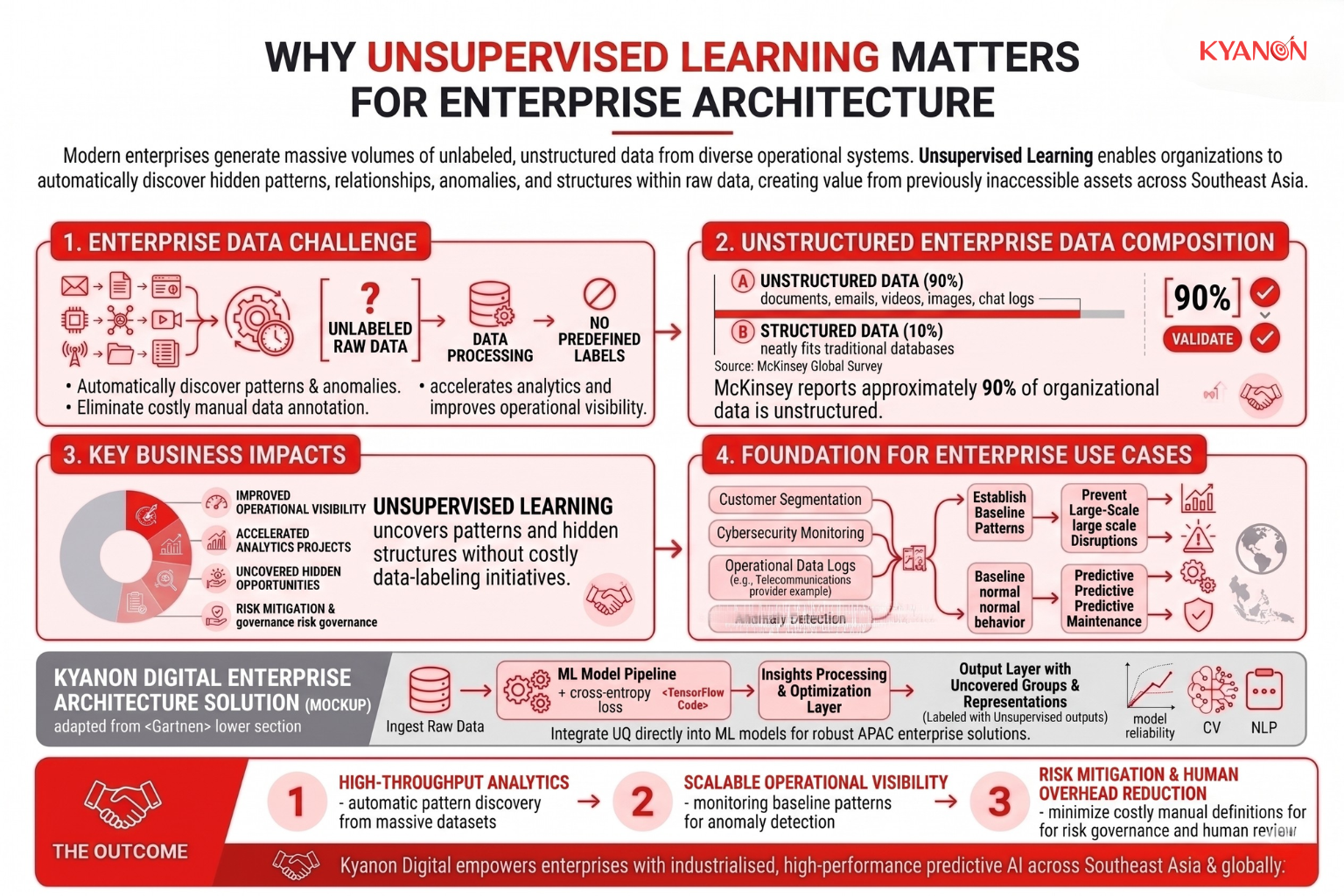
Unsupervised Learning plays a critical role in enterprise architecture because it allows organizations to extract value from unlabeled data without waiting for lengthy data-labeling initiatives. By automatically identifying clusters, detecting anomalies, reducing data complexity, and uncovering hidden associations, enterprises can accelerate analytics projects, improve operational visibility, and uncover opportunities that would otherwise remain buried in massive datasets.
For example, a regional telecommunications provider applied clustering techniques to raw network traffic logs to establish baseline patterns of normal server behavior. By continuously monitoring deviations from these learned patterns, the organization was able to identify localized hardware degradation before it escalated into large-scale service disruptions. Because the system learned directly from unlabeled operational data, it eliminated the need for manually defining every possible failure scenario in advance.
Beyond anomaly detection, unsupervised learning supports a wide range of enterprise use cases, including customer segmentation, fraud detection, recommendation systems, cybersecurity monitoring, predictive maintenance, and knowledge discovery. As organizations continue to accumulate growing volumes of unstructured and unlabeled data, the ability to automatically uncover meaningful patterns has become a foundational capability for building scalable, data-driven enterprise architectures.
Common Misconceptions
Unsupervised learning requires zero human guidance because the model works on its own
While the algorithm operates without predefined target labels, data scientists must meticulously orchestrate the inputs and structural assumptions. Distance-based algorithms are highly sensitive to feature scaling; if teams fail to manually normalize the dataset or remove irrelevant variables, the model will cluster based on mathematical noise, and humans must still explicitly define architectural constraints, such as the total number of clusters.
Unsupervised learning is an independent alternative to supervised learning
In modern enterprise AI pipelines, unsupervised techniques rarely function in complete isolation. They are predominantly utilized as a preprocessing step for dimensionality reduction to compress wide datasets before they enter a supervised classifier, or they act as the self-supervised foundation for training Large Language Models to map language patterns.
How Kyanon Digital Applies Unsupervised Learning
Kyanon Digital applies unsupervised learning in customer analytics, fraud pattern discovery, and exploratory data pipelines where clients lack annotated datasets. Our implementation strategy prioritizes rigorous feature engineering and optimized objective functions to expose structural insights without relying on manual labeling, enabling enterprises across Southeast Asia, ANZ, and the US to accelerate their analytics time-to-market and lower the Total Cost of Ownership (TCO) of their data operations.
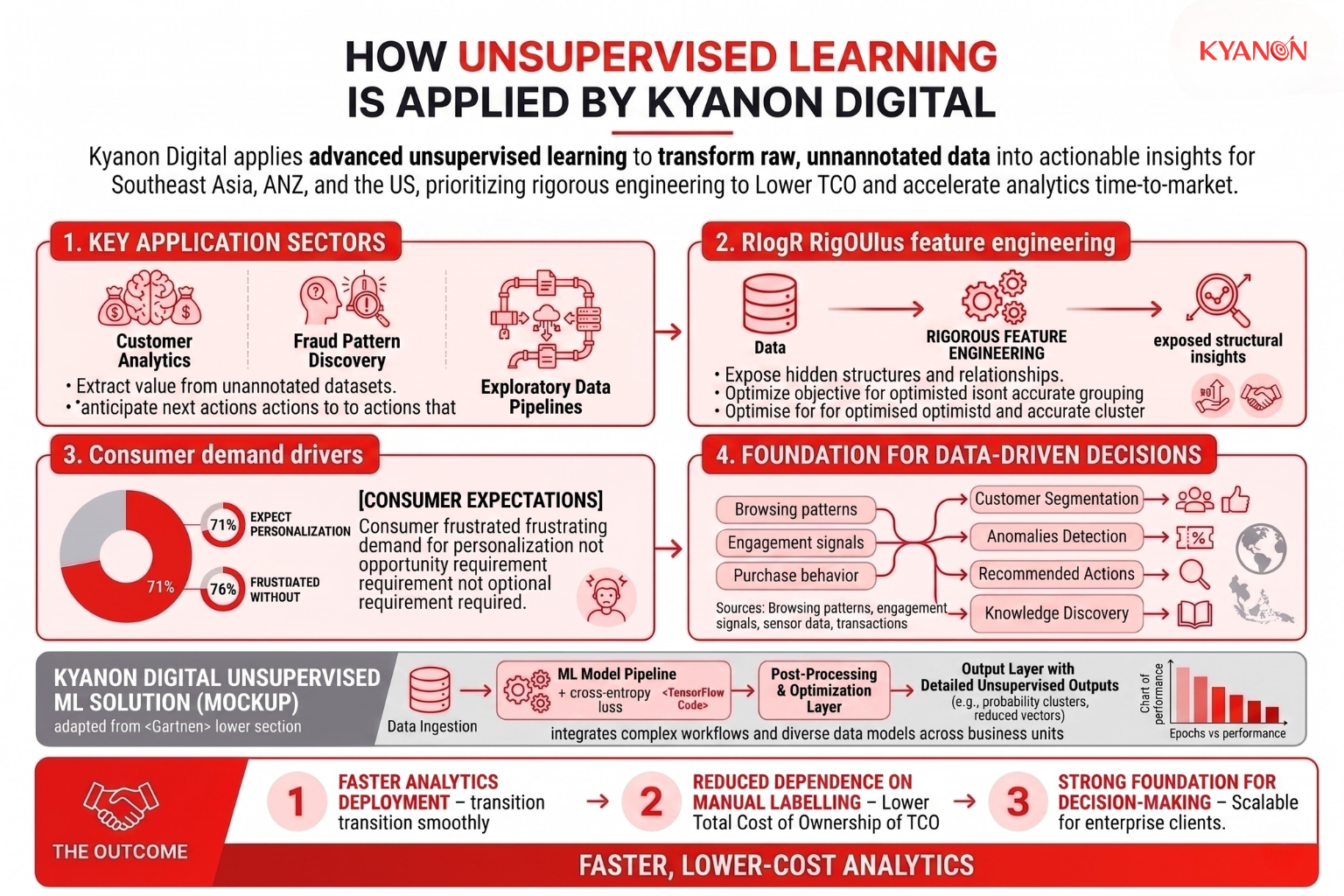
By combining advanced machine learning techniques with scalable data architectures, Kyanon Digital enables enterprises across Southeast Asia, ANZ, and the US to extract value from previously untapped data assets. The result is faster analytics deployment, reduced dependence on manual labeling processes, lower Total Cost of Ownership (TCO), and a stronger foundation for data-driven decision-making across the organization.
→ Explore our Machine Learning Development services.

 Create project brief with AI