
What is semantic search?
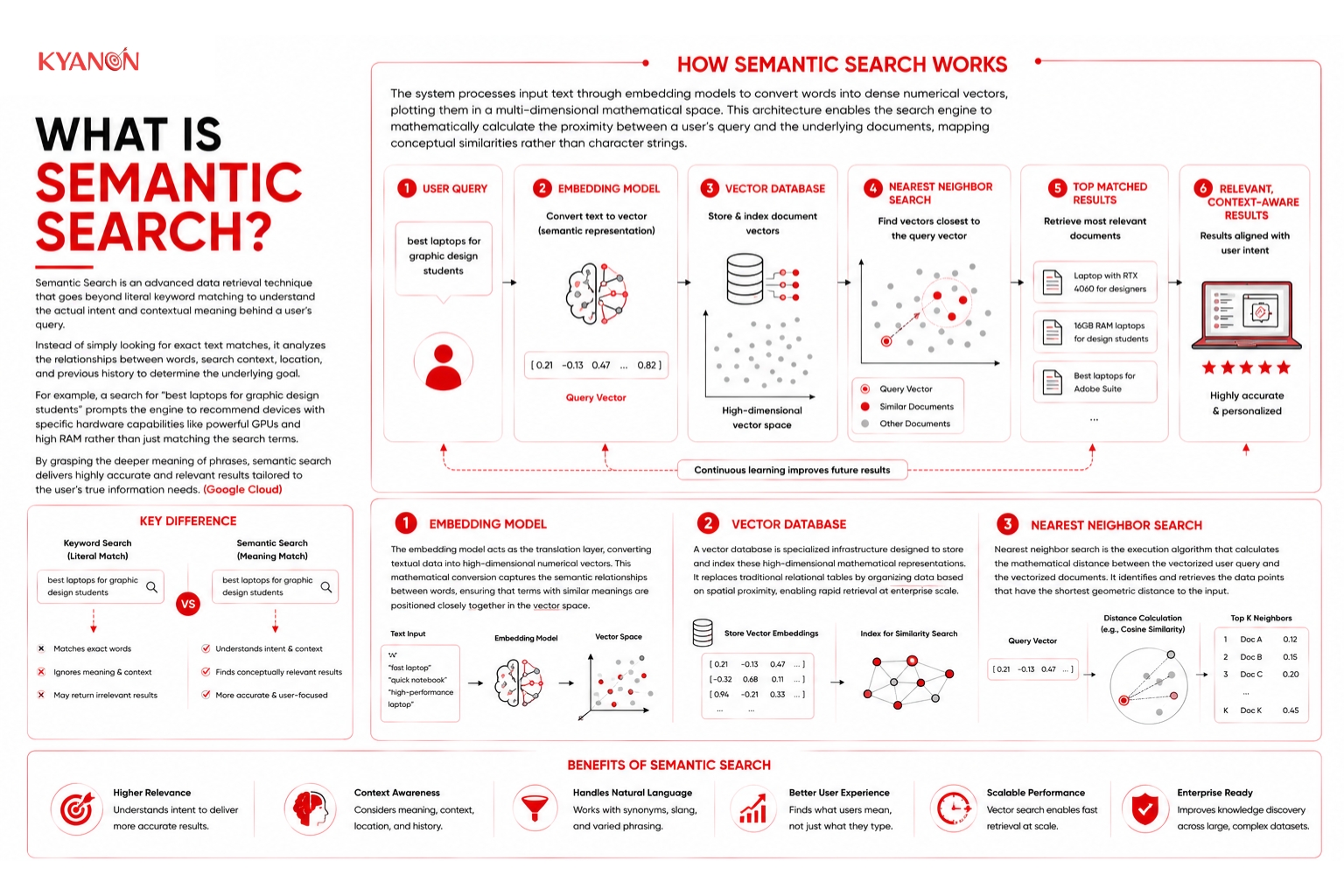
Semantic Search is an advanced data retrieval technique that goes beyond literal keyword matching to understand the actual intent and contextual meaning behind a user’s query. Instead of simply looking for exact text matches, it analyzes the relationships between words, search context, location, and previous history to determine the underlying goal. For example, a search for “best laptops for graphic design students” prompts the engine to recommend devices with specific hardware capabilities like powerful GPUs and high RAM rather than just matching the search terms. By grasping the deeper meaning of phrases, semantic search delivers highly accurate and relevant results tailored to the user’s true information needs. (Google Cloud)
How semantic search works
The system processes input text through embedding models to convert words into dense numerical vectors, plotting them in a multi-dimensional mathematical space. This architecture enables the search engine to mathematically calculate the proximity between a user’s query and the underlying documents, mapping conceptual similarities rather than character strings.
Embedding Model
The embedding model acts as the translation layer, converting textual data into high-dimensional numerical vectors. This mathematical conversion captures the semantic relationships between words, ensuring that terms with similar meanings are positioned closely together in the vector space.
Vector Database
A vector database is specialized infrastructure designed to store and index these high-dimensional mathematical representations. It replaces traditional relational tables by organizing data based on spatial proximity, enabling rapid retrieval at enterprise scale.
Nearest Neighbor Search
Nearest neighbor search is the execution algorithm that calculates the mathematical distance between the vectorized user query and the vectorized documents. It identifies and retrieves the data points that have the shortest geometric distance to the input.

Semantic Search vs Keyword Search
Both methodologies retrieve information from a database, but they differ entirely in their parsing mechanics and underlying data structures.
Dimension | semantic search | Keyword Search (Lexical Search) |
| Matching Mechanism | Contextual meaning and intent | Exact alphanumeric character matching |
Data Infrastructure | Vector databases | Inverted indices |
| Handling Synonyms | Native capability | Requires manual dictionary maintenance |
Exact SKU / ID Lookup | Poor | Excellent |
| Computational Overhead | High (Requires GPU processing) | Low (Standard CPU processing) |
When to consider semantic search
Consider semantic search if:
- Your digital commerce platform suffers from high search abandonment rates because users search for product features or use cases rather than exact product titles.
- Your enterprise knowledge base returns zero results when employees use regional synonyms, differing acronyms, or non-standard jargon to describe documented processes.
- You are engineering a Retrieval-Augmented Generation (RAG) pipeline that requires context-aware document extraction to feed an LLM accurately.
It may not be the right priority if:
- Your primary operational use case involves users searching exclusively for exact alphanumeric serial numbers, specific SKUs, or structured transaction IDs where approximate matching causes critical errors.
Why semantic search matters for E-Commerce
Semantic search is critical for e-commerce because it directly converts ambiguous, natural-language shopper queries into accurate product purchases, preventing lost revenue caused by traditional search engines failing to understand user intent.
Up to 80% of online shoppers leave a retail site if the internal search bar returns irrelevant results. While keyword-based search forces shoppers to type precise product titles, semantic search understands how humans actually describe products, drastically lowering bounce rates and driving higher conversion metrics.
Common misconceptions
Semantic search solves our exact-match problem and eliminates the need for legacy keyword search entirely
Reality: Dense vector search is notoriously bad at finding specific alphanumeric codes, serial numbers, or exact names. If a customer types an exact part number like “XY-104-B,” a purely semantic search engine might bring back articles about related parts, whereas a traditional keyword search will pinpoint the exact product page instantly. Enterprise environments require hybrid search.
We can plug in an embedding model and it will instantly understand our internal business jargon and data
Reality: An embedding model only knows what it was trained on. If your engineering team uses highly niche internal terminology, unique product names, or unstructured, messy documents, a generic semantic model will misinterpret them. Chunking strategies, data cleaning, and metadata tagging are strictly mandatory for high-quality retrieval.
How Kyanon Digital applies semantic search
Kyanon Digital builds semantic search solutions for enterprise clients managing large document repositories and complex B2B product catalogs across the US, ANZ, and Southeast Asia. Our implementation strategy relies on hybrid search architectures that combine dense vector embeddings with traditional keyword indexing (BM25). This ensures our clients achieve high retrieval accuracy for broad contextual queries while maintaining absolute precision for exact SKU lookups, driving faster time-to-market and optimizing the total cost of ownership.
Explore our Generative AI Development services.

 Create project brief with AI