
What is latent space?
Latent space is a compressed, lower-dimensional mathematical representation of data learned by a neural network, where semantically similar inputs are positioned close together. This geometric mapping allows machine learning models to identify relationships, classify data, and generate new content by navigating continuous numerical coordinates rather than parsing discrete source files.
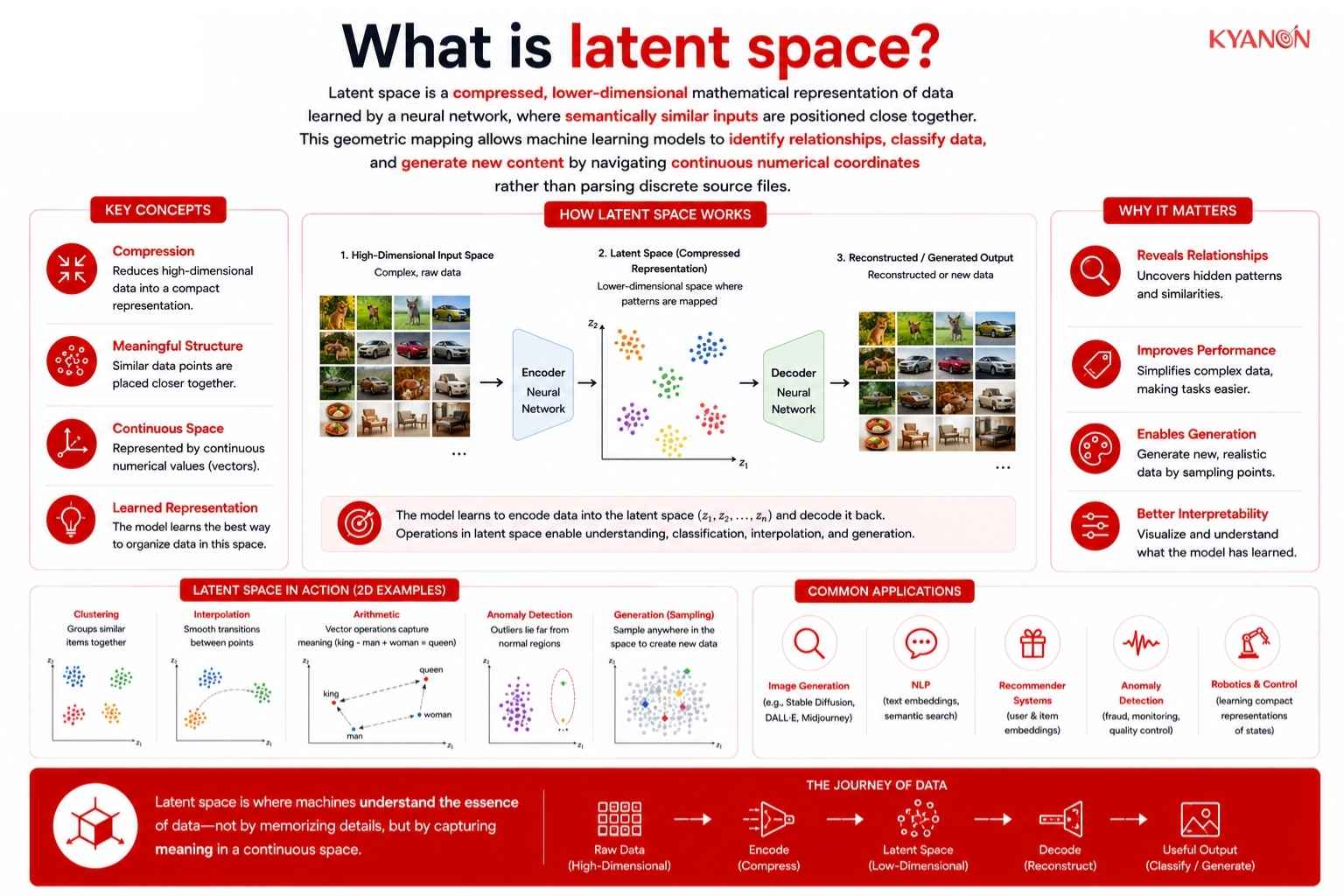
How latent space works
Neural networks map high-dimensional raw inputs into a dense vector space, stripping away superficial noise to isolate core semantic features. The network calculates mathematical distances between these vectors, allowing the algorithm to predict similarities, identify patterns, or interpolate between coordinates to output highly relevant, novel combinations without manual human instruction.
Dimensionality Reduction
The process of compressing raw, high-dimensional data into fewer, highly informative mathematical variables. This reduces computational overhead and allows the model to process complex datasets efficiently.
Vector Representation
The conversion of abstract concepts, text, or images into fixed-length arrays of numbers. This algebraic conversion is what allows algorithms to mathematically process non-numeric data.
Semantic Proximity
The architectural training rule that forces conceptually related data points to cluster together. This clustering enables the AI system to calculate context and contextual nuance through pure mathematical distance.

Latent Space vs Raw Data Space
Both concepts deal with data representation, but differ entirely in computational efficiency and semantic understanding.
Dimension | Latent Space | Raw Data Space |
| Data structure | Compressed, lower-dimensional | Uncompressed, high-dimensional |
Semantic grouping | High (similar concepts cluster together) | Low (pixels/words exist independently) |
| Computational cost | Low (optimized for algorithmic calculation) | High (requires processing every raw parameter) |
Best for | Generative AI, semantic search, classification | Storage, exact-match retrieval, human viewing |
| Interpretability | Low (abstract mathematical vectors) | High (direct text, RGB pixels, raw audio) |
When to consider latent space architectures
Consider latent space-driven solutions (like vector databases or embeddings) if:
- Your team needs to implement semantic search across unstructured data repositories, and keyword-based retrieval is failing to capture user intent.
- You are building custom recommendation engines that require matching complex user behavioral profiles with vast product catalogs in milliseconds.
- Your infrastructure costs for processing high-resolution media or large text corpora are scaling unsustainably, necessitating compressed mathematical representations for classification tasks.
It may not be the right priority if:
- Your organization primarily relies on highly structured, relational databases where exact-match SQL queries sufficiently address all business logic.
Why latent space matters for enterprise AI
Mapping complex enterprise data into a latent space directly accelerates data retrieval and reduces the computational load required for retrieval-augmented generation (RAG) applications. According to Gartner (2025), enterprises utilizing vector databases and latent space architectures reduce unstructured data retrieval latency by up to 65% compared to traditional scalar methods. A global financial institution used latent space models to map transactional anomalies, resulting in a 40% decrease in false-positive fraud alerts. This demonstrates how latent representations translate from an architectural principle to a measurable reduction in operational risk.
Common misconceptions
AI stores a ZIP file of its training data in latent space
Reality: Latent space captures the underlying geometric logic and mathematical relationships of concepts, such as the relationship between a “cat” and a “kitten” rather than storing specific source files. It is an abstract mapping of features, not a physical storage drive.
Latent space and embeddings are the exact same thing
Reality: Embeddings are specific vectors representing discrete objects, while the latent space is the broader, continuous mathematical manifold where those vectors reside.
Latent space implies the AI has consciousness or reasoning
Reality: Calculating relationships between concepts is strictly a mathematical method for calculating distance between data points. It is a technical mechanism for easier computation, not an indicator of intent or personality.
How Kyanon Digital applies latent space
Kyanon Digital implements latent space principles using vector databases and custom embedding models for enterprise clients across Southeast Asia, ANZ, and the US. Our approach focuses on structuring unstructured data pipelines and optimizing retrieval-augmented generation (RAG) systems to lower total cost of ownership while accelerating query response times for enterprise platforms.
Explore our Artificial Intelligence Software Development Services.

 Create project brief with AI